The “John Quincy Adams” Tansel Powder Horn from Kentucky ©
Foreword: About 35 years ago, the author heard about a Kentucky era Tansel powder horn and was given the owner’s name and phone number. He contacted the owner and was invited to visit and photograph the horn with the understanding it was a family heirloom and not for sale. Years later, the owner’s situation changed and the author was able to acquire the horn. The Kentucky era Tansel horn was exceptional for its early family history and unique image of the sixth President of the United States, John Quincy Adams, who took office in 1825.
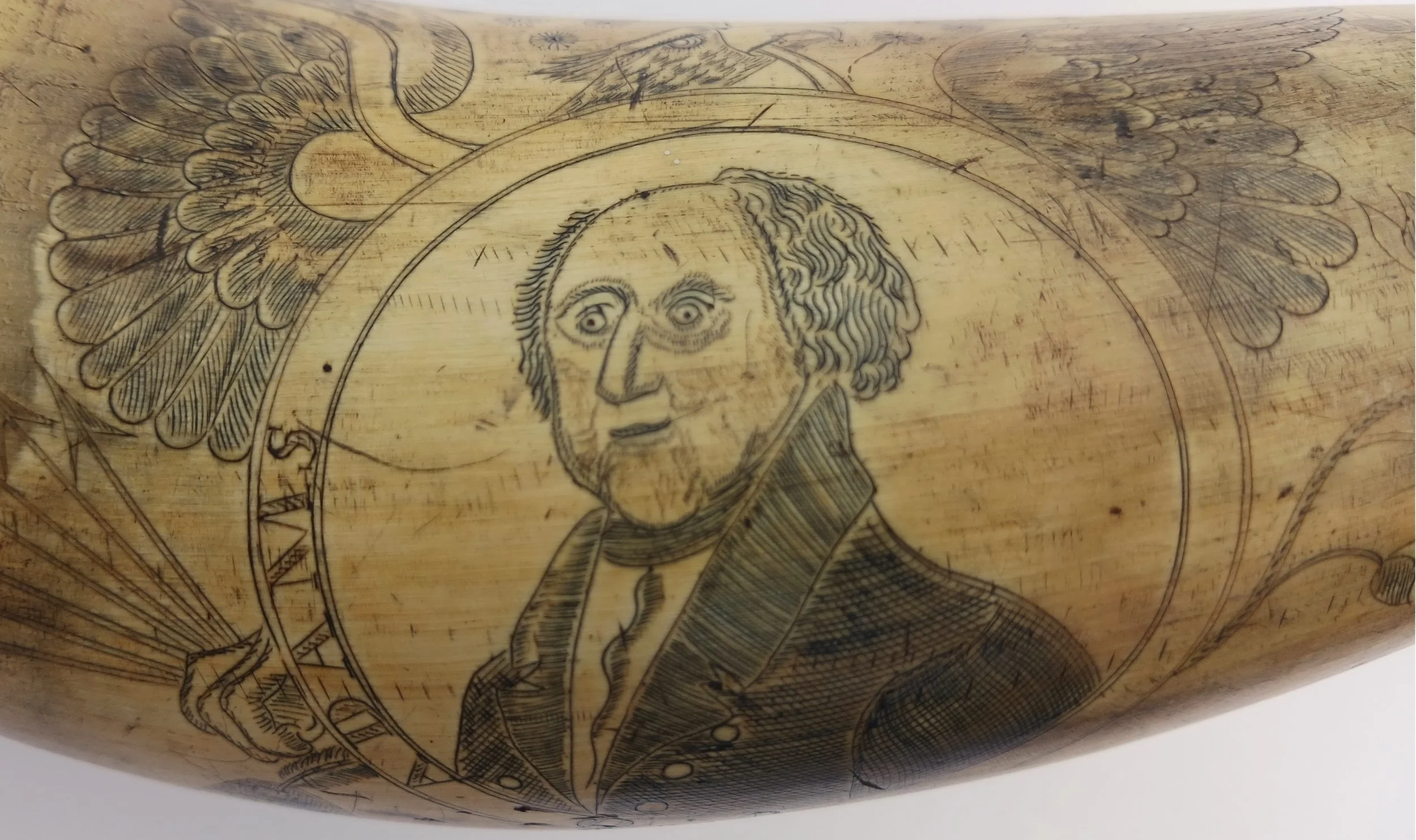
Figure No.1: This Tansel powder horn has an image of President John Quicny Adams carved on the breast of the large federal eagle that is the trademark figure on Tansel powder horns. Adams became President in 1825, and the horn was undoubtedly made to commemorate his election. The Adams image demonstrates the fine carving skills of the Tansels and their ability to reproduce images from broadsides and newspapers of the day. Author’s collection, photo by author.
The “John Quincy Adams” Horn: Several Kentucky era Tansel powder horns have acquired nicknames used by collectors to identify or reference them, and the new horn has joined that group. With its unique image of Adams on the American eagle’s breast seen in Figure No.2, it is known as the “John Quincy Adams” horn. But other significant figures also appear on the horn. The horn’s back side in Figure No.3 has an image of General George Washington in military uniform and riding a stallion. Behind Washington is a round cartouche with the bust of a gentleman that represents the horn’s original owner. Above the bust is a canon with several cannon balls above its muzzle and another stack of cannon balls below its muzzle that was a later addition. Among the Tansel carvers, John Tansel most often carved cannons and cannon balls on his horns. The top side of the horn in Figure No.4 has the horn’s only deer that lacks antlers; when antlers are present, their shape can help identify the carver. The same view also shows the top part of the eagle with a ribbon fluttering through its beak and an overhead arch with “E Pluribus Unum.” Two smaller arches just below the large arch appear to create a downward facing crescent moon, and below the moon are two fields of stars that contain twenty stars.
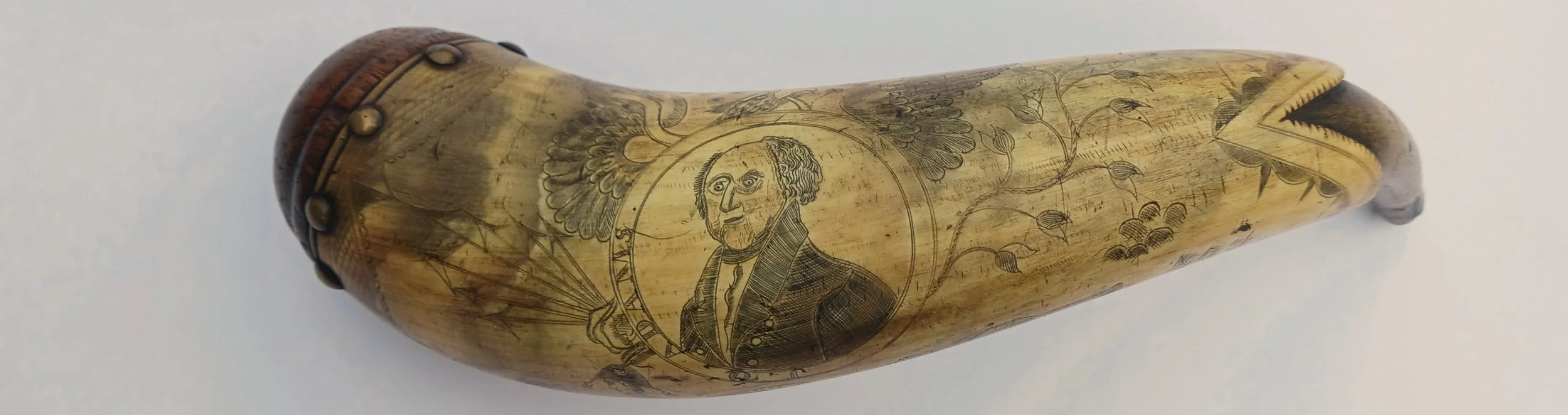
Figure No.2: The front side of the “John Quincy Adams” Tansel horn tends to fool the viewer’s eye. While not immediately obvious, the cartouche around President Adams’ image is actually the body of the large Tansel eagle that is the trademark of the Tansels’ powder horns and cups. Author’s collection, photo by author.
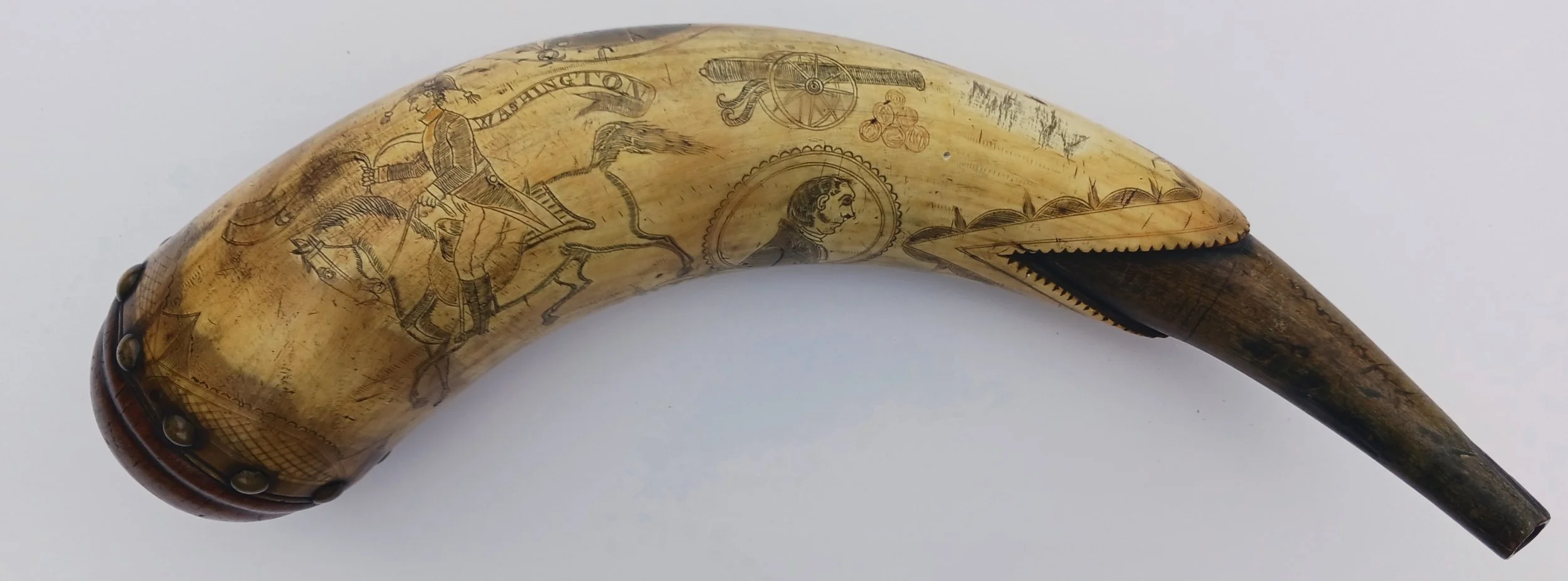
Figure No.3: The back of the Adams horn has an image of George Washington in full military dress and riding a stallion. Behind him is a cartouche with a gentleman’s bust representing the horn’s first owner, as verified by similar horns with names attached. The presence of a cannon above the cartouche suggests the horn was carved by John Tansel.
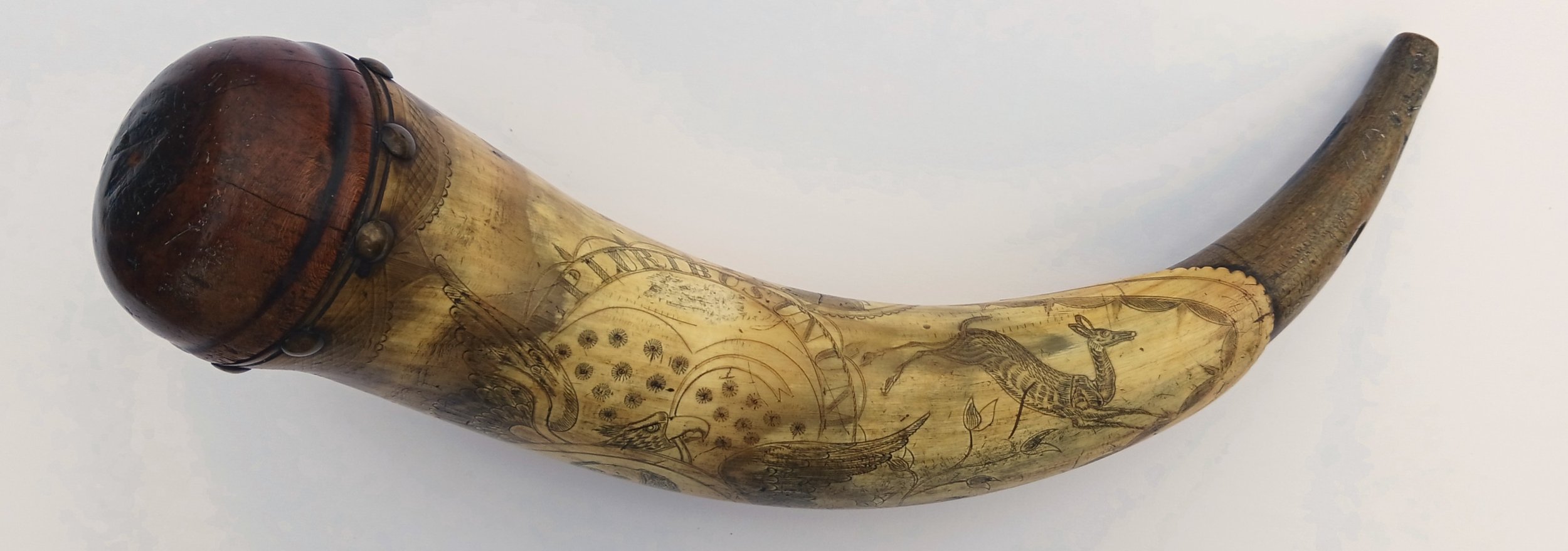
Figure No.4: A top view of the horn shows the eagle’s head with a field of twenty small stars above it. Above the stars is a large arch with the slogan, “E Pluribus Unum.” A blank ribbon flutters through the eagle’s beak, and two small arcs just above the stars create a downward facing crescent moon which often appears on Kentucky era Tansel horns.
The John Quincy Adams horn has a neatly cut, rather deep fish mouth with engrailed edges and Tansel-style scalloped border as seem in Figure No.5 below. Both older sons John and Stark Tansel usually cut their fish-mouths deeper than those of their father Francis. On the horn’s other end is a bulbous, end-grain walnut butt plug with a softly raised basal bead shown in Figure No.6. The butt plug’s surface is worn smooth from years of handling, and two small scars on its nose show where an original iron staple for strap attachment was once located. The plug’s wear pattern presents an unexpected dilemma for the horn. The horn was a left-handed horn [curved to carry on left side with spout forward and pointing upward] that was rotated 90 degrees to convert it into a right-handed horn with right-handed carving. However, the horn’s wear pattern on both its plug and body suggests it was carried on the left side for much of its working life, despite the initial alterations to make it into a right-handed horn. The seemingly contradictory history of a left-hand horn being converted into a right-hand horn with fine right-handed carving, then used for much of its working life on the “wrong” or left side by its owner, tends to support the “Provenance” section below. The horn apparently was first purchased by a right-handed Waddell/Waddill family member in Kentucky about 1825 who had the horn made that way for his use. About ten years later, the horn was given to a relative, William Greenway Waddell, who visited Kentucky during his move from Tennessee to Illinois about 1835. The horn’s wear pattern suggests the second owner, William G. Waddell, was left-handed and carried the horn on his left side during the years he used it, despite the original conversion of a left-hand horn into a right-hand horn for the first owner.
Small brass tacks seen in Figure No.6 decorate the base of the horn. The tacks show old oxidation on their heads and on the horn surface around each head, verifying they have been on the horn for many years and were probably added soon after the horn was made. Three small iron plug nails [a fourth is probably hidden under a tack head] are visible around the horn’s base between the tack heads, indicating the tacks were not used to anchor the plug but rather for decoration. The plug’s domed shape with raised basal bead is similar to plugs on several other John Tansel powder horns of the 1825 era, strengthening its attribution. When handled, the horn feels a bit heavy for its average size due to its thick wall indicative of a bull’s horn rather than a thinner walled cow’s horn. Unfortunately, the horn’s spout end lacked adequate girth to carve a raised strap retaining ring. When the horn was new, it undoubtedly had an attractive, Tansel style lathe-turned applied tip on the spout.
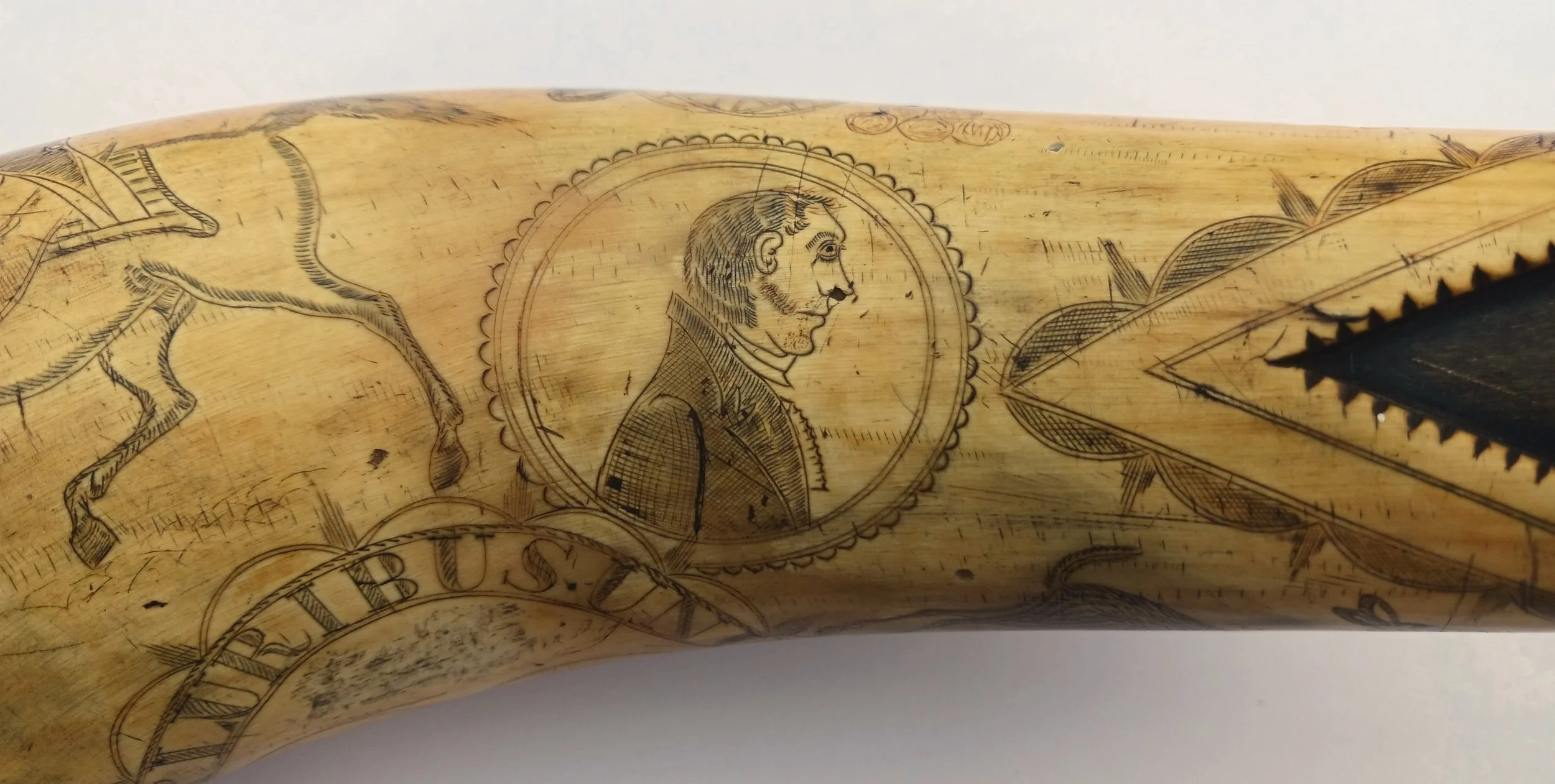
Figure No.5: This view shows the first owner’s image in a round cartouche, the horn’s deeply cut fish-mouth, and a typical Tansel-style scalloped border. Below the “E Pluribus Unum” banner is a blurred area where a name or initials were removed.
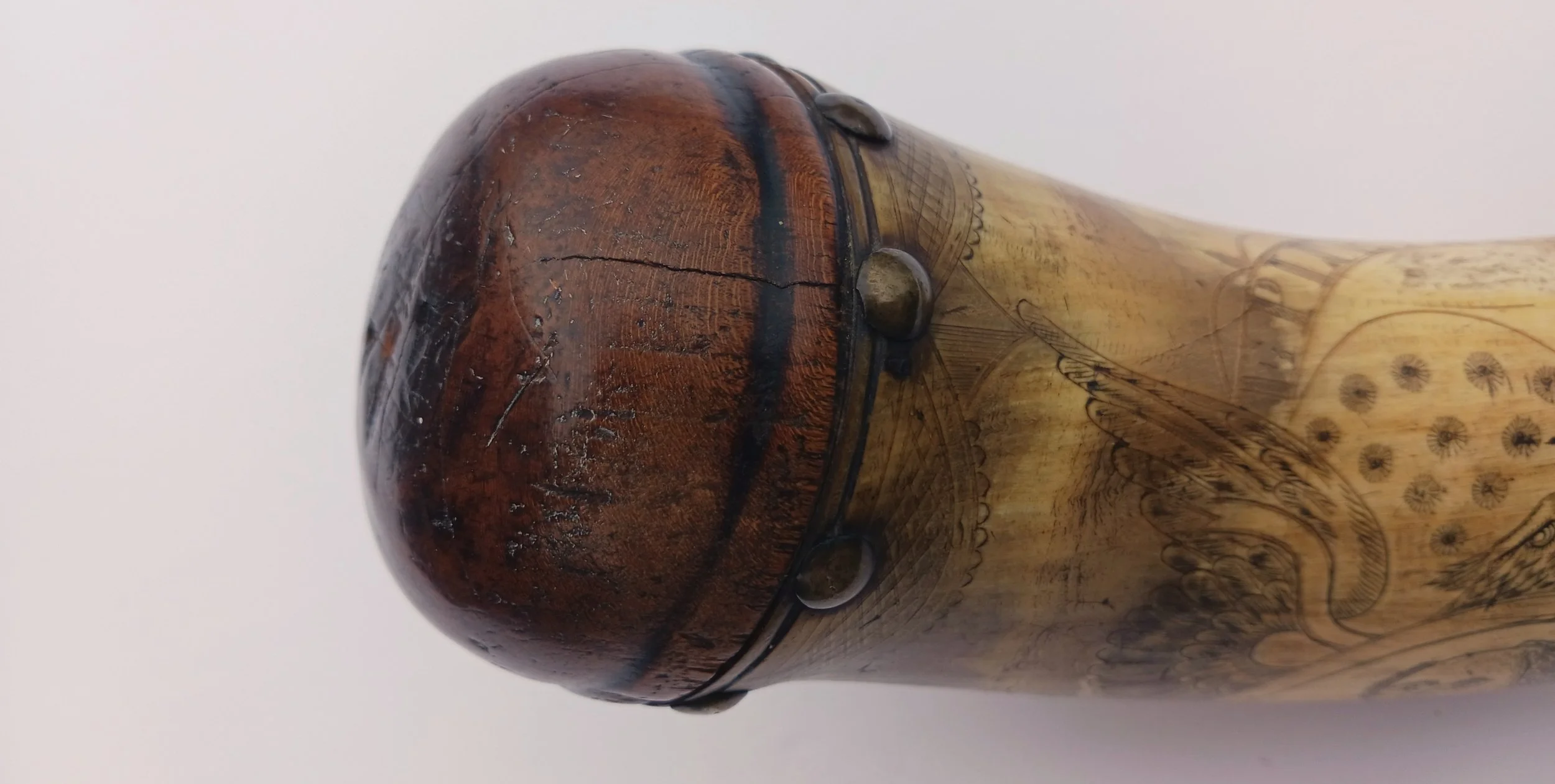
Figure No.6: The horn’s end-grain walnut plug is lathe-turned with a shallow bead around its base; similar plugs are found on other John Tansel horns ca. 1825. Oxidation is seen on the brass tacks, and the horn has a typical Tansel style basal border of large scallops.
Dating & Attribution: Several figures including the owner’s bust in Figure No.5, deer in Figure No.7, and the eagle’s head/wings/overhead banner with field of small stars in Figure No.8 closely resemble the work of John Tansel from the mid-1820s. The use of a left-handed horn also suggests John’s work, since the father Francis always used right-handed horns; the author has never seen a left-handed horn made by Francis Tansel… unless it was a finished horn made elsewhere and brought to him by a neighbor for decorating. The shapes of the carved figures also indicate John Tansel was the likely carver and tends to rule out Francis, while younger brother Stark had not yet reached this level of carving sophistication in 1825. The evolution of the Tansel eagle over the years, particularly in the head shape and feathering/shading of its wings, strongly relates this horn to other signed John Tansel horns. The unsigned horn can be attributed to John Tansel with a high degree of certainty and dated circa 1825. Supporting this date is the fact that John Quincy Adams became America’s 6th President in 1825, and the horn undoubtedly commemorated his election for one of his Scott County, Kentucky, supporters.
Author’s Note: On Francis Tansel horns, the number of stars often correlates with the number of states in the Union the year the horn was carved. Some collectors mistakenly try to use the number of stars on later John and Stark Tansel horns to date them. Mississippi became the twentieth state in 1817, well before this horn was made, and by 1825 when the horn was carved, there were twenty-four states in the Union. The number of stars on this horn is simply the number needed by the carver to nicely fill the designated area.
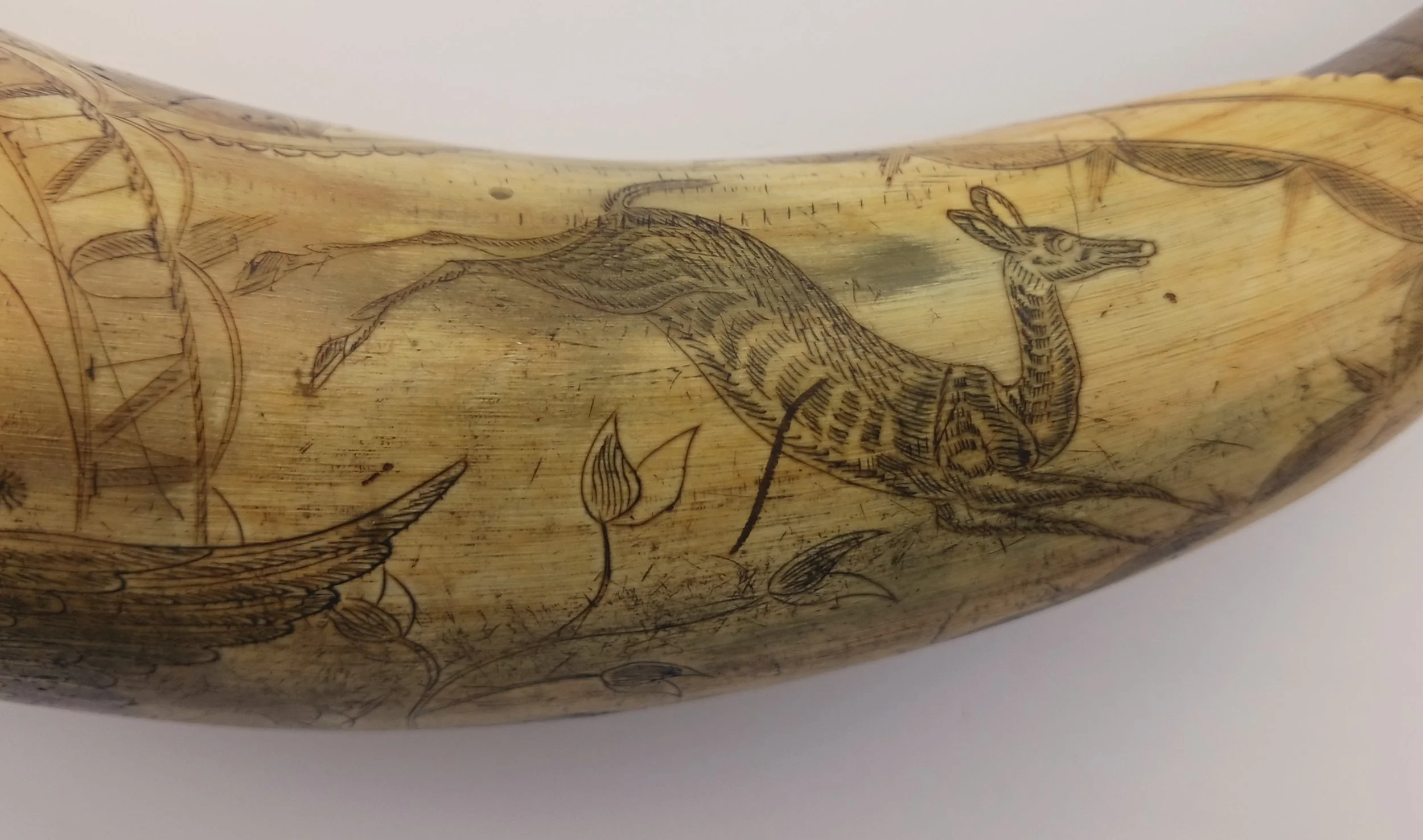
Figure No.7: There is only a single running deer on the Adams horn with no hunting dogs chasing it, when most Tansel horns have several deer chased by dogs. Unfortunately, the deer does not have antlers, the shape of which can often identify the carver on early horns.
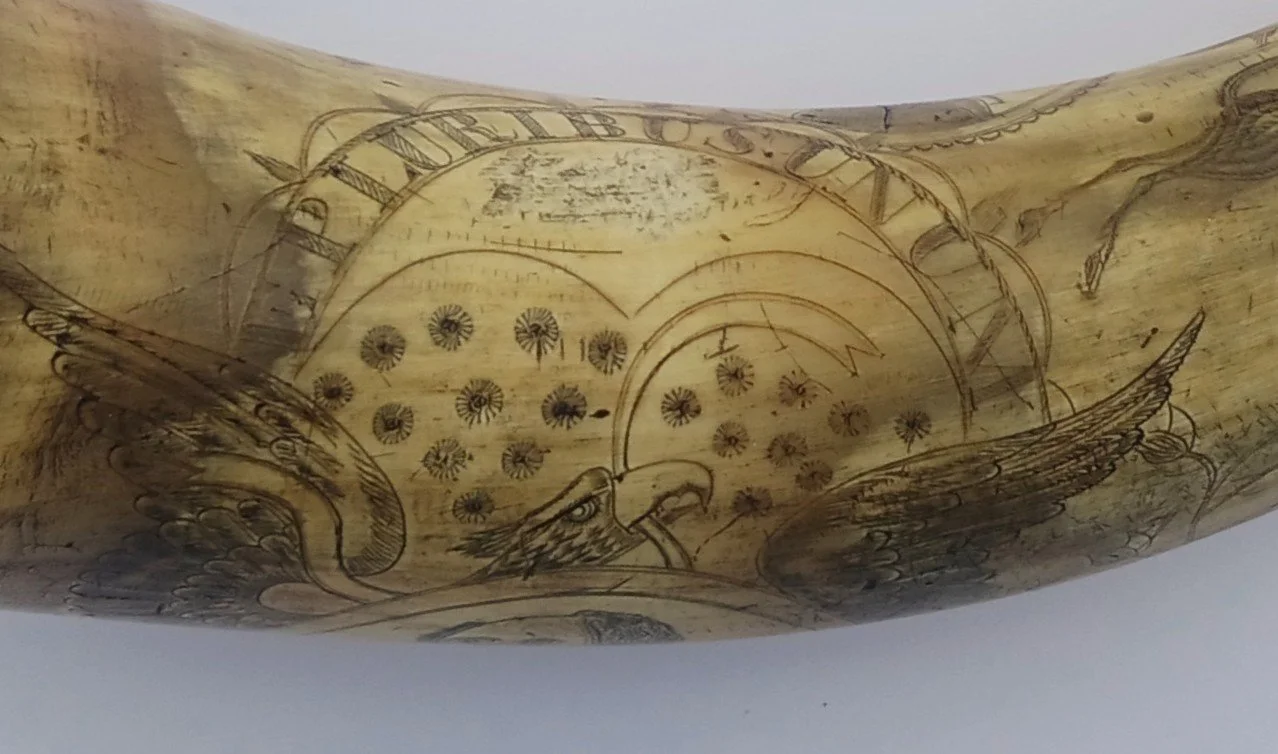
Figure No.8: Above the eagle’s head are two small fields of stars separated by a blank banner flowing through the eagle’s beak. The very small, thickly rayed stars of uniform shape are indicative of John Tansel’s work. Stars by Stark and Timmothy were larger.
Provenance: The horn has spent the last 190 years in Coles County, Illinois, accompanied by an old family provenance. It had been the personal horn of William Greenway Waddell/Waddill (1804-1894) who was born in Virginia and living in Tennessee in the 1830s when he decided to move north through Kentucky to Coles County, Illinois. He arrived in Coles County about 1835 with the powder horn, and it has remained with him and his descendants until 2026. That year, the last family descendent who owned the horn and still lived in Coles County allowed the author to acquire it, with the caveat that it would be well taken care of and retain its family history in the future.
Since the horn dates to about 1825, its whereabouts between 1825 and 1835 is vague. A number of Waddell/Waddill relatives were living in central Kentuck from about 1800 until the present day. The author believes the horn was purchased new in 1825 by a Waddell/Waddill relative in or near Scott County, Kentucky, where the horn was made. The first Waddell owner was the gentleman depicted in the horn’s cartouche in Figure No.5. [Note: Depicted owners all look the same except for modified hair lines.] His initials were probably on the horn when new but later removed when the horn changed ownership. Two small areas on the horn have been scraped to remove earlier names or initials. Those “cleaned” areas are seen in Figure No.3 just right of the cannon’s muzzle, and Figure No.8 just below the “E Pluribus Unum” banner. When William Greenway Waddell travelled through Kentucky on his way to Illinois, he undoubtedly stopped and spent time with old friends and Waddell/Waddill relatives who had moved to Kentucky ahead of him. An earlier Waddell family member probably was the first owner of the “John Quincy Adams” horn and gifted it to William Greenway Waddell while visiting as a reminder of his Kentucky kin and for use in the wild, unbroken lands that lay ahead in Illinois.
Summary: Sometimes wishes come true. A fine Kentucky era Tansel powder horn with a rare image of the sixth President of the United States, John Quincy Adams, had fascinated the author since he first saw it almost 35 years ago; at that time, he was told it was a family heirloom and not for sale. But sometimes peoples’ lives get disrupted and cause their plans to change. Such a change happened with the John Quincy Adams horn, and the author was given an opportunity to acquire it. All Tansel powder horns are unique, but some are more unique than others, and the image of John Quincy Adams on a Tansel horn makes it one of those “more unique” horns. The author never expected it to come his way, but it did, making his years of wishful thinking become a reality.