
Sometimes You Just Have to Buy a Junk Rifle ©
Foreword: There is a big difference between a gun collector and a gun researcher. A collector buys what appeals to him and enhances his collection, usually with the thought that when the time comes to sell it, he can make a profit. But a researcher at times faces the tough decision of buying a heavily damaged or junk rifle with no financial upside, just for the sake of an important detail that can add significantly to his ongoing work. A “junk” Louisville rifle recently fell squarely into that category for the author.

Figure No.1: This half-stocked Louisville rifle dates to about 1870 when guns were more generic in appearance with few specific details to identify the maker. While stocked in decent curly maple, the gun lacks molding lines and both wrist and wedge inlays. The position of the rear sight behind the nose cap suggests the barrel was shortened, but it is original length based on the well-centered barrel signature between rear sight and breech, and even ramrod pipe spacing. Barrel: 39-7/8 inches long, .34 caliber bore, 6-groove rifling. Author’s collection, photos by author.
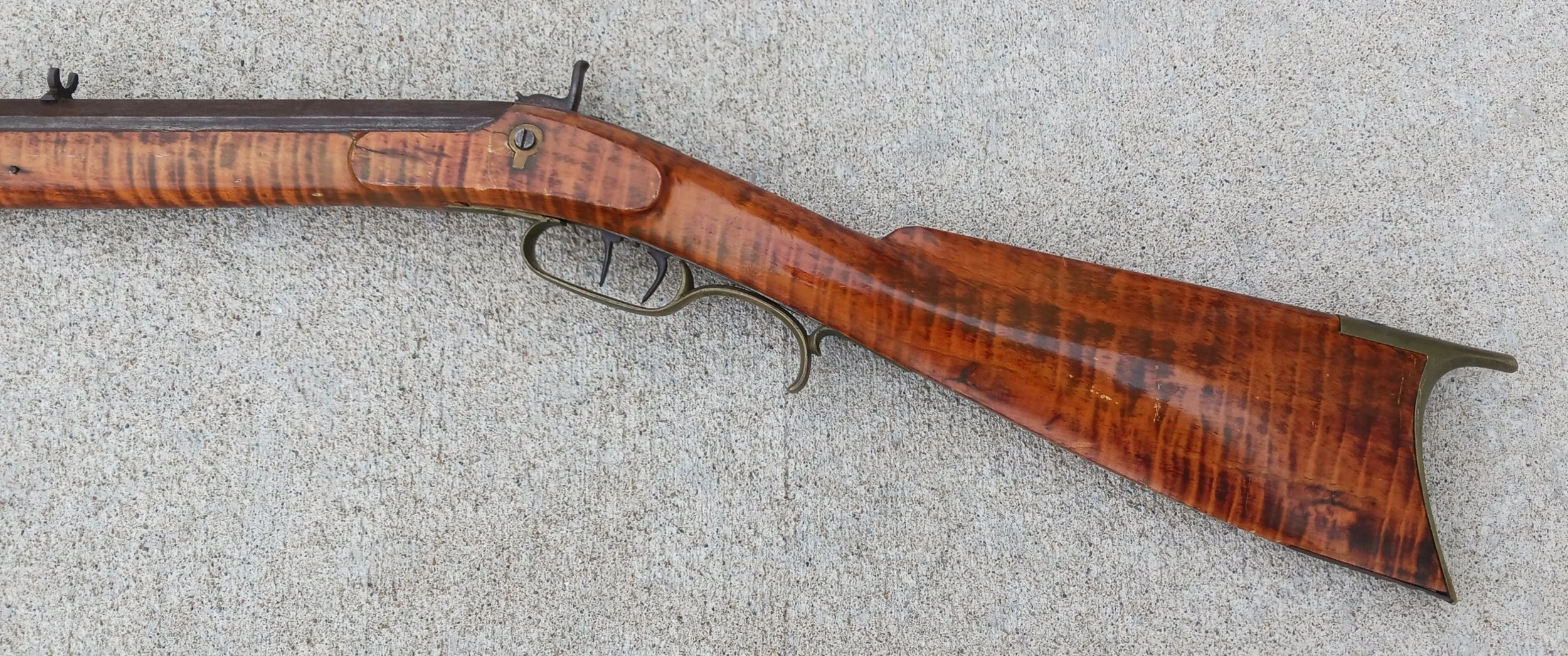
Figure No.2: The back of the Louisville half-stocked rifle has no cheekpiece and a simple lock bolt washer, both later details. The butt plate’s excessively extended heel is reminiscent of work by Louisville gunsmith Gustave Baurmann. Note the slight “fish belly” in the lower butt line, rarely seen on Louisville rifles, and the large “buckhorn” style rear sight. Side-facings are clean without a small step in the top edge of the nose section.
The Junk Rifle: No surviving original rifle is really junk, but some heavily damaged, modified, or poorly restored guns get close to junk… and if the gun had no original redeeming qualities, it becomes junk to most collectors. In 2023, a heavily refinished, half-stocked rifle with a missing ramrod pipe, short ramrod, and broken lock appeared at auction in Florida. Most bidders and collectors showed no interest in the gun with its glossy urethane finish, loose hammer, missing pipe, short ramrod, and no inlays, capbox, or molding lines as seen in Figures No.1 and No.2 above. But to the author who had researched early Kentucky gunmaking for many years, the rifle had one outstanding detail… its barrel signature. The signature shown in Figure No.3 reads “Harvey, Girdler & Co. / Louisville KY.” In over forty years of collecting and researching early Kentucky guns, the author had never seen or heard of that name on a Kentucky gun. Despite the author having no interest in the rifle itself, the signature was too important to let the gun disappear undocumented, so he purchased it… grudgingly.
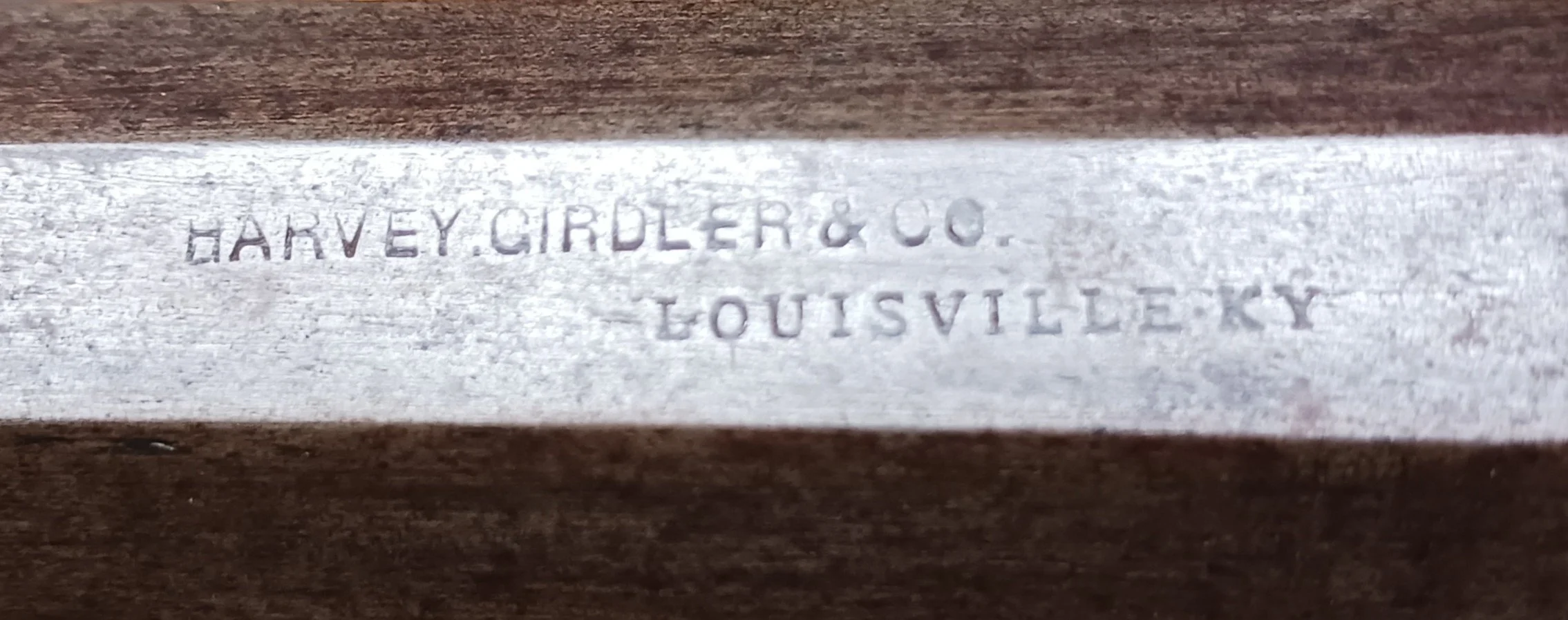
Figure No.3: The most important detail on the otherwise late, generic half-stocked rifle was its previously unknown barrel stamp, “Harvey, Girdler & Co. / Louisville KY.” The author had never seen that name on a Kentucky gun before. The name identified the Louisville hardware store that sold the rifle, rather than the local gunsmith who made the rifle for the store.
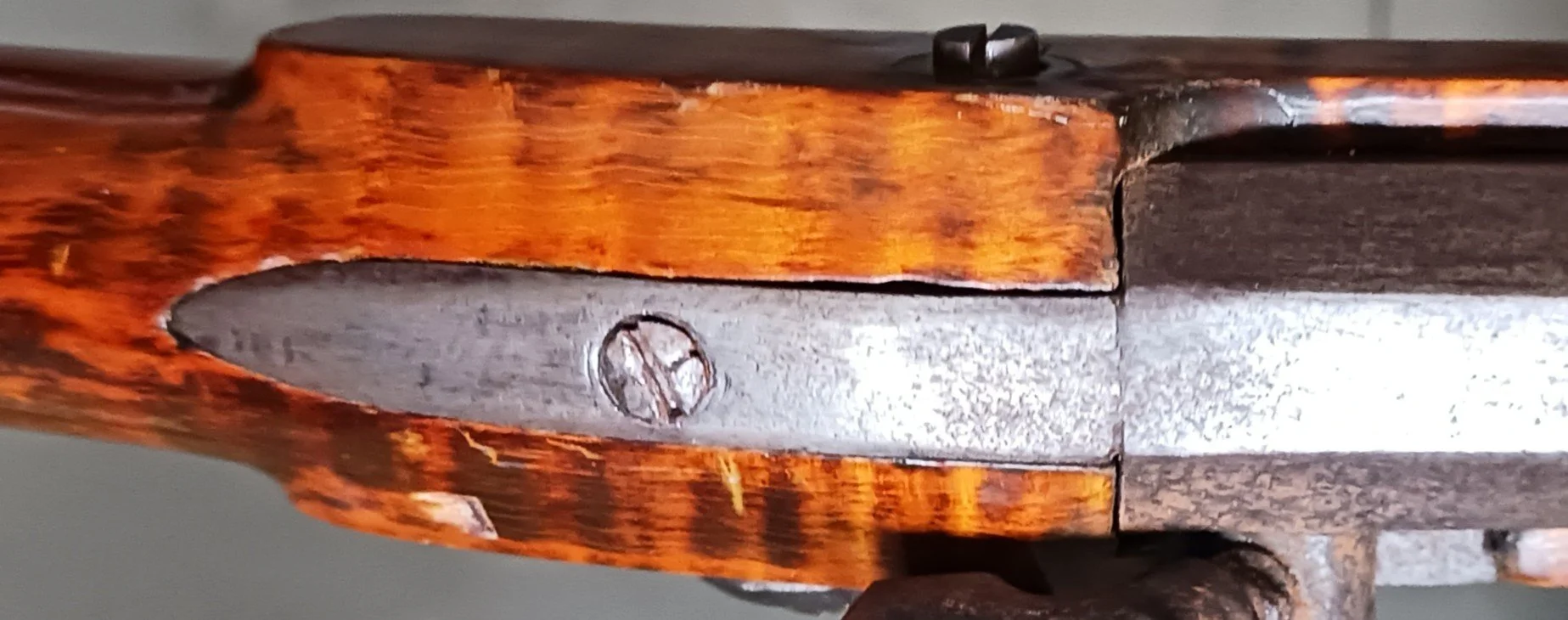
Figure No.4: The “Harvey, Gridler & Co.” rifle has a late Louisville style tang with tapered tip and a single tang bolt. Heavy amateur refinishing of the rifle has left the tang and barrel scrubbed with little original color remaining. But despite damage, missing parts, and poor refinishing, the gun structurally remains original.
Harvey, Gridler & Co. Rifle: The rifle is a late Louisville product made after the Civil War in the early-to-mid 1870s. It has a heavy barrel and thin butt stock with a slight “fish belly” in its lower line, an unusual detail for a Louisville gun when earlier rifles had triangular butts with straight comb and toe lines. Stock wood is nicely figured curly maple, perhaps the gun’s best feature on an otherwise low-cost rifle. Brass mountings are a late Louisville style with an extended heel on the butt plate reminiscent of work by Louisville gunsmith Gustave Baurmann who worked in the 1860s and 1870s. Triggers are a common hardware store variety without the usual small Louisville “C” scroll on the front trigger’s rear edge. The tang is also a hardware store item with its common lozenge shape and single tang bolt seen in Figure No.4. With a barrel about 40 inches long and 1-1/16 inches across the flats combined with a thin butt stock, the gun is a bit barrel heavy. It was made as a smaller caliber “squirrel rifle” of decent workmanship, basic design, and moderate cost… but stamped with an exceptionally rare Louisville barrel signature.
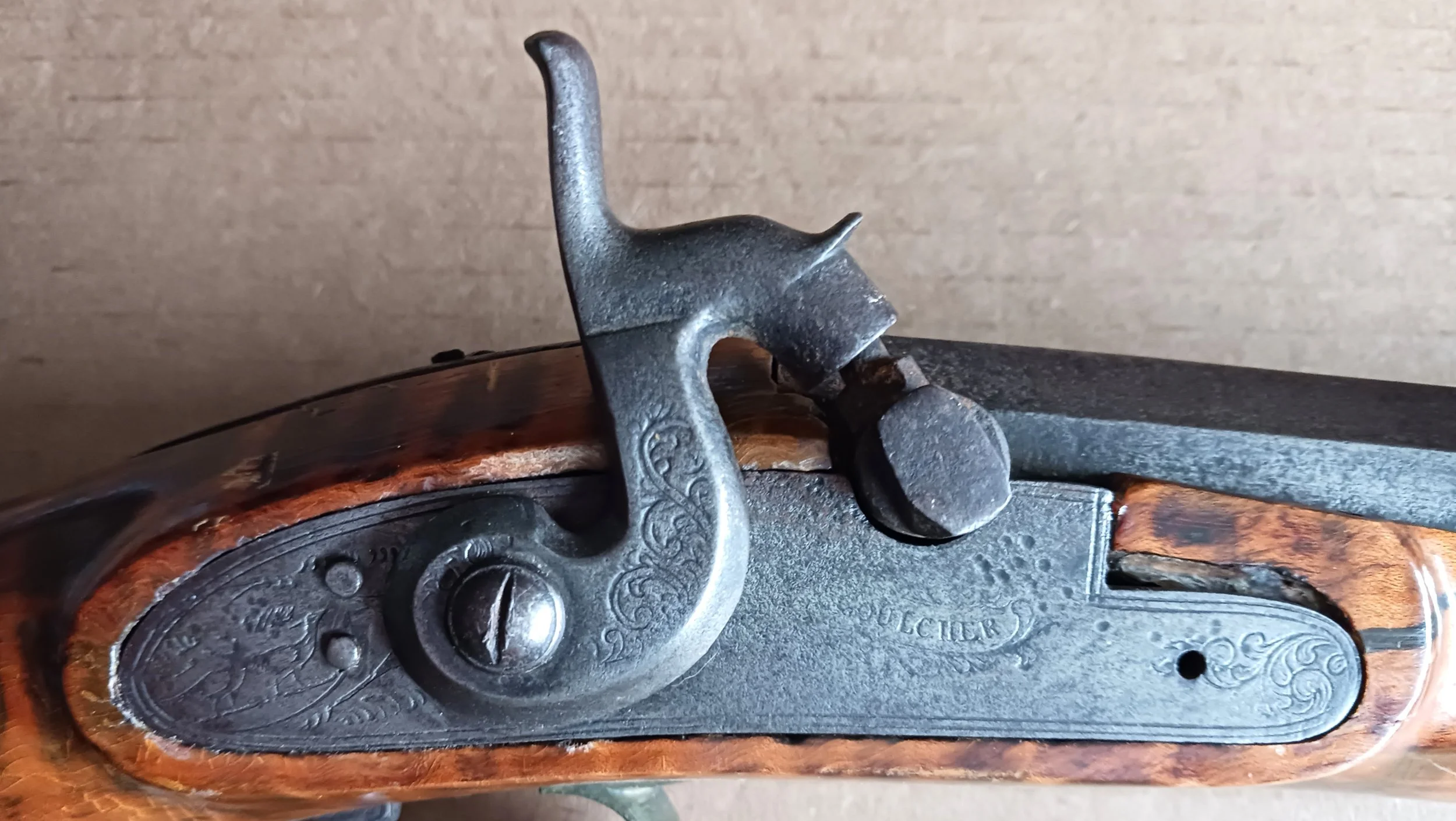
Figure No.5: The rifle’s original “Goulcher” percussion lock with roller engraving remains on the gun. Most Kentucky percussion drums, or side lugs, are filed either square on the ends or with two opposed flats for easier mounting and/or removal. A poorly glued crack at the nose of the lock has pushed the original splinter upward and away from the lock. While appearing like a replacement splice, it is simply a poorly replaced piece of original wood.
Harvey, Gridler & Co.: Little is known about the firm; a search by the author located only two surviving references. On Friday, February 9, 1872, Harvey, Gridler & Co. placed an advertisement in Louisville’s The Courier-Journal as a hardware store with a typical list of hardware goods; the list did not include rifles. A more significant advertisement by C. T. Siever & Co. appeared in The People’s Vindicatory of Natchitoches, Louisiana, on November 30, 1878. The newspaper ran several advertisements for Louisville firms, since both Natchitoches and Louisville were on the Mississippi River/Ohio River north-south route, and all north-bound traffic stopped at Louisville. C. T. Siever & Co. was Harvey, Girdler & Co.’s successor, and the November 30, 1878, advertisement clarified Siever & Co.’s relationship to Harvey, Gridler & Co. by stating, “C. T. Siever & Co., Successors to Harvey, Girdler & Co. etc., etc., etc., 289 Main Street, bet. 7th and 8th, Louisville, KY.” The advertisement listed an assortment of hardware merchandise that included firearms. The fact that Siever & Co. was selling firearms and had recently acquired ownership of Harvey, Gridler & Co. indicates that Harvey, Gridler & Co. was selling firearms when they were purchased by Siever & Co. and undoubtedly prior to that time.
The two above advertisements indicate Harvey, Girdler & Co. was doing business in Louisville at 289 Main Street in the 1870s and probably earlier, and by/before 1878 it was bought out by C. T. Siever & Company. Based on the author’s research of other Louisville hardware stores selling firearms in the mid-to-late 1800s, most such stores sold commercial firearms while periodically purchasing unmarked rifles made by local gunsmiths using the store’s parts to keep costs down. Finished guns were then stamped with the hardware store’s name for resale in the store. Most larger stores kept a gunsmith on their payroll to handle local gun purchases, mark the barrels of “unmarked” local and imported firearms with the hardware store’s name, and do repairs on local and commercial guns that required service.

Figure No.7: The back side of the late Louisville rifle has no cheekpiece, uses three ramrod pipes [outer pipe missing] typical of Louisville guns, and has a later style cast pewter nose cap. The barrel’s large diameter [across the flats] makes the gun rather muzzle-heavy for a half-stock. While many Louisville guards had “double spurs” in the 1840s and 1850s, the guard on this lower cost, later gun has only a single rear spur. In addition, the front “hair” trigger lacks the usual small Louisville decorative “C” scroll on its back edge, and the lock bolt washer is simple with a protruding tab at the bottom to prevent turning when the bolt was being removed or reinstalled. A replacement ramrod is badly broken with the end missing.
Summary: The “Harvey, Girdler & Co. / Louisville Ky.” barrel mark found on a late half-stocked rifle was previously unknown to the author and most collectors. Despite minimal collector value due to the gun’s late date, generic appearance, refinished stock, and damaged/missing parts, the rare barrel stamp made an otherwise “junk” rifle a significant Kentucky gun for research purposes. Harvey, Gridler & Co. probably supplied parts and contracted with local gunsmiths for low cost, unmarked guns that could be stamped with their store name for resale. Such low-cost rifles were usually decently made but very plain. A good candidate for the gunsmith who made the Harvey, Gridler & Co. rifle is Gustave Baurmann, a post-1850 Louisville gunsmith known to make similar undecorated rifles with the same brass mountings and stock architecture.