Revisiting Fremont and his Dickson & Gilmore Rifles ©
Foreword: A prior article, “Moses Dickson and His 1845 Freemont Expedition Rifles,” posted July 16, 2025, discussed Fremont’s 1845 visit to Louisville and his purchase of eight Dickson & Gilmore rifles for his third expedition. Since then, a reader provided new information on Fremont’s Dickson & Gilmore rifles [thanks to Brent Baldwin], and a similar Dickson & Gilmore rifle with iron mountings sold at auction. The new information and rifle are discussed in this follow-up article.
Fremont’s Dickson & Gilmore Rifles: Fremont’s papers retained the bill of sale for his Dickson & Gilmore rifles on May 24, 1845, when he purchased 6 iron mounted half-stocked rifles @ $35 each, 1 patent breeched silver mounted half-stocked rifle @ $45, 1 patent breeched half-stocked rifle at $40 [brass mounted], eight powder horns, and 12 boxes of percussion “capts.” His total purchase was $304.00, a major investment for his expedition. His expedition rifles looked like the half-stocked Dickson & Gilmore rifle in Figures No.1a and No.1b below. Surviving records from Fremont’s memoirs and a diary kept by expedition member Thomas Martin provide an explanation for Fremont’s purchase of Dickson & Gilmore rifles and how he intended to use them.
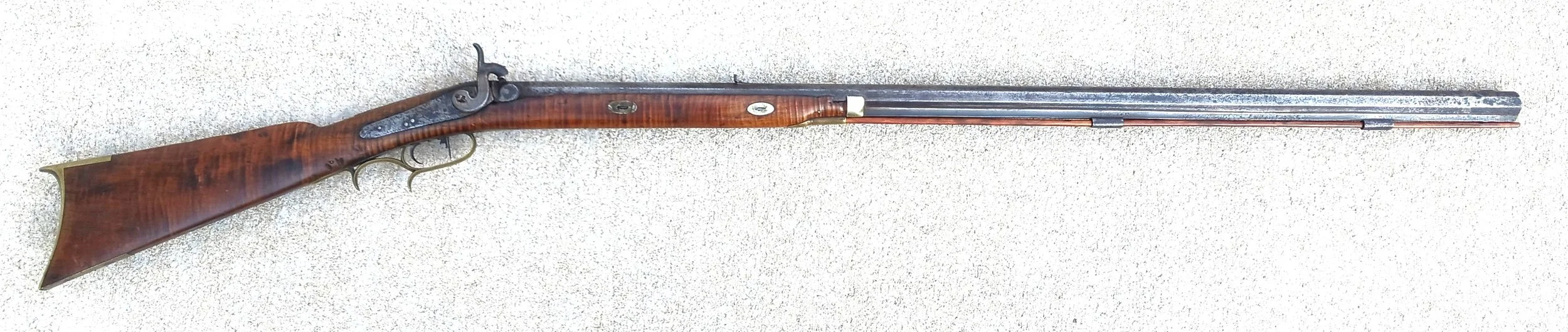
Figure No.1a: This Dickson & Gilmore half-stocked rifle with patent breech is similar to rifles purchased by John Fremont for his 1845 expedition to the Rockies. The rifles were double-keyed in the forestock with a long 2-screw tang for strength and durability. Moses Dickson preferred back-action locks and patent breeches for his better rifles, similar to this rifle. The lock is stamped “M. Dickson.” While hard to see, the lock’s tumbler shaft uses a tapered pin to hold the hammer on the shaft. Barrel: 40-1/2 inches, .42 caliber bore. Author’s collection.
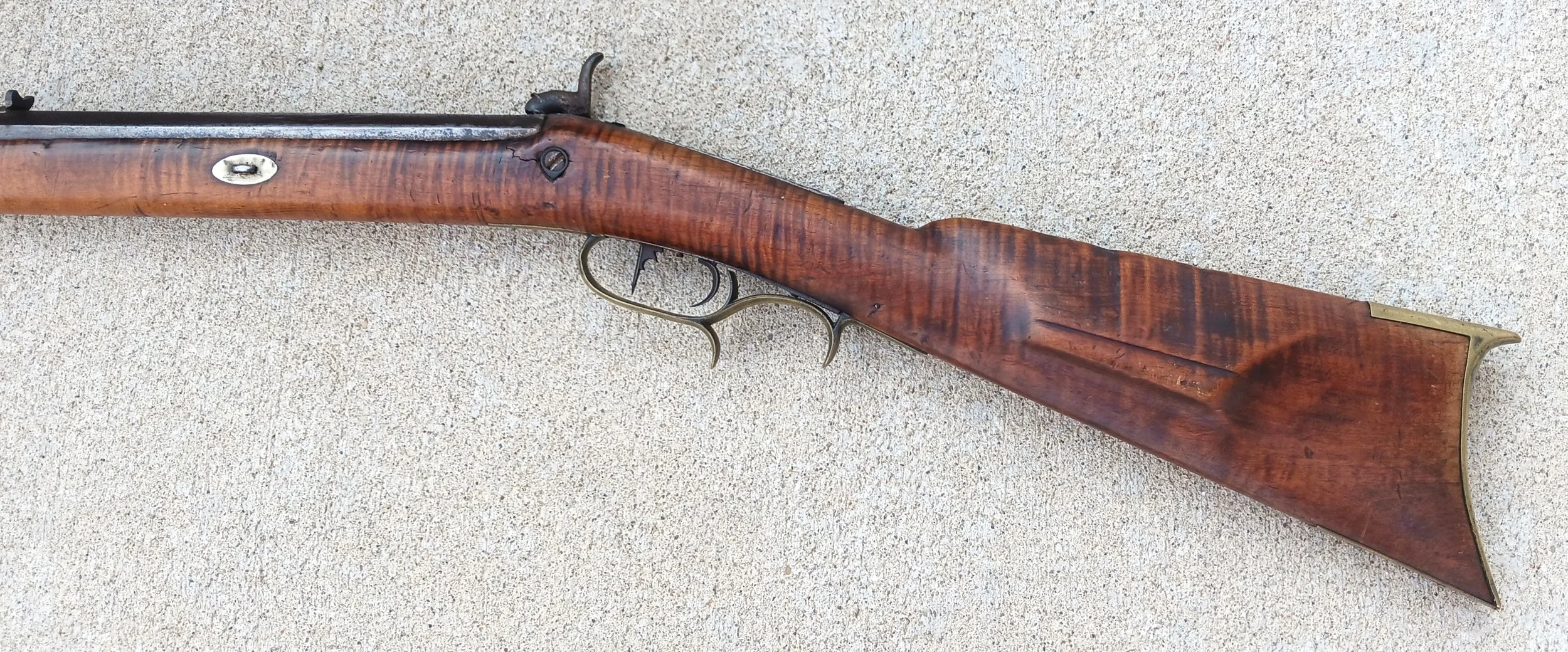
Figure No.1b: The back of this 1840s brass mounted Dickson & Gilmore rifle has a conventional cheekpiece with single molding line, suggesting an earlier rifle, while its guard has a slightly flattened bow that suggests a later rifle. These details show the difficulty in accurately dating 1840s rifles from the Dickson & Gilmore shop when a range of details were used interchangeably.
In Fremont’s memoirs, he described his purchase of several superior rifles [Dickson & Gilmore rifles in Louisville] for his third expedition to the Rocky Mountains:
“For this expedition ampler means had been provided, and in view of uncertain conditions the force suitably increased. In addition to the usual outfit of arms I had procured about a dozen rifles, the best that could be found; with the object of setting them up as prizes for the best marksmen, to be shot for during the journey.” [1]
Fremont did not specifically mention Dickson & Gilmore as the source of his rifles, but a member of his party, Thomas Martin, kept a record of the expedition’s activities in which he identified the rifles used for prizes in a shooting contest during the party’s journey west. [2] Martin joined Fremont’s expedition in St. Louis where he met Fremont at the recruiting office, presented his letters of recommendation, and was hired as a member of the expedition party. According to Martin, Fremont then told him to: “…go to Joe Hawken’s shop where the rifles for the men were being manufactured, and select from among them whichever suited me.” [3] Martin also described how each man in Fremont’s party was outfitted:
“Each man’s equipment was furnished by the Gov’t to be deducted afterward from his wages, and consisted of 1 whole-stock Hawkens rifle, two pistols, a butcher knife, saddle, bridle, pistol holsters and 2 pr. Blankets. For his individual use each man was given a horse or mule for riding and one to two pack animals to care for…” [4]
About two months after the expedition left St. Louis, it stopped and made camp at Hardscrabble, a small Colorado settlement “about 25 miles up the Arkansas River from Pueblo, and about 100 miles from Bent’s Fort.” [5] It was here that Fremont held a shooting match for his men with fine rifles as prizes for the winners. Martin described the match:
“While at Hardscrabble, we had a shooting match. The prizes being 7 fine rifles made at Louisville, KY. The targets was 80 yds. Each man (?) shots; the best shot to have first pick of rifles, the second best second pick and so on. I won the best rifle and sold it on the spot for $80.” [6]
The “7 fine rifles made at Louisville, KY” referred to seven of the eight Dickson & Gilmore rifles Fremont had purchased, since they were the only rifles he purchased in Louisville. The “missing” eighth rifle could have been the fine silver-mounted Dickson & Gilmore rifle, which Fremont may have reserved for himself or perhaps for a later Indian gift. The seven prize rifles were probably the six iron mounted guns and one brass mounted gun. Martin reportedly picked the best rifle as his prize, which then would have been the brass mounted rifle with patent breech, since brass mountings were considered superior to iron mountings.
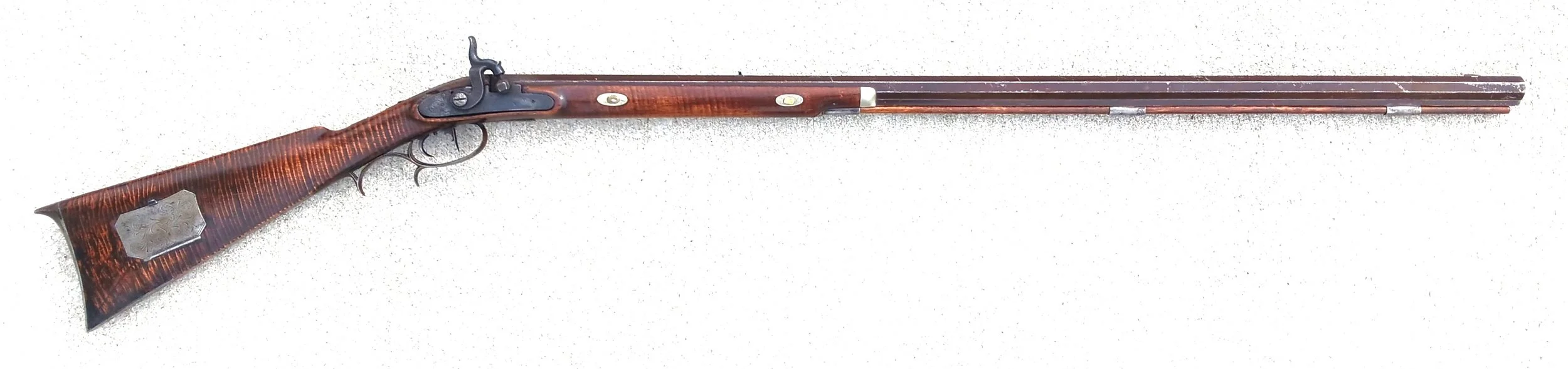
Figure No.2a: This iron mounted Dickson & Gilmore rifle is similar to the brass mounted rifle with it is double-keyed forestock, cast nose cap, and double spurred guard. When new, it had a patent breech. The fine curly maple stock has a bottom-hinged Dickson & Gilmore patchbox with engraved lid. The Louisville style guard has a “square shoulder” above its rear spur and Louisville triggers with a small “C” scroll behind the front trigger. This rifle differs from the brass mounted rifle with its patchbox and front action lock. Barrel: 37-1/4 inches with .36 caliber bore. Author’s collection, all photos by author.
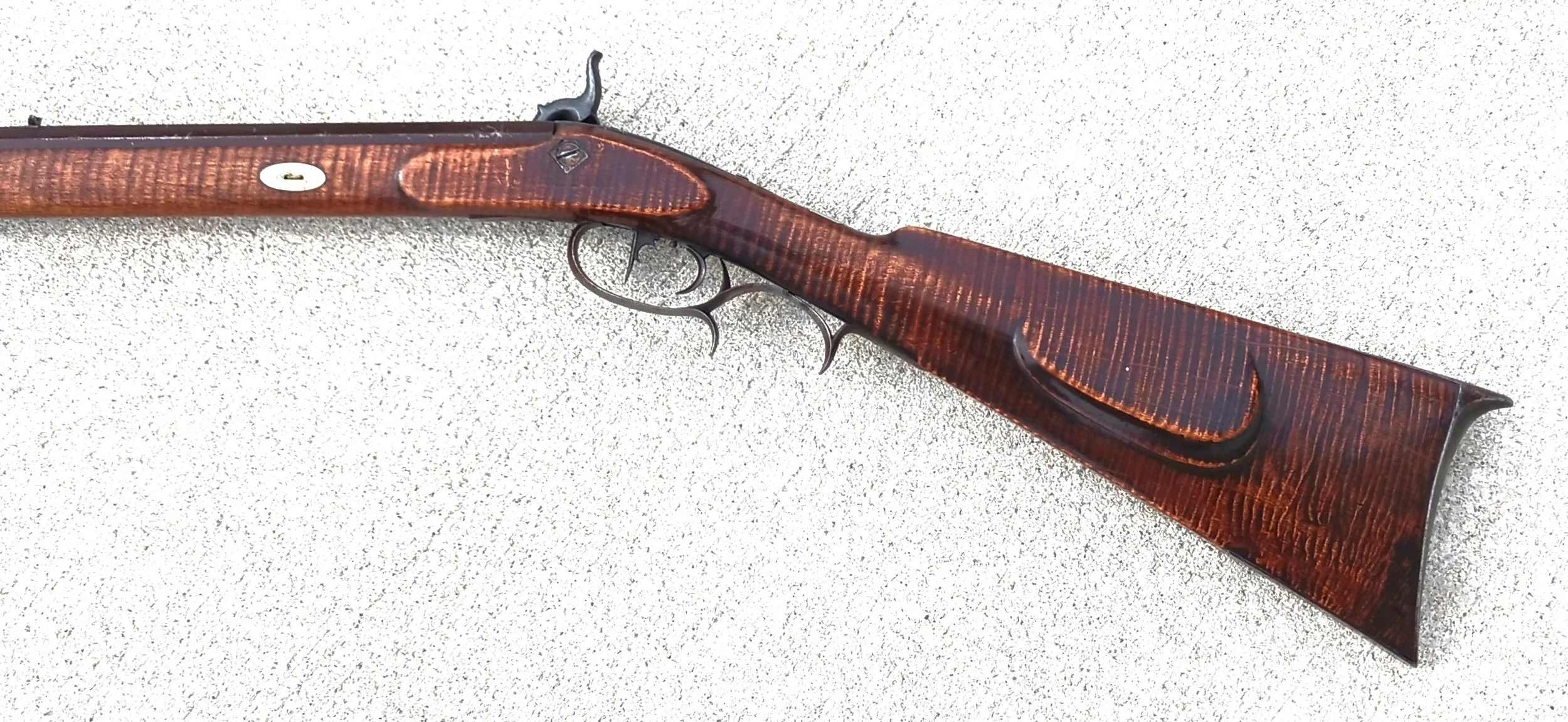
Figure No.2b: The back of the iron mounted Dickson & Gilmore rifle has their mid-to-late 1840s heavily molded oval cheekpiece. Other than at barrel wedges, Dickson & Gilmore rifles used few inlays and rarely a cheek inlay. Their sharply defined, triangular butt is evident in this view, along with their use of flatter butt plates than most other gunsmiths in the 1840s. Note the small, simple lock bolt washer that is square with its top corner clipped off.
An 1840s brass mounted Dickson & Gilmore rifle similar to what Fremont carried west was shown in Figures No.1a and No.1b. Recently, an iron mounted Dickson & Gilmore rifle sold at auction and provides an example of what Fremont’s iron mounted rifles looked like. It is shown in Figures No.2a and No.2b. The gun was signed like the brass mounted rifle with “M. Dickson & J. J. Gilmore/Louisville KY” on the barrel and “M. Dickson” on the lock plate as seen in Figures No.3 and No.4, respectively. When the brass and iron rifles are compared, there are subtle differences in the butt plates, guards, and triggers. Both rifles have Dickson & Gilmore’s earlier style two-screw tang with straight sides seen in Figure No.5, but the iron rifle has a front-action lock while the brass rifle has a back-action lock. Dickson & Gilmore used both style locks, as well as iron and brass mounts, interchangeably in the mid-1840s, but they preferred back-action locks, patent breeches, and brass mounts for their better guns. Their iron butt plates usually have a bit less curvature than brass butt plates, but it seems to be more a supplier’s style preference than dating issue with Dickson & Gilmore, since their butts often look earlier than their rifles’ actual dates.
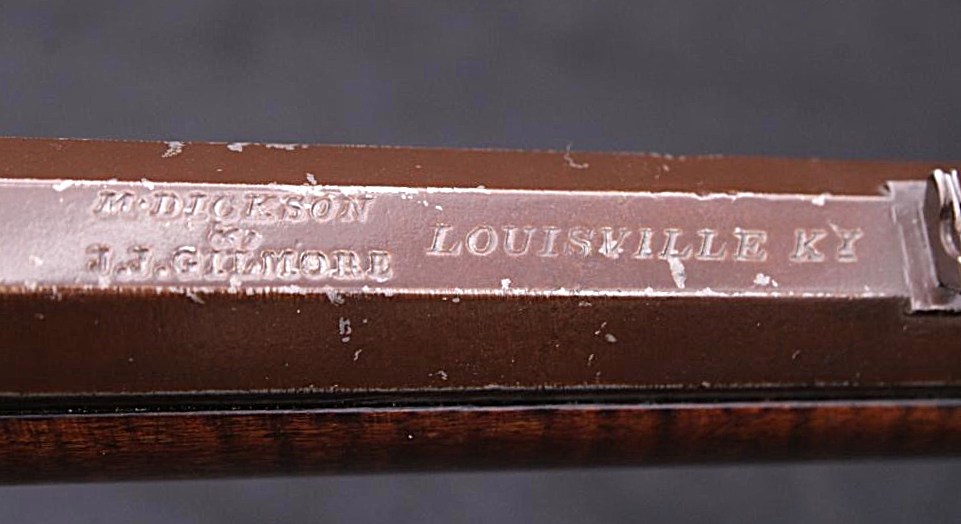
Figure No.3: The barrel signature is deeply stamped on the iron mounted Dickson & Gilmore rifle, followed by their location “Louisville, KY.” On this rifle, the signature was placed closer to the rear sight that normal, and the barrel has been re-browned a bit too dark.
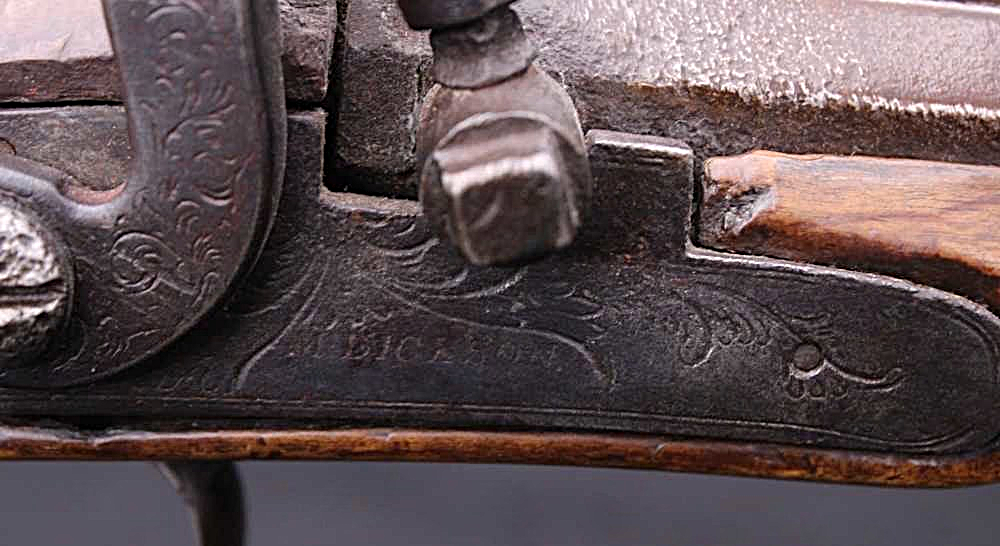
Figure No.4: This view of the gun’s original percussion lock shows its worn “M. Dickson” stamp, and more importantly, the rectangular cutout for its original patent breech that was later replaced with a percussion side drum/lug with Kentucky style square shank on the end.
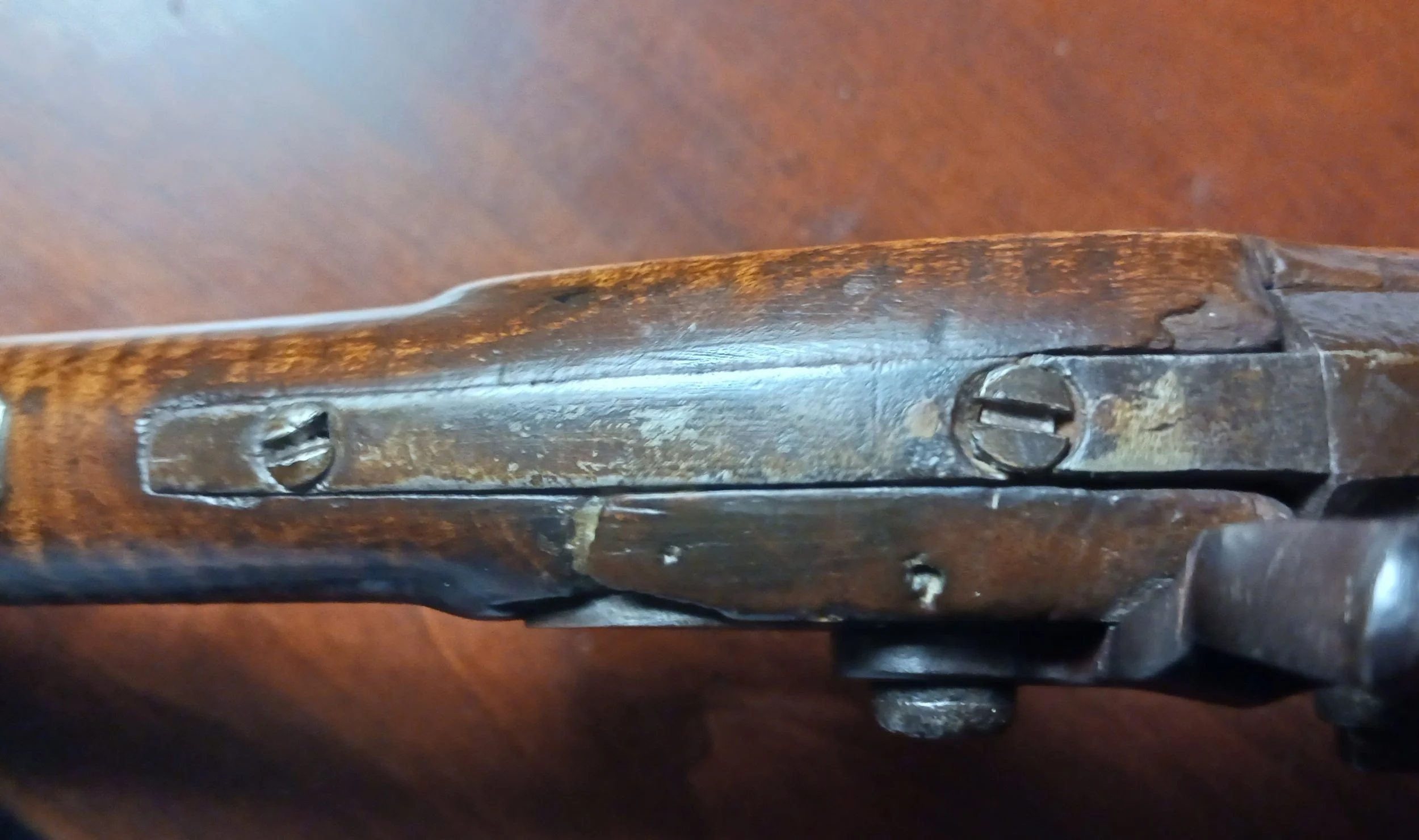
Figure No.5: Pre-1850 Dickson & Gilmore rifles had long 2-screw, straight-sided tangs like this one, while later rifles had tangs that pinched in at the middle creating a narrower tail section. In the late 1840s, both style tangs were used during the transition period.
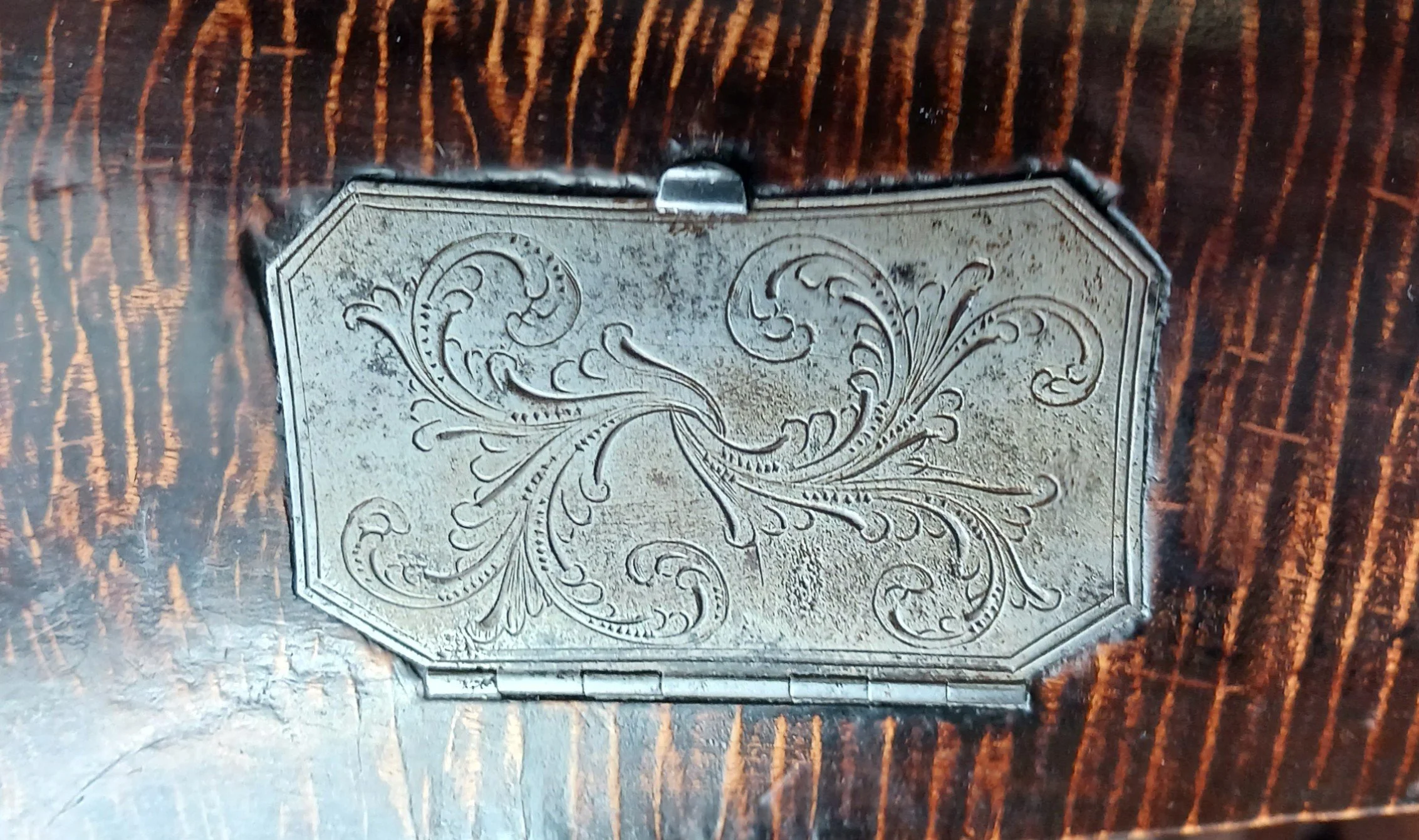
Figure No.6: A significant detail on the iron mounted Dickson & Gilmore rifle is its small, bottom-hinged iron patchbox. These patchboxes varied slightly in size and depth of curves in their edges, but they always looked about the same with similar engraved patterns.
An outstanding detail on the iron mounted rifle is its octagon-shaped patchbox seen in Figure No.6; the style was used by Dickson & Gilmore in the 1840s and made in their shop since no two are identical. Most are engraved with a similar floral pattern consisting of four scrolls extending outward toward the lid’s four corners as seen in Figure No.6. The rifle’s iron toe plate in Figure No.7 is engraved with similar scrolls. and screw heads on the toe plate and guard’s extensions are engraved, making the rifle an upgrade over Dickson & Gilmore’s standard iron mounted rifles. Like their gun mountings, these patchboxes are found in iron, brass, silver, and German silver… all with the same general shape and engraving.
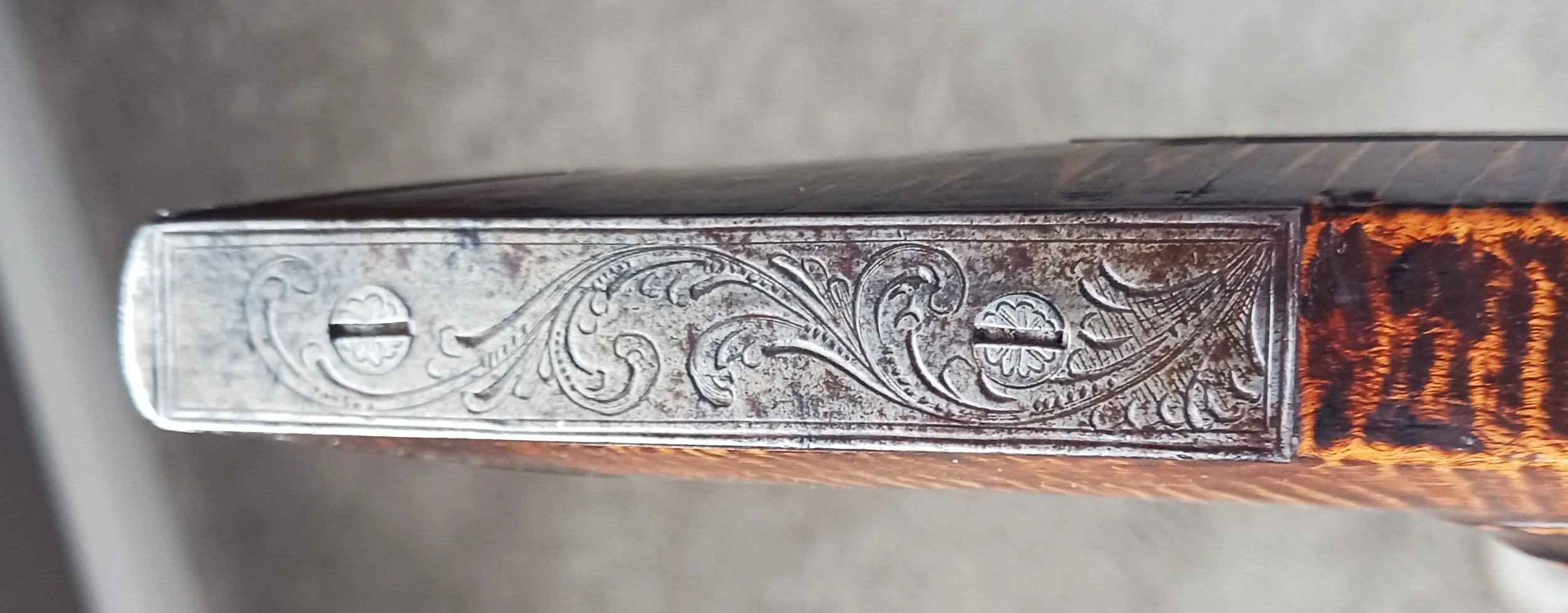
Figure No.7: The toe plate on Dickson & Gilmore’s iron mounted rifle is engraved in a pattern matching the engraving on the patchbox lid. The screw heads are also neatly engraved along with the screw heads in the guard’s front and rear extensions. Dickson & Gilmore did not make Kentucky’s fanciest guns, but they paid attention to details and consistently made high-quality guns that were among the best in Kentucky.
The two study rifles share many similar details, yet their butts differ in height, shape, and drop. The iron mounted rifle with patchbox was made several years after the brass rifle, yet it looks earlier with its taller, more triangular butt. Moses Dickson began importing English rifles, fowlers, and pistols in the 1840s to expand his product lines, but his Dickson & Gilmore rifles were always the shop’s premium guns. The imported English sporting rifles had English floral engraving and taller, less curved butts than most American rifles. Since many people thought England made superior firearms, Dickson began using the English butt style and floral engraving to make his rifles appear more elegant with a touch of English styling. The style change made his rifles more attractive, but it also made them appear earlier than they actually were, making his 1840s and 1850s rifles more difficult to date accurately.
Summary: John C. Fremont’s choice of Dickson & Gilmore rifles as prizes for his best marksmen on his third trip to the Rockies attests to Dickson & Gilmore’s widespread reputation for quality. The two study rifles have no documented link to the Fremont expedition, but they illustrate what Fremont’s brass mounted and iron mounted rifles looked like. Both rifles date to the 1840s with the iron mounted rifle being a few years later than the brass mounted rifle. But Dickson & Gilmore rifles of this vintage are difficult to date accurately. Small variations thought to suggest an earlier or later rifle can be misleading, since at times they show up on guns at the other end of the date range, leaving only Dickson and Gilmore to know their actual dates.
Sources:
[1] John Charles Fremont, Memoirs of My Life, Belford, Clark & Co., Chicago and New York, 1887, p.424.
[2] Thomas S. Martin, With Fremont to California and the Southwest 1845-1849, “The Thomas S. Martin Narrative,” Ferol Egan, Editor, Lewis Osborne Pub., 1975, p.1.
[3] Ibid, p.1.
[4] Ibid, p.2.
[5] Ibid, p.4.
[6] Ibid, p.4.