
A Rare Daniel Heath Rifle Finally Appears ©
Foreword: One of the benefits of studying Kentucky’s early rifles for many years is the ability to understand small details and nuances that help identify unsigned Kentucky guns, place them in their proper School, and often identify the maker, at times even when no rifle by that maker is known. A plain, unsigned rifle at auction with no background information recently caught the author’s eye. Its stock architecture indicated it was a Kentucky gun, but who made it? This article goes through the author’s analysis to place it in a Kentucky school, then into a specific county, and finally strongly attribute it to a little-known blacksmith and parttime gunmaker whose work had not been seen before.

Figure No.1: The auction rifle has very specific Kentucky details in its triangular butt, relatively long barrel for a late 1860s percussion gun, 2-screw tang, and tight side-facings around the lock. But it also has details that indicated a specific county in Kentucky and a specific gun shop that made similar rifles. Barrel: 39-1/2 inches long, .40 caliber bore.

Figure No.2: The back side of the unknown rifle shows its unique, “clunky” cheekpiece, course workmanship, and iron mounts. More importantly, it shows the spatial gaps between its rear pipe and nose cap, and rear pipe and rear sight that help locate it. Also visible is its tall rear sight and iron mountings, all details that help determine its place of origin and most probably maker.
Unknown Rifle: An unsigned, half-stocked rifle of somewhat course workmanship recently sold at auction. The seller had no information on where the gun came from, and based on the gun’s selling price, neither did the bidders. The gun, shown in Figures No.1 and No.2, caught the author’s eye for its slender lines, good barrel length on a later rifle, sharply triangular butt, and long 2-screw tang, all strong Kentucky details. The half-stocked gun’s lack of decorative details such as molding lines, cap box, or inlays suggested it probably came from the Barrens area of southcentral Kentucky. More importantly, its distinctive stock architecture in the forestock and “clunky” cheekpiece related the gun strongly to rifles from the southern end of the Barrens School near Allen County, Kentucky. Its “clunky” cheekpiece, tall “buckhorn” style rear sight, nose cap set well past the rear ramrod pipe, and lack of a small step-down on the side-facing’s nose suggested it may have been made in the town of Scottsville in Allen County. Finally, the distinctive spatial relationship between rear pipe and nose cap, and rear pipe and rear sight [most Kentucky guns have the rear sight over/near the rear pipe] indicated it was probably made in the Heath gun shop in Scottsville where brothers William and John Heath worked. But the gun differed a bit from the Heaths’ normal work. Instead of their expected brass mountings, the gun had iron mountings, the iron butt plate was poorly mounted, and the “clunky” cheekpiece had an odd rectangle carved in it. The keys to identifying the gun’s actual maker were its iron mountings and poorer workmanship, and when added to all the Heath shop details in the gun, the combination strongly suggested the gun was made by a lesser gunsmith working with or near the Heaths, whose work had not been seen in collecting circles before. That description perfectly fit gunsmith Daniel Heath, the younger brother of gunsmiths William and John Heath. William and John were Scottsville’s primary gunsmiths making good quality guns from 1850 until well after the Civil War, but Daniel, while trained as a gunsmith and working with/near his brothers, was a less gifted gunsmith and worked primarily as a blacksmith in Scottsville.
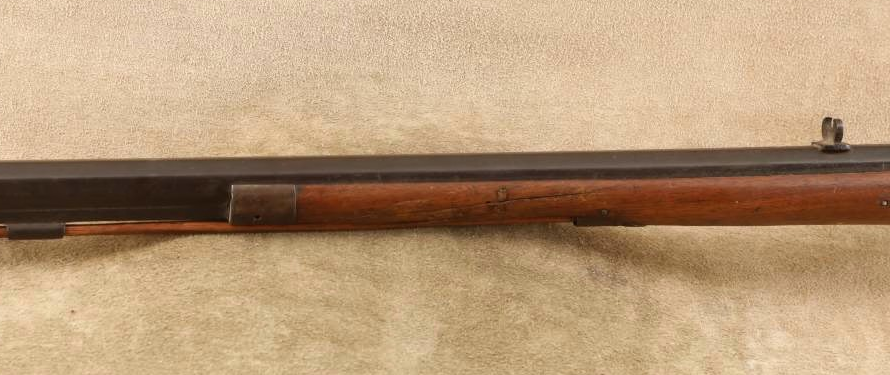
Figure No.3: The forestock on the new rifle is an important key to its identification. The nose cap sits about 6 inches past the rear pipe while the rear sight sits about 5 inches behind it. The longer than normal spacings between the rear pipe and both the nose cap and rear sight are details specific to the Heath rifles from Allen County, Kentucky.
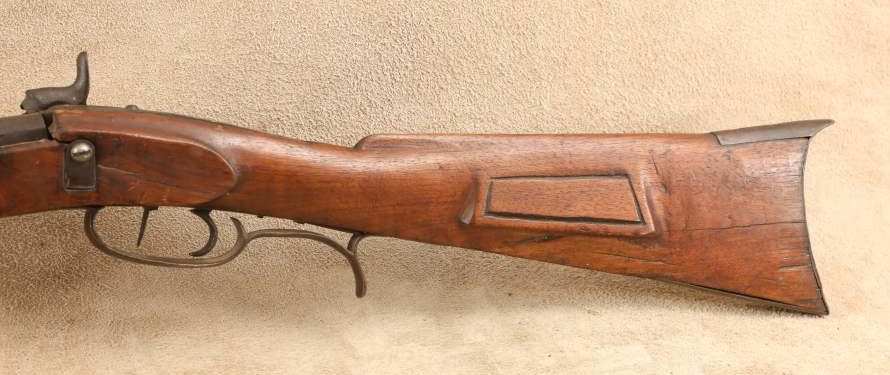
Figure No.4: The back side of the new rifle shows its iron mounts with a hand-forged butt plate. The cheekpiece has a “clunky” shape, the side-facings lacks a small step-down in its nose, and a long 2-screw tang [hard to see] runs down wrist. The poor butt plate mounting, slightly rough stock, and odd cheekpiece show the hand of a lesser skilled gunsmith.
Daniel Heath: Daniel’s father was Richmond Heath, a gunsmith and blacksmith in Sumner County, Tennessee, who raised four sons to become gunsmiths. Three of his sons upon becoming adults moved a short distance north across the state line into Allen County, Kentucky, and settled in Scottsville. They were gunsmiths William “Billy” Heath, John Heath, and Daniel Heath. William arrived in Kentucky in 1849, followed by younger brother John in 1852, and Daniel in about 1858. William and John were accomplished gunsmiths whose guns were almost identical. A typical Heath rifle is shown in Figures No.3 and No.4. Daniel was not as skilled at gunsmithing as his older brothers and ended up working more as a blacksmith, but family recollections claim he built a few guns, mostly for family members, despite none being known today. Daniel worked in Scottsville with his brothers until his wife Elizabeth died in 1879, leaving him with seven children. He then returned to Sumner County, Tennessee, where other family members and old friends still lived.
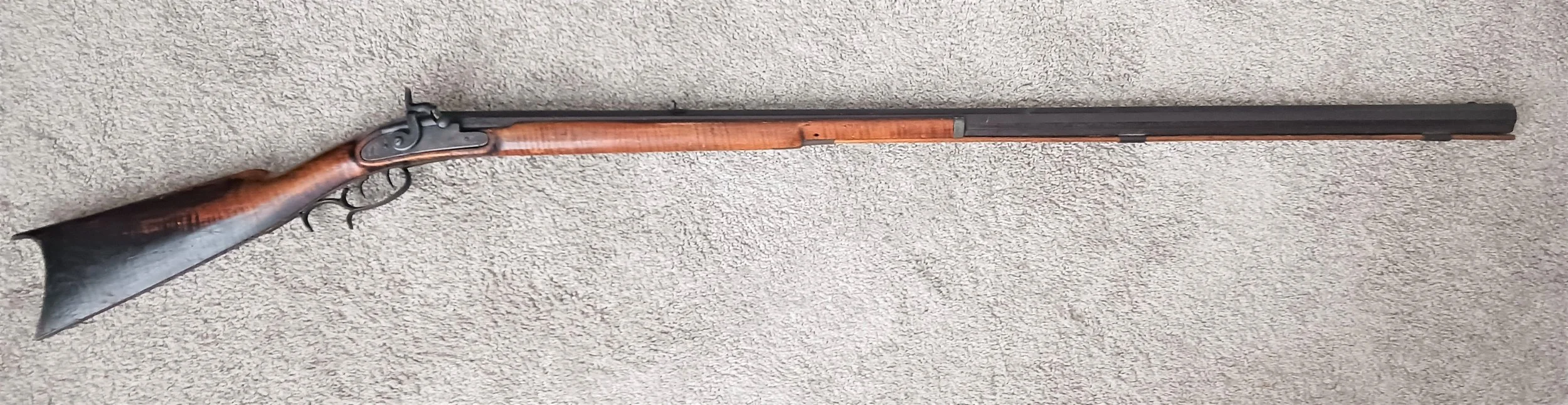
Figure No.5: This fine Heath rifle was built by John Marshall Heath and signed in large block letters as “J. M. H.” The rifle illustrates the Heath’s distinctive arrangement of rear sight, rear ramrod pipe, and nose cap. There is more space between the rear pipe and nose cap than on most circa 1860s half-stocked rifles, and the rear sight sits farther behind the rear sight than on most period rifles. The rear sight is in its original position on the full-length original barrel. Note the Heaths’ three pipes and tight side facings around the lock plate.
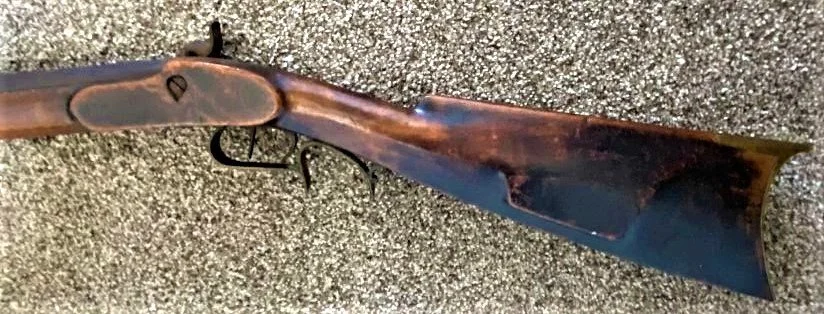
Figure No.6: This is the back of a William Heath rifle of about the same vintage and stock architecture as the John Heath rifle above, but with a different style guard. The mountings are brass, the rear side-facing has no “step” on its top edge, and the cheekpiece is heavy or “clunky” looking. However, the gun is well stocked with clean lines and smooth surface, and the butt plate is properly mounted with its top return parallel with the comb line.
Making the Attribution: The recently found rifle has distinctive Kentucky features with its slim stock architecture, sharply triangular butt, long barrel, tight side-facings around the lock, and 2-screw tang. However, the rear sight placement well behind the rear pipe and nose cap well beyond the rear pipe was a distinctly Heath family arrangement as seen in Figure No.7. Southern Kentucky guns with Tennessee influences, when half-stocked, often had nose caps set well past the rear pipe, but rarely did those guns have a rear sight set so far back from the rear pipe. In addition, a tall buckhorn-style rear sight was common on Heath rifles, along with a large, chunky looking cheekpiece like the one in Figure No.8. When all the numerous Heath-style details on the new rifle are added up, it undoubtedly came out of the Heath gun shop in Allen County, Kentucky. Once understood, Heath rifles are easy to identify among Kentucky guns as well as those from northern Tennessee.
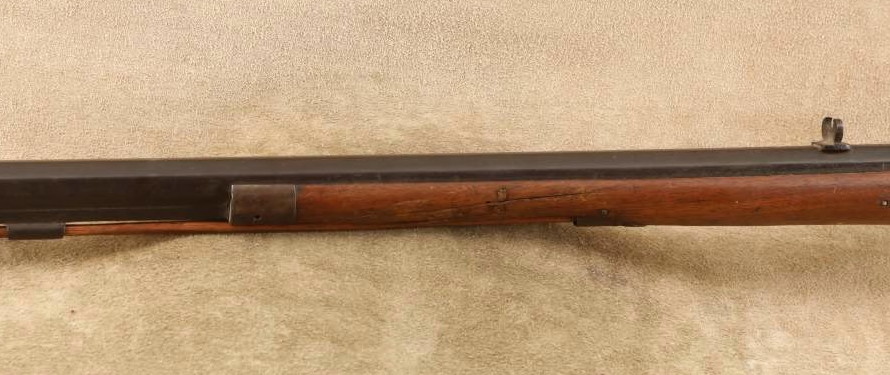
Figure No.7: A key to identifying Heath rifles from Kentucky is found in the forestocks, where the rear sight sits well behind the rear pipe, and the nose cap sits well beyond the rear pipe. Most Kentucky guns, as well as others, have the sight over or near the rear pipe.
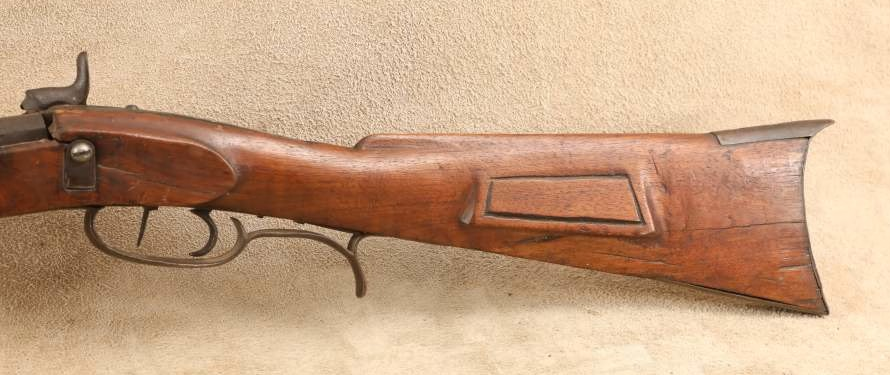
Figure No.8: Despite the yellowish hue to the guard and butt plate, they are made of iron. The side facing outline is not quite perfect, the butt plate is mounted at an angle, and the cheekpiece is large and a bit clunky. Those details suggest the maker had modest skills.
The study rifle is a carbon-copy of an Allen County, Kentucky, Heath rifle despite not being signed; other known Heath rifles are stamped “W.M.H.” for William Heath and “J.M.H.” for John Heath. But it also differs subtly from William’s and John’s work. It has lower quality workmanship, a slightly different “clunky” cheekpiece, and perhaps most importantly, iron mountings as seen in Figure No.8. The gun reused an older barrel with an old dovetail near the breech that can be seen in Figure No.9, making it a low-cost rifle. Younger brother Daniel was known to be a good blacksmith but poorer gunsmith than his brothers, so the less refined stocking, awkward butt plate mounting, amateurish “chunky” cheekpiece, recycled barrel, and iron mountings all point toward younger brother Daniel Heath as the maker of the Heath style study rifle. The iron mountings are significant, since no rifle by William or John Heath is known with iron mountings. That leaves part-time gunsmith and full-time blacksmith Daniel Heath as the logical and strongly attributed maker of the newly discovered Heath-style rifle from Allen County, Kentucky, in the state’s Barrens School.
Author’s Note: The unsigned barrel was probably intentionally left unsigned. Kentucky gunsmiths were reluctant to put their name on another gunsmith’s signed barrel when reusing it, especially when older barrels were hand-made. The study rifle’s barrel was probably signed at one time, but the old open dovetail near the study rifle’s breech indicates a recycled barrel that was shortened for use on this gun, and any old signature was lost in the process.
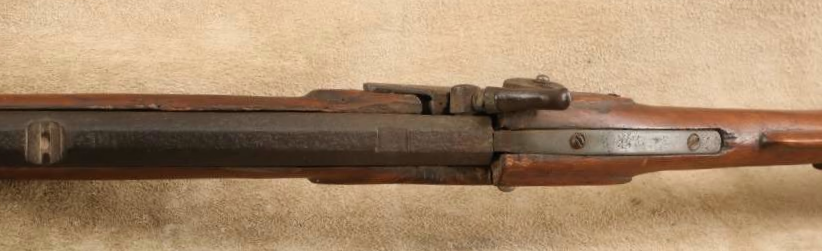
Figure No.9: A top view of the Daniel Heath study rifle shows its long, 2-screw tang, current rear sight, and an old dovetail for a prior rear sight when the barrel was on an earlier gun. The reuse of an earlier gunsmith’s barrel may have been the reason this barrel was not signed by Daniel Heath.
Summary: The Heaths made distinctive rifles in Allen County, Kentucky, that stand out from other rifles made in Kentucky and nearby northern Tennessee. An unsigned rifle strongly in the Heath tradition recently sold at auction. It appeared to be made by one of Kentucky’s Heath gunmakers, but which one? By examining its construction methods, stock architecture, and use of iron mountings, it has been strongly attributed to Daniel Heath of Allen County, Kentucky, and is his first documented rifle.