
A New Lexington Rifle with Several Unique Features ©
Foreword: A Lexington School rifle from Kentucky recently sold at auction that had several non-standard features making it difficult to attribute. The gun’s cheekpiece had an odd star that was unique to Lexington rifles [and Kentucky guns in general], a slight curvature in the butt’s comb and toe lines, and a Lexington style side-plate with the seldom seen “bottle shaped” tail. Despite being unsigned, the rifle offered hints on where it was most likely made, but its maker remains a mystery.
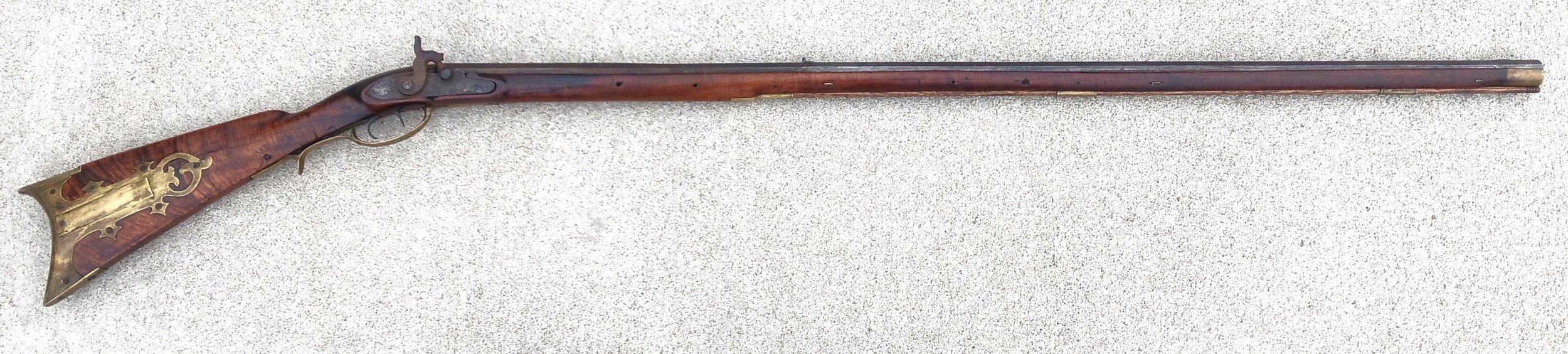
Figure No.1: The new rifle has the iconic “captured lid” Lexington cast brass patchbox and long barrel common to Kentucky guns. However, several details suggest the gun was made well outside of Lexington. The guard has the expected two flats on its outer surfaces but lacks the heavy front post and forward sloping bow of guns made in or near Lexington. The bow’s rounded guard and straight rear spur suggest the gunsmith had Virginia roots. Barrel: 46 inches long with .38 caliber bore. Author’s collection, photos by author.
The Rifle: The new rifle has the traditional 2-piece, cast brass Lexington patchbox with release button in the toe as shown in Figure No.1. However, the unengraved patchbox lacks the traditional Lexington border of simple dots or a small serpentine line running around the patchbox’s perimeter and along the inner edges of the surround with an arch above the lid’s hinge end. The box is a true “captured lid” box with the surround completely enclosing the lid. Butt architecture differs slightly from the expected triangular Lexington butt with its slight curve in both the comb and toe lines. The butt in Figure No.2 has vividly curled maple with grain that curves through the wrist, strengthening the stock’s weakest area. The guard has the Lexington School’s typical two flats on the bow’s outer surface and simple joint where the grip rail meets the bow. But strong Virginia influences are seen in the guard’s rounded bow, downward angled rear spur, and lack of a heavy front post. Triggers also show a Virginia influence with increased curvature of the rear trigger and no decorative tab on the front “hair” trigger. Perhaps more importantly, the gun is a bit thicker than expected in the wrist/lock area with a less scooped cheekpiece, both Virginia influences, and the barrel is lightly swamped at the breech and muzzle.
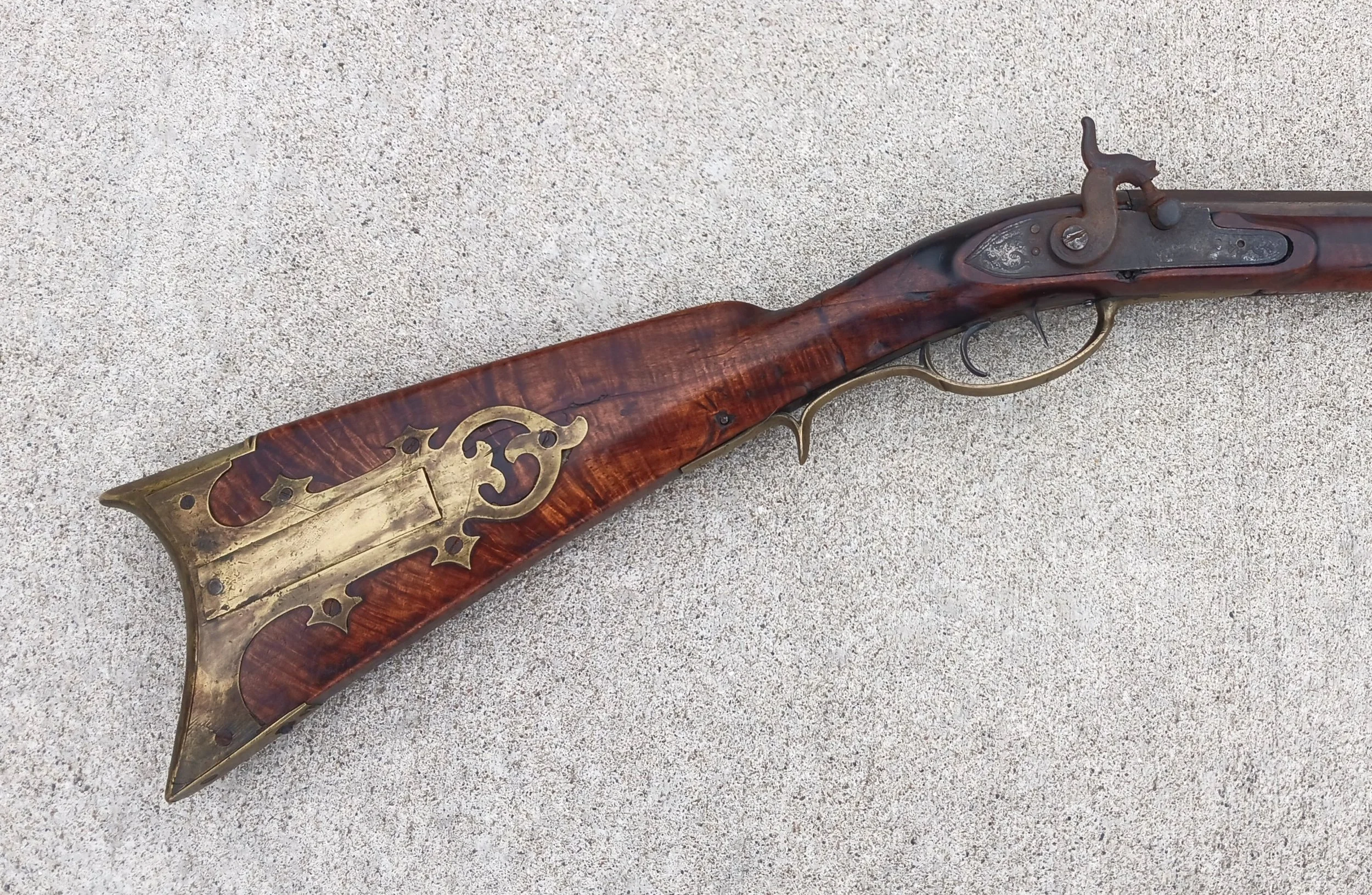
Figure No.2: The Lexington patchbox has a fully captured lid, with a strip of surround between the lid’s open end and the butt plate. However, there is no border engraving on the patchbox, and the guard has a Virginia influence with its rounded bow and straight spur.

Figure No.3: The cheekpiece has Lexington’s single mold line across its base but lacks the short molding lines below the cheek with “squiggly” ends. The large silver moon is common to Lexington guns, but the undersized, oddly shaped cheek star is unique to Kentucky guns.
The back side of the new rifle’s butt in Figure No.3 has a typical Lexington large silver moon behind the cheekpiece, but the cheek star is unexpectedly different in size and shape. Rather than the usual oval inlay mounted with a center screw, this inlay is a small, oddly shaped 6-pointed star mounted with two silver pins as seen in Figure No.4. The only place the author can recall seeing a somewhat similar inlay is on Kennedy rifles from North Carolina. The cheekpiece is also less scooped [almost flat] than most Lexington cheeks and lacks the traditional Lexington “squiggle” molding line under it, adding to the Virginia influences in the gun. A minor deviation occurs in the butt plate. It has the traditional raised ridge at the end of the top extension, but there is only a single filed line in the ridge, rather than the traditional two filed lines. The rifle’s most highly decorated detail is its large side-plate seen in Figure No.5 with an engraved border and short rays below/behind the bolt heads. The side-plate has a “bottle shaped” tail seen only on a few Lexington guns; the uncommon side-plate and odd cheekpiece star may eventually help identify the gun’s maker. The gun has three ramrod pipes while guns made near Lexington often have four pipes, and its rear sight sits a couple inches past the rear pipe instead of over it. Also noteworthy is the lack of moldings lines on the cheekpiece, lower butt, and forestock, which eliminated the traditional Lexington “wavy line” termination at the rear pipe and the two parallel lines under the cheekpiece with “squiggly” ends.
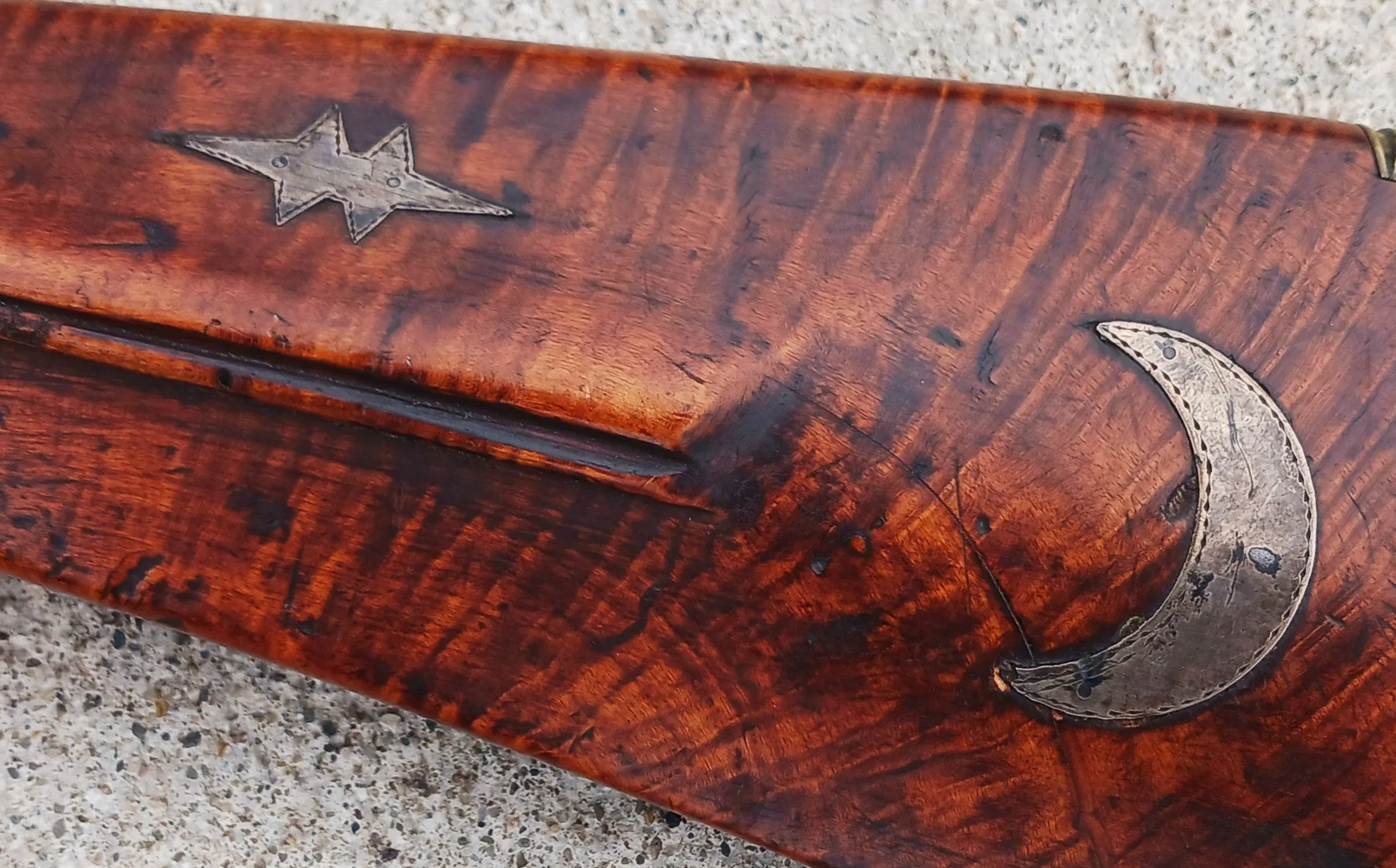
Figure No.4: The coin silver inlay work on the new rifle is limited but significant. The large silver moon was used on many pre-War of 1812 Lexington guns, while the small silver cheek star is oddly shaped and the only example of that style known on a Kentucky gun.
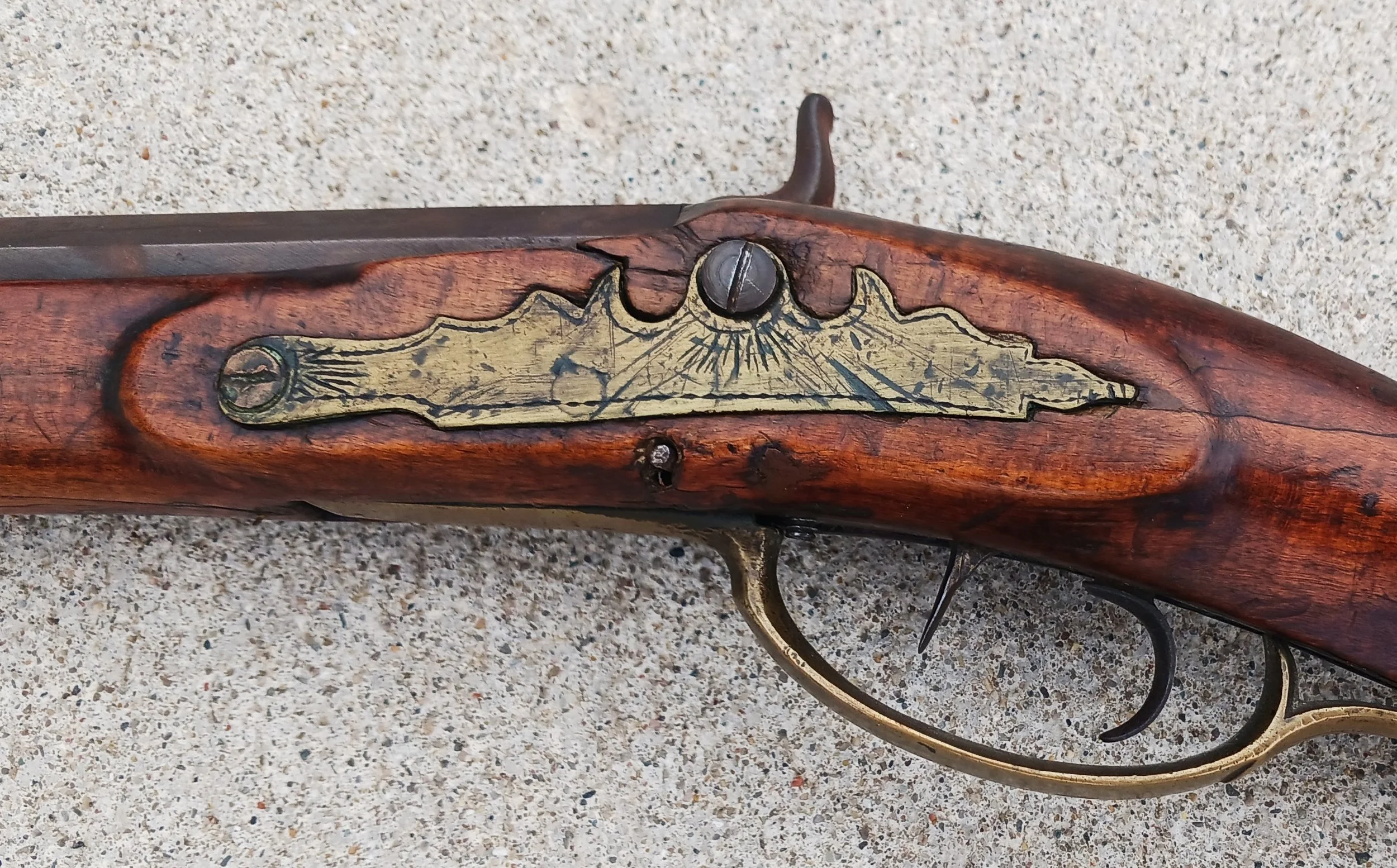
Figure No.5: The lock bolt plate opposite the lock is engraved with a dotted border with elongated dots that appear connected, and emerging rays decorate the lock bolt locations. The side-plate has traditional Lexington “horns” and a less common “bottle-shaped” tail.
Placing the Rifle: The new rifle is definitely a Lexington School rifle from the central Bluegrass area of Kentucky, but where in that eight-county school was it most likely made? The author knows of no other rifle by this maker, but its many subtle Virginia influences suggest it was made outside of Fayette County where most guns exhibit the Bryan family’s North Carolina influences. The stylistically closest known rifle is by gunsmith Capt. Lynn West of Georgetown in Scott County, just west of Fayette County. West was trained in Virginia before moving to Kentucky, and while working in the Lexington School, his guns retained traces of his Virginia training. The new rifle was not made by Lynn West due to several key differences, but West’s patchboxes had a similar outline, his guards had a similar rounded bow, and his side plates had the same “bottle shaped” tail. The similarities suggest the new rifle was made on the western side of the Lexington School, perhaps in Scott or Franklin County, where Virginia influences were stronger, cheekpieces less scooped, guards had rounder bows, and molding lines were not considered mandatory on rifles.
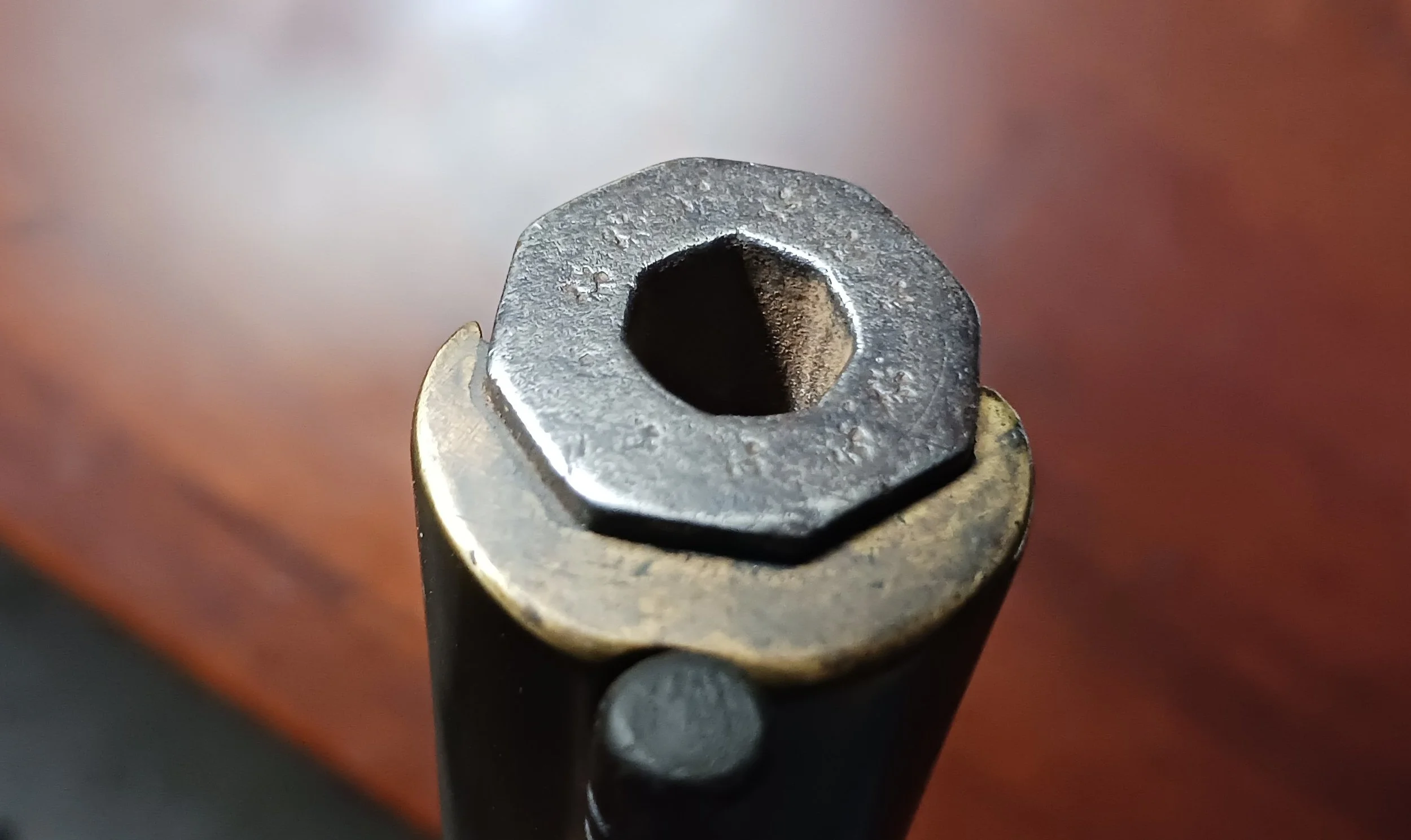
Figure No.6: The new rifle’s muzzle has a ring of small stars punched around the bore, a somewhat common muzzle decoration used in Kentucky as well as other states. The barrel’s 7-groove rifling is visible in this view, but what is not visible is the slight swamp at the barrel’s breech and muzzle. Many Lexington School guns made in or near Lexington had straight barrels without flared/swamped breeches and muzzles, but the Virginia influences in this rifle led gave it a swamped barrel.
Dating the Rifle: The new rifle has been re-breeched twice during its working life, as indicated by added holes in the forestock for barrel pins that replaced the original wedges. [Note: the barrel has been stretched back to its original length and wedges reinstalled]. The current lock fits the mortise, but it is probably a replacement for an earlier and more traditional “T. Ketland” or “C. Bird” lock during one of the re-breechings. The gun’s butt is almost 1-5/8” wide, suggesting a flint era gun, as does its fully “captured” lid on the patchbox and a thicker than normal brass casting. The smaller “Q” finial on the patchbox tends to date the rifle from the start of the War of 1812 and later. Dating an unidentified Lexington rifle without its original lock plate is subjective, but the author dates this gun to about 1812 to 1815.
Summary: A recently found Lexington School rifle tweaked the author’s interest with its oddly shaped cheek star, side-plate with a “bottle shaped” tail, and Virginia influences in the stocking and mountings. The gun’s cast brass 2-piece patchbox had a fully “captured lid” and its surround was significantly thicker than surrounds on most Lexington rifles. The gun presented an interesting study piece that was probably made on the western side of the Lexington School about 1815. The slight curve in the comb line and wide cheekpiece with a very strong molding line across its lower edge suggest it may be related to the work of William Graham or one of his sons, several of whom were gunsmiths in Franklin County on west side of Scott County.