
A Fine Benjamin Mills Rifle in Rough, Neglected Condition ©
Foreword: Fine rifles are usually better cared for than plain working rifles and survive in better condition. The author has owned several Benjamin Mills rifles from Harrodsburg in Mercer County, Kentucky, and all have been in excellent condition, showing the value early owners placed on them. Recently a Mills rifle sold at auction that started life as a fine gun, but it later suffered a broken wrist, scratched and dinged wood finish, and exposure to moisture on its back side. The gun is shown in Figures No.1 and No.2. Despite the damage, it was still a rare Mills rifle and deserved more respect and better care.
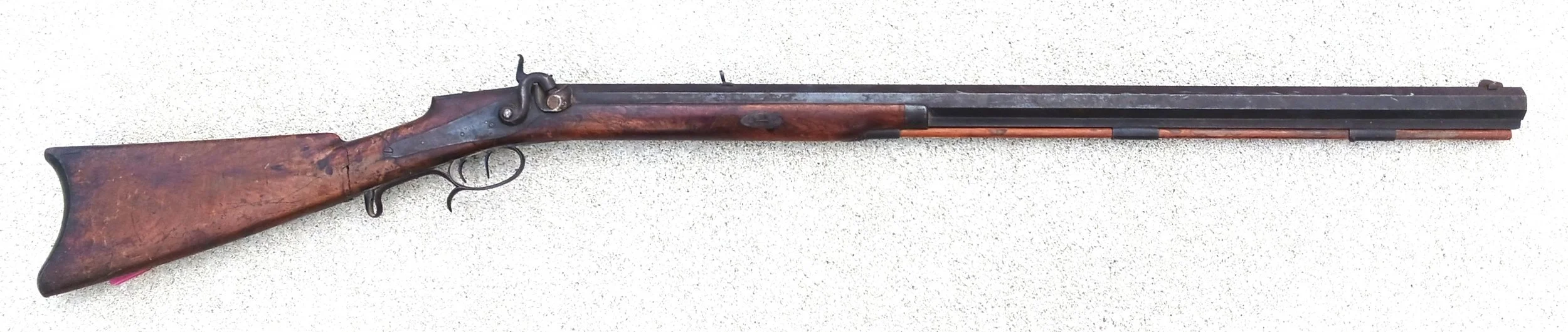
Figure No.1: This worn Benjamin Mills rifle was made in Harrodsburg, Kentucky, about 1850. The gun is complete but had a hard life for what was originally a fine rifle. Barely visible in the butt stock is Mills’ preferred fancy “feather” graining in the walnut wood, which undoubtedly contributed to an eventual break in the wrist area. The front side of the rifle survived in better condition than the back side, which apparently laid face down for years, allowing moisture/humidity to rust its iron surfaces. An auction tag hangs off the guard. Author’s collection.
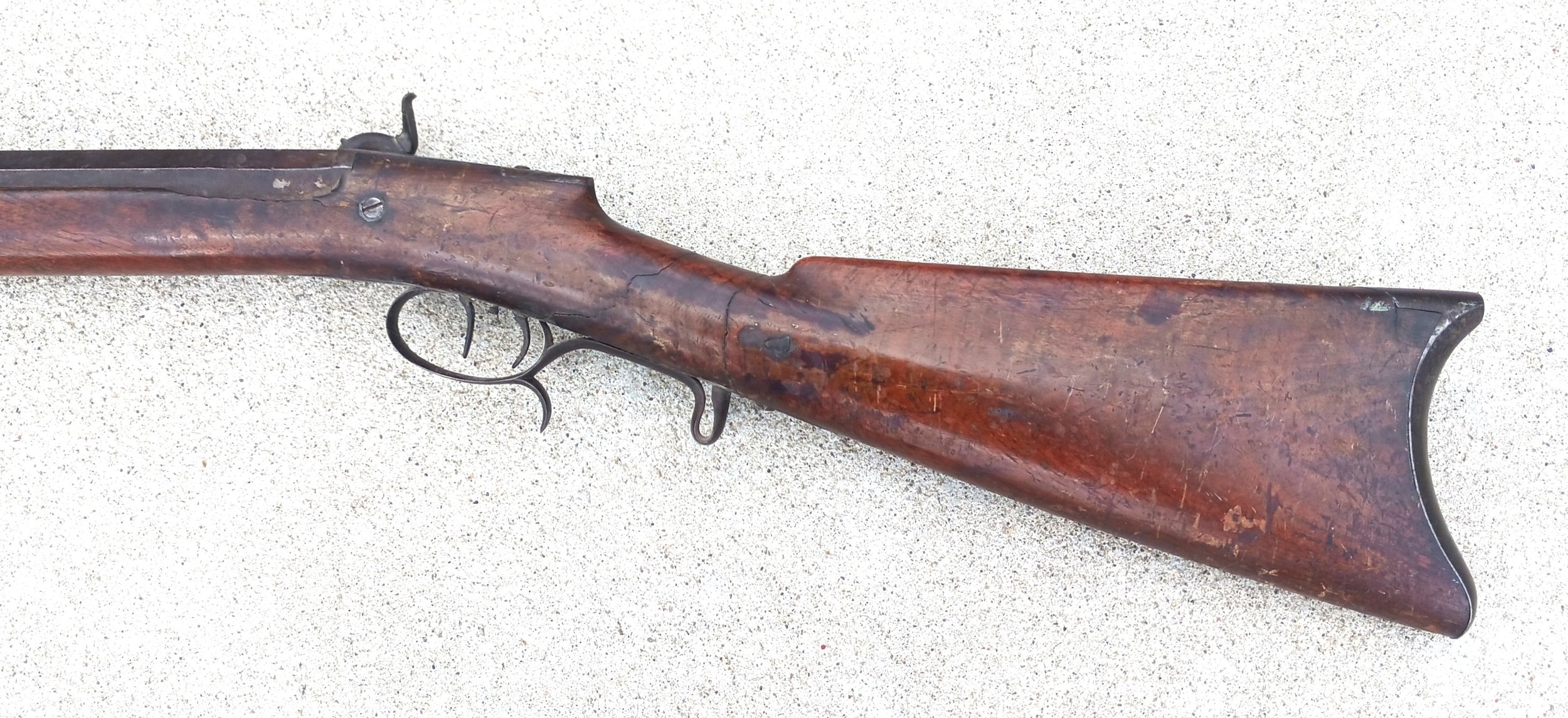
Figure No.2: The back of the Mills rifle has a small area of wood loss ahead of the breech, along with many small dings and scratches in the stock. A break in the wrist is visible here above the guard’s rear spur, with a smaller crack about an inch ahead of it. Not visible here are the rust spots on the back side of the barrel from exposure to moisture or humidity for an extended time.
Benjamin Mills: Mills was born in New York in 1810 and trained as a gunsmith while growing up. After completing his training in 1831, he moved to Toronto, Canada, where he married Jane O’Connor and worked for several years. Rifles from his Canadian years are known, all marked with his name and “U. C.” for Upper Canada. Except for a single known full-stocked rifle, his early work looked much like his later Kentucky work with strong New York influences that included his trademark “saw handle” tang, figured walnut stocks, superior locks and barrels, and consistently fine workmanship.
Mills left Canada for Mayslick in Mason County, Kentucky, in 1838 or 1839, where he was recorded in county tax records in 1839. Mills’ Mayslick time was short; he moved to Stanford in Lincoln County in 1841, and in 1842 he settled permanently at Harrodsburg in Mercer County. It was at Harrodsburg that he prospered and became known as one of Kentucky’s finest gunmakers with a wide-ranging reputation for superior rifles among target shooters from the east coast to the west coast. A fine Mills target rifle is shown in Figure No.3. Most Mills rifles had both open (hunting) and globe (target) sights, but Mills was also known for his superposed rifle/shotgun combination hunting guns like the one seen in Figure No.4. He seemed to enjoy mechanical challenges and also made double-rifles, three-barreled rifles, and later in life breech loading guns… not to mention pistols of all shapes and sizes. Two points about Mills’ work define his career: he worked in the style of better New York gunmakers for most of his life, and his workmanship was on a level seldom matched by other gunmakers in Kentucky or elsewhere.

Figure No.3: This fine Mills target rifle displays his best work, although all of his work was well above average. Mills always used patent breeches and preferred back-action locks on his best rifles. This rifle has retained its original rear peep and front globe sights along with its false muzzle that blocks the sighting plain when in place. The lack of open [hunting] sights suggests the gun was made specifically for target shooting, and the tang’s downward slope indicates a date of about 1860. Note the attractive “curly” walnut wood in the butt, fine wrist checkering, and separate forestock grip section, a rare detail on Mills’ rifles. Photo courtesy T. Prince at College Hill Arsenal, Nashville, TN.

Figure No.4: This gun provides a good example of Mills’ range of firearms with its superposed rifle and shotgun barrels. Mills used longer New York style ramrod pipes/catchers at the rear of his stacked barrels. The gun has survived in remarkable condition and has a rare double-cavity patch/wad box in the butt with thin sheet silver overlaid on the lids. Mills’ preference for highly figured walnut stocks is seen here with a feather grained pattern visible around the cap/wad box in the butt. Author’s collection, photo by J. Jaeger.
Damaged Rifle: Fine guns, like fine China, lose much of their collector interest and value when damaged. But to the author, a Mills rifle, even when damaged like the auction rifle, is a rare and special Kentucky gun. On the positive side, the auction gun was complete, had proper markings on both its lock and barrel, stocking and mountings were typical of Mills’ fine work, and the stock used highly figured walnut typical of Mills’ better rifles… but also the culprit in the rifle’s demise. The barrel and lock markings are shown in Figures No.5 and No.6 below. The lock and triggers still function perfectly, despite the gun’s rust, surface damage, and years of neglect.
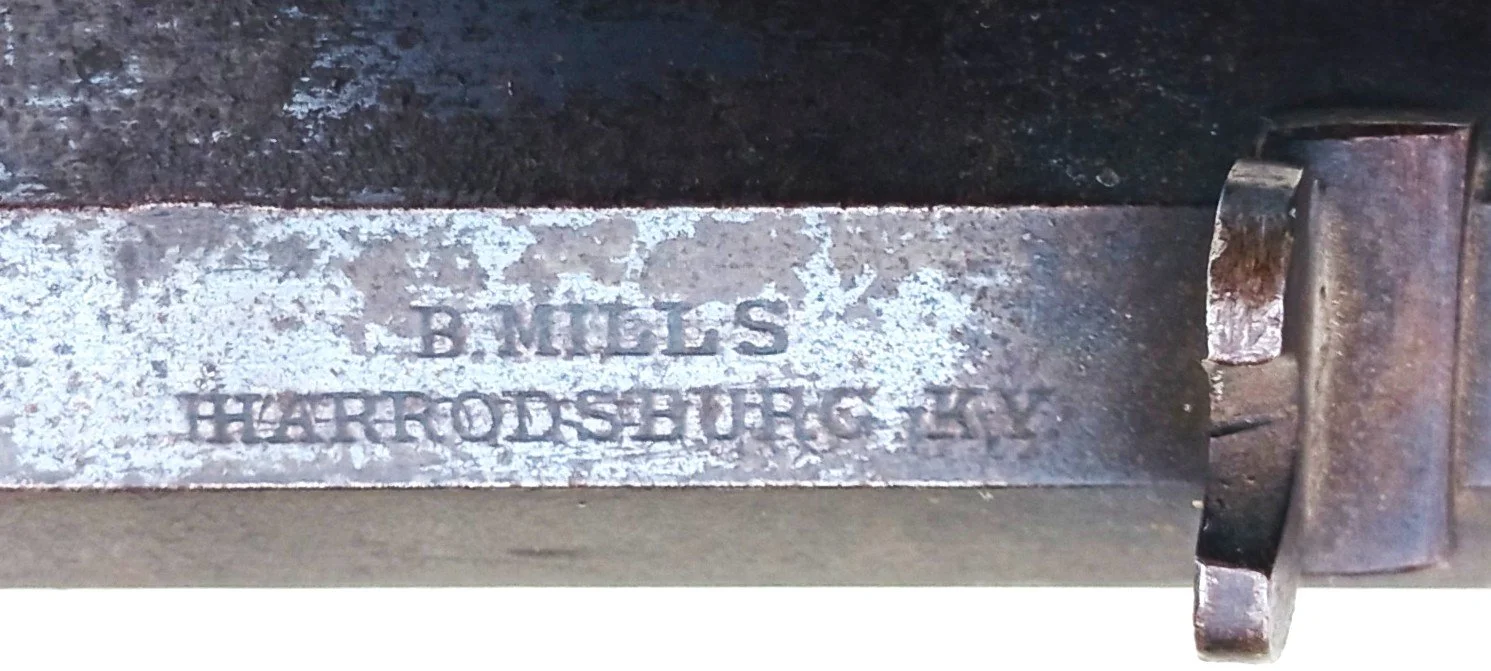
Figure No.5: The barrel stamp on the auction rifle is Mills’ typical two-line stamp with his name and location. In this case, the “Harrodsburg KY” was double stamped leaving a shadow behind it. The spotty rust plaguing much of the barrel is visible in this view.
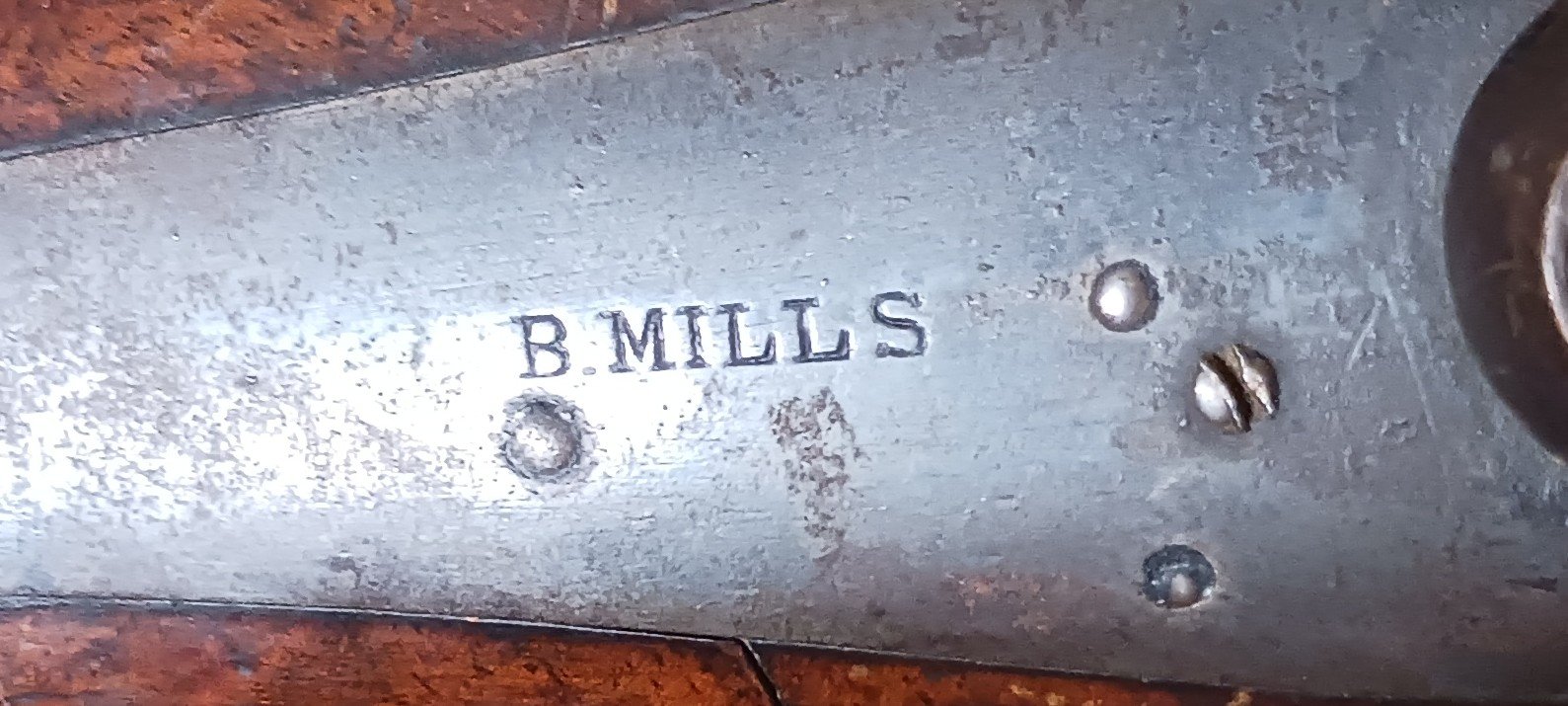
Figure No.6: Mills consistently stamped his locks in addition to his barrels. Locks often had just his name as on the auction gun, but at times his “Harrodsburg KY” was also present. A small crack is visible below the lock with a full wrist break at the lock’s tail screw.
The lock area of the Mills rifle is shown in Figure No.7 and highlights its guard, triggers, and straight “saw handle” tang. Also visible is a repaired break in the wrist that was probably the cause of the gun’s later neglect. Mills preferred highly figured walnut butt stocks with vivid “crotch” or “feather” graining, but he was careful to keep the fancy grained wood well back in the butt with straighter grained wood in the more vulnerable wrist area. On this particular rifle with a feather grained butt, the jumbled grain structure ran well up into the wrist area where the wood’s distorted annular rings literally angled across the wrist rather than lengthwise with it. When new, the wood in the wrist must have been as attractive as the fancy wood in the butt, but it came at a price… a weaker than normal wrist that was more prone to break. A glued break across the highly figured wrist can be seen in Figure No.7 at the lock’s tail screw, and it appears on the back side of the wrist with another crack a short distance away that didn’t go completely through the wrist; the break and secondary crack probably occurred at the same time when the butt took a hard thump. While the wrist break and partial crack were repaired, the gun lost its much of its “superior quality” reputation when the wrist broke, and it apparently spent the rest of its working life being treated as a second-rate gun.
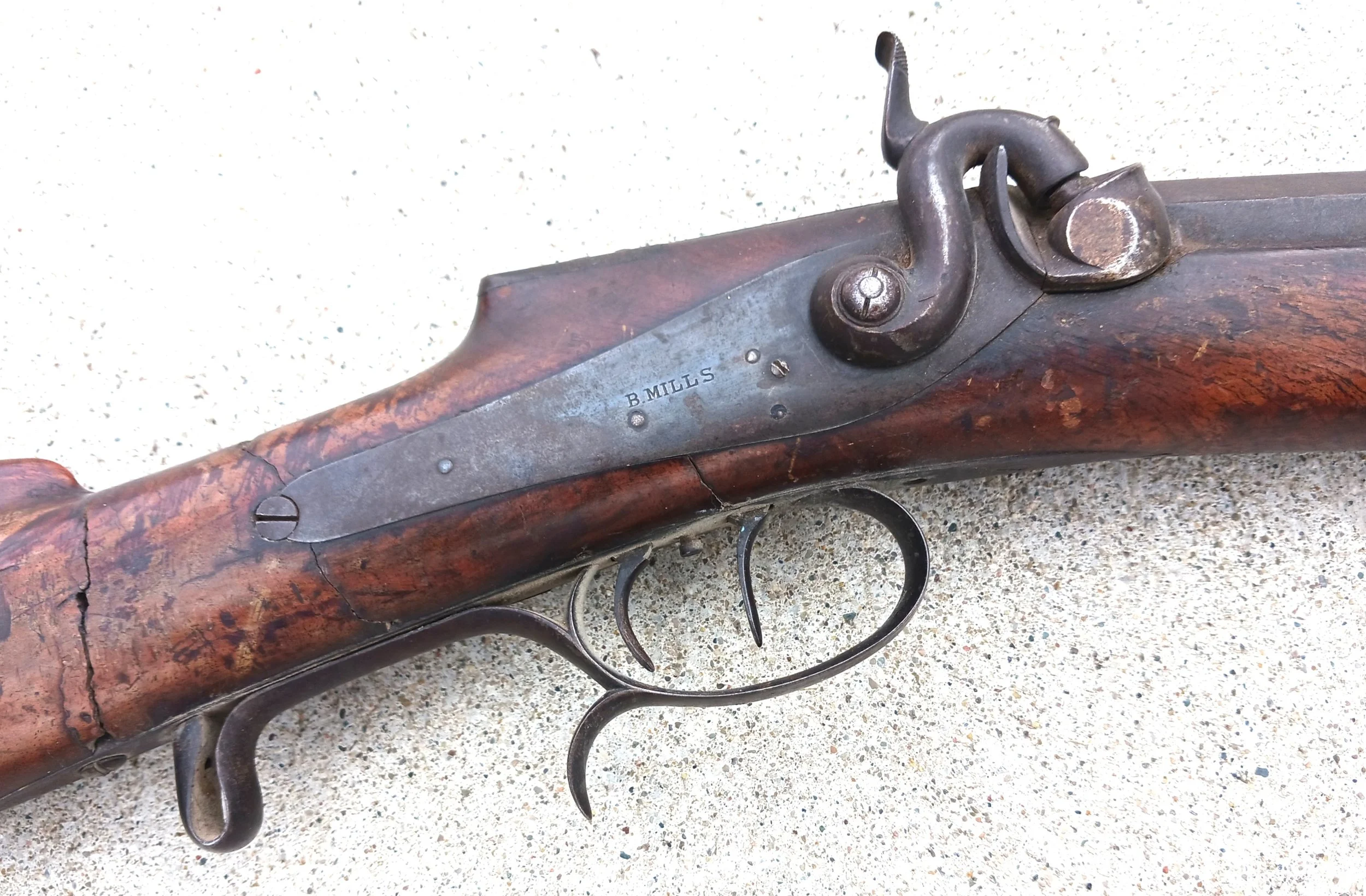
Figure No.7: This photo shows the auction gun’s lock and wrist area with a stock break running almost perpendicular across the wrist at the tail of the back-action lock. The break occurred at the lock’s tail screw, which may have been a '“stress riser” leading to the break in that area. The highly figured wood in the wrist area with an almost burl-like grain snapped when the gun took a hard hit. The active wood grain can be seen continuing past the percussion snail and into the forestock. Mills’ slotted nut holding the hammer on the tumbler shaft was another detail he learned in New York and continued to use in Kentucky.
The author had never seen a Mills rifle with a broken wrist before the auction rifle appeared, a testament to Mills’ careful wood selection and superior stocking skills. It’s a bit baffling why Mills used a piece of wood with a weakened grain structure in the wrist area, knowing his penchant for high quality guns. The only answer seems to be that the beauty of the figured grain in the wrist outweighed his usual caution for plainer wood in that area. Or perhaps, as the author prefers to think, a less knowledgeable customer requested the fancy stock blank with figured wood running well into the wrist area… despite Mills’ suggestions of caution.
Final Chapter: Perhaps the reader is left wondering what will happen to the damaged Mills rifle. Will it be left “as is,” or will some level of restoration be done? The author dislikes heavily restored guns, but fine target rifles lose too much of their functional identity when left in poor condition. The author intends to do a careful cleaning of the entire rifle, wood and metal, to see how much surface rust can be safely removed and how much of the original wood grain in the butt can be recaptured. The broken wrist will be examined to see if it can be separated without additional loss of wood, then rejoined in a stronger and less visible manner. Depending on how the stock looks after cleaning, and how much of the butt’s fancy feather grain shows, the stock may, or may not, get a light oil finish over the old finish to even it out… but only time will tell.