
The Exceptional Rifles of Kentucky/Missouri Gunsmith John G. Philips ©
Foreword: Some American gunsmiths worked in obscurity in the 1800s with little information and no known guns to document their work. John G. Philips was that kind of gunsmith, and he suffered from having his last name misspelled at times, hiding who he really was. But several new rifles signed “J. G. P.” and “J. G. Philips” with a unique “P” in the last name [see Figures No.1 and No.2 below] have verified his surname and prompted new research that proves he was an exceptional gunmaker in Kentucky and later Missouri.
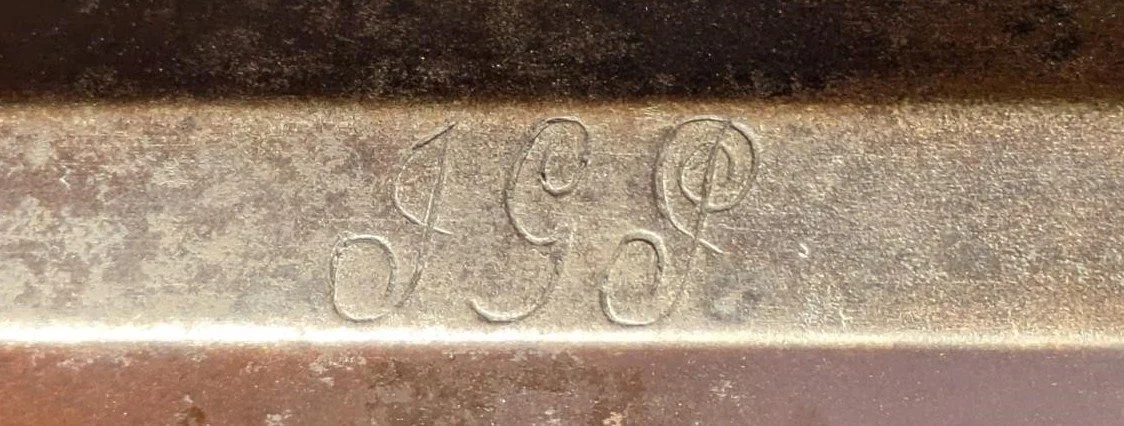
Figure No.1: This initialed signature is on John G. Philips’ earliest rifle made while he was in Kentucky about 1815. Note the unique “P” that quickly identifies a gun by Philips… despite not immediately being recognized as a “P” by most people.
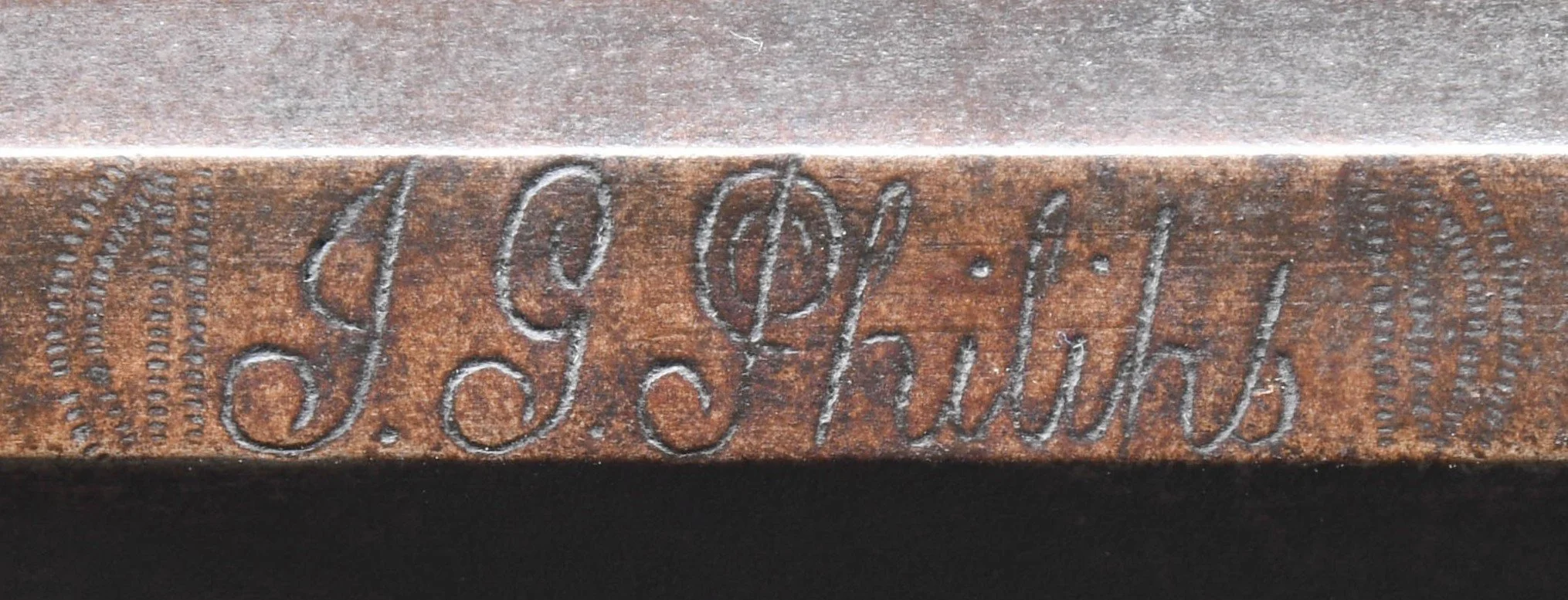
Figure No.2: This signature is on Philips’ second, more heavily decorated rifle. It documents the single “L” in his last name, as do all his barrel signatures with last names. While his engraving was not elaborate, it was neat and well done on all his known guns.
Surname Verification: The difficulty in properly identifying the gunsmith was twofold: 1) his last name was misspelled at times as “Phillips” instead of “Philips” in records, and 2) he had a relative of about the same age [younger but in same census brackets] with the same first name and middle initial but last name “Phillips” who lived in the same county in Kentucky as the gunsmith. New research and the recent appearance of several signed rifles have verified the gunsmith was John G. Philips of Casey County, Kentucky, and later Boone County, Missouri. Philips’ grandparents were James (ca.1710-1772) and Mary Phillips (b. ca. 1712) from Augusta County, Virginia. Their fifth child was John Phillips Sr. born in 1745 [1], who later married Jane Jackson in Virginia. That couple’s third child was the gunsmith John G. Phillips Jr. (1789-1861). The family surname was “Phillips” at the time, but a period record shows the surnames of John Phillips Sr.’s children as “Philips,” indicating the coming change for some family members. The family moved to Casey County, Kentucky, by/before 1810, where the 1810 census listed the gunsmith’s father, John Phillips, with his wife, three sons, and four daughters.
Kentucky Years: Gunsmith John G. Philips’ youngest son, John F. Philips of Pettis County, Missouri, provided information about his father in 1882 for a local county history book. “His father [gunsmith John G. Philips] was a native of Virginia who went to Kentucky and served in the War of 1812 where he was at both the Battle of Tippecanoe and Battle of Thames. After the war he settled in Kentucky [Casey County], where he worked as a mechanic and farmer.” [2] John G. Philips Jr. is documented in Kentucky records as serving in the War of 1812. Several listings for “John Phillips” (no middle initial) appear in Kentucky Soldiers of the War of 1812, but there is only one listing for a “John Philips Jr.,” who served as a private in Ellerston’s Company, 3rd Regiment of Kentucky Mounted Militia, from September 1st until October 15th in 1812. [3] Another “John Phillips” was in the same company of soldiers and was probably the relative/cousin who later remained in Casey County and has been misidentified at times as gunsmith John Philips Jr., causing errors in his biography. John Philips Jr. worked as a gunsmith in Kentucky from about 1810 until 1817. His earliest known rifle from this period is undecorated but nicely stocked in curly maple with fine iron mountings, indicating he was an excellent gunsmith, blacksmith, and woodworker. The rifle is shown in Figures No.3a, No.3b, No.3c, and No.3d.
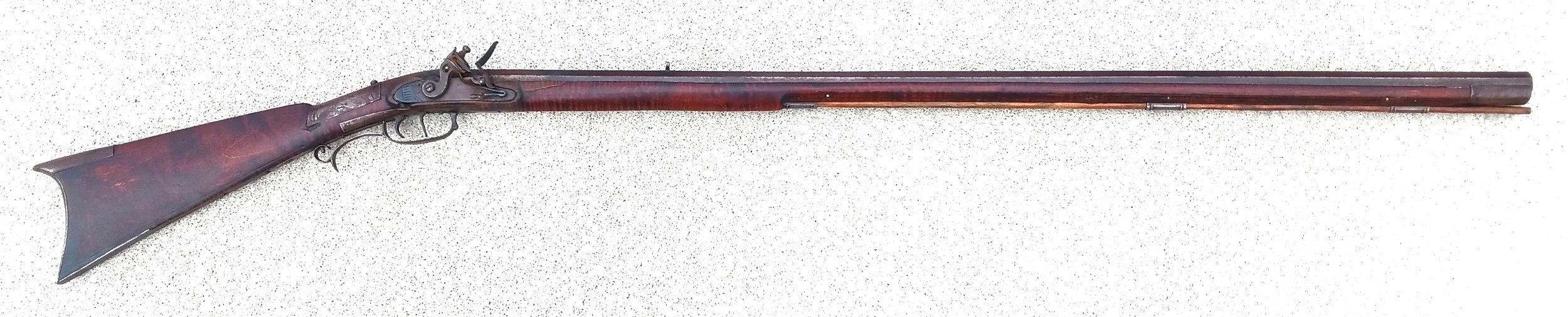
Figure No.3a: This full-stocked rifle by John G. Philips’ is his early work, signed with his initials in Figure No.1 above. The stock’s only enhancement is forestock and lower butt molding lines, leaving fine stock architecture to make an otherwise plain rifle attractive. Mountings are iron with a fancy guard with heavy front post and combination spur/scroll for a rear spur, and the rear pipe is flangeless. A broken wrist has been repaired with well-shaped iron reinforcements set into the wood to retain a smooth wrist surface. The triangular butt and tight side facings around the lock are typical of Kentucky guns. The barrel has been shortened about 4-3/4 inches, but it is still 40-7/8 inches long with a .44 caliber bore and 7-groove rifling. Author’s collection.
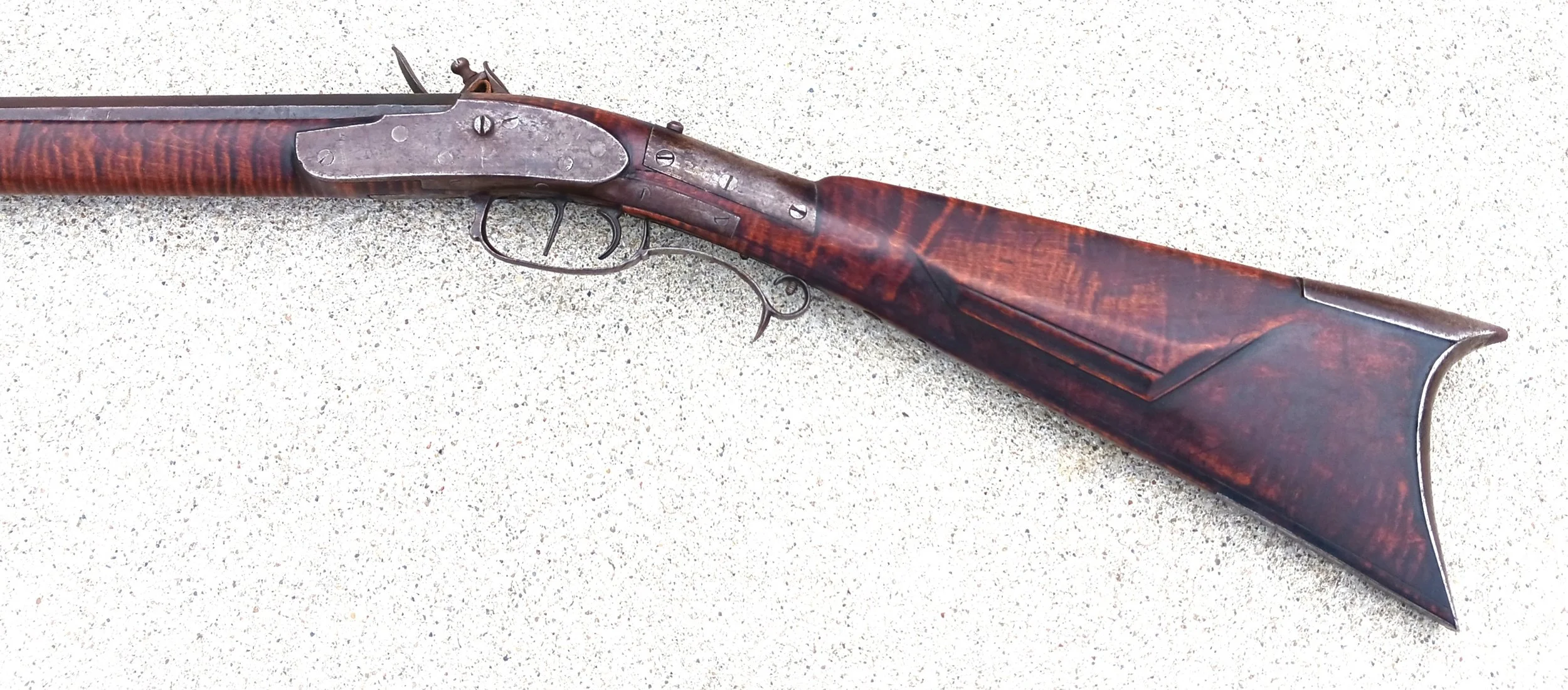
Figure No.3b: The back side of the early Philips rifle highlights its fine iron butt plate and guard. Note the clean, triangular butt lines and conventional cheekpiece that indicate an early gun by Philips. A well-done repair to a broken wrist is comprised of iron supports inlet into the stock wood so that the wrist’s surface remained smooth with no raised edges. A full iron side plate also reinforces the break area. The iron repair work is so good, it almost matches the fine iron work of the mountings, suggesting gunsmith Philips may have also done the repair work. Author’s collection, photos by author.
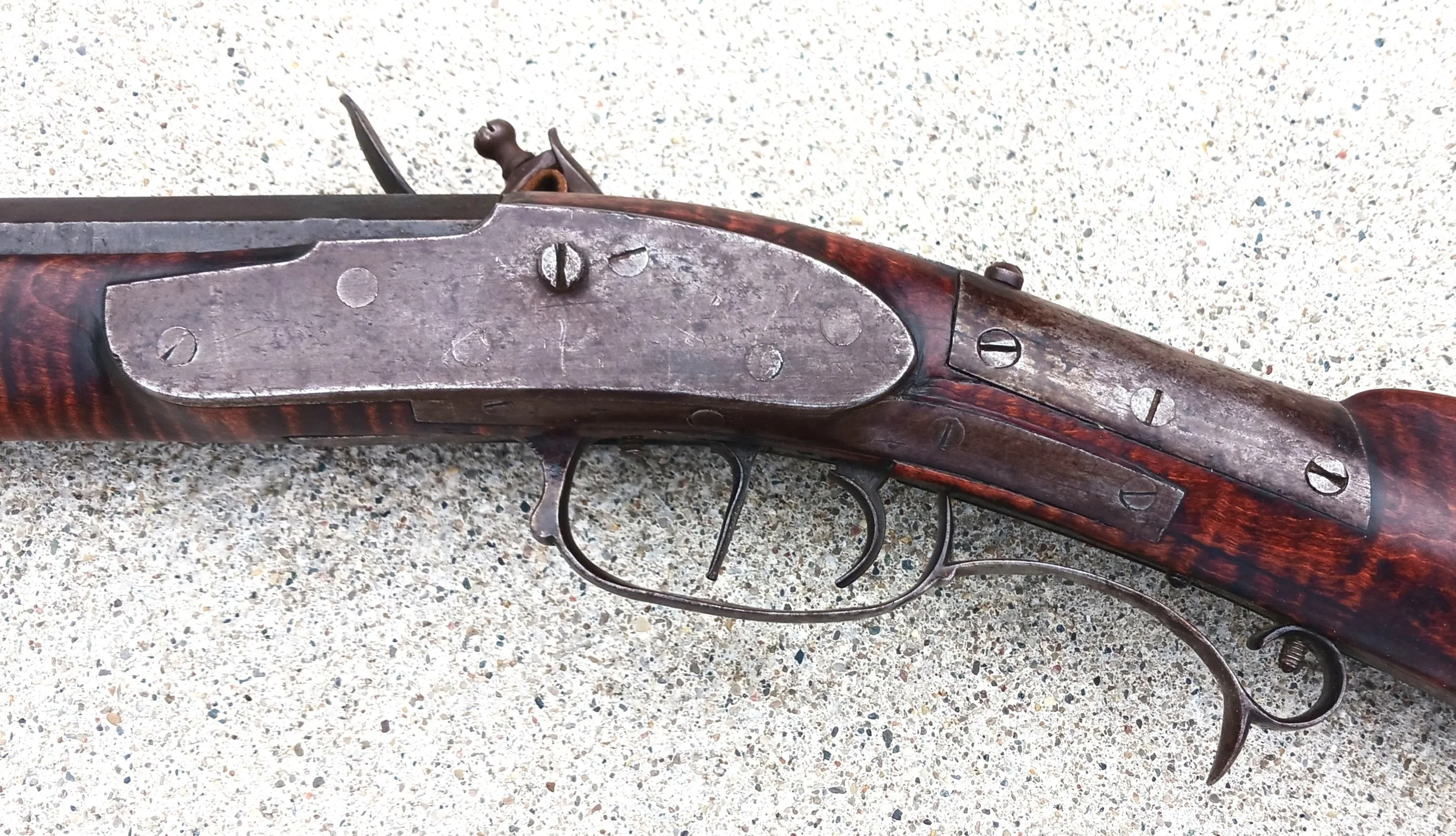
Figure No.3c: A closer view of the wrist shows its fine iron repairs done to stabilize a wrist break. The iron supports, including the top one that wraps around the wrist, are inlaid evenly with the wood surface for a smooth grip. Note the well-shaped iron guard and triggers.
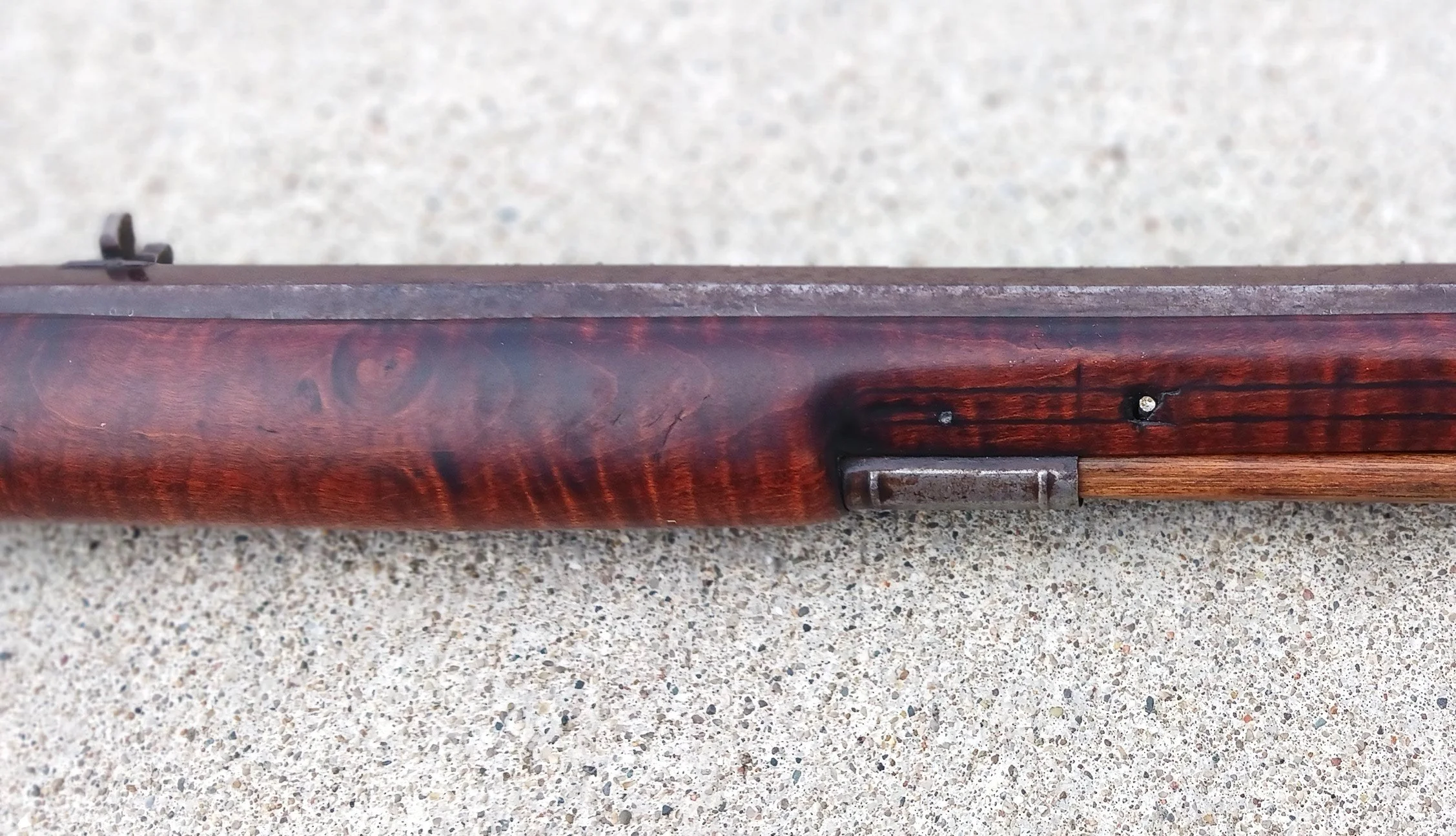
Figure No.3d: Philips’ early rifle has fine iron mountings. A flangeless rear pipe butts squarely against the forestock, and a double line forestock molding runs outward from the rear pipe. The rear sight has been moved back, indicating the barrel was shortened.
In 1816 Philips married Mary Copeland (1796-1876) of Mercer County, Kentucky, just north of Casey County [4]. The couple made their home in Casey County until 1817 and then joined other Phillips/Philips relatives moving to Missouri. Philips and several other men who had served in the War of 1812 used their military land warrants to claim new homesteads in Missouri. Records show Philips settled in eastern Howard County in Missouri, but their area soon became part of Boone County when Howard County’s population surged, causing the new Boone County to be broken off from it in 1820. After Philips’ departure for Missouri in 1817, a “John Phillips” of about the same age remained in Casey County, Kentucky, where he was listed in the 1830 and 1840 censuses [5]. Those listings have created confusion about John Philips Jr., but new research verifies he was in Missouri and the man in Casey County was a relative.
Missouri Years: No 1820 census records for Missouri were found, but Philips appeared in the 1830 and 1840 Missouri censuses in Perche Twp. of Boone County. [6] Other records put his home and shop in Roche or Rocheport on Perche Roche Creek. In the 1850 census when occupations were first recorded, he was in Boone County as “John G. Phillips (sic),” 61 years old, occupation “Gunsmith,” born Virginia, with wife Mary, 53, born Kentucky. Their third child, son Preston, was living with them, 21 years old, born in Missouri, and also a “Gunsmith.” The 1850 census is important for identifying John G. Philips as a gunsmith despite the incorrect surname; the wife’s name, age, and age gap [8 years] between husband and wife are correct along with their birth states and children. A fine rifle by Philips made in Missouri around 1830 is perhaps his best work extant and is shown in Figures No.4a, 4b, 4c, and 4d.
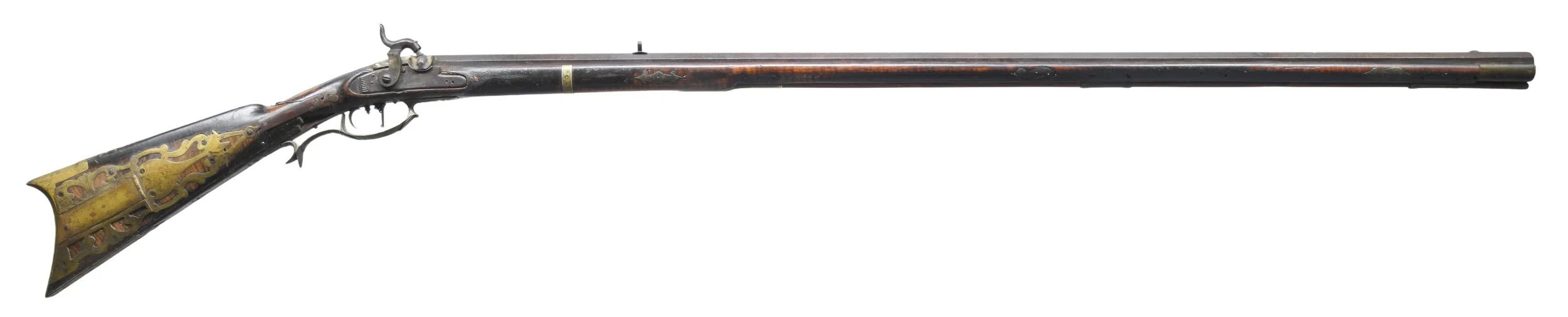
Figure No.4a: This highly decorated rifle by Philips has a large patchbox that resembles a modified National Road patchbox despite the gun being made in Missouri about 1830. Note the increased drop in the butt compared to Philips’ earlier rifle, and a similar broken wrist repaired this time with crude iron strips. The guard and triggers are more elaborate than expected for a Missouri gun, and while hard to see, there are forestock and butt moldings and fancy German silver inlays at the barrel wedge locations that are neatly engraved. The gun exhibits superior workmanship for its late flint era date and rural location. Photos courtesy Poulin Antiques & Auctions, Fairfield, Maine. Barrel: 44 inches long, .38 caliber.
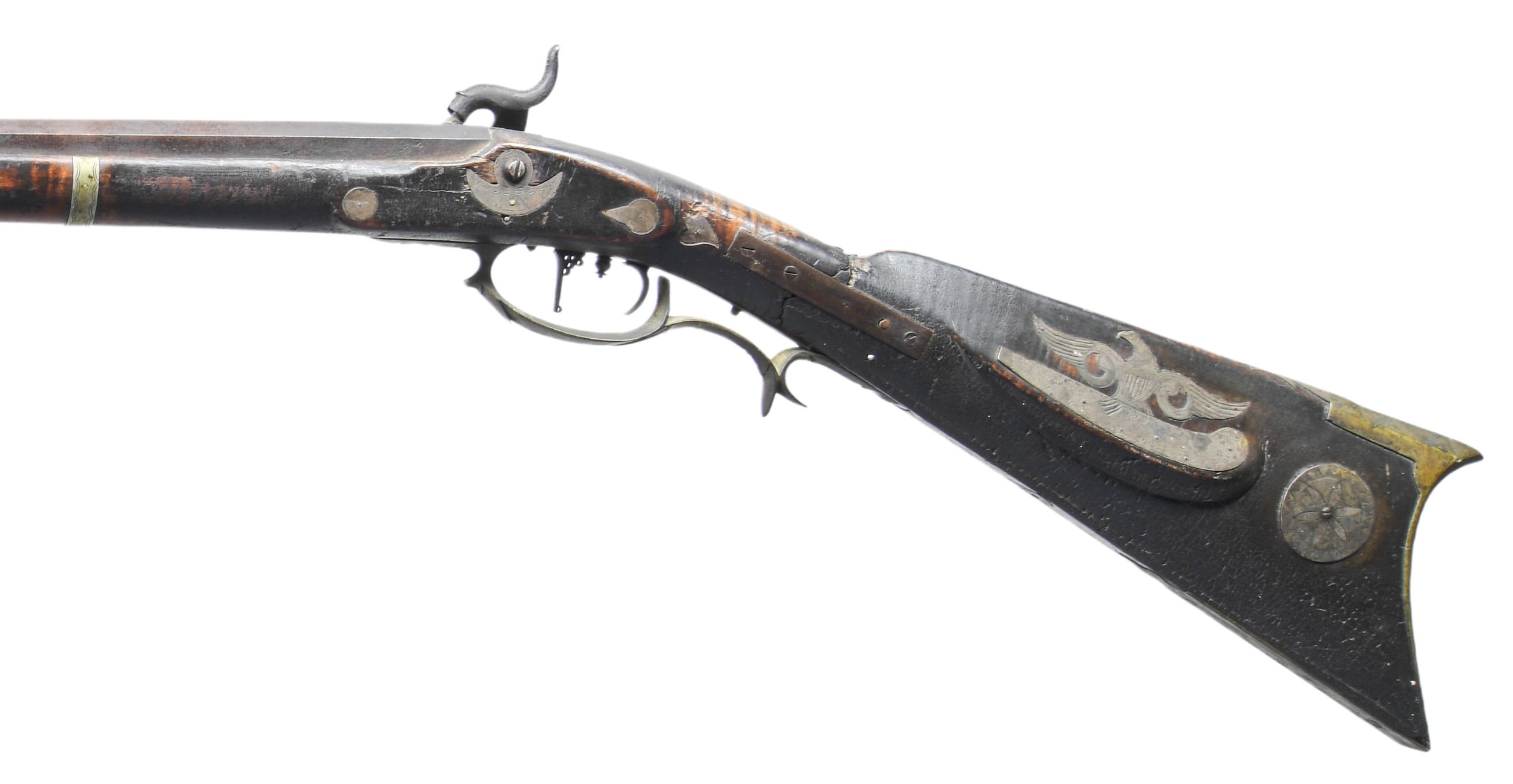
Figure No.4b: The back of the fancy Philips full-stocked rifle is decorated with multiple German silver inlays, suggesting a fine rifle made for a wealthy patron. The inlays have tarnished to an odd gray color, possibly due to excessive exposure to heat as a crackled stock finish suggests. The gun can be dated by its single lock bolt with small washer. Single bolt flint guns first appeared in Kentucky about 1822, and a year or two later in Missouri. While the lock is a converted flintlock, it was either a late single bolt flint gun or an early percussion gun using an older rebuilt lock… but the gun dates well past Philips’ 1817 departure date from Kentucky. Courtesy Poulin Auctions.
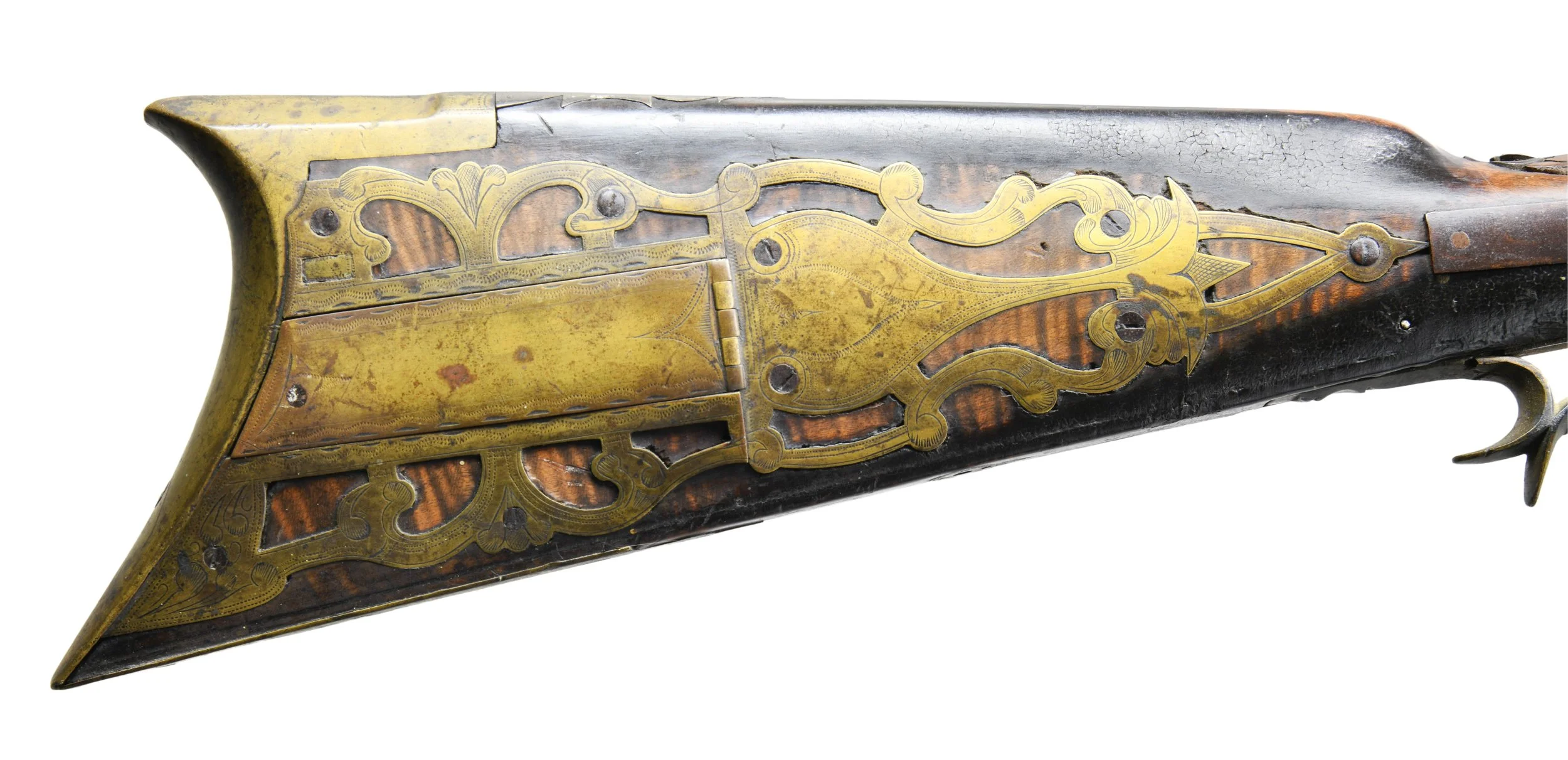
Figure No.4c: The brass patchbox on Philips’ fancy rifle is related to National Road style boxes often seen on early Ohio rifles, suggesting Philips was influenced by guns carried into Boone County, Missouri, by Ohio settlers. Courtesy Poulin Auctions.
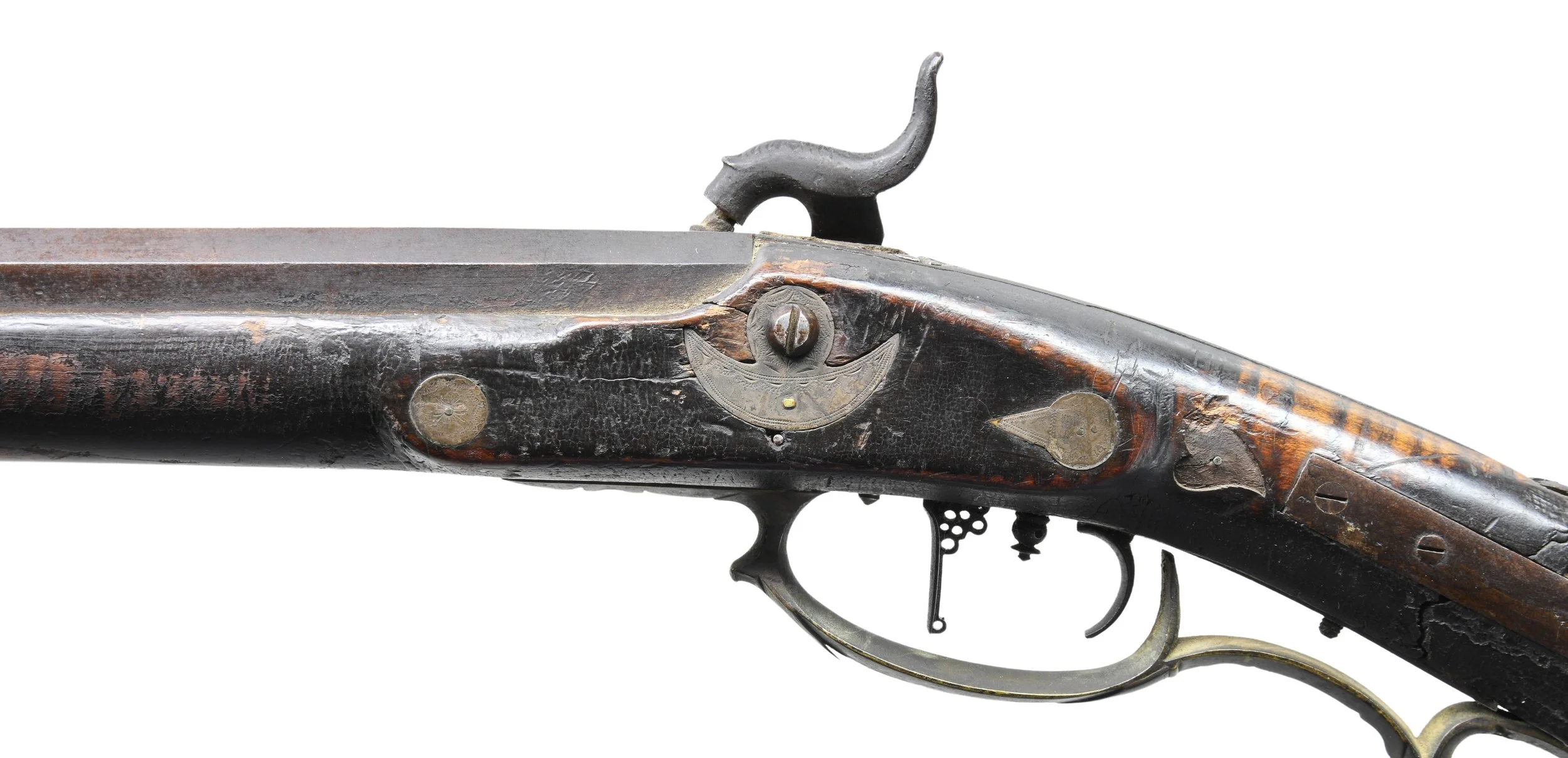
Figure No.4d: This image shows the elaborate triggers and adjustment screw on Philips’ fine rifle. While smaller inlays are plain, the larger ones are engraved, and the anchor-shaped lock bolt washer has an attractive border of small scallops in a “swag” pattern.
One apprentice from Philips’ Missouri years is known, and he was David Pipes who later became a recognized Missouri gunmaker. Pipes was born in Kentucky in 1811 and his family moved to Missouri in 1817, perhaps accompanying the Phillips/Philips group, and settled in Howard County. Pipes was 18 years old in 1829 when he apprenticed to Philips, whose gun shop was near the Pipes family home. Pipes trained for three years and then opened his own gun shop in Howard County in 1831. [7] A third rifle by Philips from the 1840s is shown in Figures No.5a through 5f. The gun had a rough life with damage and several missing inlays, but its decorative elements indicate it was a fine full-stocked rifle when new that was later cut to a half-stock. The gun used the same butt plate as the prior rifle, with a small bump or “scallop” in the upper corner where the vertical section meets the top extension. This gun was not available to the author for photography; the pieced-together partial views were provided by the owner who lacked experience in photographing longrifles.
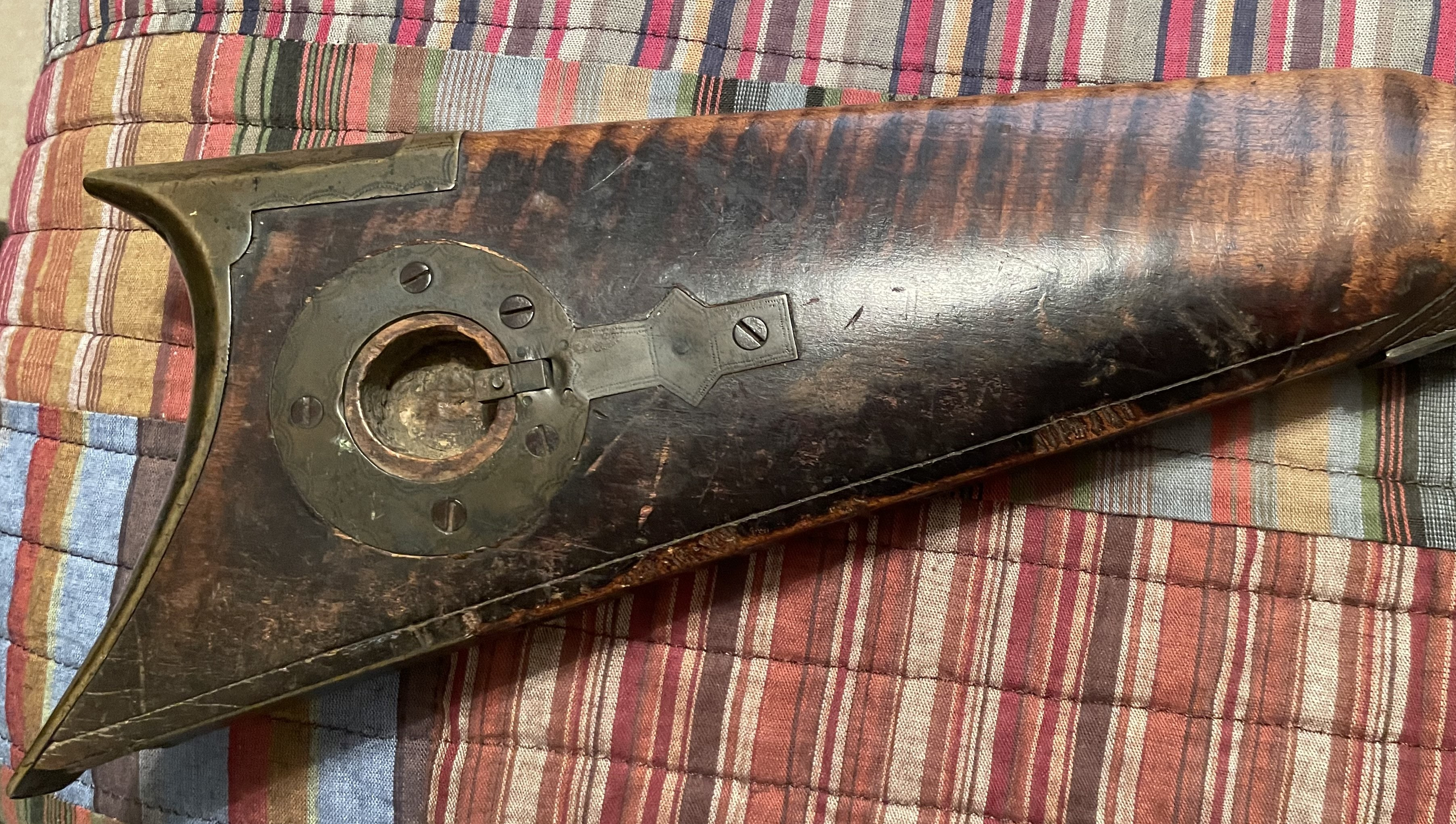
Figure No.5a: This mid-1840s Philips rifle has the same butt plate and lower butt molding line as his prior rifle, but the earlier elaborate patchbox has been replaced by a hand-made, sheet brass cap box [or grease box] of simpler but inventive design.
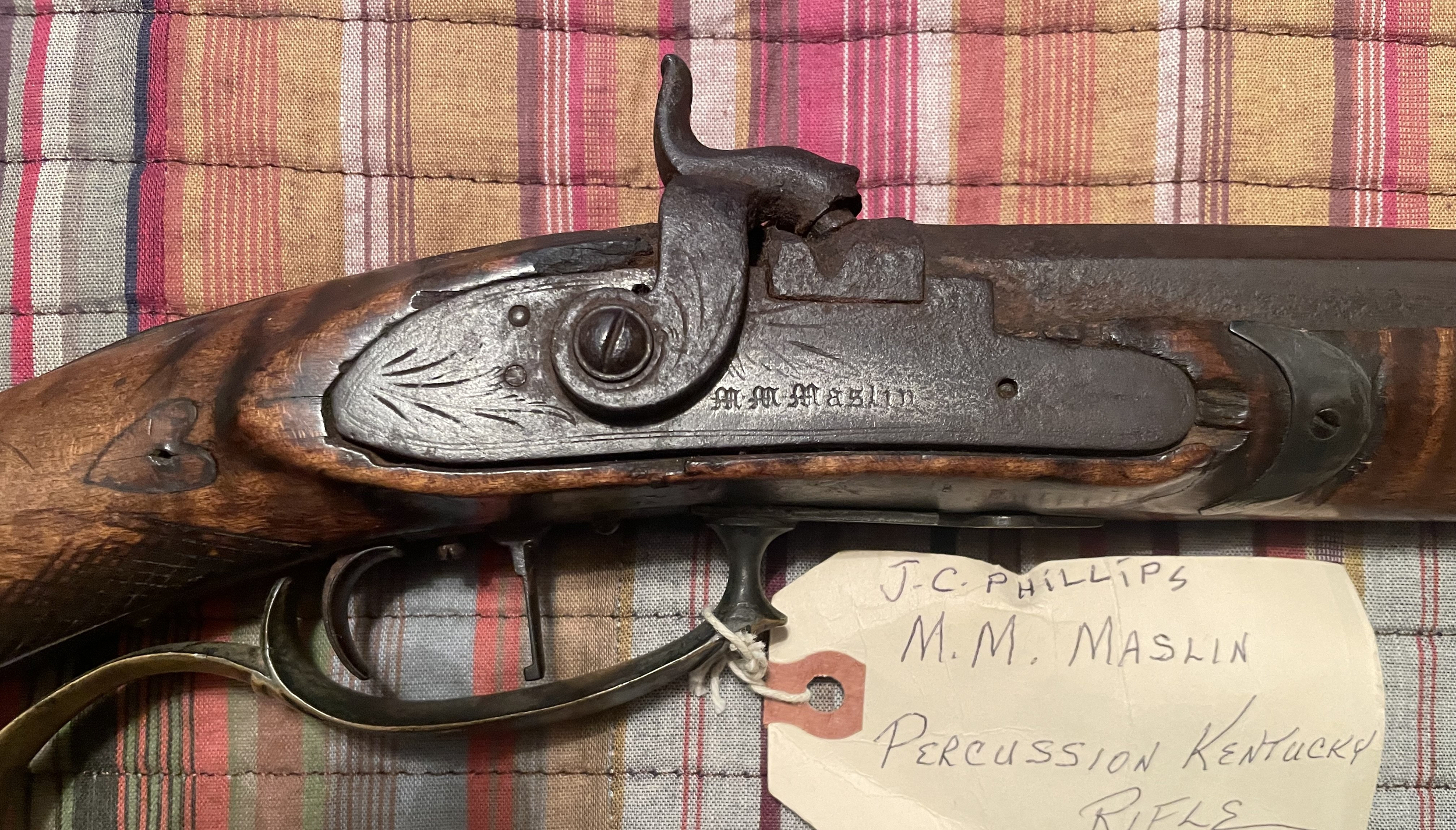
Figure No.5b: The side facings around the lock on the 1840s Philips rifle are rather snug, similar to Kentucky guns of the same era. The gun has a patent breech, original percussion lock, and hand-made triggers, while the guard is reminiscent of Lexington, Kentucky, guards.
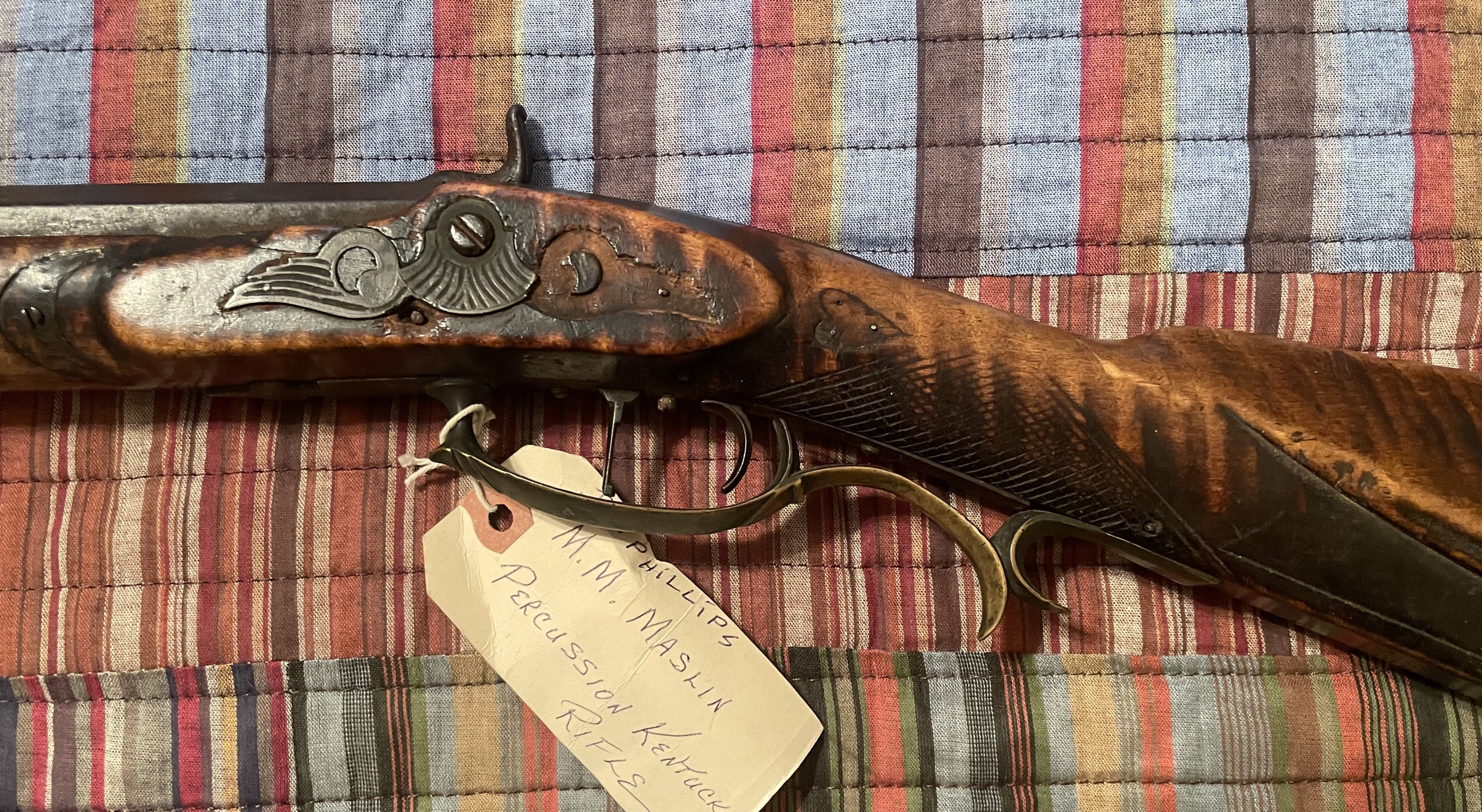
Figure No.5c: The rear side facing has an exceptional winged side plate, an almost exact duplicate of earlier side plates used by Kentucky gunsmith Moses Dickson of Louisville. Note the nicely checkered wrist. The rifle’s barrel is signed “J. G. Philips” in script.
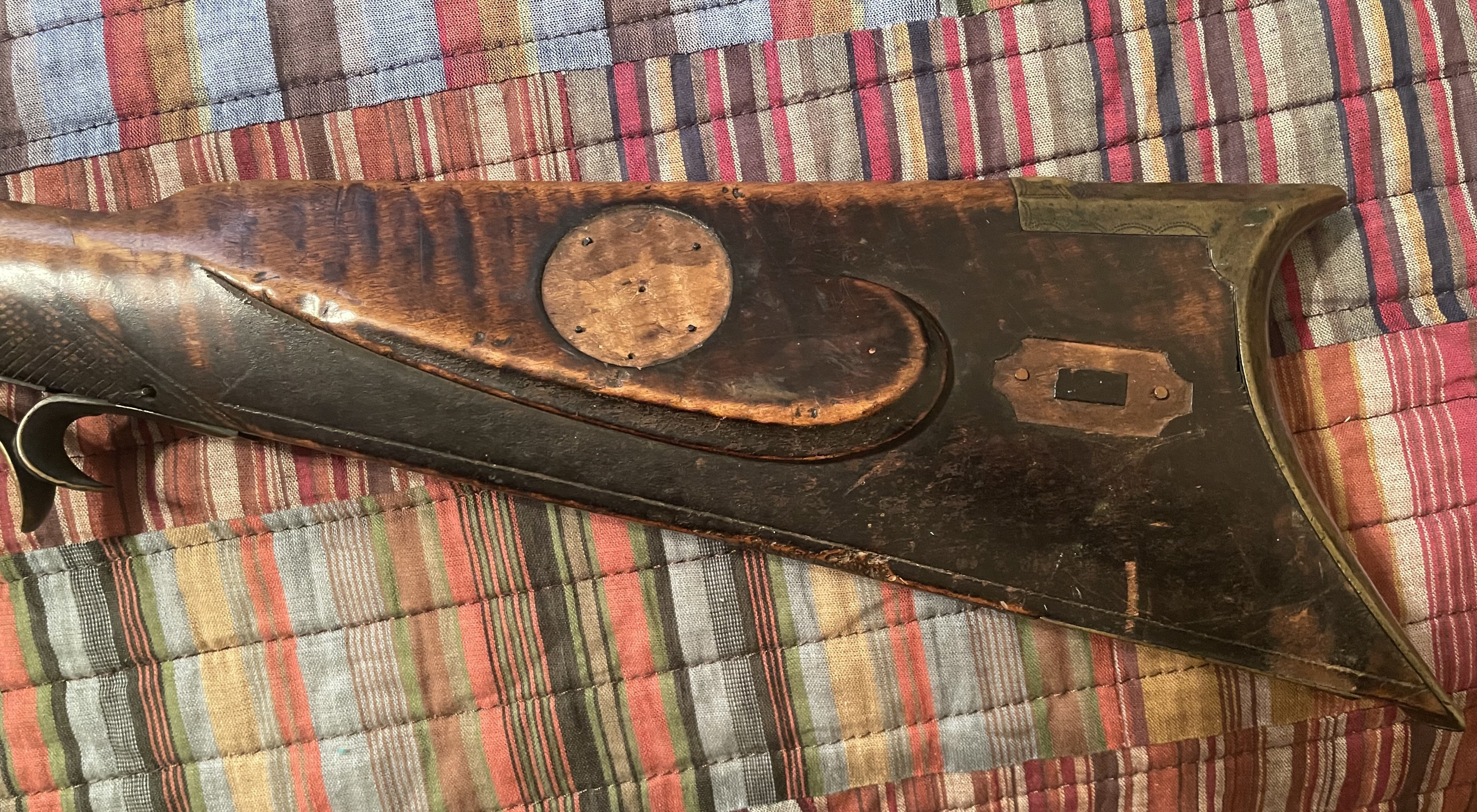
Figure No.5d: The 1840s “beaver tail” style cheekpiece has nicely molded edges and sits high above the butt’s surface. It once had a large, round inlay in its center, perhaps engraved like its counterpart on the prior rifle seen in Figure No.4b due to similar nail patterns.
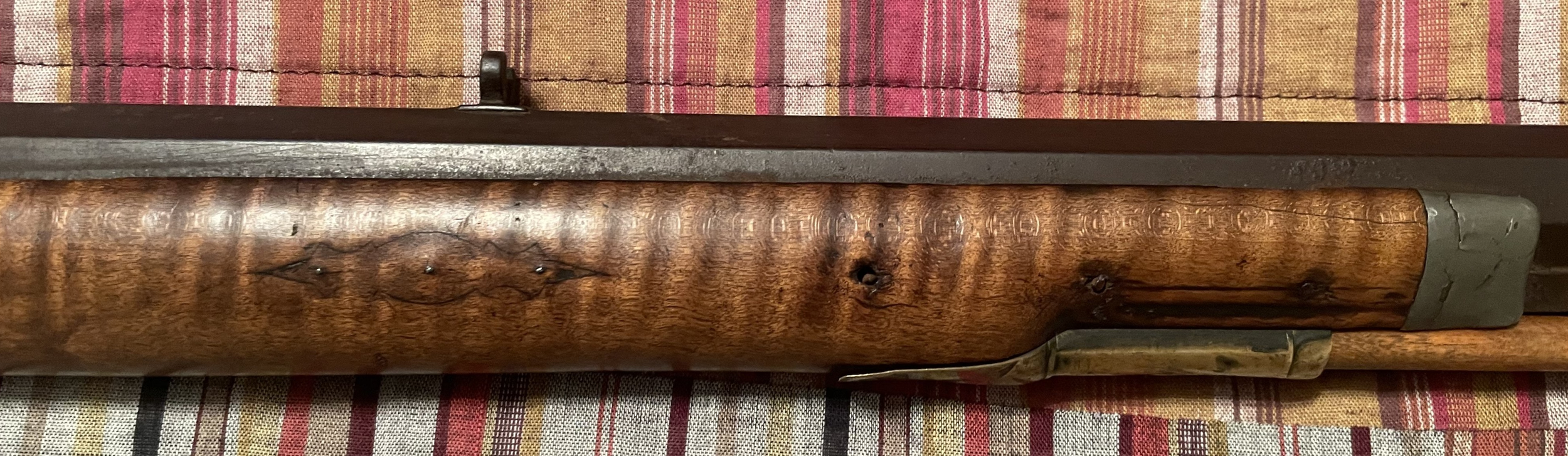
Figure No.5e: The damaged rifle’s forestock has been cut back to a half-stock during its working life, as verified by the remnant of a forestock molding line cut off by a later cast nose cap. An attractive forestock inlay is now missing, and Philips’ rear pipe now has a flange.
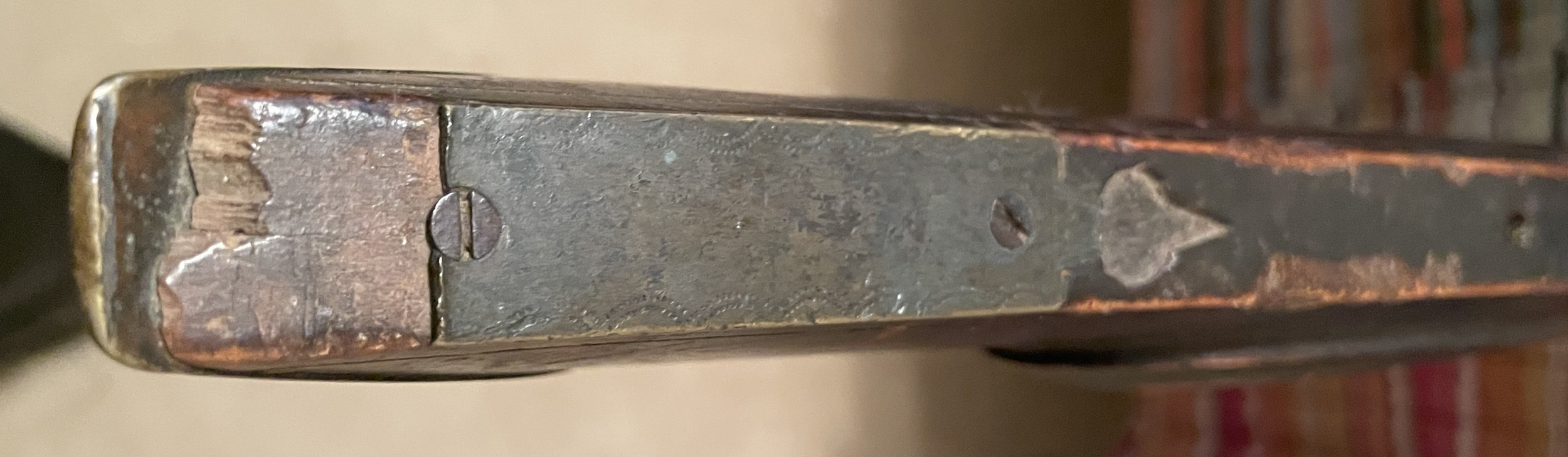
Figure No.5f: While damaged, the rifle’s toe plate still shows traces of its original quality with a missing pointed finial and barely visible swagged borders running lengthwise along its edges. What appears to be a vent pic hole suggests it may have been a very late flint gun.
The 1860 census listed John G. Philips [correct spelling] in Boone County as a “Farmer,” age 71, born VA, with his wife Polly (nickname for Mary) age 63 and born KY. Two grandchildren remained in the household, John and Mary Mussett, 16 and 14 and born in Missouri, who were the children of Philips’ oldest daughter Sara Jane who married a Mussett. These names, dates, and birth locations verify this is the same family as in the 1850 census. [8] Philips reportedly died on January 26, 1861, and was buried in Crown Hill Cemetery at Sedalia in nearby Pettis County where his youngest son Col. John F. Philips was living. John’s wife Mary died in 1876 and was buried beside him. A later half-stocked rifle by Philips from the 1850s is shown in Figures No.6a, No.6b, and No.6c. Despite the gun’s later vintage, Philips’ superior craftsmanship remains evident in the gun’s clean lines, well-shaped mountings, fancy barrel bands, and fine silver work.

Figure No.6a: This fine, silver inlaid half-stocked rifle was made by John G. Philips in Boone County, Missouri, in the 1850s. It is the latest Philps rifle known to the author, and as expected, it maintains Philips’ high levels of quality in both stocking and furniture with particularly fine silver inlay work. The patent breech, silver borders on the side facings [a southern influence?] and silver barrel bands all indicate a high-priced rifle for a demanding customer. Barrel specifications were not available. Photos courtesy of Rock Island Auction Co., Rock Island, IL.
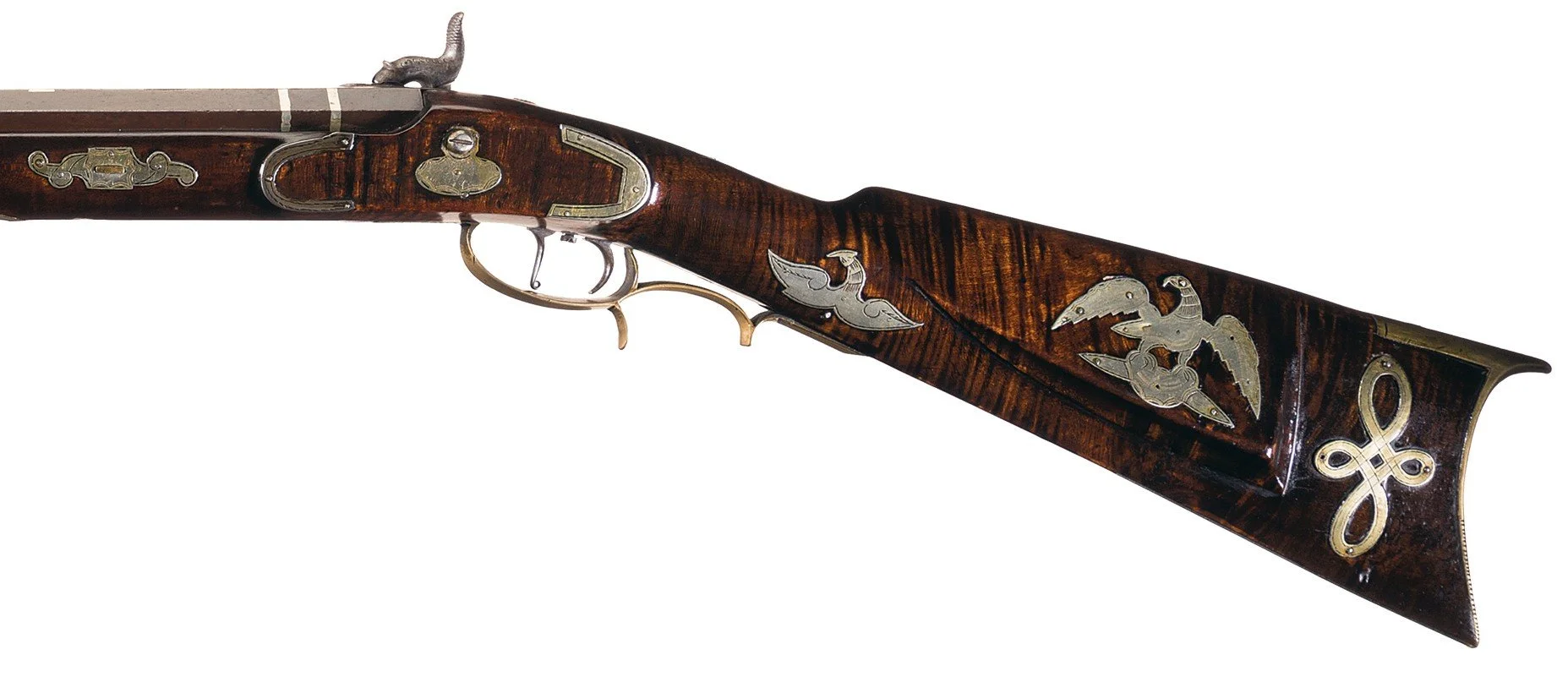
Figure No.6b: The back side of the 1850s half-stocked rifle by Philips shows matching wrist inlays in the form of a raised wing eagle that complement the larger cheekpiece eagle. The cheekpiece itself is a bit surprising; it is not the later rounded or “beaver tail” style cheekpiece used on Philips’ earlier rifles, but rather a somewhat more conventional style of cheekpiece with a flat bottom. Photo courtesy of Rock Island Auction Co.
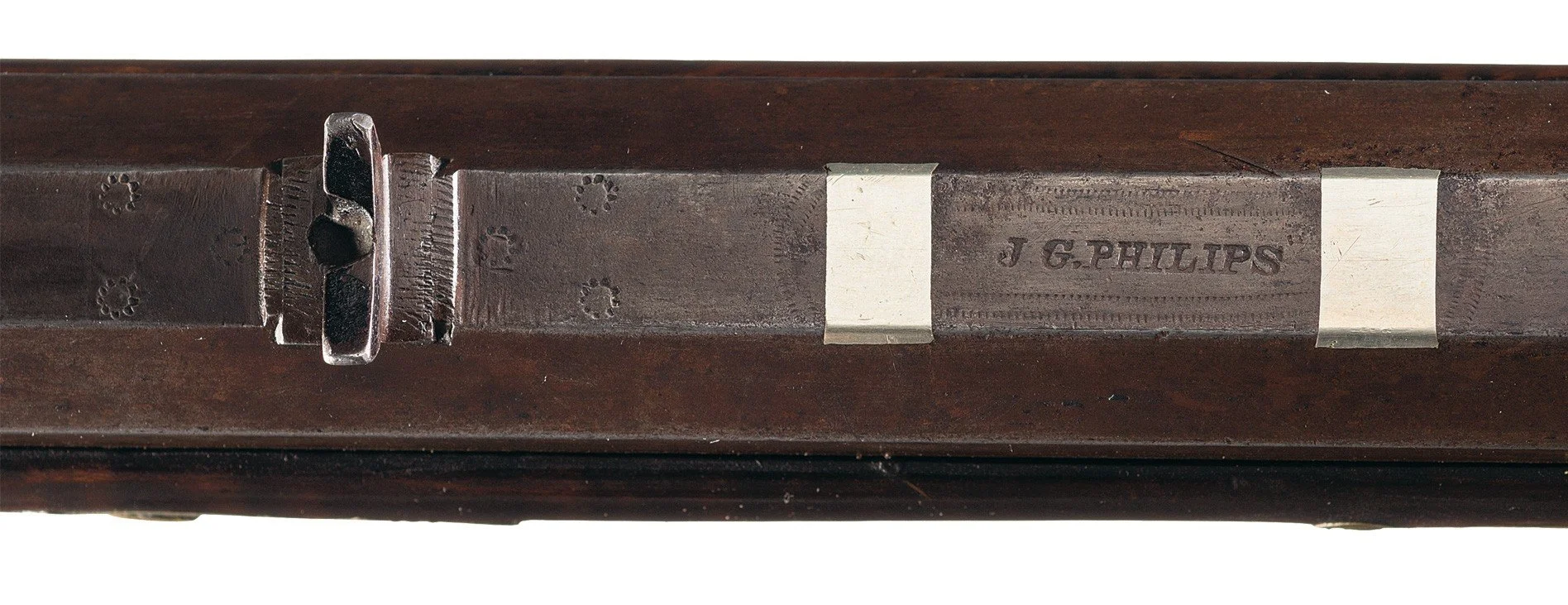
Figure No.6c: By the 1850s, Philips was stamping name on his rifle barrels with his first two initials and full last name. Note how the silver wedges set in the barrel on either side of the signature highlight both its location and the signature itself. Photo courtesy of Rock Island Auction Co.
Summary: At times a gunsmith remains just a shadowy figure in his state’s history due to limited and mistaken information about him, and more importantly, no signed rifles to document his work. John G. Philips Jr. was one of those marginalized gunsmiths for many years, but recently the appearance of several superior rifles with his name on their barrels have dramatically changed his status. The new guns prompted new research, and a more accurate story of Philips’ life emerged. He can now be appreciated as a superior early Kentucky and Missouri gunsmith who left several fine rifles to document his abilities.
Sources:
[1]
[2] The History of Betis County, Missouri, 1882, see “Philips, John F., Col.,” p.72.
[3] Kentucky Soldiers of the War of 1812, Minnie Wilder, compiler, Genealogical Publishing Company, Baltimore, 1969, p.20.
[4] Kentucky, County Marriages, 1786-1965.
[5] Federal Census of 1830, 1840, 1850, Kentucky Division.
[6] Federal Census of 1820, 1830, 1840, Missouri Division.
[7] The Descendents of John Pipes Jr., Elizabeth Ellsberry, June 1964
[8] Federal Census of 1860, 1870, Missouri Division.