
Another Good Shooting, Plain Looking Settle Rifle ©
Foreword: The best-known gunmaking family in Kentucky is the Settle family of the Barrens region in southcentral Kentucky. Three generations of Settle gunsmiths supplied the area with well built, accurate rifles and built a lasting reputation while doing so. But while their guns had a reputation for accuracy, they never won a beauty contest. Recently a new Settle rifle sold at auction, and while not an earthshaking discovery, it was the epitome of many Settle rifles… a well-made, half-stocked rifle lacking enhancements, making it a very ordinary looking rifle…but was it really? The rifle is shown in Figures No.1 and No.2 below.
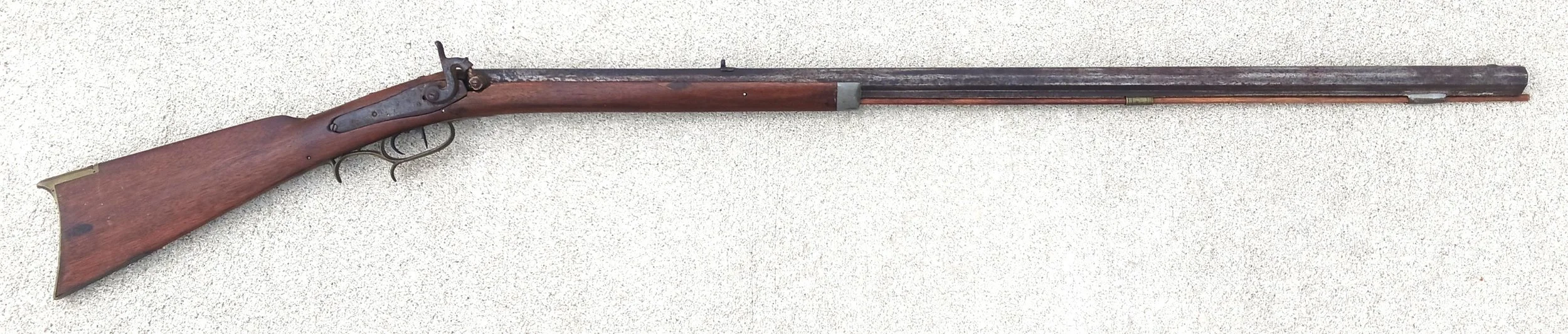
Figure No.1: This Settle rifle is stamped “W. F. Settle” [Willis Franklin Settle] on the barrel and is representative of most Settle rifles from the mid-1800s. It is undecorated with good barrel length and clean lines, but there is nothing outstanding about it… except its accuracy. Settle rifles were no-frills guns made for the common man who wanted a solid, accurate hunting rifle at a reasonable price and did not feel the need for a flashy gun to impress his neighbors. He was a true Kentuckian who demanded function over frills out in rural west central Kentucky. Barrel: 40-1/8 inches, .32 caliber bore, 7-groove rifling. Author’s collection, photos by author.
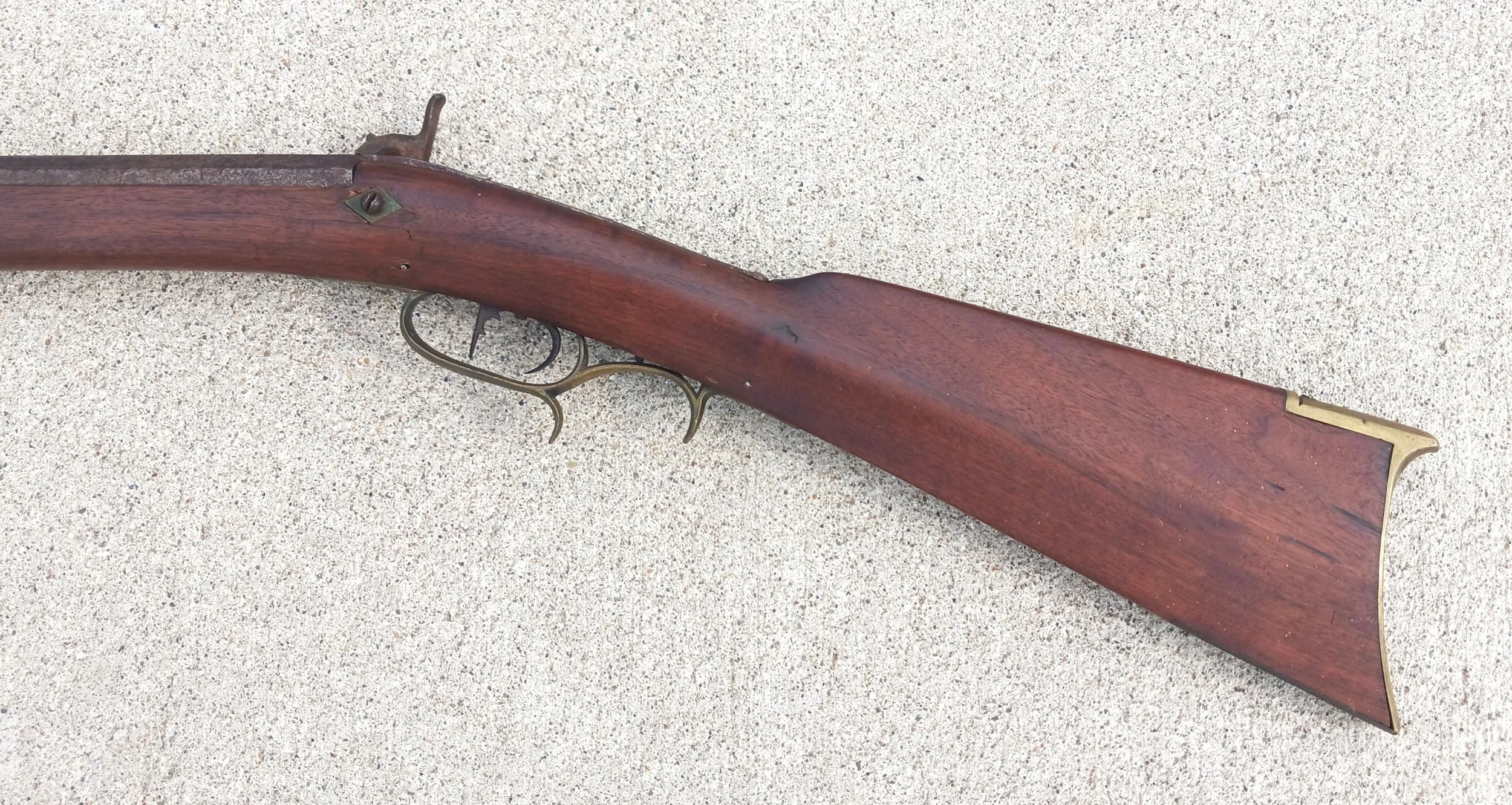
Figure No.2: The back side of the Willis Settle rifle is about as plain as a Kentucky gun could get. It lacks a cheekpiece, thumbpiece, is stocked in walnut rather than curly maple, and has only a small, diamond shaped lock bolt washer that would not turn in the wood when the lock bolt was removed or replaced. Yet the rifle has an appeal in its simplicity, clean lines, and triangular Kentucky butt. An above average feature on the rifle is its walnut stock, with its grain bending with the wrist curvature, strengthening the gun’s weakest area.
Settle Family: Three generations of Settles made rifles in southcentral Kentucky. The patriarch, William Settle, arrived from Virginia in 1798 and worked as a blacksmith and gunsmith in Barren County until his passing in 1808. Very few [if any] signed guns by William are known, but his son Felix followed the trades in Barren County and was more prolific with a number of surviving rifles. Felix had four sons with three becoming gunsmiths: Simon, Willis, and Joseph. Two of the sons, Simon and Willis, made most of the Settle rifles known today. In fairness to the Settles, the author has seen one full-stocked Felix Settle rifle with incised butt carving of decent quality behind the cheekpiece… but that is only gun out of perhaps fifty Settle rifles he has seen with any significant decoration.
Willis Settle: He was born in 1826 and trained by his father Felix at Roseville in Barren County. When Willis turned twenty-one in 1847, he moved to nearby Glasgow to work and then about 1850 relocated to Hiseville in Barren County, where he worked until 1859. During those years, Willis often marked his barrels with “Glasgow” or “Hiseville” after his name, and many rifles were numbered. By 1860 Willis’ first wife had died and he remarried and moved to Russellville in Logan County. He was a southern sympathizer during the Civil War and paid a heavy price when the Union Army destroyed his gun shop and chased him out of town. After the war, he worked more as a blacksmith than gunsmith in Russellville until 1880 when he moved to Russellville in Pope County, Arkansas.
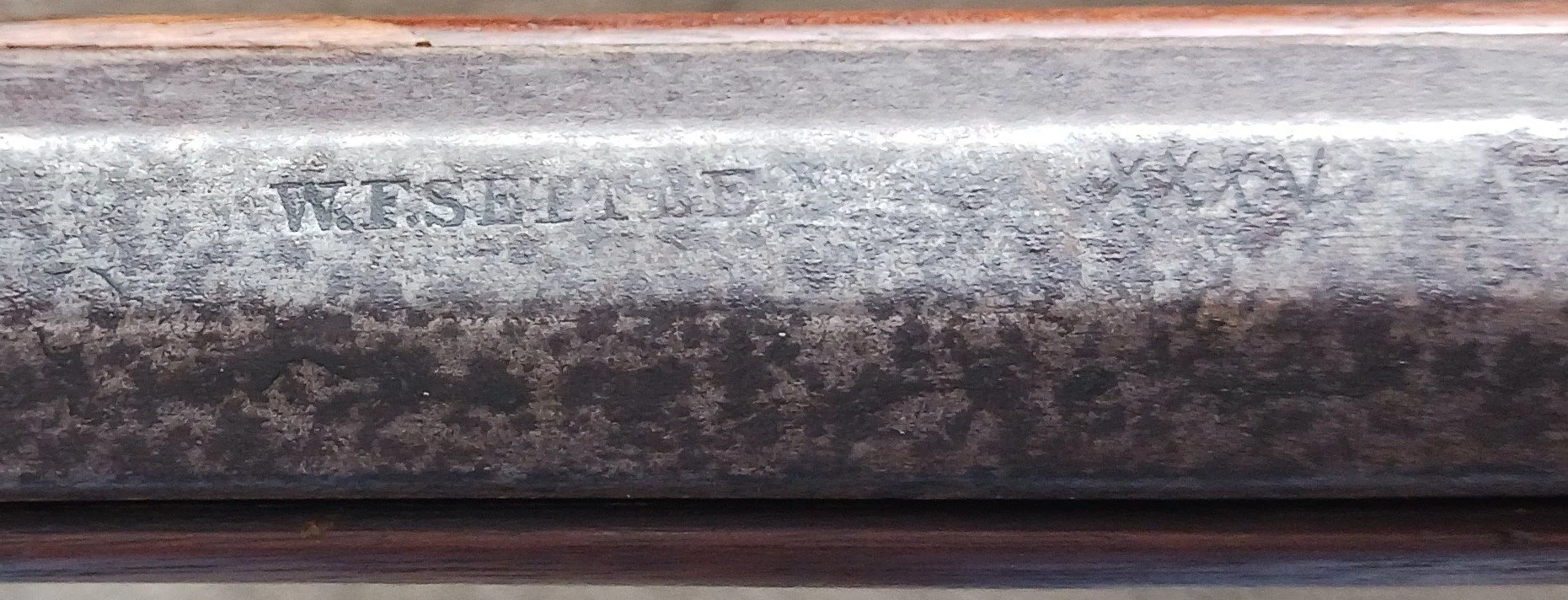
Figure No.3: Several of the later Settle gunmakers added a “serial number” after their name and at times a date, indicating where the rifle ranked among the many rifles they made during their lifetimes. Here Willis F. Settle used Roman numerals XXXV to indicate this was his thirty-fifth rifle.
Auction Rifle: The auction rifle in prior Figure No.1 is stamped “W. F. Settle” followed by “XXXV” as seen in Figure No.3 above, indicating it was his thirty-fifth rifle. The gun is half-stocked in good quality walnut but lacks decoration, similar to many mid-1800s Settle rifles. The author was hesitant to bid on the gun at first since it was so plain… but then he thought, “It has the Settle name, it would make an interesting blog article, and it can be re-sold to a Settle descendant” [the author has a waiting list], so it was a win-win-win. The rifle’s forestock grip area is a bit longer than on many half-stocked Kentucky guns but normal for a Settle rifle. An expected Settle detail not seen on this rifle is a slightly rounded toe on the butt found on many earlier Settle half-stocked rifles. The gun used commercial brass mountings, a later double-spurred guard, and set triggers with a small Louisville style scroll on the front trigger as seen in Figure No.4. It dates to about 1860, or when Willis was in Russellville, due to its smaller caliber, lack of a location name on the barrel, and lack of a rounded toe on the butt. While undecorated, it has graceful lines enhanced by its long barrel and clean, triangular butt. One detail hard to see in the pictures is the gun’s superior quality of walnut in the stock. Its grain bends nicely with the wrist’s curvature, strengthening the stock at its weakest point and showing the care Willis Settle put his work. The gun’s long, 3-screw tang in Figure No.5 further strengthened the wrist area, protecting the gun even more from wrist breakage. Settle rifles were well-built guns, despite their ordinary appearance.
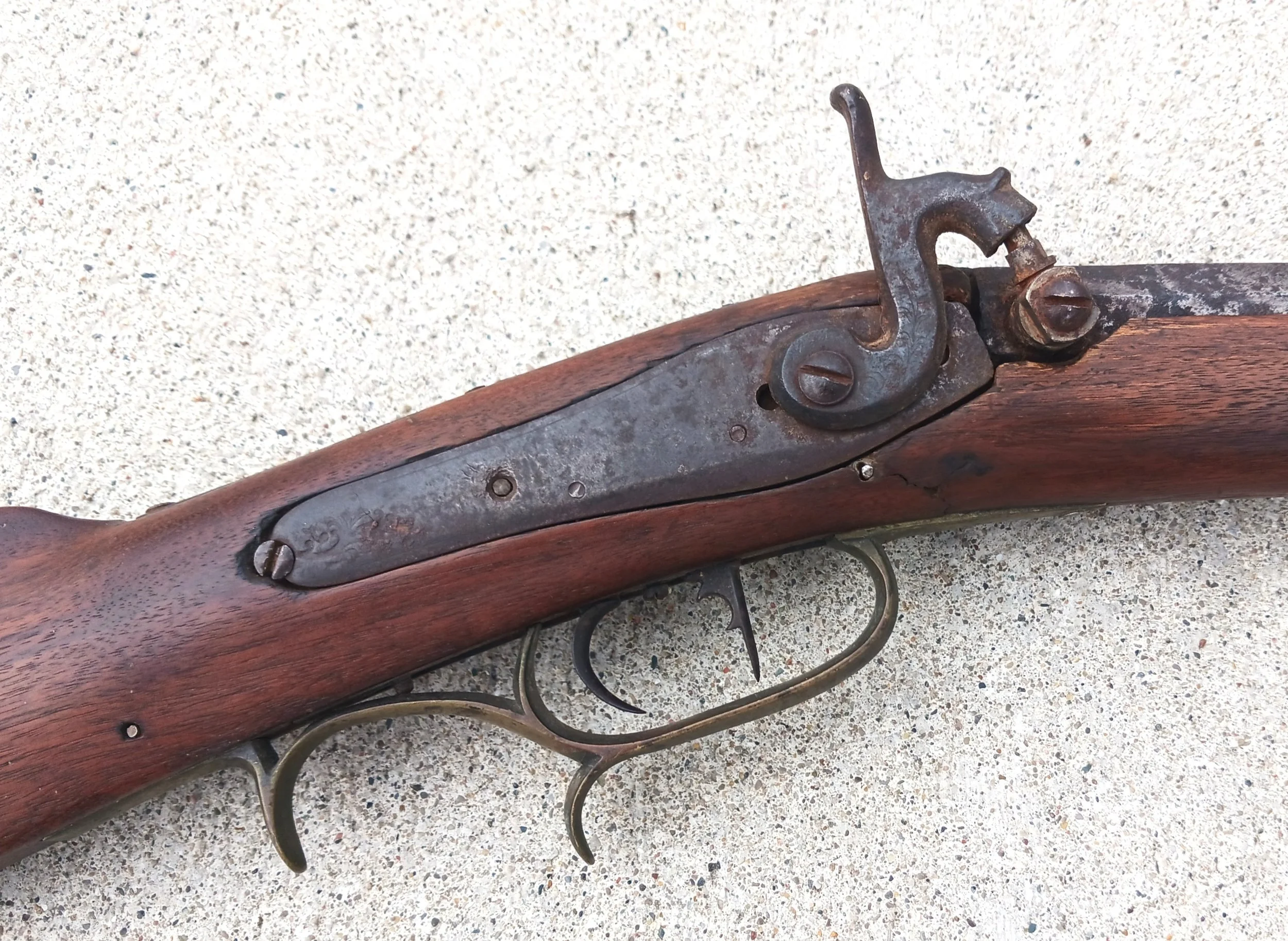
Figure No.4: This rifle has a Kentucky style guard with a “square shoulder” above the rear spur, often seen on northern Kentucky guns, and a front “hair” trigger with a “C” scroll on its back edge, again, a detail more often seen on Kentucky guns made closer to the Ohio River.
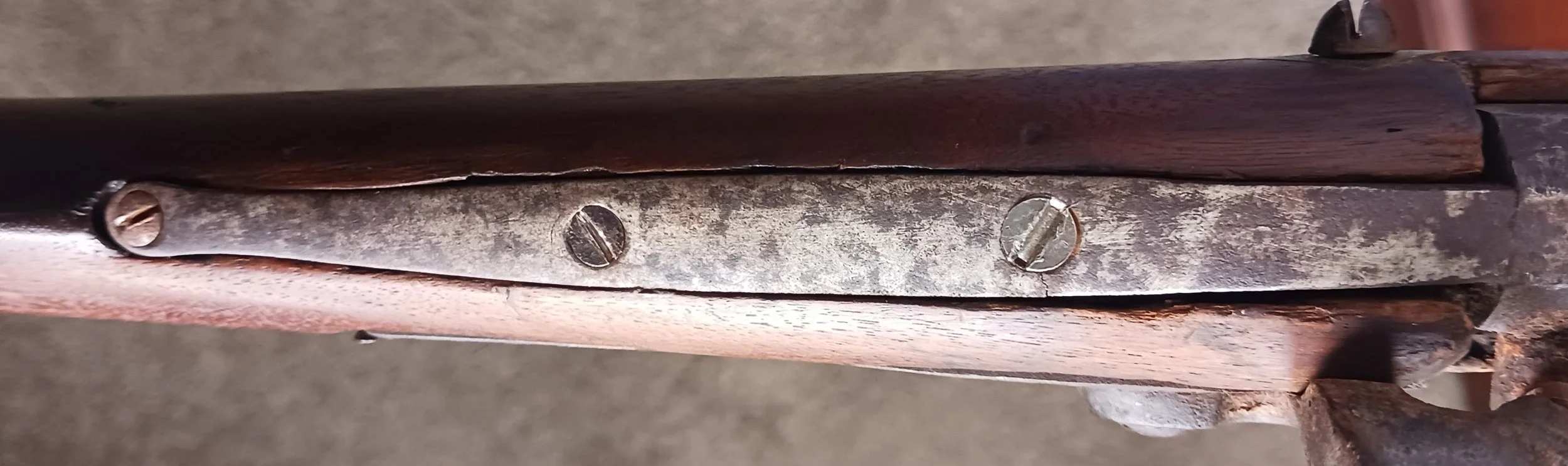
Figure No.5: The rifle has a longer than normal tang with three screws. This arrangement is more a southeastern mountain rifle feature, where there is no tang bolt threaded into the trigger plate, but simply multiple wood screws holding the tang and barrel to the stock. The lack of a tang bolt leaves the lock mortise more vulnerable to breakage, and in this case the stock cracked across the lock mortise at the guard’s mounting pin for its front extension, as seen in Figure No.4 to the left. If a tang bolt had been present, locking the tang and trigger plate tightly together, the crack may not have occurred.
Summary: The author has often teased in the past about Settle rifles being overly plain and almost homely at times, despite being well-made and considered one of Kentucky’s most accurate guns. While he favors the fancier Bluegrass rifles, the Settle rifles were the ones that settled western Kentucky and serviced their owners well. In return, Settle gun owners, both past and present, have been forever grateful and dedicated to preserving the memory of the Settle rifle.