
An Important Clark County School Rifle by Abram Renick ©
Foreword: Recently an important Kentucky longrifle sold at auction. It was a signed Abram Renick full-stocked rifle from Bourbon County, Kentucky. The Renick family was instrumental in defining the recently discovered Clark County School of gunmaking in Kentucky, a sub-set of Kentucky’s Lexington School with a different style patchbox and toe plate. Abram Renick was a well-documented gunsmith, but his previously known guns were from his later Missouri years. The new rifle in Figures No.1 and No.2 was made during Renick’s earlier Kentucky years between 1835 and 1843 and has many distinctive Clark County School features. It is a major addition to the small number of signed Clark County School rifles known to collectors today.

Figure No.1: The signed Abram Renick rifle was made in Bourbon County, Kentucky, about 1837-1840. It retains Lexington School stock architecture, mountings, and four ramrod pipes, but strongly establishes itself as a Clark County School rifle with its “spider shaped” engraving around the toe plate’s screw heads, tang shape, cheekpiece details, and guard with “Renick flat spot” on the bow. Barrel: 43 inches long, .50 caliber bore, with 7-groove rifling. Author’s collection, photo by author.
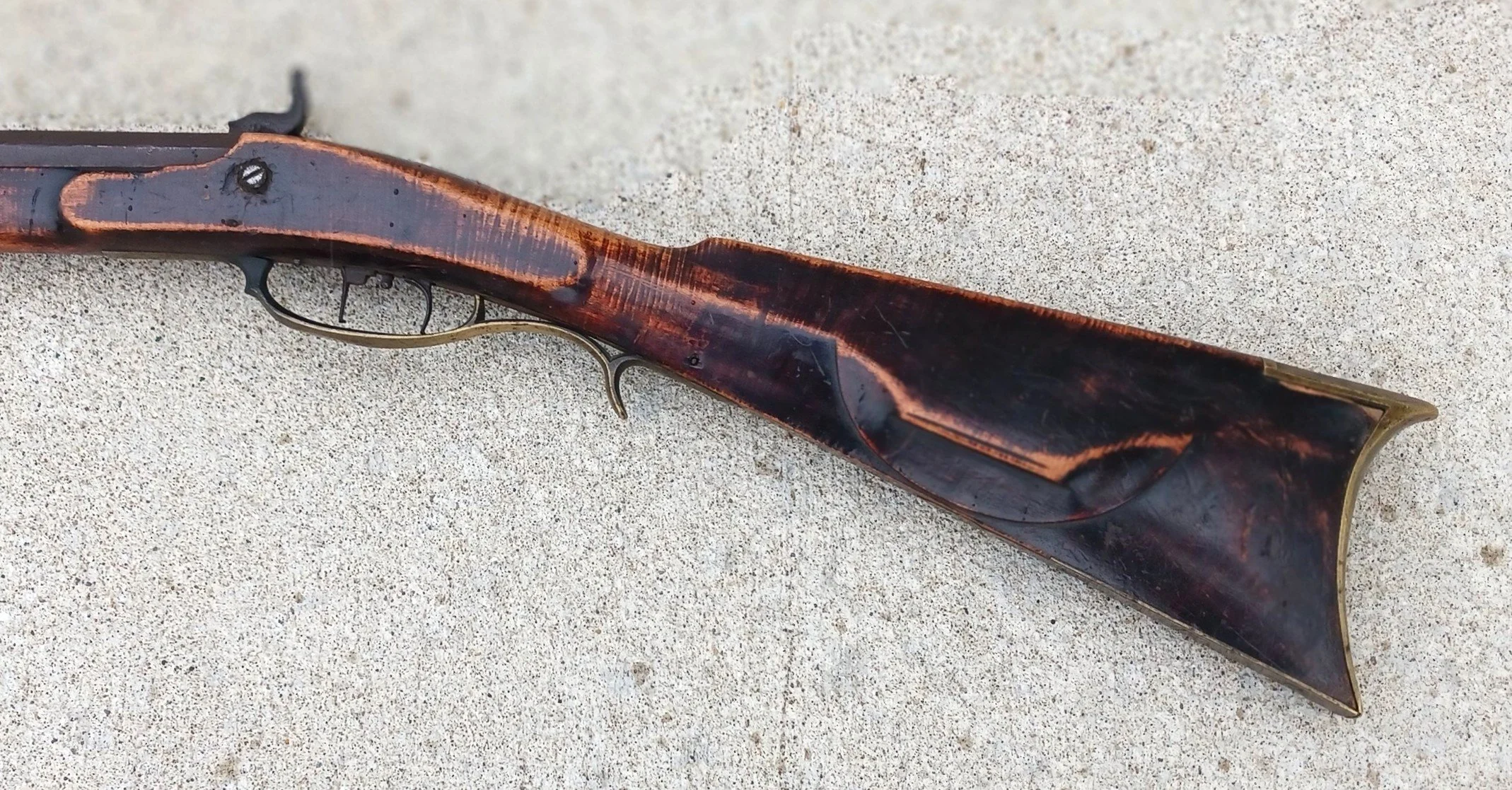
Figure No.2: The back of the “A. Renick” rifle shows its original finish, darkened with age but highlighted in the proper wear areas. This is an early use of a back-action lock based on the presence of side facings on both the lock side and a matching side facing on the back side.
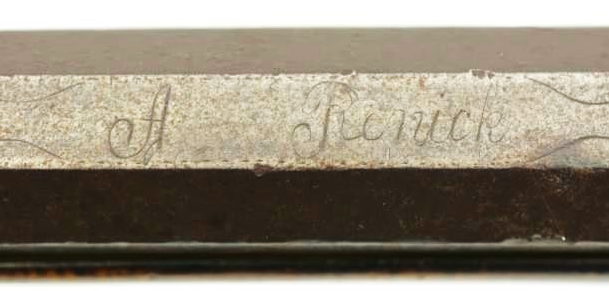
Figure No.3: The early Abram Renick rifle is engraved “A. Renick” in flowing script, while later Missouri rifles are stamped “A. Renick” on their barrels. All known guns by the Renicks are signed “Renick” rather than “Rennick” that appears periodically in records.
Renick Family: Two generations of Renick/Rennick gunsmiths worked in Kentucky with four documented gunsmiths and perhaps others yet to be identified. The name is intermixed in records as Renick [the correct name] and Rennick [recording clerk’s rendition]. William Renick left Germany for America and settled in Pennsylvania well before the Revolutionary War; a few years later he resettled in Virgina and started a family. His son James was living in Hardy County, Virginia, on October 6, 1775, when grandson George Renick was born. George was the progenitor of the Renick gunsmiths in Kentucky.
George Renick, his wife Magdalene Reid Renick, and infant sons John A. and James H. left Virginia in 1793 and moved to Clark County, Kentucky, where they settled about six miles northeast of the town of Winchester. Eventually four more children were added to the family. George Renick has not been documented as a gunsmith, but at least two of his sons, John A. (1792-1871) and James H. (1805-1878), became gunsmiths in Kentucky. A third son, William H. Renick, may have been a gunsmith, but was better known as a market hunter and hunting dog trainer. Oldest son John Abram Renick began working as a gunsmith in Clark County about 1813 and later moved to Bourbon County, Kentucky; a fine rifle by him is shown in Figure No.4. He had a large family and trained two of his sons, Abram Renick (1814-1882) and George Renick (1815-1880) as gunsmiths. Both sons worked in Bourbon County until 1843 when they moved west to Leeds/Independence in Jackson County, Missouri.

Figure No.4: This fine half-stocked Kentucky rifle surfaced about fifteen years ago with its barrel signed “J. Renick” for Abram Renick’s father, John Abram Renick. The patchbox design was strongly influenced by the Sheets gunsmiths of Virginia and West Virginia and made of conventional sheet brass rather than the heavier cast brass of Lexington School patchboxes. Yet the gun retained Lexington School details in its decorative tab on the front “hair” trigger, heavy front post on the guard, and two flats on the guard’s bow. Photo courtesy R. Lambert.
Abram Renick: He was the oldest son of Kentucky gunsmith John A. Renick and worked as a gunsmith in Bourbon County from 1835 until 1843 when he moved to Jackson County, Missouri, with his brother George A. Renick, who was also a gunsmith. Abram grew up on a farm, was mechanically inclined as a child, and learned the gunsmith’s trade from his father. He married Malvina Reed of Bourbon County on December 24, 1840, and in 1843 they moved to Jackson County, Missouri. He continued working as a gunsmith in Missouri while acquiring good farmland. His wife died in 1858 leaving him with four children, and later that year he married his wife’s widowed sister, Louisa. In 1861 Abram moved to his farm property near Independence, where he planted large orchards of apple and peach trees. He reportedly continued working as a gunsmith until 1881, died on May 2, 1882, and was buried in the Woodlawn Cemetery at Independence.
The author had heard of a full-stocked Abram Renick rifle that sold at auction years ago, but he was never able to get a description or images of the gun. Two signed half-stocked rifles were known to the author but dated to Abram’s later Missouri years. The newly discovered Abram Renick rifle is an important gun in the study of early Kentucky firearms, since it is the first rifle to document Abram’s early Kentucky work. The rifle, shown in prior Figures No.1, No.2 and No.3, shares many details with the John A. Renick rifle but appears earlier based on its simpler guard style and full-length stock. The author dates the rifle to about 1837-1839 based on its early use of a back-action lock. Guns with back-action locks in combination with full, matching side-facings were usually made early in the percussion era, since pronounced side-facings with back-action locks fell out of favor rather quickly, going to a smoother surface by mounting locks flush with the wrist’s surface. Like all Clark County School rifles, the “A. Renick” rifle retains slender Lexington School architecture with straight butt lines and Lexington style butt plate and guard.
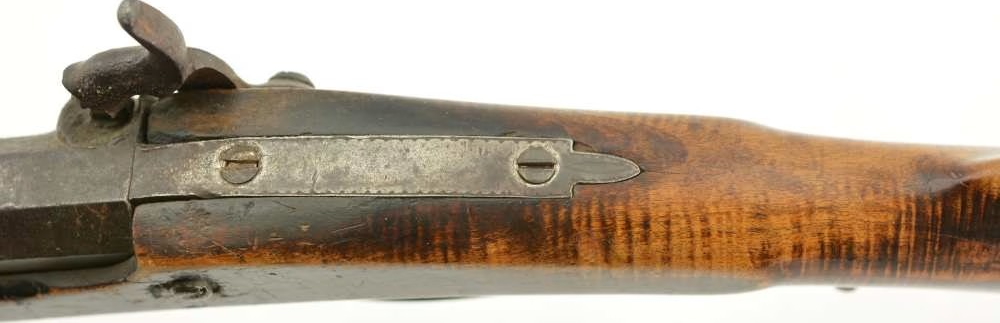
Figure No.5: The Abram Renick rifle has the longer two-screw tang of Clark County School rifles with a lozenge shaped finial and dotted borders. The tightly curled maple can be seen in this view, with its major grain bending smoothly through the wrist area for added strength.
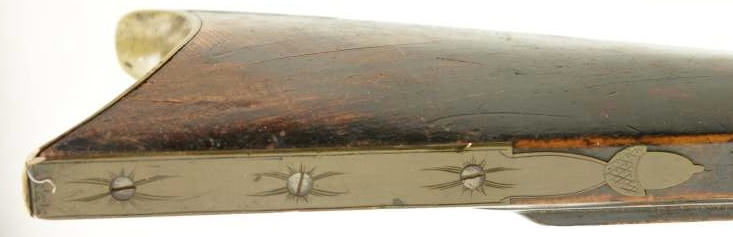
Figure No.6: A distinctive detail that defines Clark County School rifles is the “spider-like” engraved rays around the toe plate screws. No other Kentucky-made guns have this detail. Both the “spider” engraving and acorn finial show close ties to Virginia’s Sheets gunsmiths.
Specific details indicating the Renick rifle is a Clark County School gun include its 2-screw tang with lozenge-shaped finial in Figure No.5 above, and more importantly, its toe plate with the Clark County School’s “trademark” spider-shaped engraved rays around the screw heads seen in Figure No.6. Other major Clark County School details include its Lexington style guard and small tabs on the triggers seen in Figure No.7, and the traditional “Renick flat spot” on the bottom of the guard’s bow seen in Figure No.8. A final interesting detail that appears on early Renick rifles is the large arc running below the cheekpiece on both John A. Renick’s rifle and the Abram Renick’s rifle seen in Figures No.9 and No.10.
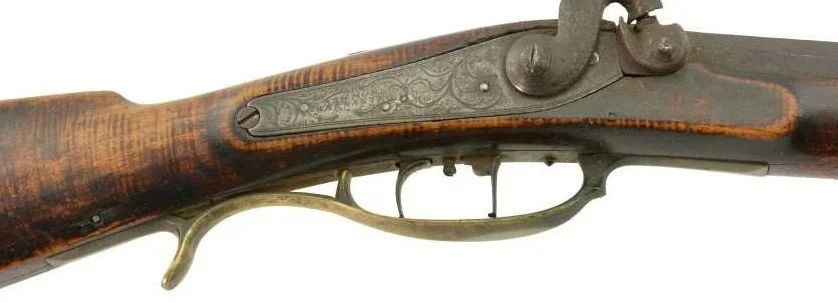
Figure No.7: This rifle has an early back-action lock, which became popular about 1835-1837 when better Kentucky gunsmiths such as Jacob Rizer and Moses Dickson began using them on their premium guns. Note the fine hand-made triggers with small tabs on the tips, and the Lexington guard with heavy front post and two outer flats. Detail photos courtesy Joe Salter.
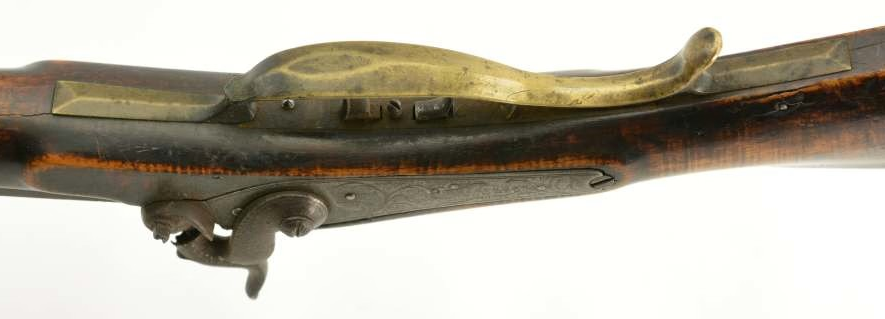
Figure No.8: An important detail on all Renick rifles from the Clark County School is the “Renick flat spot” filed on the guard’s outer ridge under the bow. To date, all known Kentucky era signed Renick rifles have this unique detail. Note the simple Lexington style joint where the finger rail meets the back of the bow, and typical two flats on the guard’s outer surface.
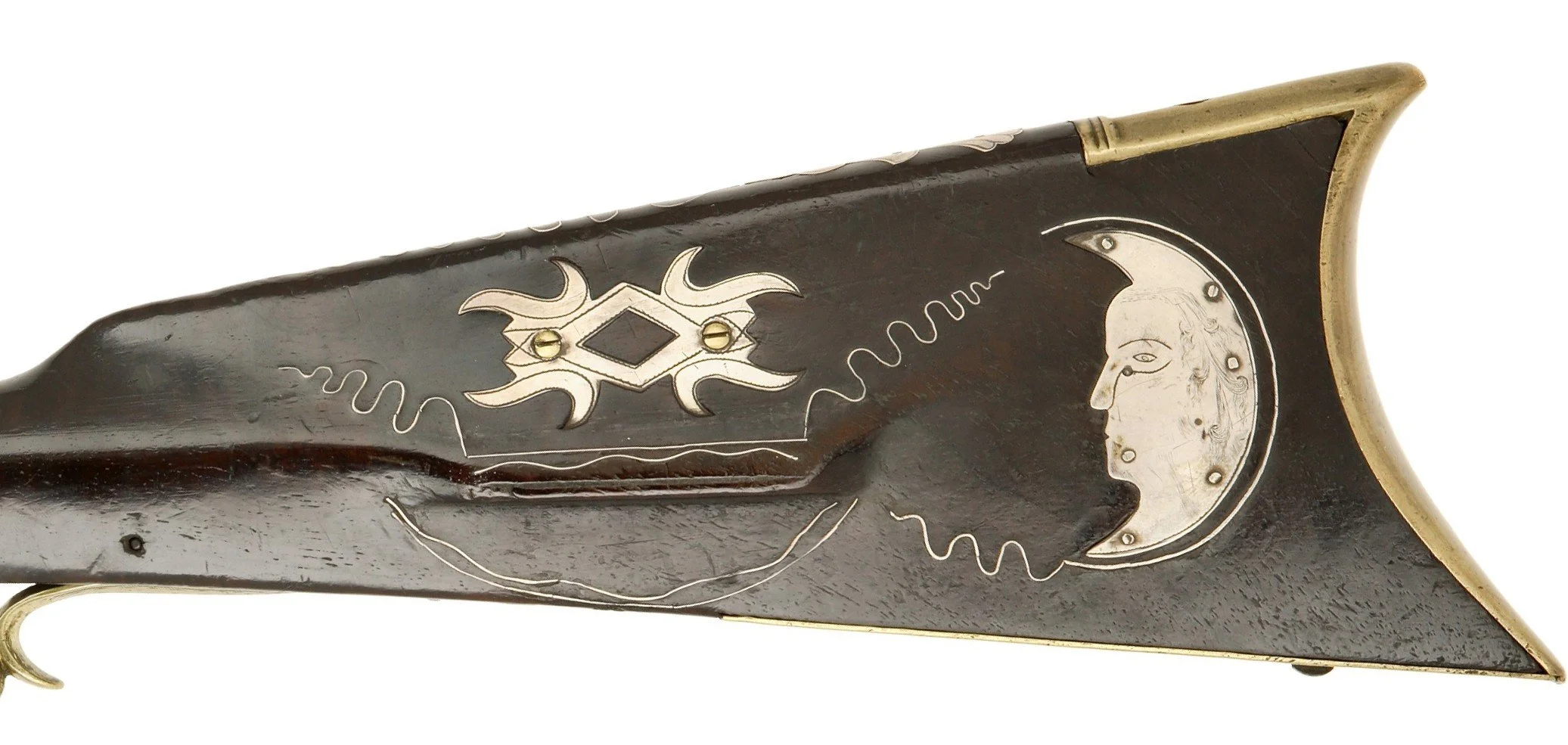
Figure No.9: The John A. Renick rifle has a Lexington style butt and short cheekpiece with a single molding line across its base. The typical Lexington style butt plate has a small, raised ridge on the return. Silver wire inlay makes a large arc below the cheek. Photo by R. Lambert.
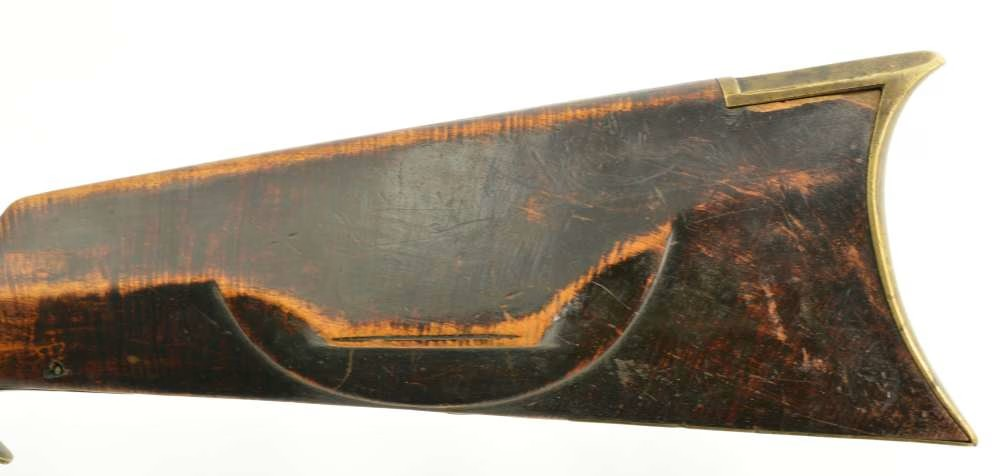
Figure No.10: Abram Renick’s rifle also has a Lexington style butt with short cheekpiece and butt plate with raised ridge. A rare detail is the large arc carved below the cheekpiece that is similar to the silver wire arc on the John Renick rifle: Detail photos courtesy Joe Salter.
Summary: The Renick family of Kentucky’s central Bluegrass region was a major contributor to the recently identified Clark County School of gunmaking in Kentucky. The new school ran over small areas of Clark, Bourbon, and Montgomery Counties, and its guns were a sub-set of the better-known Lexington School rifles and made in counties where most gunsmiths were making Lexington style guns. But a handful of gunsmiths were influenced by the Sheets gunmakers of Virginia/West Virginia, and their “slightly different” rifles with Sheets influences in the patchboxes, inlays, and “spider-like” engraving around screw heads set them apart from local Lexington guns. Abram Renick was a major figure in the Clark County School, despite his few known rifles. But recently an early, signed Abram Renick rifle from his Kentucky years appeared at auction. Despite not being highly decorated, the gun’s fine stocking, unique cheekpiece, hand-made triggers, and graceful script signature combined to make it one of the most interesting Clark County School rifles known and important for documenting Abram Renick’s early Kentucky work. It answered the lingering question about what his Kentucky guns looked like and filled a blank spot in our knowledge of early Clark County School gunsmiths.