
An Intriguing Iron Mounted Rifle, Perhaps Kentucky? ©
Foreword: Recently an interesting half-stocked rifle with a “southern” appearance and unclear barrel stamp changed hands at the Tennessee Longrifle Show in Knoxville. It had details that suggested it was from Kentucky, but other details suggested the Carolinas or even other states. The gun was mounted in superior but unconventional iron work that drew a lot of attention but was so unique, it made an attribution nearly impossible. Was it from Kentucky, and if not, then where?

Figure No.1: This iron mounted “southern” rifle has numerous details that could indicate it was made in Kentucky about 1840. Its tall, triangular butt, guard with a heavy front post and two flats on the outer surface, and slight forward taper to the guard’s bow were all common to Lexington rifles. Not visible are “thumbnail” finials on the 2-screw tang, guard extensions, and toe plate that are also common to Lexington rifles. But a double-line molding running along the comb and a strongly hooked rear trigger hinted at a Carolina origin. Barrel: 42 inches long, .56 caliber bore, 7-groove rifling. Courtesy B. LaMaster, photos by author.
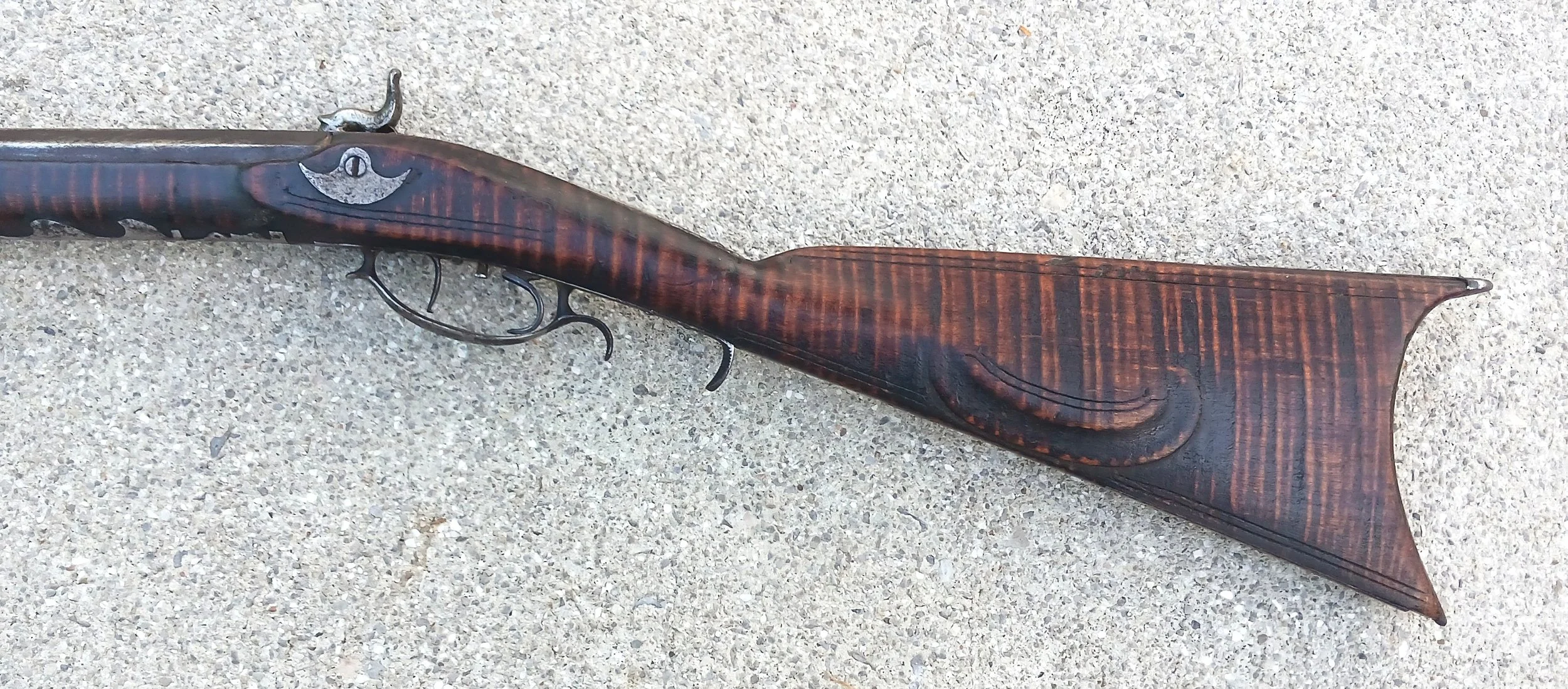
Figure No.2: The back of the iron mounted rifle has a heavily molded, oval style cheekpiece set low on the butt that breaks the lower butt molding, a detail found on Kentucky’s percussion era Clark County School rifles. Both the “winged” lock bolt washer and double line molding just below it are rare details. The guard resembles a “secondary” Lexington School guard with its finger rail flat against the stock with an almost straight rear spur. Courtesy B. LaMaster, photos by author.
Iron Rifle: The iron mounted rifle in Figures No.1 and No.2 is not overly elaborate, yet it immediately catches the viewer’s eye with its impressive iron work. The guard in Figure No.3 has the heavy front post, slightly forward sloping bow, and two outer flats of a Lexington School rifle from Kentucky, while the gun’s well-made triggers have a small tab at the tip of the front trigger and a ball-headed tension screw often used on Kentucky’s Clark County School rifles, which are a sub-set of the nearby Lexington School. Also connecting the gun to in/near the Lexington School are its tang and toe plate, shown in Figures No.4 and No.5, respectively, which have the expected “thumbnail” shaped finial on their ends. The 2-screw tang is longer than expected for a Lexington School rifle but appears original with its thumbnail finial. Clark County rifles have longer 2-screw tangs than their Lexington “cousins,” giving the gun a bit more of a Clark County flavor.
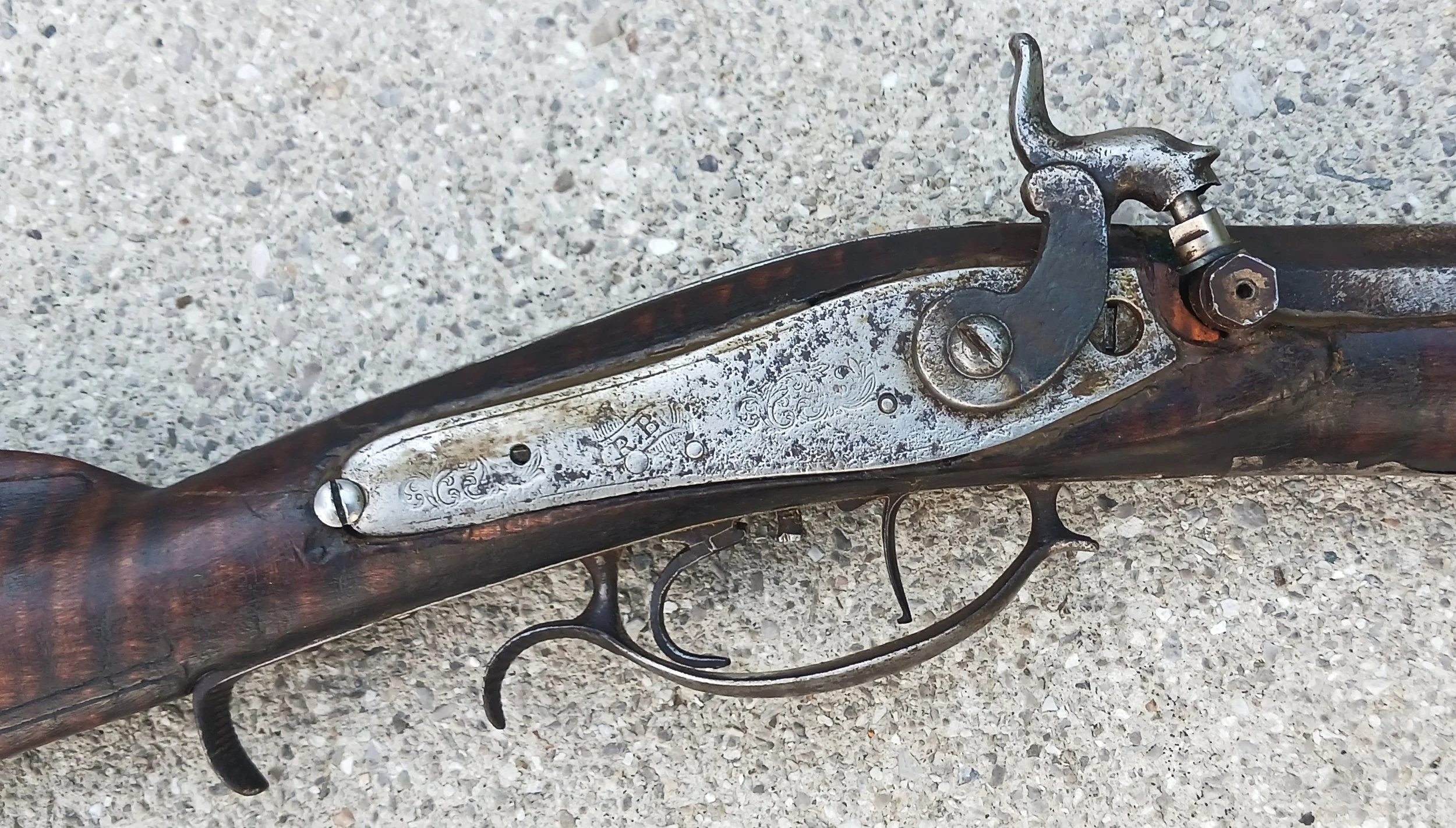
Figure No.3: The front “hair” trigger has a small tab at its base while the rear “set” trigger has significant curvature often associated with Carolina rifles. Barely noticeable are many parallel grooves running across the inside surface of the rear spur, making its inner surface look like a course metal file. The percussion drum’s cleanout port has a hex-shaped head on its screw/bolt, when Kentucky drums usually have a squared off end for wrenching out.
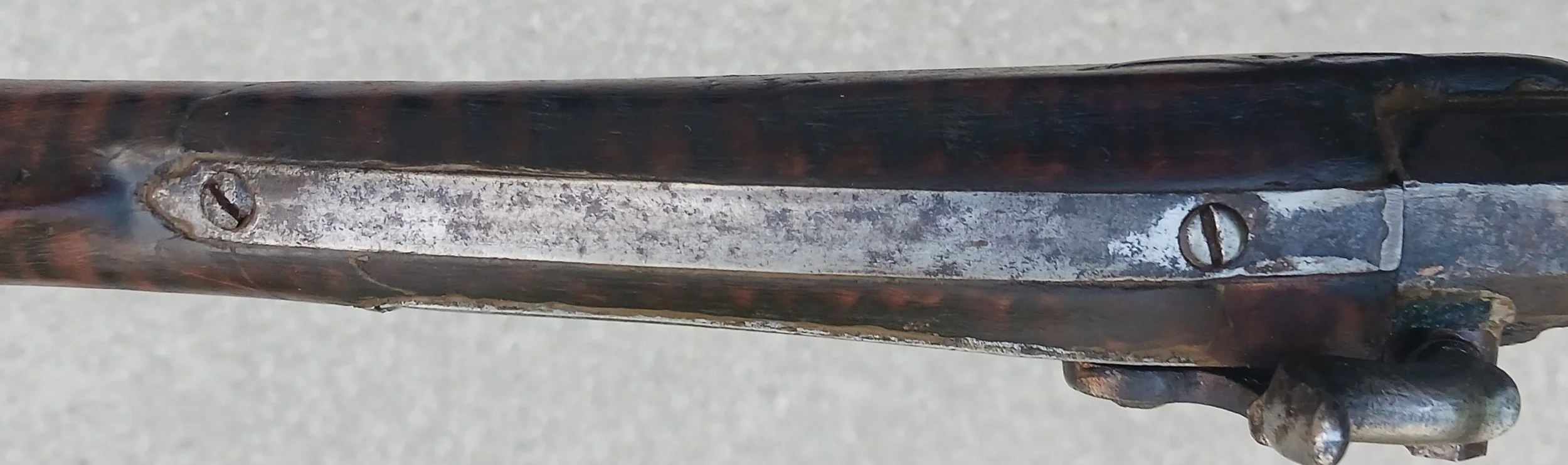
Figure No.4: The long, two-screw tang has parallel sides and a “thumbnail” finial at the end, matching the finials on the guard’s extensions and the toe plate and often present on both Lexington and Clark County School rifles.
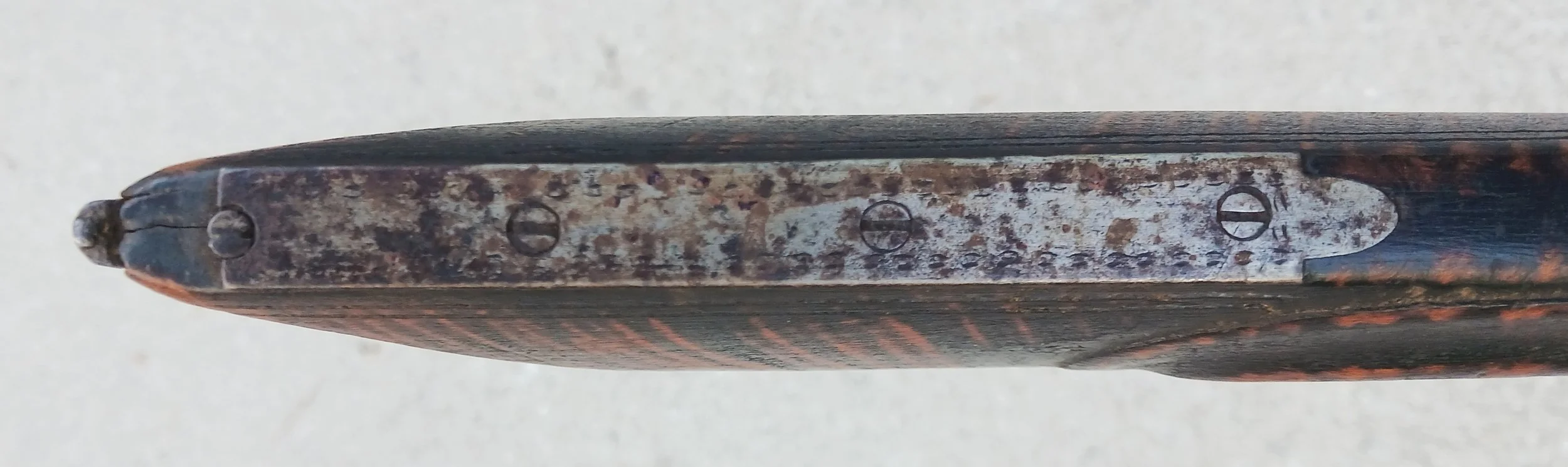
Figure No.5: The iron mounted rifle’s toe plate has four screws and a “thumbnail” finial similar to finials on Lexington rifles. Note the simple border engraving along both sides without central engraving, common to both Lexington and Clark County School rifles.
The gun’s fine quality of iron mountings is best seen in the elaborate wear plate under the forestock that extends from the guard’s front extension all the way out to the rear ramrod pipe as seen in Figure No.6. Its specific shape, like small shields hooked together, is a unique detail not previously seen on Kentucky or Carolina guns before… but not seen on other southern guns as well, so it is probably unique to this creative gunsmith’s hand. The decorative ironwork continues from the wear plate across a smaller matching iron inlay and then across the attractive guard and its extensions as seen in Figure No.7. The guard has the expected simple joint where the finger rail meets the bow, while the finger rail is flattened against the stock wood similar to “Secondary” Lexington rifles known for their less adorned “poor boy” stocking and iron mounting.
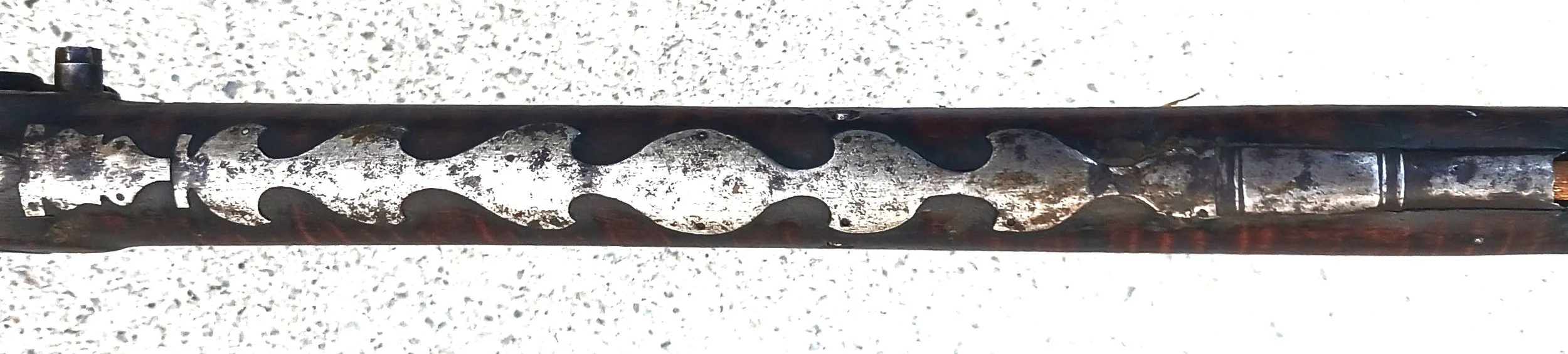
Figure No.6: The most spectacular detail on the new rifle is its forestock wear plate that runs from the guard out to the rear ramrod pipe. The unengraved iron wear plate appears to be a chain of small shields attached together. Note the fine file work on the rear pipe.
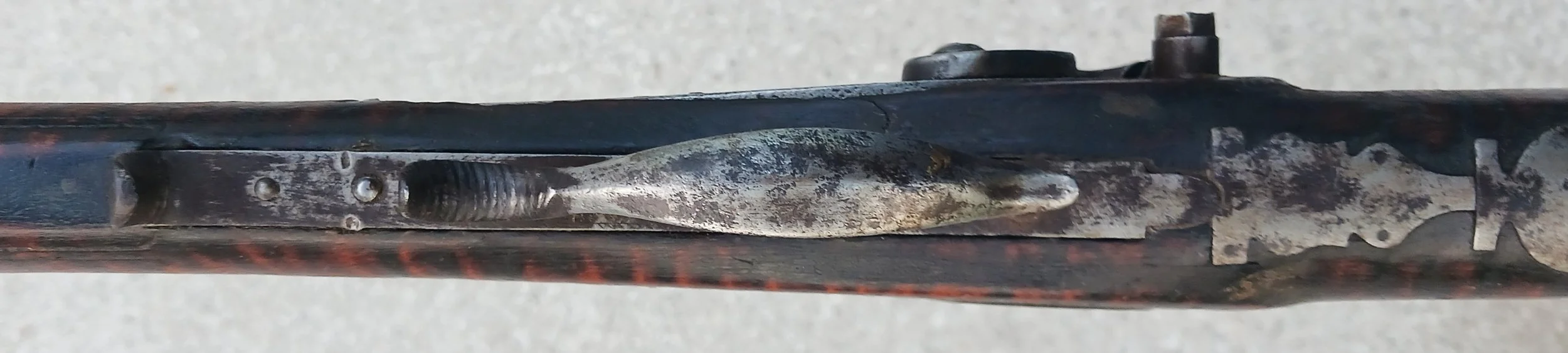
Figure No.7: The gun’s iron guard has a thumbnail finial on its front extension that meets the back end of the long forestock wear plate. Note the guard’s two outer flats on the bow, similar to Lexington rifles. Here the many small ridges inside the guard’s two spurs can be seen.
Perhaps the iron mounted rifle’s strangest detail is its “skeleton” style butt plate seen in Figures No.8 and No.9. While the butt plate provides a solid iron tip on butt’s top heel position where most damage and wear occur, it has only a narrow iron strip for its top extension [with thumbnail finial] and its lower plate that sits against the shoulder. The style adequately protects the butt’s heel area, but it offers less protection to the lesser wear-prone areas of the butt. One could argue it saves a bit of iron and weight, but the author attributes it to the whim of the gunsmith to make a more distinctive gun than those of his contemporaries.
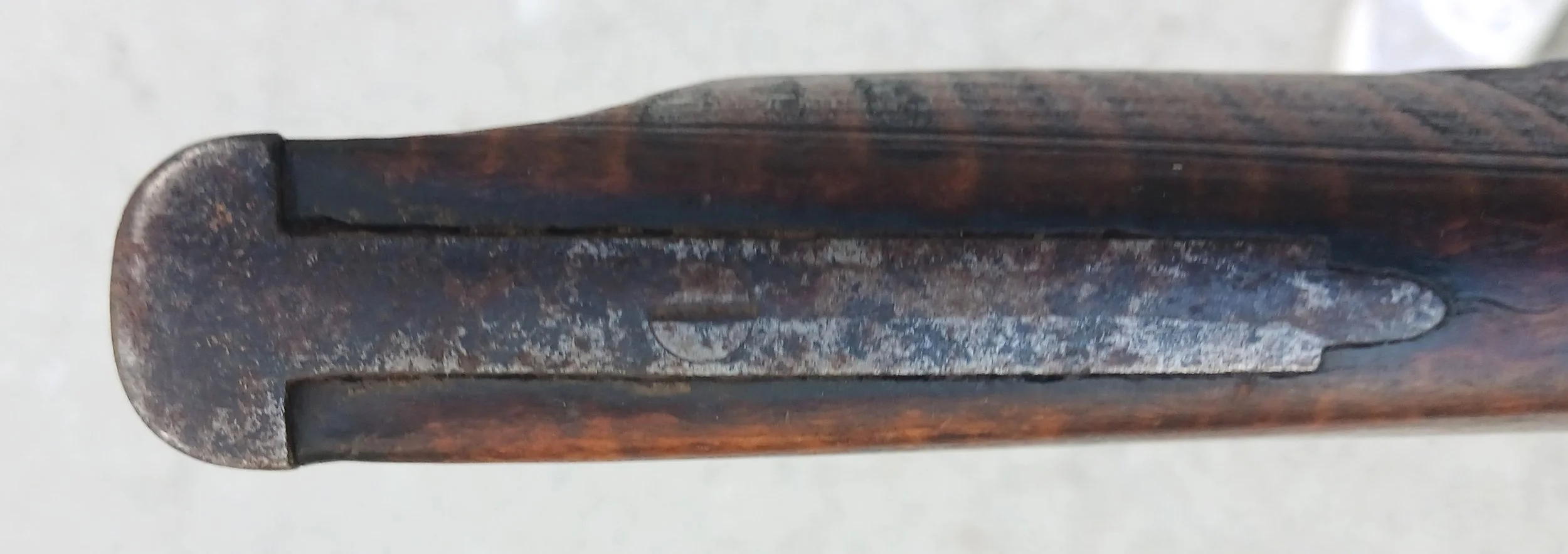
Figure No.8: Butt plate construction is perhaps the oddest feature of the iron mounted rifle. Some call it a “skeleton” style butt plate. It has a substantial iron heel to protect the butt when set down, but the butt plate’s top extension is narrow with a thumbnail finial.
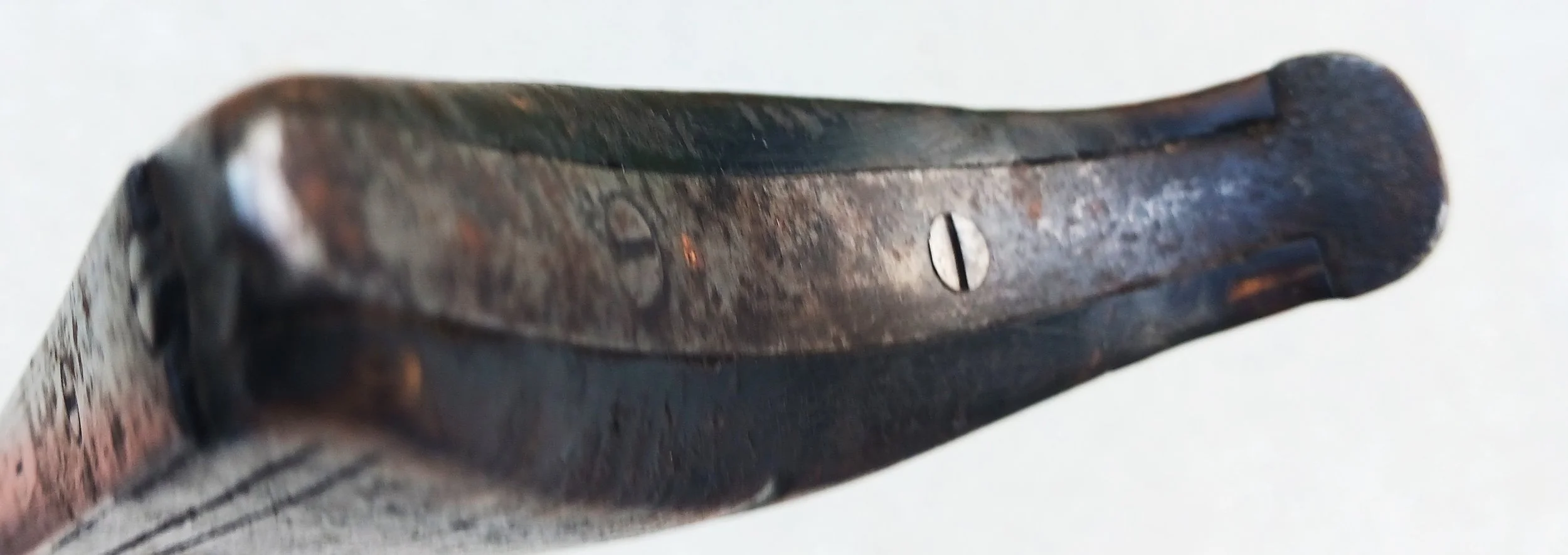
Figure No.9: The gun’s butt is protected by only a thin strip of iron in its skeleton style butt plate, allowing heavier stock wear along its exposed edges. Three screws are used to attach the vertical section of the butt plate, perhaps needed due to its thinner/weaker form.
Two additional details on the iron mounted rifle stand out. First, it has an exceptionally tall, triangular butt in fine curly maple with a beautifully carved small, oval cheekpiece seen in Figure No.2 above and Figure No.10 below. Of particular note is the double-line incised molding along either side of the butt’s comb, suggesting a Carolina influence in the gun. Second, the barrel has a maker’s mark that is small and worn as seen in Figure No.11, introducing a bit of uncertainty into what the maker’s initials really are. Regarding the butt of the rifle, its tall, triangular shape suggests a Kentucky gun more than a Carolina gun, and the double-line lower butt molding interrupted by the low cheekpiece is a feature of percussion era Renick rifles of the Clark County School… which is where the gun would most likely be from if proven to be from Kentucky. But the double-line molding along the comb suggests a Carolina connection. Kentucky guns from the central Bluegrass region assimilated North Carolina details through the Bryan family and other transient North Carolina gunsmiths. However, the exaggerated height of the butt and small, finely carved oval cheekpiece do not relate well to North Carolina guns, and brings South Carolina into the mix as a possible origin for the gun, where only a few fine guns have been documented, but known guns tend to show more freedom, or variation, from “standard” patterns than in other southern states, which could also explain the unique iron work on the gun.
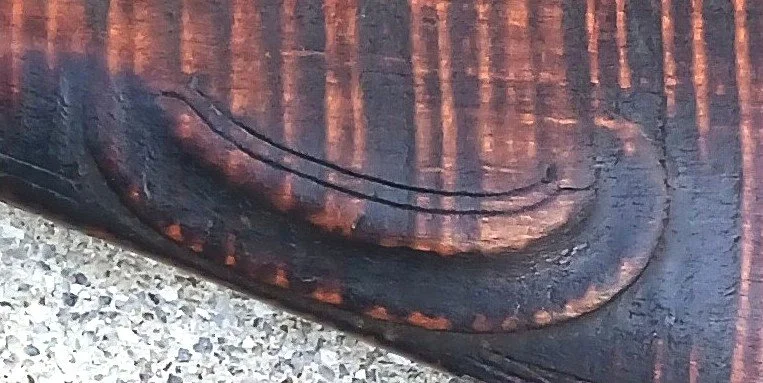
Figure No.10: The rifle’s cheekpiece is rather small for a large butt, but it is nicely molded around its edges. Note how its low position on the butt causes an interruption or break in the butt’s toe molding, a detail found at times on Kentucky’s Clark County School rifles.
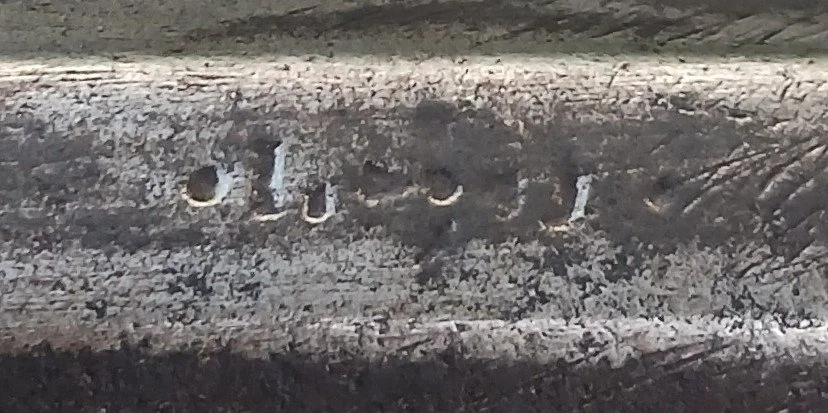
Figure No.11: The iron mounted rifle’s stamped barrel signature is hard to read, but appears to be two initials inside large dots, the first initial being an “L” and the second being a “J,” separated by a “pinwheel” figure with a round center and four triangular “arms.”
Barrel Stamp: Any attribution of a rifle with a partial barrel signature/stamp should agree with the remnants of the barrel mark. The signature begins and ends with large dots, with the first initial an “L” or possibly “I” that could stand for a “J.” Between the two initials is a large “pinwheel” figure with round center section and four triangular arms. The second initial is damaged but appears to be a “J.” Perhaps viable candidates can be found among lists of Kentucky, North Carolina, or South Carolina gunmakers, but until a similar rifle is found with a clear barrel signature, any attribution is speculative. However, the large triangular butt, long 2-screw tang, “thumbnail” finials on guard/toe plate/tang, guard with heavy front post and finger rail tight to stock, and double-line molding on comb all strongly suggest a southern origin. If from Kentucky, which is the leading possibility, it would fall within the Clark County School, but any final attribution is risky until additional work is found by this exceptional maker who was highly skilled in working iron.
Addendum: A possible “southern” maker of the iron mounted rifle based on its non-standard features and fine workmanship, might be New Orleans gunsmith Louis Juzan. He worked in New Orleans for many years, had a reputation for fine guns, and his initials “L. J.” match the study rifle’s barrel stamp. Juzan was born in New Orleans in 1815 to parents Pierre Francois Juzan and wife Marie Laurent Luzan, where he established a reputation as New Orleans’ best gunsmith for many years before his death on September 29, 1899. His family had a French background, suggesting an artistic flare in his gunmaking. The author has not been able to locate an image of a gun [or barrel stamp] by Juzan. (4-25-2026)
Author’s Request: If any reader has seen a similar rifle, or a similar stamped signature with distinctive initials, please contact him through this web site or at sgallien@comcast.net and share your knowledge and thoughts on the gun. It is a fine gun that deserves to be identified and properly placed, so collectors can appreciate its unique features and the skills of its maker.