
A Fine Rifle Likely from Kentucky but Hard to Identify ©
Foreword: The author had known about this rifle for years and corresponded with the owner in the past. Pictures were shared that showed a fine rifle stocked in superb curly maple with features that suggested it was from northern Kentucky near the Ohio River. But it had an elaborate cast pewter nose cap that threw a monkey wrench into figuring out where it was made, since no one had seen that style of nose cap before.
The Rifle: Years ago the owner of the unsigned study rifle sent pictures of the gun to the author to find out if it might be from Kentucky. He had noticed several details that suggested it may have come from Kentucky and was trying to get conformation. The gun, shown in Figures No.1 and No.2, proved both fascinating and frustrating, with multiple details strongly suggesting a northern Kentucky origin, but one baffling detail that could not be explained or placed… a previously unseen style of cast pewter nose cap shown in Figure No.3. Cast pewter nose caps with piercings are usually associated with Tennessee rifles, or Tennessee trained gunmakers who migrated to other states. But the study rifle’s nose cap did not match any published Tennessee rifle nose cap, and the gun’s fine stock architecture did not suggest a Tennessee gun… other than a slight similarity to Alfred Bearden’s stock profiles. Rather, most of the gun’s identifiable details suggested it most likely came from northern Kentucky near the Ohio River.

Figure No.1: This well-built longrifle is stocked in vivid curly maple and has survived in excellent condition. It has many Kentucky features that include a slender forestock and triangular butt, fine “Louisville” style triggers with a “C” scroll behind front hair trigger, Kentucky “square shoulder” above the guard’s rear spur, and a lock plate marked “T. Davidson & Co./Cincinnati.” A ridge runs along the butt’s centerline and is visible in this picture. Barrel: 42 inches long, .34 caliber, 7-groove rifling. Author’s collection, photo by author.
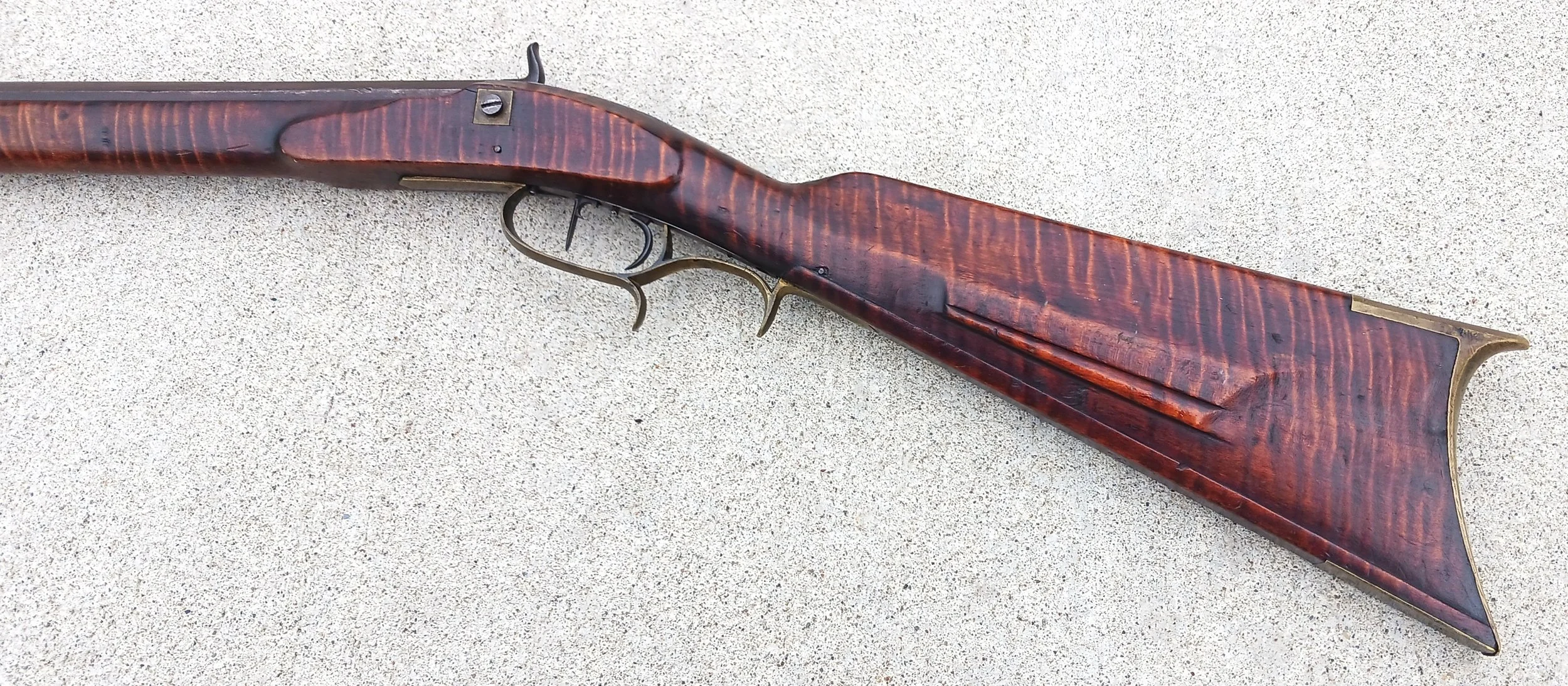
Figure No.2: The back side of the study rifle has a wide cheekpiece with flattened top, strong incised line across its base, and no cheek inlay. Most Louisville full-stocked guns lacked cheek inlays. The lower butt molding is slightly relieved along its top edge, making it appear to stand out from the butt stock, similar to the forestock molding. Superior quality curly maple stock wood is evident in this view. Author’s collection, photo by author.
Kentucky Details: The study rifle, while unsigned, has its original “T. Davidson & Co./Cincinnati” percussion lock seen in Figure No.4 that strongly indicates a Midwest origin on/near the Ohio River most likely in either Ohio or Kentucky. Fine set triggers with a “Louisville” scroll behind the front trigger are more a Kentucky detail than Ohio, as is the Louisville style guard with soft points on its extensions and a “Kentucky” square shoulder above its rear spur. The gun’s longer 2-screw tang seen in Figure No.5 is also a Kentucky detail, along with the butt plate’s small, raised ridge on its top extension in Figure No.6 used on Kentucky’s Lexington School guns and those made north of Lexington up to the Ohio River. A related detail is the rifle’s front sight that is a simple blade set into a slot in the top flat of the barrel, typical of front sights on Lexington area guns.
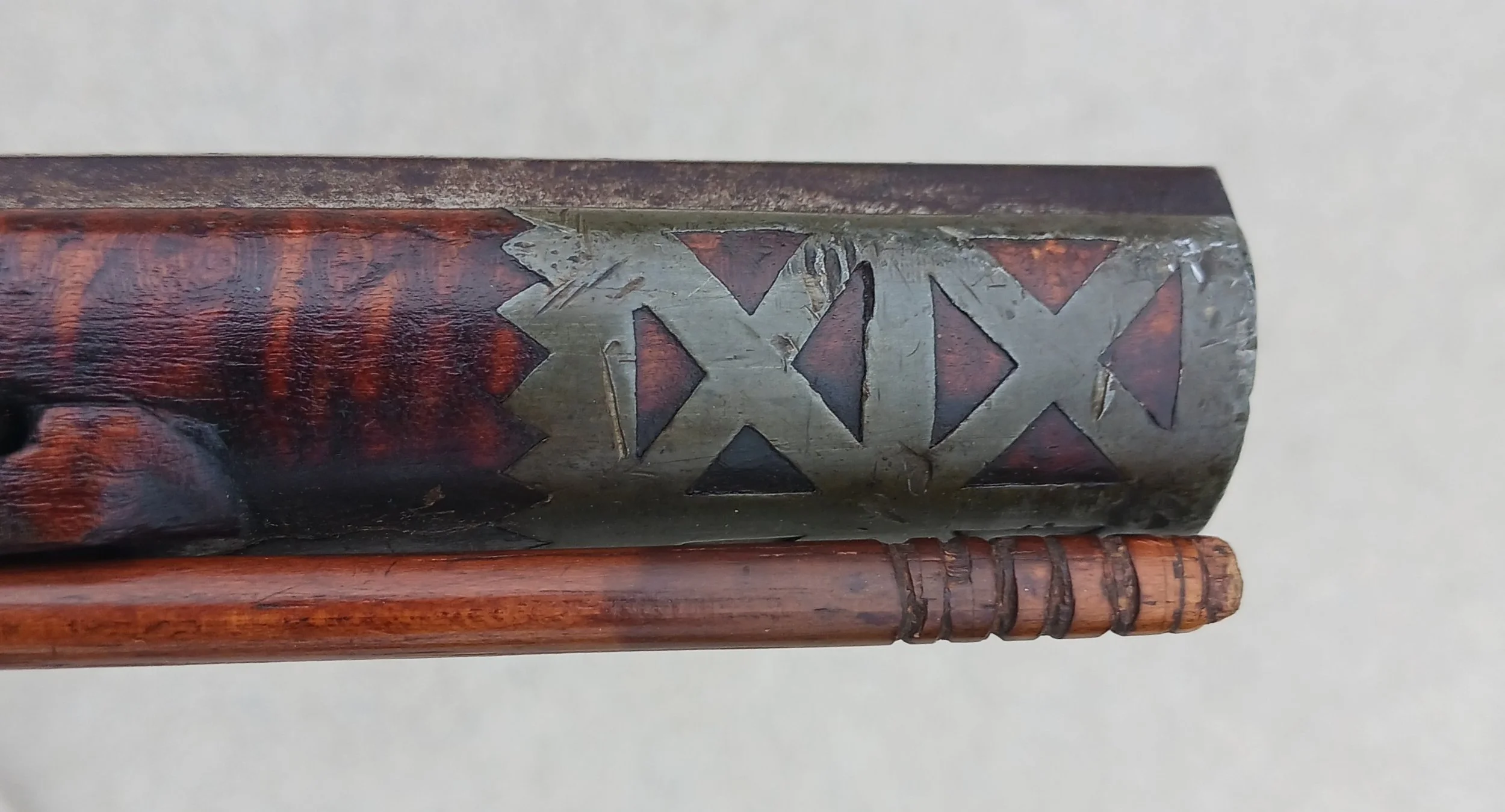
Figure No.3: The new rifle’s most important decorative detail is its fancy cast pewter nose cap that is more elaborate than most pierced pewter nose caps. This specific style of nose cap has not been seen on other Kentucky guns, introducing doubt about the gun’s origin.
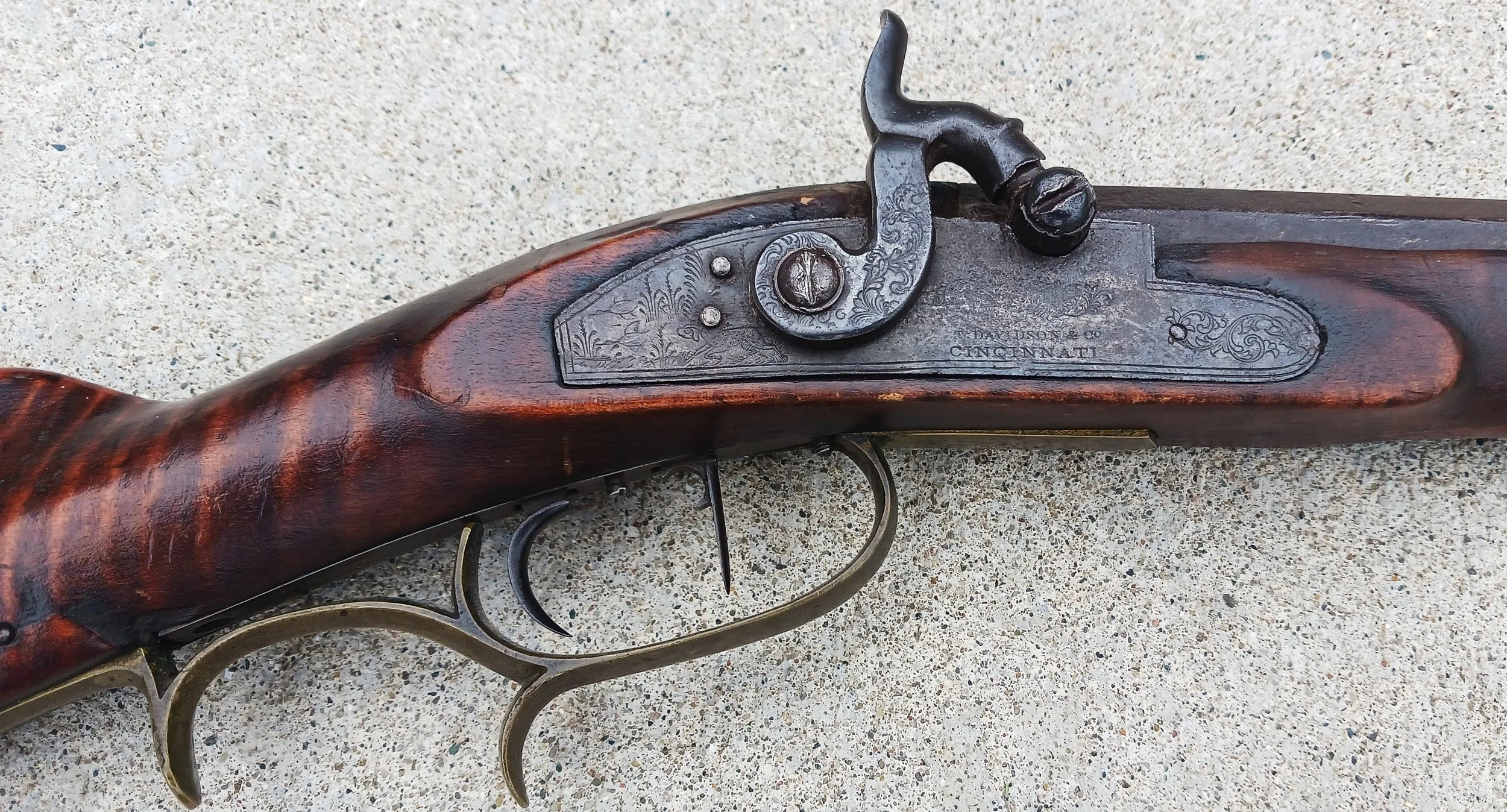
Figure No.4: The gun’s original lock is stamped “T. Davidson & Co./Cincinnati” suggesting the gun was made in the Midwest near the Ohio River. Note the Kentucky “square shoulder” above the guard’s rear spur and a Louisville style front trigger with a small “C” scroll.
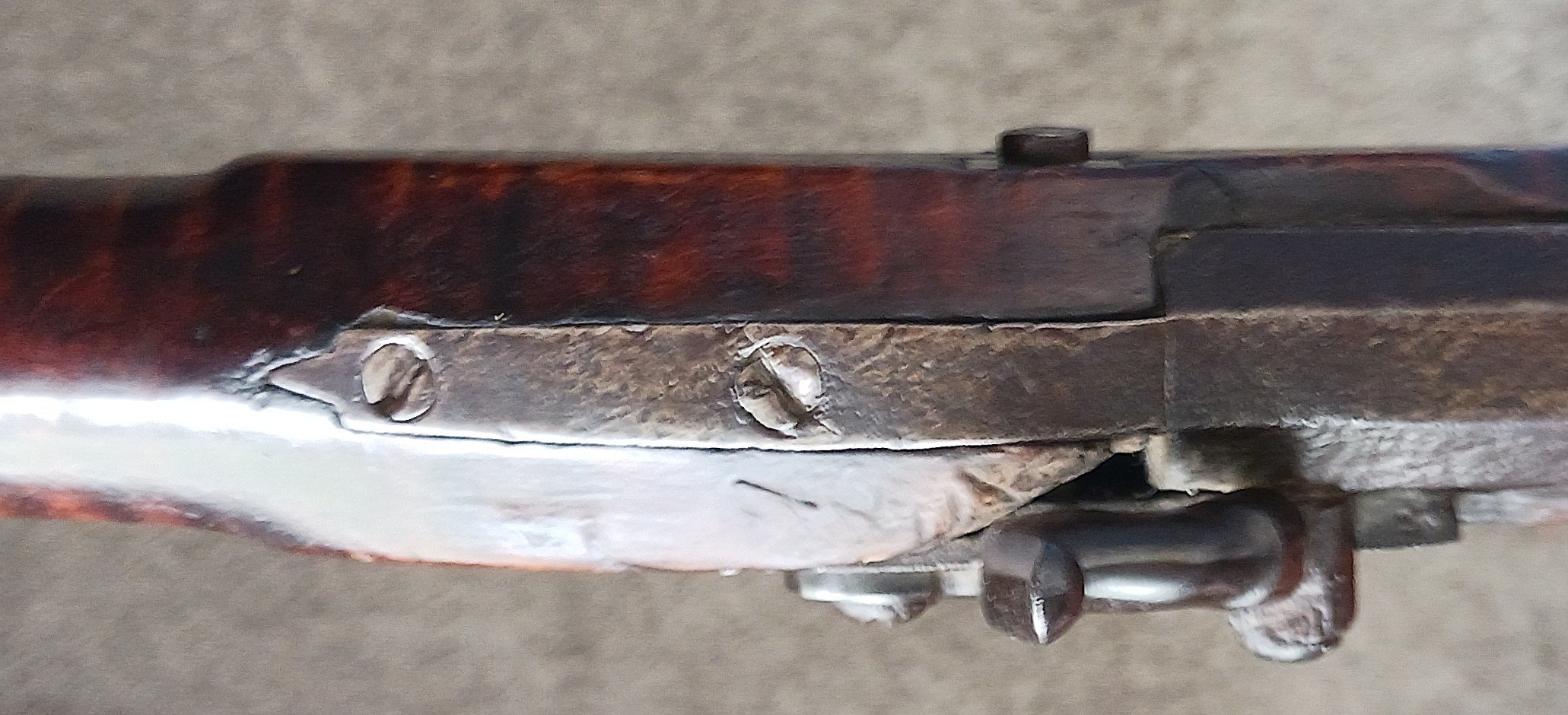
Figure No.5: The gun’s tang behind the breech is strongly Kentucky in style with its additional length, two screws [tang bolt and tail screw], and a small finial.
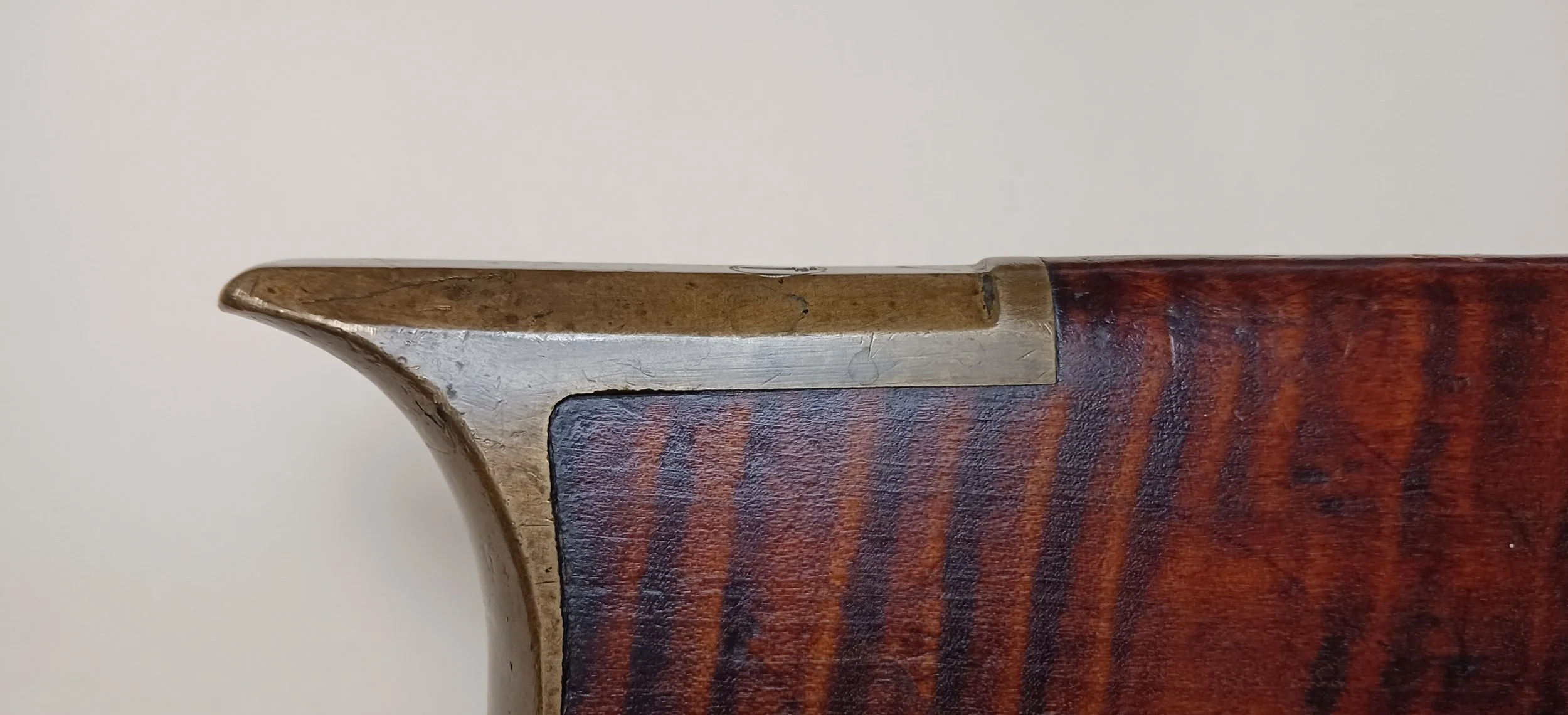
Figure No.6: The new rifle’s butt plate has a small, raised ridge on its top extension similar in size and shape to Lexington School guns, but lacking Lexington’s two fine lines filed across it.
The new rifle’s entry ramrod pipe does not have a rear flange, similar to rear pipes used at times by Moses Dickson in Louisville and by a few other gunsmiths in/near Louisville. Its buckhorn style rear sight in Figure No.7 was not common on Louisville guns, but it was used by several Kentucky gunsmiths working upriver from Louisville toward Cincinnati with one gunsmith being Washington Jett of Port William or today’s Carrollton in Carroll County. Another noteworthy detail is the rifle’s lower butt and forestock molding lines. Rather than being a simple incised line, the lines were lightly relieved along their top edges, making the area below the incised line stand out as a sculpted molding. Finally, both sides of the butt have a ridge running along their center lines, a bit like Soddy rifles from eastern Tennessee. The ridge is visible on the butt’s front side in prior Figure No.1 but obscured on the back side since it turns into the top edge of the large cheekpiece.
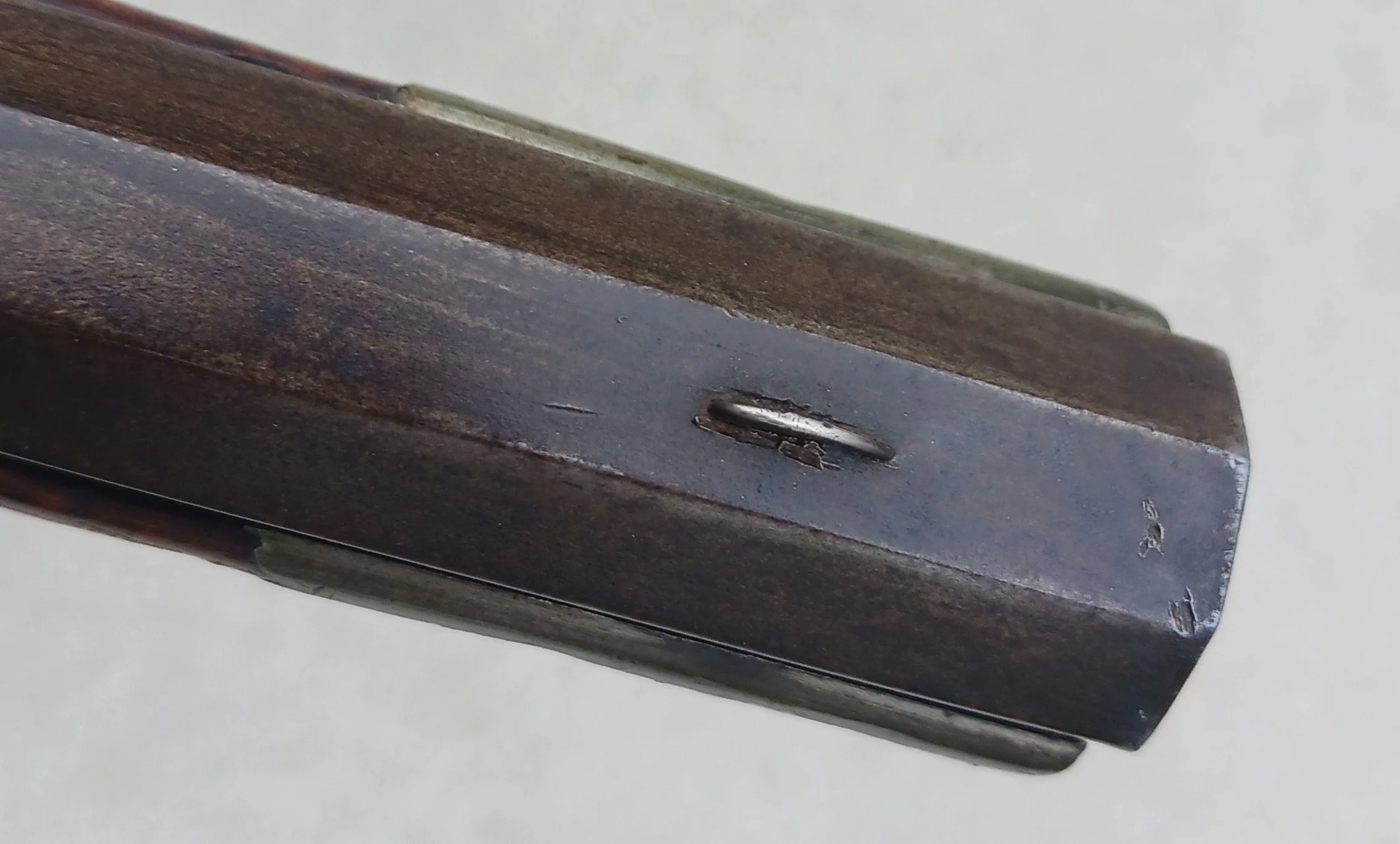
Figure No.7: The front sight on the new rifle is set into a small slot cut in the top flat of the straight [non-swamped] barrel, similar to front sights and straight barrels on Lexington School rifles as well as in some counties above Lexington going toward the Ohio River.
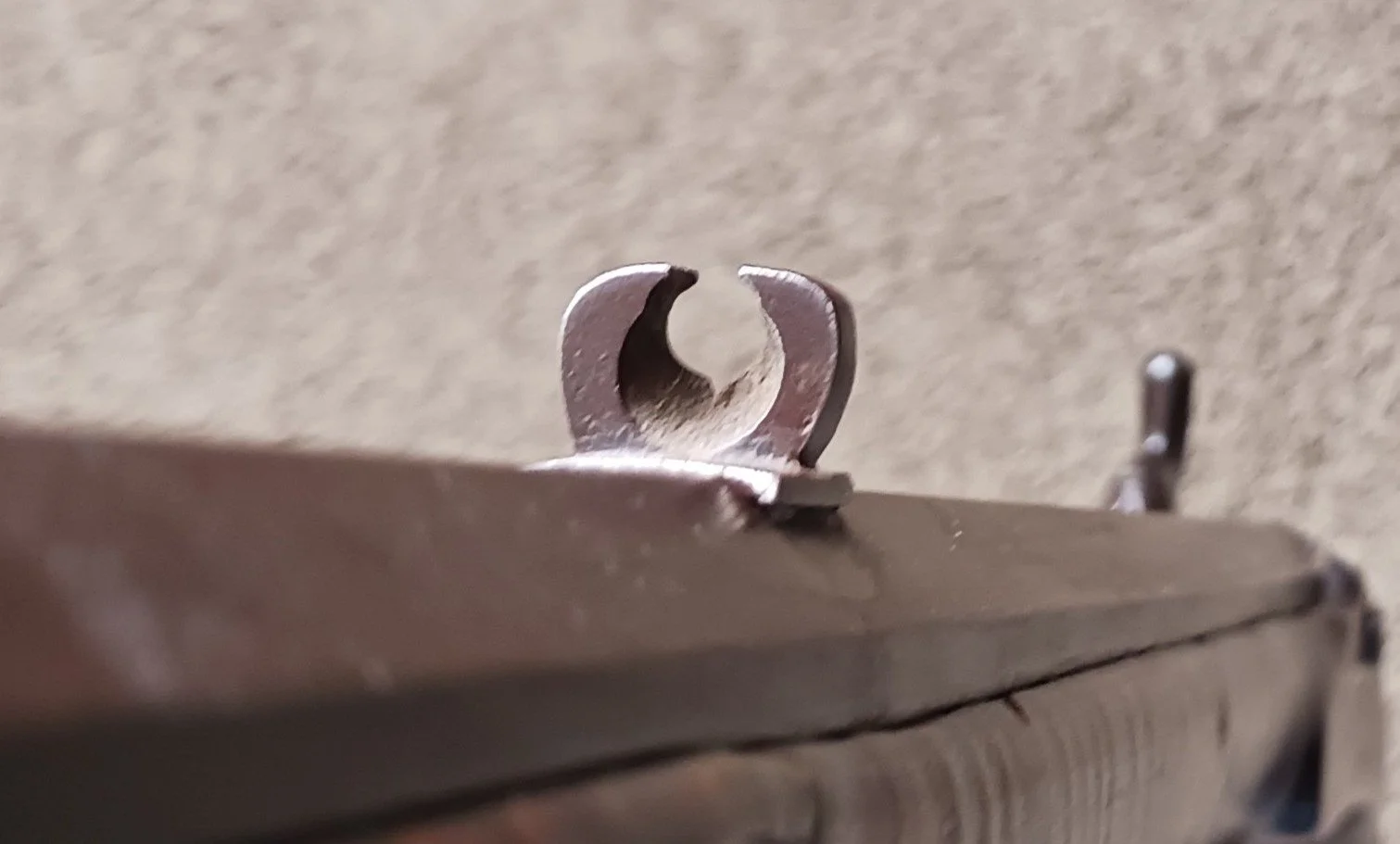
Figure No.8: This may be a key to identifying the new rifle’s maker… the use of a tall “Buckhorn” style rear sight. It was seldom used in Louisville and Lexington, but several Kentucky gunmakers on/near the Ohio River northeast of Louisville used it.
Attribution: The study rifle has yet to be properly attributed, despite numerous people examining it over the years. It is a fascinating rifle with superb wood and attractive features that have drawn collectors to it… but no one has been able to identify its origin with any supporting evidence. The author was offered the opportunity to acquire the rifle after years of knowing about it, and he purchased it on the strong possibility it came from northern Kentucky on or near the Ohio River, where both Louisville and Lexington influences were seen in area guns. The author was told by one collector that he had seen two guns with similar nose caps that were collected in Lewis County, Missouri, in the 1960s. However, no images of the reported nose caps were provided to verify their similarity. The author has seen several full-stocked percussion era Missouri rifles that could be mistaken for Kentucky guns, and many central Kentuckians [including gunsmiths] migrated to northeastern Missouri’s Lewis County and Clark Counties in the 1830s and 1840s, so that area is a possibility. However, it is difficult to explain away the gun’s original “Cincinnati” lock plate and triggers/guard/butt plate all with strong northern Kentucky styling. The author thinks the gun will eventually be documented to northern Kentucky near the Ohio River and perhaps closer to Cincinnati than Louisville… when a similar signed rifle by a lesser-known maker appears that is out there just waiting to be found.