
Golden Mountain Rifles - the 10th School of Kentucky Gunmaking ©
Foreword: The Mountain Rifle School in southeastern Kentucky covers the hilly Cumberland Plateau region where backwoods gunsmiths were mechanics, blacksmiths, carpenters, and millwrights who made guns in their spare time… and their guns looked like it. A typical mountain rifle by Kentucky’s best known Mountain Rifle School gunsmith, John Shell of Leslie County, is shown in Figure No.1. It has a simple walnut stock, forged iron mounts, and no embellishments. But a few highly skilled gunsmiths in the southern end of the school were capable of making exceptional rifles that far exceeded the usual mountain rifles. They worked in the Mountain Rifle School, but the superior quality of their work sets it apart as “Golden” Mountain Rifles.

Figure No.1: This Kentucky mountain rifle by John Shell is signed “No 35 1870 J S $16” on the barrel. Due to Shell’s late-in-life notoriety for claiming to be the oldest living man in the world, he became the best-known Mountain Rifle School gunsmith in Kentucky. The rifle has hammer marks on the barrel, a two-piece iron butt plate nailed on the stock, and a simple iron guard screwed to the stock. Ramrod pipes and nose cap are brass. The gun is typical of many Kentucky mountain rifles in its simplicity with walnut stock, iron mountings, hand-made lock, and no inlays or molding lines. In the hill country, it was a basic tool for hunting and protecting of the homestead. Barrel: 46-5/16 inches with .36 caliber bore. Author’s collection, photo by J. Jaeger.
Golden Mountain Gunsmiths: The originators of “Golden” Mountain Rifles were Pleasant Wilson of Clay County and John Bull of Knox County, two men whose work was exceptional by any standard. Several other area gunsmiths also made “golden” quality mountain rifles when called upon to do so. Those men included John Bull’s nephew, Jesse Bull, of Harlan County [1]; possibly Jesse’s son Jacob Bull of Josh Bell County [Bell County today]; William Hall of Floyd County; and Stephen Langford of eastern Pulaski County. Among the Golden Mountain Rifle gunsmiths, John Bull was the oldest, born in 1754 and in Kentucky by 1806 where he taught the trade to his nephew Jesse Bull and neighbor William “Gunsmith Billy” Hall. Pleasant Wilson and Stephen Langford were trained in Kentucky after their arrival, but their teachers remain unknown. Golden Mountain Rifles have beautiful, racy lines with North Carolina and Bull/Bean influences, while Langford’s rifles hint at a Virginia influence despite his coming from North Carolina when young.

Figure No.2a: Pleasant Wilson of Clay County consistently made fine guns, way above the typical mountain rifle of southeastern Kentucky. Even his plain guns have an elegance in architecture and finish work, setting them apart from the “working rifles” of most hill country gunsmiths. This is one of his best rifles with great architecture, graduated ramrod spacing, German silver inlays, and his own design of a small, side opening iron patchbox that matches his other iron mountings. Barrel: 46 inches with .36 caliber bore. Author’s collection, photo by J. Jaeger.
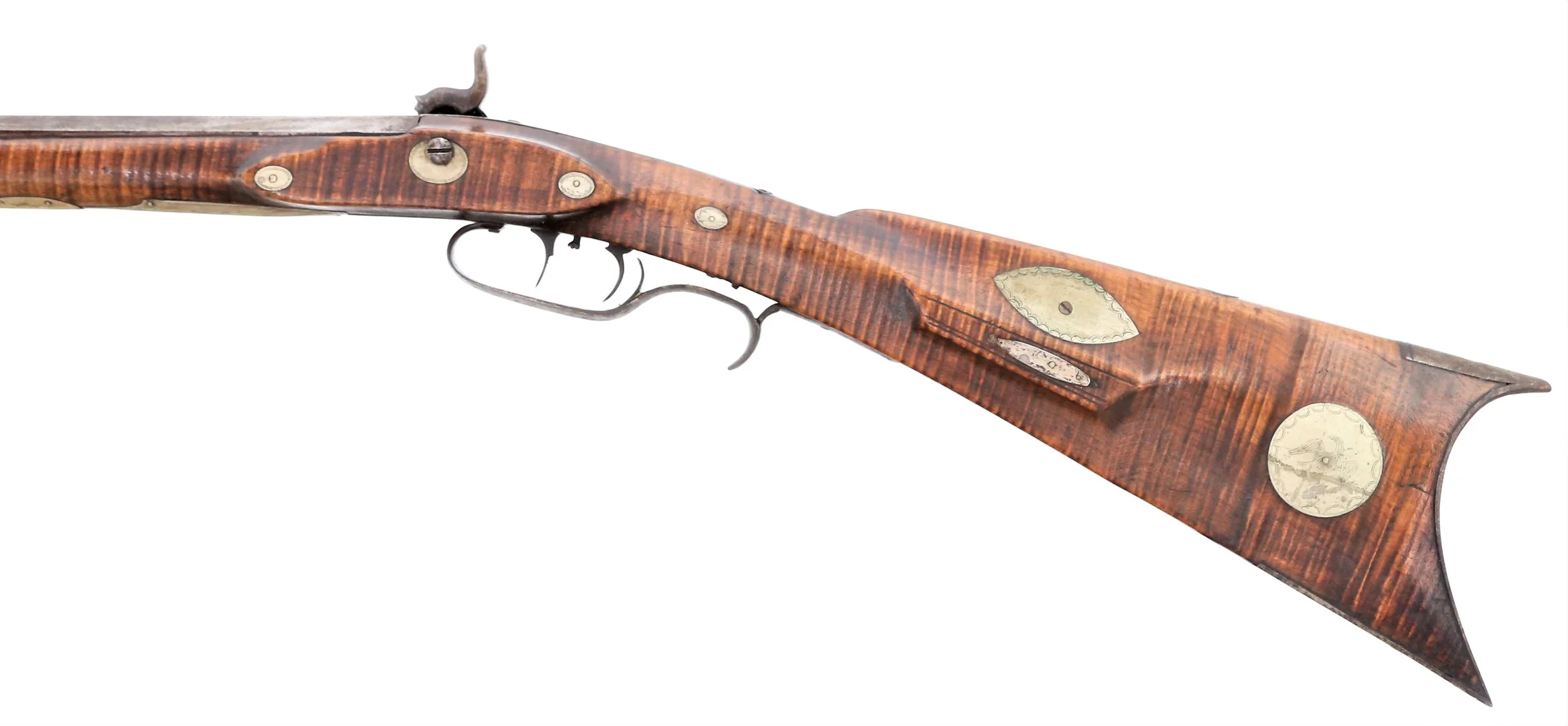
Figure No.2b: The back of Pleasant Wilson’s fine mountain rifle displays even more German silver than the front side. His cheekpiece has two molding lines, his oval lock bolt washer has an off-center bolt location, and his guard is unique without a front extension where the tang bolt threads into the front of the bow. Wilson’s engraving was limited to wiggle-engraved borders and simple arc cut borders. The round butt inlay has a federal eagle done completely in wiggle engraving.
Golden Mountain Rifles: Kentucky’s traditional mountain rifles are walnut stocked, iron mounted, and lack embellishments such as inlay work, molding lines, and patchboxes. Stocking often appears “hurried” with less care than stocks on other Kentucky guns while hand-forged mountings often are a bit crude. John Shell’s rifle in Figure No.1 illustrates most of the mountain rifle characteristics seen in Kentucky. In stark contrast, Golden Mountain Rifles have fine curly maple stocks, well-filed mountings in either iron or brass, sleek stock architecture, inlay work, patchboxes, and at times molding lines. Pleasant Wilson’s Clay County rifle in Figures No.2a and 2b above is beautifully stocked in curly maple with inlay work and a side-opening patchbox. The rifle is a “mixed metal” gun with major mountings made of hand-forged iron and secondary mountings [pipes and nose cap] made of German silver, with all hardware finely shaped and finished. A second Pleasant Wilson rifle in Figures No.3a and 3b is not as embellished, yet it captivates the eye with its superb stocking, graceful lines, and unique patchbox. Wilson’s rifles feel as good in the hand as they look to the eye.

Figure No.3a: This rifle, in the author’s opinion, is the finest stocked rifle made in Kentucky. Stocking is perfection with its fine architecture, curly maple wood enhanced with graduated ramrod pipes, and a long, lightly swamped barrel. The guard has Wilson’s unique front attachment by the tang bolt, and his “trademark” small side-opening patchbox that blends with the other iron mountings. The original finish has darkened with age, making the wood’s fine curl hard to see. Barrel: 46-1/2 inches, .32 caliber bore. Author’s collection, photo by J. Jaeger.
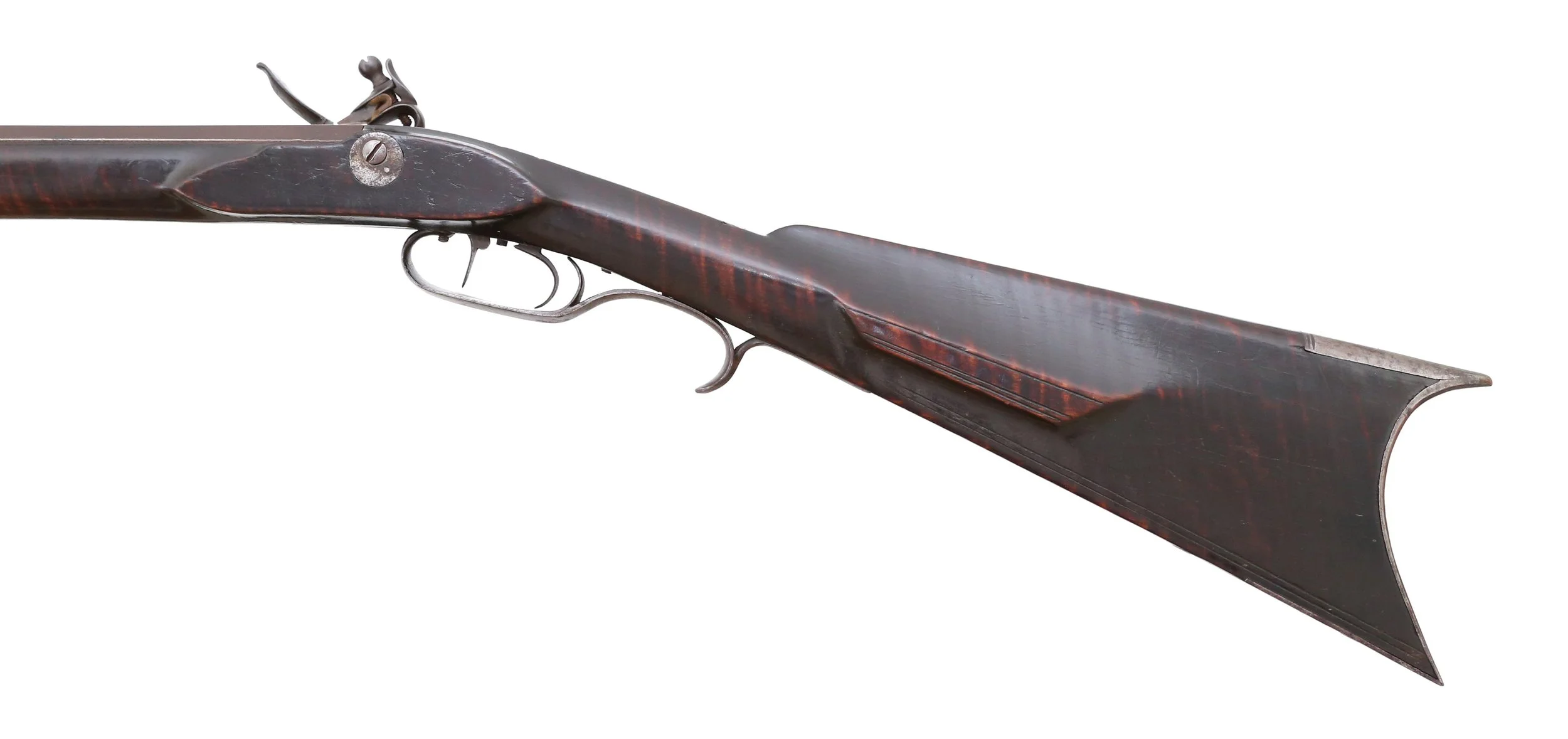
Figure No.3b: The back of Pleasant Wilson’s “dark” rifle exhibits sharp, clean lines with his typical cheekpiece with two incised lines. The lock bolt washer is original with its off-center bolt hole. Other than the side-opening patchbox, the rifle lacks embellishments, but its clean stocking with elegant lines, unmolested finish, and well-shaped and finished iron furniture make it one of Kentucky’s finest mountain rifles… if not the finest.
Gunsmith John Bull’s rifle from Knox County, Kentucky, in Figures No.4a, 4b, and 4c below matches Wilson’s rifles in quality and eye appeal. Bull arrived in Kentucky in 1806, but this rifle was not made until about 1830. It is the only signed John Bull rifle from Kentucky known to the author, despite rumors of other Bull rifles still in families in southeastern Kentucky. The work of William “Gunsmith Billy” Hall in Figures No.5a and 5b is strongly related to Bull’s work. While unproven, Hall apparently apprenticed under Bull. He was in Knox County with Bull at the right time and one of his rifles is identical to the illustrated Bull rifle in all aspects, including its unexpected “Lancaster” style daisy-headed patchbox.

Figure No.4a: This is the only signed “John Bull” rifle known from Kentucky, and it exhibits the best of mountain rifle gunmaking. Bull was from North Carolina, served in the Revolutionary War, and used his bounty land warrants at Bull’s Gap in northeastern Tennessee in 1796, where he built a gun shop. In 1806 he left the shop in charge of his nephews [whom he trained] John Valentine Bull and Elisha Bull and moved north into Knox County, Kentucky. The author has never seen an earlier signed John Bull rifle, despite this gun dating to about 1830. The gun has an unexpected “Lancaster” style patchbox with daisy finial and Tennessee style guard made from three brazed pieces of brass rather than forged iron. Author’s collection, photos by T. Prince.
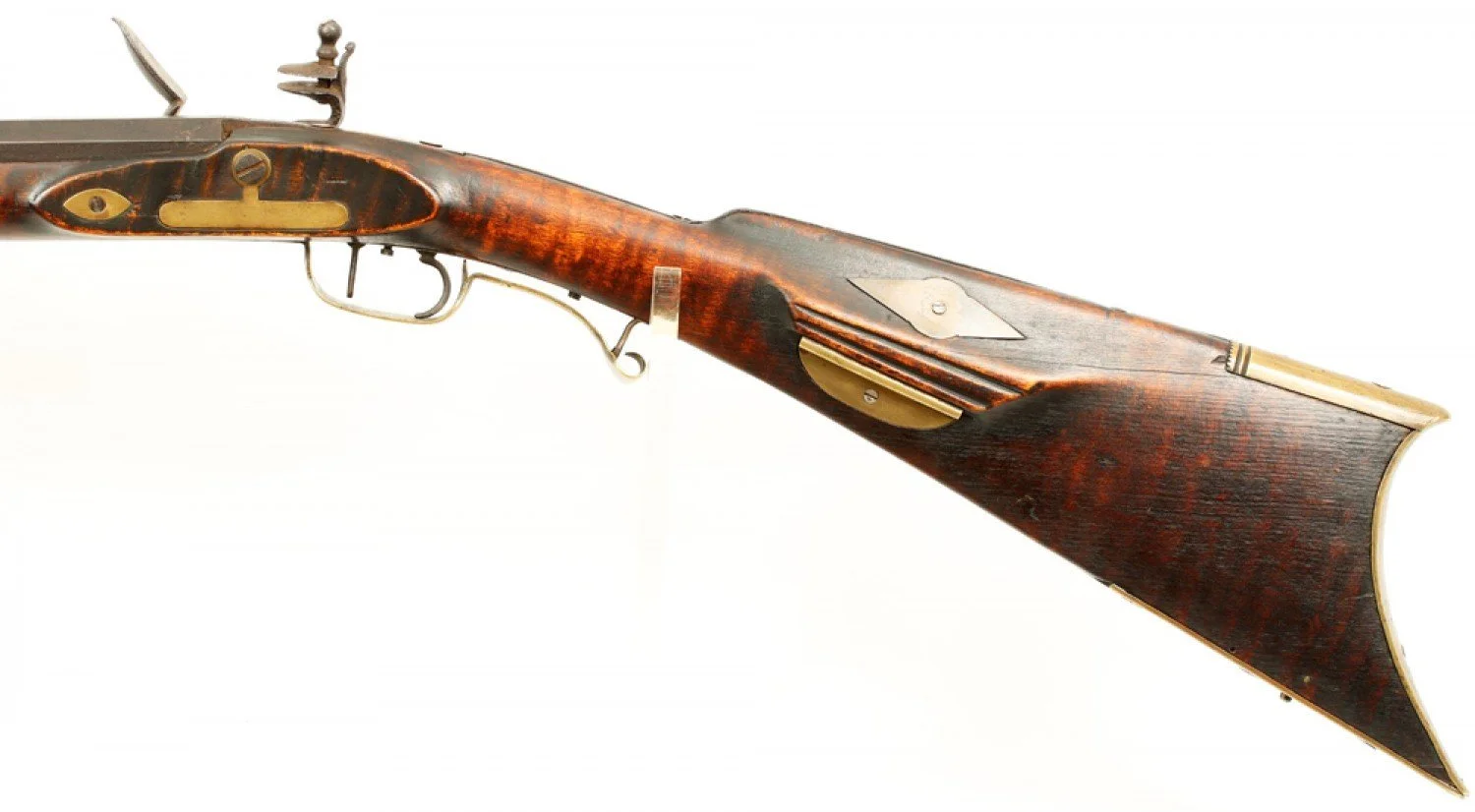
Figure No.4b: The back of John Bull’s rifle has his typical “inverted T” lock bolt washer with an oval front bolt washer. Mountings copy iron Tennessee furniture but are made of brass. Note Bull’s cheek inlay and vent pic holder. Barrel: 46-1/2 inches with .42 caliber bore.
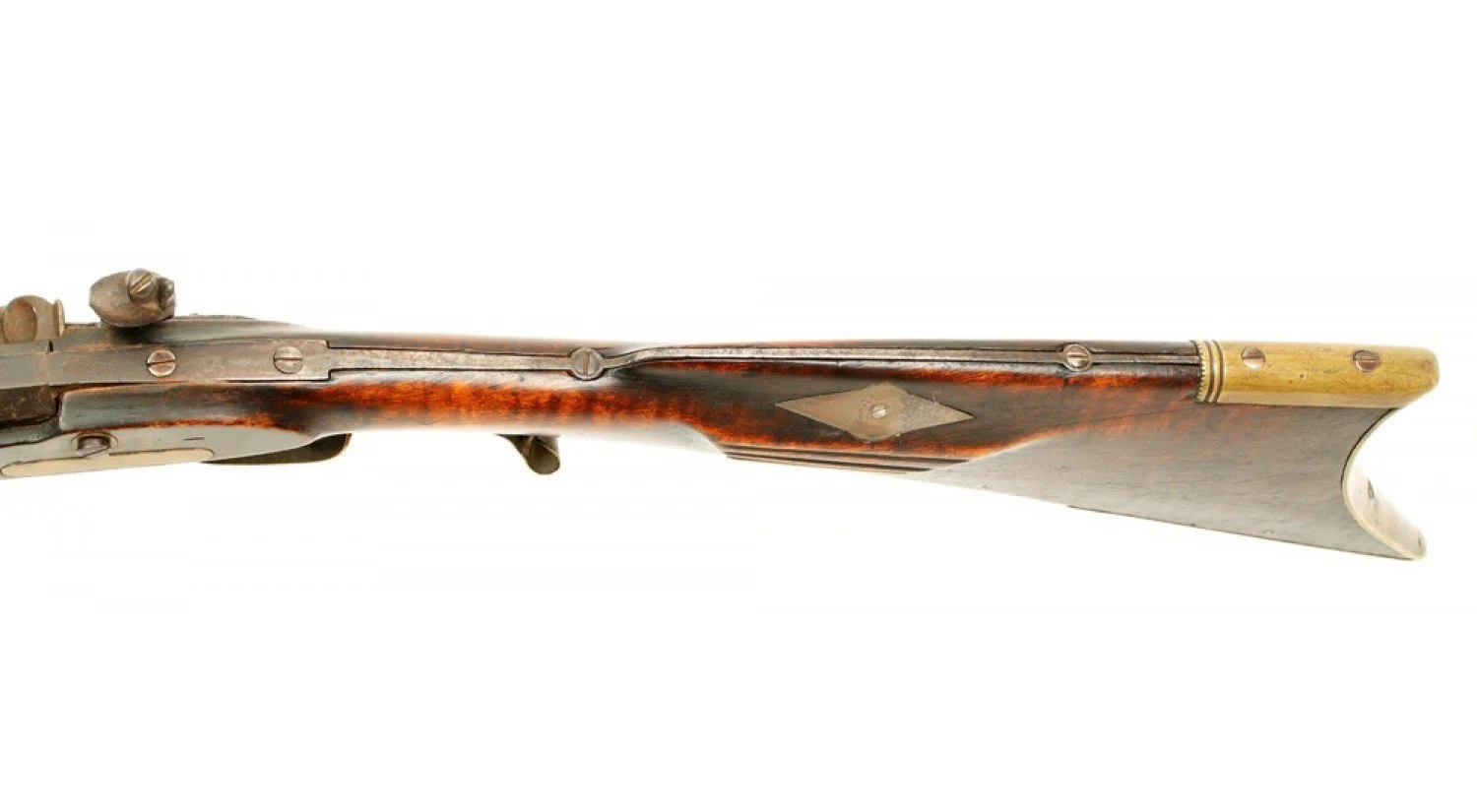
Figure No.4c: The Bull rifle has a long, Tennessee style tang that extends back over the comb to the butt plate. This same tang was used by local gunsmith William Hall, supporting the assumption he apprenticed to John Bull in Knox County in the 1810-1816 period.
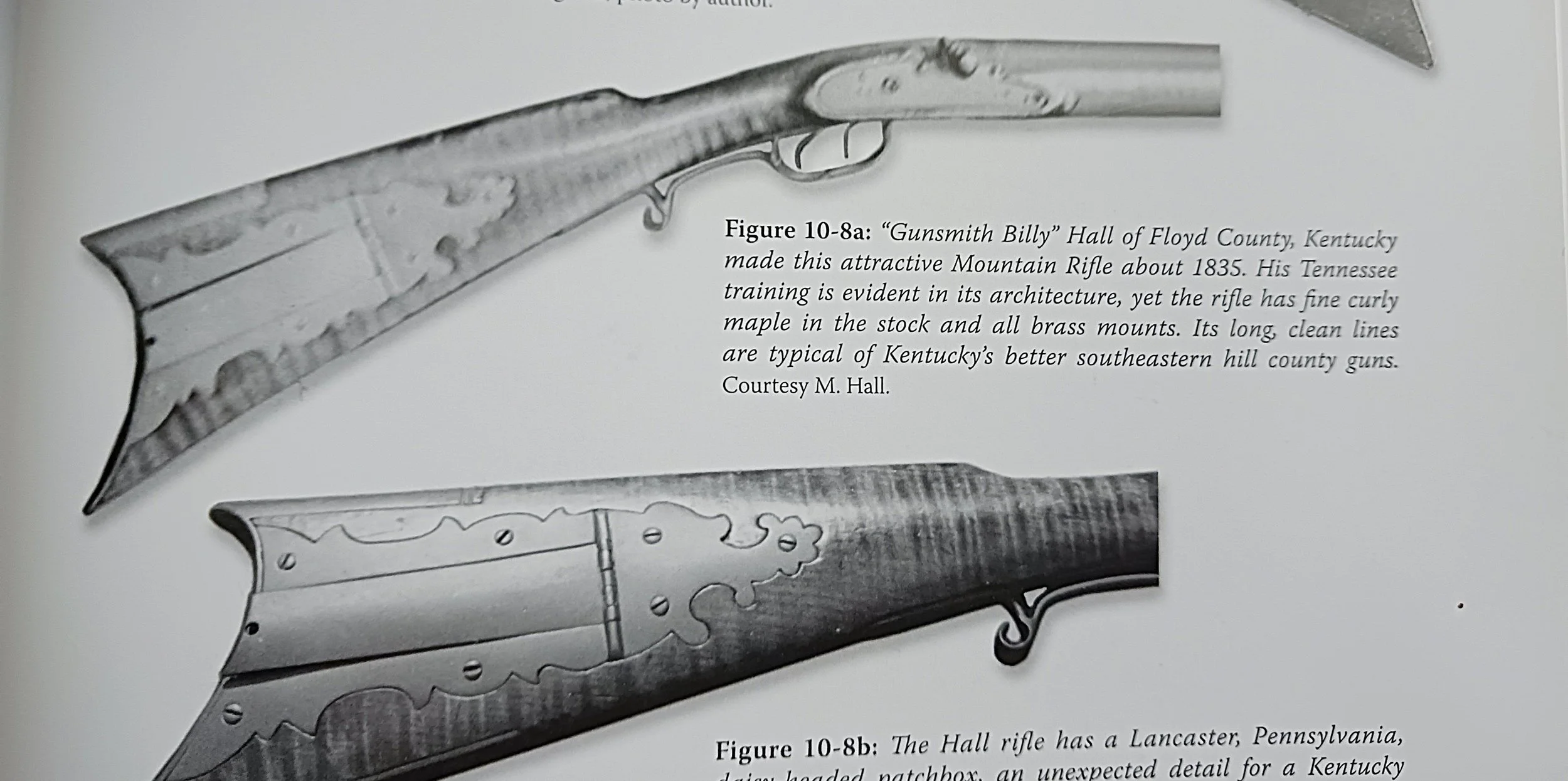
Figure No.5a: This image shows William Hall’s Floyd County, Kentucky, rifle with the same architecture, guard shape, brass furniture, and Lancaster style patchbox with daisy finial used by John Bull. [2] The gun was made in 1835 as a wedding gift, which documents its date.
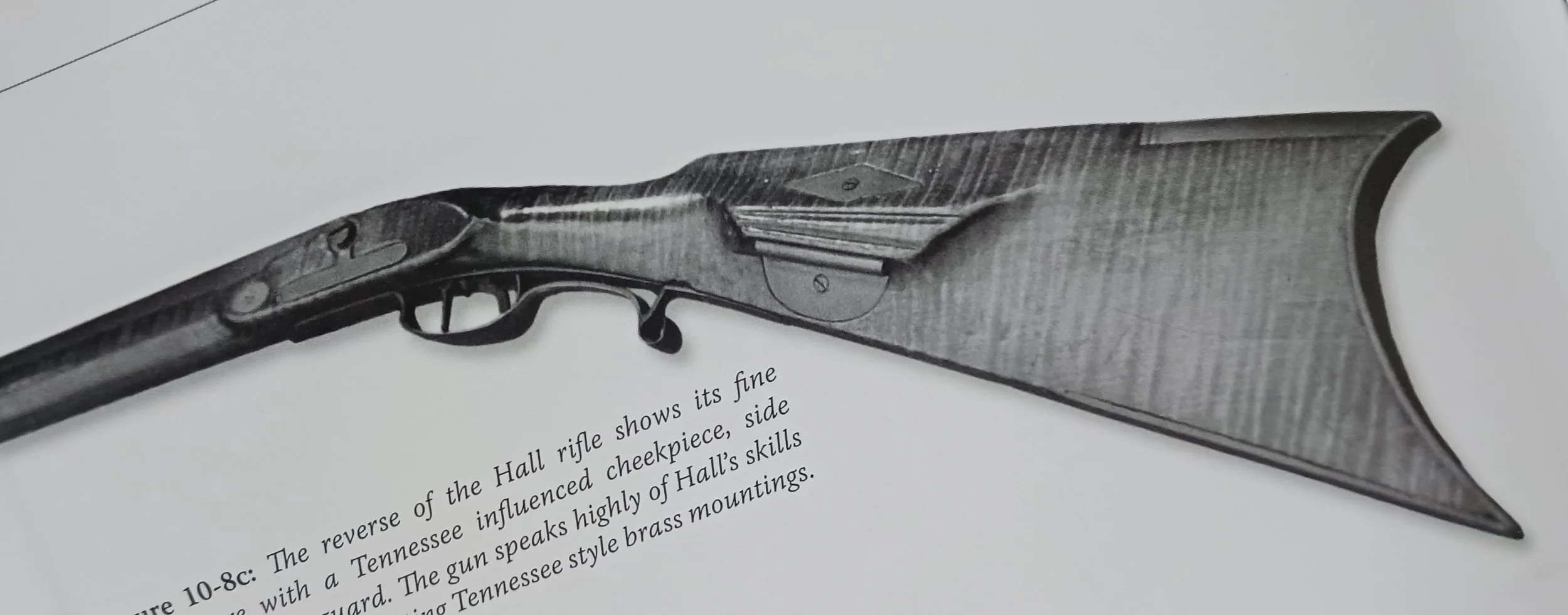
Figure No.5b: William Hall’s early rifles closely followed the work of the older John Bull, as the stock architecture, lock bolt washers, guard, cheekpiece, and inlay work show, supporting the idea that Hall was apprenticed to Bull. Several known Hall rifles are plain with simpler stocking, but he could make a fine rifle when the need arose, such as this one made for his son-in-law, John Bates, as a wedding gift in 1835. The gun remains with descendants of John Bates as a family heirloom, despite losing its percussion hammer. Barrel Specs: unknown.
A second rifle signed by Hall has similar stock architecture and mountings that include an extended Tennessee style tang, but it has all iron furniture. Its most important feature is a rare “captured lid” iron patchbox with a “bullet” shape seen in Figures No.6a and 6b below. The rifle dates about 5 years later [ca. 1840] than the above Hall rifle based on a bit more drop in the butt, narrow 1-1/4 inch thick butt, shorter barrel, and small bore. Yet it retains the same racy architecture with extended toe and slim forestock seen in the earlier rifles by Hall and Bull. The author has not examined the gun in-hand, but its rear sight position suggests the gun was re-breeched with the barrel shortened about 2 inches.

Figure No.6a: This iron mounted rifle with a rare captured-lid patchbox is signed “W H” in William Hall’s usual block-letter barrel signature. The gun has Hall’s typical stock architecture and iron furniture with a Tennessee style tang and guard, but it is decorated with small silver forestock inlays that suggest the owner was financially well off… at least by Appalachian standards. The author had never seen this “bullet” style captured lid patchbox on a Kentucky gun before the appearance of this rifle. Barrel: 40-1/2 inches with .32 caliber bore. Courtesy R. Pierce.

Figure No.6b: The back of the William Hall rifle with iron mountings and a captured lid patchbox is similar to his other rifles, with two molding lines on the cheekpiece, a diamond-shaped cheek inlay, and typical “inverted T” lock bolt washer, and a smaller, oval front bolt “washer” only for decoration on an original single bolt percussion rifle. Rifles by both Hall and Bull have strongly extended toes that changed little over the years, making it an unreliable dating indicator. Courtesy R. Pierce.
A final damaged rifle shown in Figures7a and 7b appears to be Hall’s work based on similar stocking, iron mountings, and “bullet” shaped iron patchbox. Unfortunately, its worn barrel has no visible signature. The gun may be later than Hall’s other illustrated rifles based on not having a “faux” front lock bolt washer. None of Hall’s known rifles, or Bull’s rifle, use two lock bolts despite having false front lock bolt washers to make them look earlier. Single bolt flintlocks were common in Kentucky from the mid-1820s onward, so these guns may have had either flintlock or percussion ignition. The damaged rifle’s lack of a false front lock bolt washer tends to put it in the percussion era and therefore later than the other illustrated “Golden” rifles with false washers. While probably Hall’s work, slight variations in the iron patchbox leave its attribution a bit open and John or Jesse Bull should also be considered. Future hands-on inspection may resolve the maker issue.
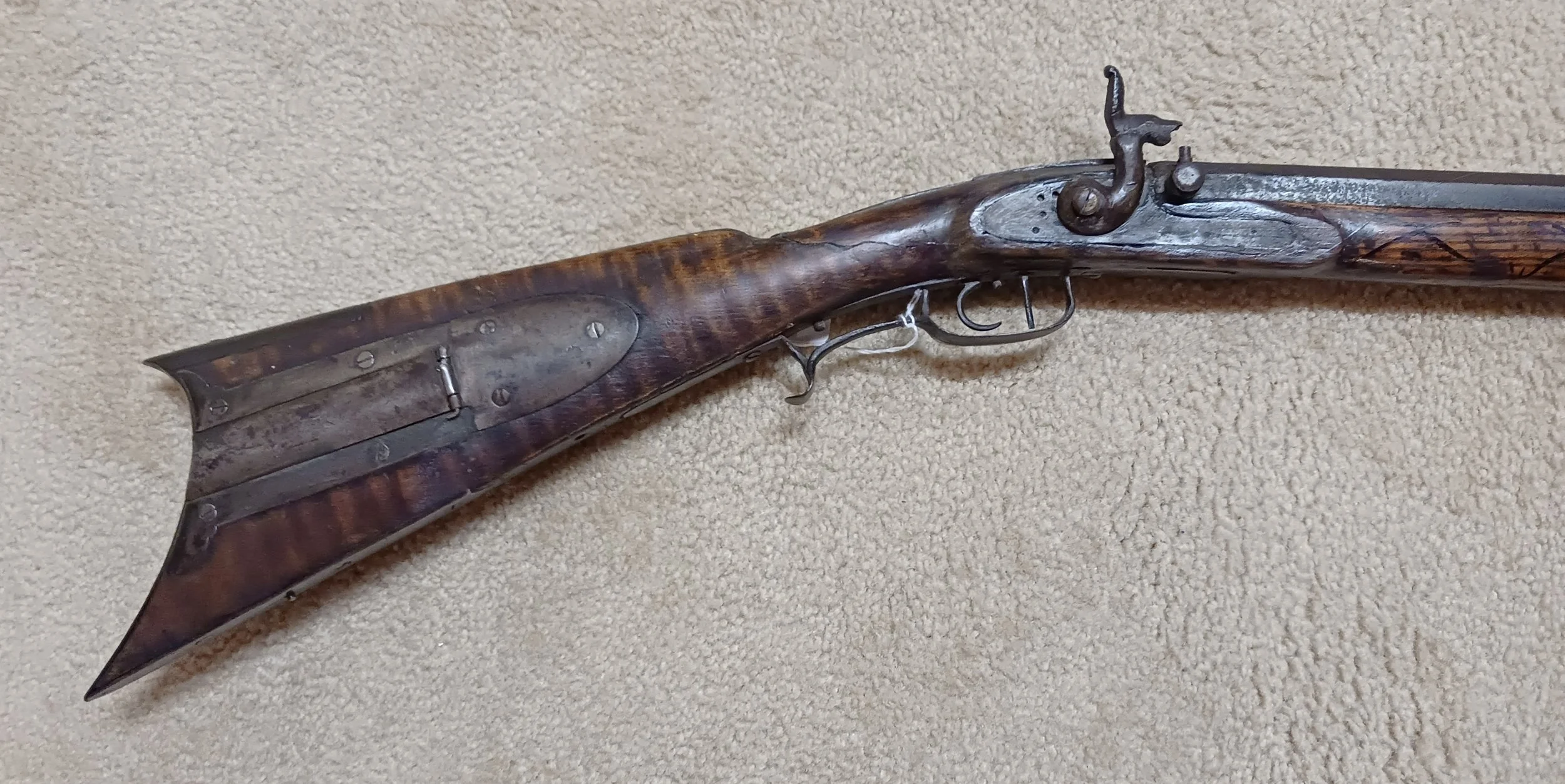
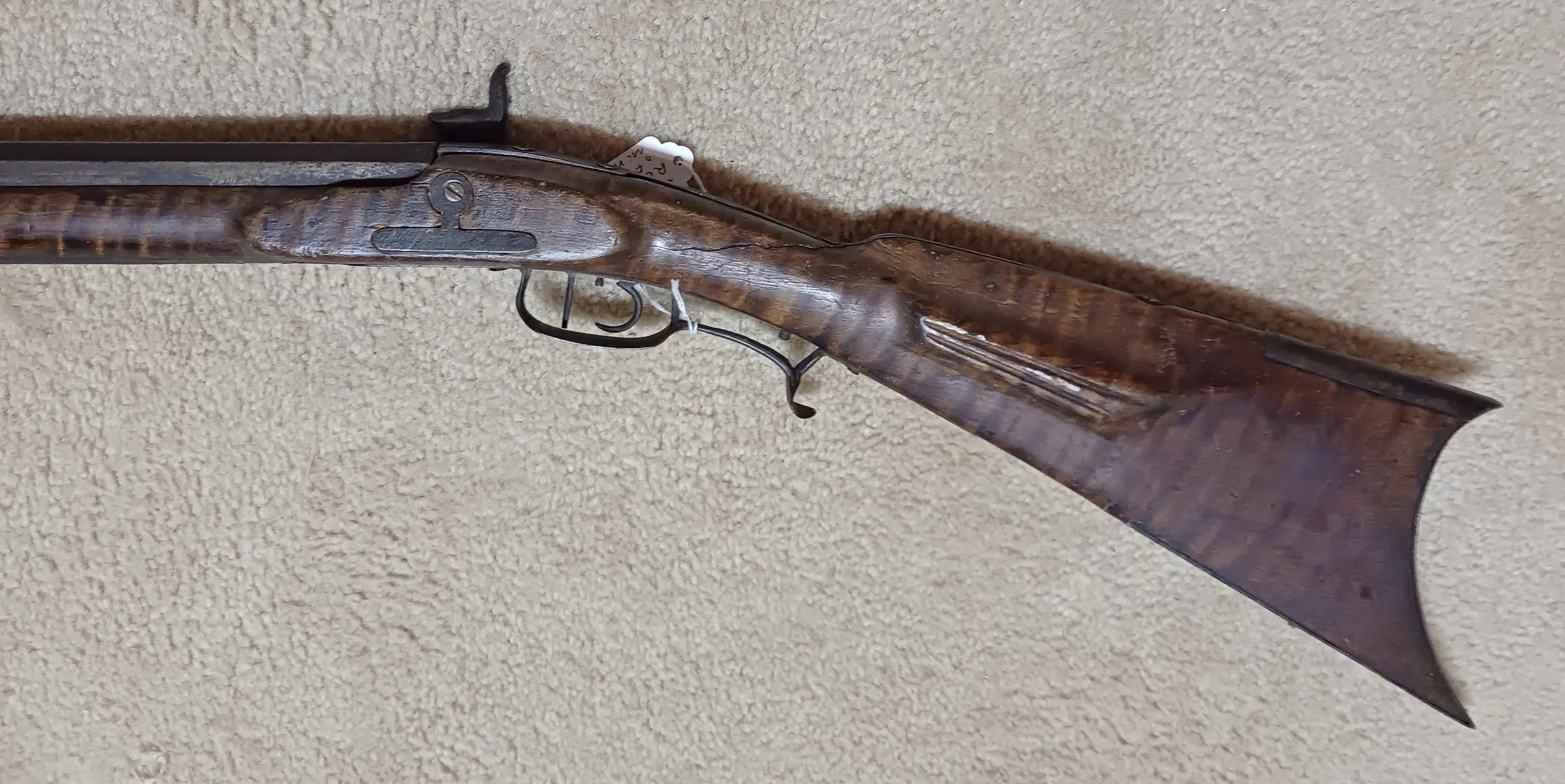
Figure No.7a and Figure No.7b above show the unsigned rifle with a “bullet” shaped iron patchbox similar to the work of William Hall. The gun differs from the other guns by its lack of a false front lock bolt washer, strongly suggesting is has always been a percussion rifle. Other details such as the cheekpiece shape, “inverted T” lock bolt washer, butt plate with two filed lines on its top extension, and extended tang that runs over the comb to the butt plate all closely follow Hall’s work. However, slight variations in the '“bullet” shaped patchbox with its 4-piece construction [rifle No.6 is 2-piece] and rounded nose leave the attribution slightly open for another area gunsmith. This rifle lacks cheekpiece and forestock inlays along with no false front lock bolt washer. Despite its damage and less decoration, it has good curly maple wood and stock architecture, shows above average workmanship, and has a rare iron “bullet” shaped patchbox, all details of a superior mountain rifle and sufficient to consider it a Golden Mountain Rifle.
Stephen Langford of eastern Pulaski County has several surviving rifles, with one surpassing all his other work with its fine curly maple stock, good architecture, and attractive brass patchbox with a dog’s head finial. The gun is fully brass mounted and according to family descendants, the dog’s head finial originally had a gold collar and silver teeth, but any precious metal overlays are now gone. That one rifle, when his other guns are plain, elevates Langford to a Golden Mountain Rifle gunsmith. Photographs of his fine gun were not available for this article, but images of it can be seen in Kentucky Gunmakers, Vol. 1, p.246. Gunsmiths Jesse Bull of Harlan County and Jacob Bull of Josh Bell County were trained by “Golden” mountain rifle gunmakers and may be “Golden” gunsmiths, but the author has not seen a signed rifle by either man to verify his ability. It is also possible that both John Bull and Pleasant Wilson had other apprentices or journeymen that were well-trained and capable of working as “Golden” gunsmiths. However, the total number of Mountain Rifle School gunsmiths capable of superior quality work that elevates them to the “Golden” Mountain Rifle School is undoubtedly small.
Footnotes:
[1] John Bull established a gun shop at Bulls Gap in northeastern Tennessee in 1792 or 1793, While at Bulls Gap, he trained later Tennessee gunsmiths John Valentine Bull and Elisha Bull [sons of his younger brother Jacob Bull] and left them in charge of the Bulls Gap gun shop when he moved north into Knox County, Kentucky, in 1806. Jesse Bull was John V. and Elisha Bull’s younger brother who went with John Bull to Kentucky where he was trained as a gunsmith and worked in nearby Harlan County.
[2] Images and a detailed description of the Stephen Langford rifle can be found in Kentucky Gunmakers 1775-1900, Vol. 1, pp.245-246.