
An Exceptional 1809 Francis Tansel Powder Horn ©
Foreword: Powder horn collectors all have opinions on which horns are the most outstanding, most historically significant, or simple the most attractive to the eye... and the same is true for those who collect Tansel powder horns. The author has owned many fine Tansel powder horns over the years, and his favorites are the early horns of Francis Tansel made in the decade before the War of 1812. Perhaps his horns made in the first few years of his carving career are the most interesting, but the author leans toward the horns carved just before and during the War of 1812 as his personal favorites. One horn in particular has impressed the author with its superb condition, fine construction, and extensive artwork. The horn has survived in excellent condition and is signed “Fransis Tansel” and dated “1809.” It has impressed the author so much that it has become his favorite pre-War of 1812 Tansel powder horn.
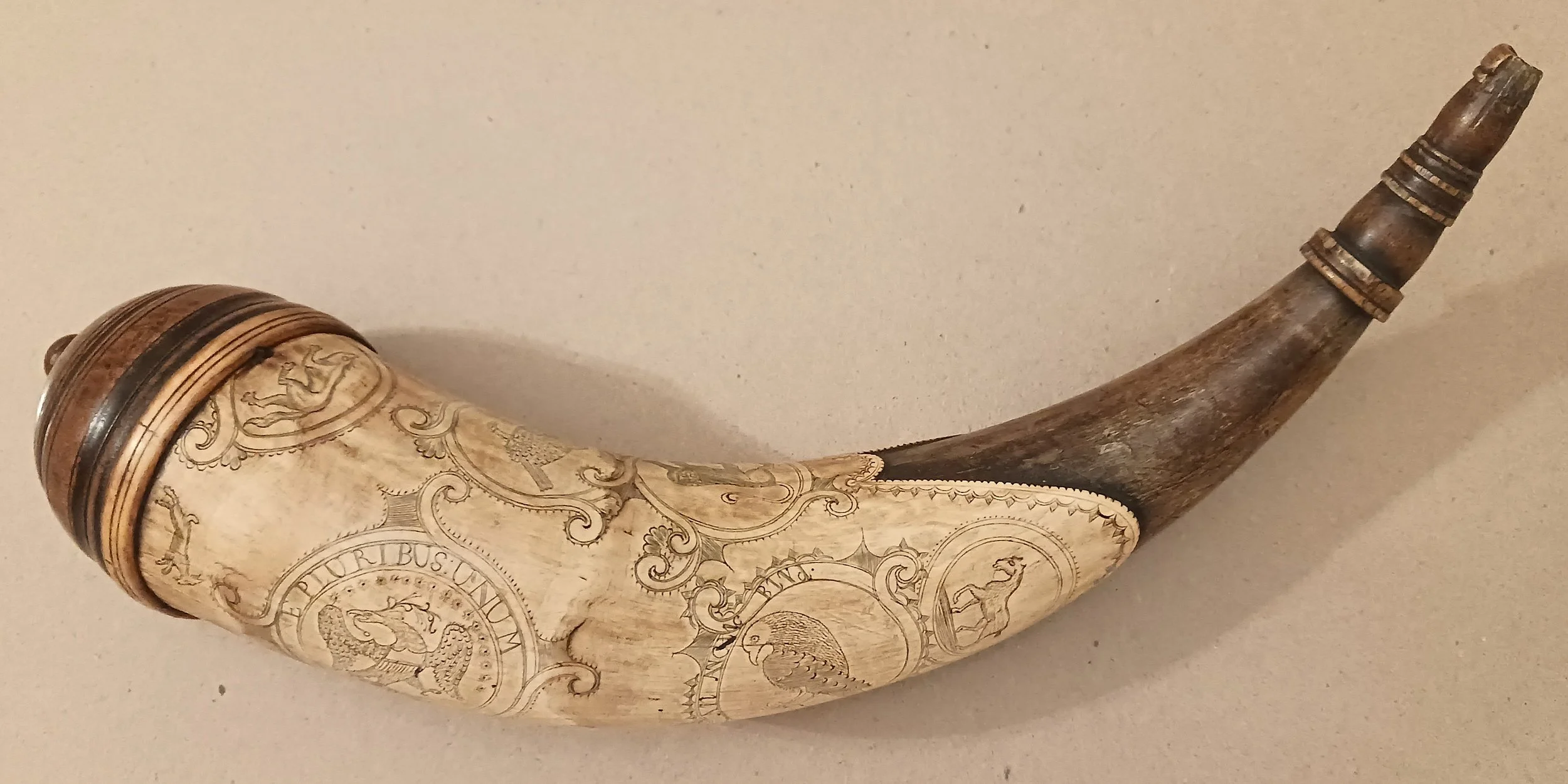
Figure No.1: The front side of the Fransis (sic) Tansel horn has his typical War of 1812 federal eagle in a round cartouche with “E Pluribus Unum” arced over his head. There are seven animals “caged” in round cartouches, with three deer, a bobcat, and a turkey running around loose on the horn. Dimensions: Outside curve 15 inches, inside curve 11-1/8 inches, horn diameter at base 2-15/16 inches. Author’s collection, photos by author.
Make it stand out
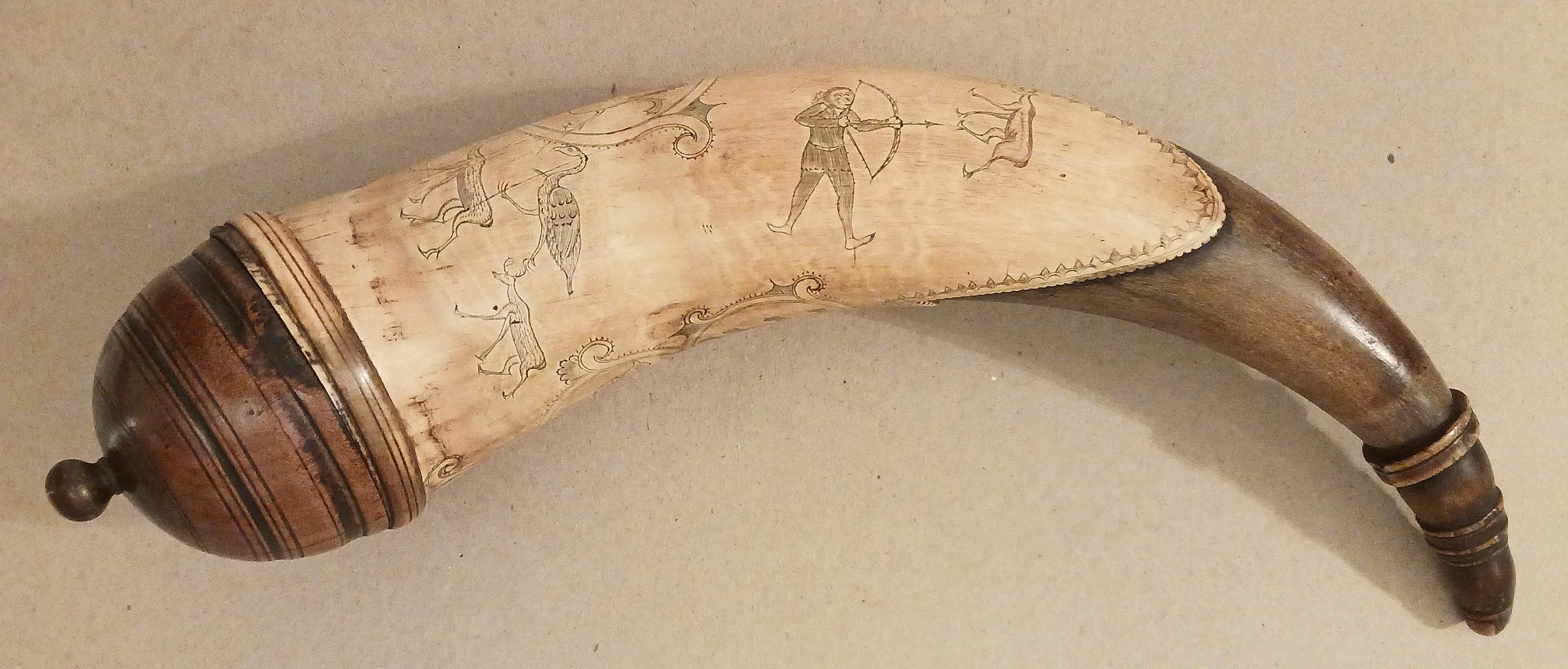
Figure No.2: The back of the “1809” Tansel powder horn has Francis’ typical Indian figure with bow and arrow shooting at a deer. On the butt end are two more deer and a wild turkey. Note the fine condition of the horn with its original spout tip, horn button in the plug for strap attachment, and narrow horn ring behind the plug that hides the plug nails. Both the horn button and the thin horn ring hiding the nails are often broken or missing.
Francis Tansel’s Early Horns: The early work of Francis Tansel slowly evolved through several distinct phases, or style changes, as he matured as a horn carver [1]. The author favors pre-War of 1812 horns because they show the developmental changes in his artform most clearly. Among those horns, his work from 1808 to 1812 [Phase 3] with his distinctive War of 1812 eagle in a round cartouche [2] has captivated the author. Within that group of horns are a handful of horns dated “1809” that the author favors due to their artistic consistency. The year 1809 must have had a significance to Kentuckians, perhaps the first inklings of the War of 1812, since it is the most frequently seen date on Francis Tansel’s early pre-war horns. Among the known 1809 horns, one horn stands out above the rest in the author’s opinion and has been called the “Thumb Nail” horn seen in Figure No.1 and Figure No.2 above. There are larger and more heavily decorated horns by Francis, but the “Thumb Nail” horn is beautifully decorated, signed and dated by Francis Tansel, survives in exceptional condition, and has an attractive turned walnut butt plug and hand-carved spout tip.
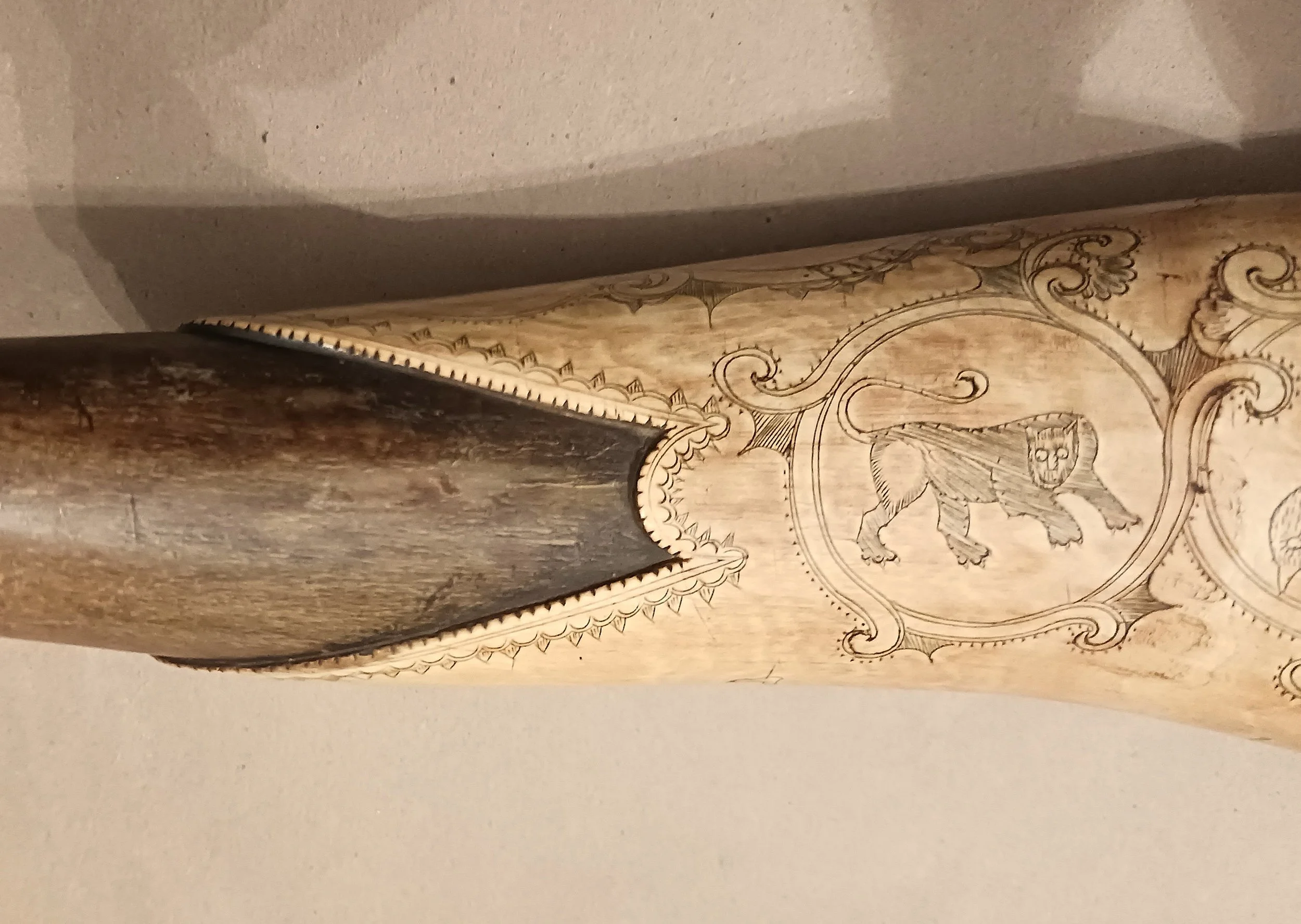
Figure No.3: The “Thumb Nail” horn’s name comes from the small tab in the intersection of the top “V” of the Tansel fish-mouth about the size and shape of a thumb nail. The unique tab adds interest to the horn, in addition to terminating the fish-mouth before it runs too deeply into the horn’s body and restricts the carving surface.
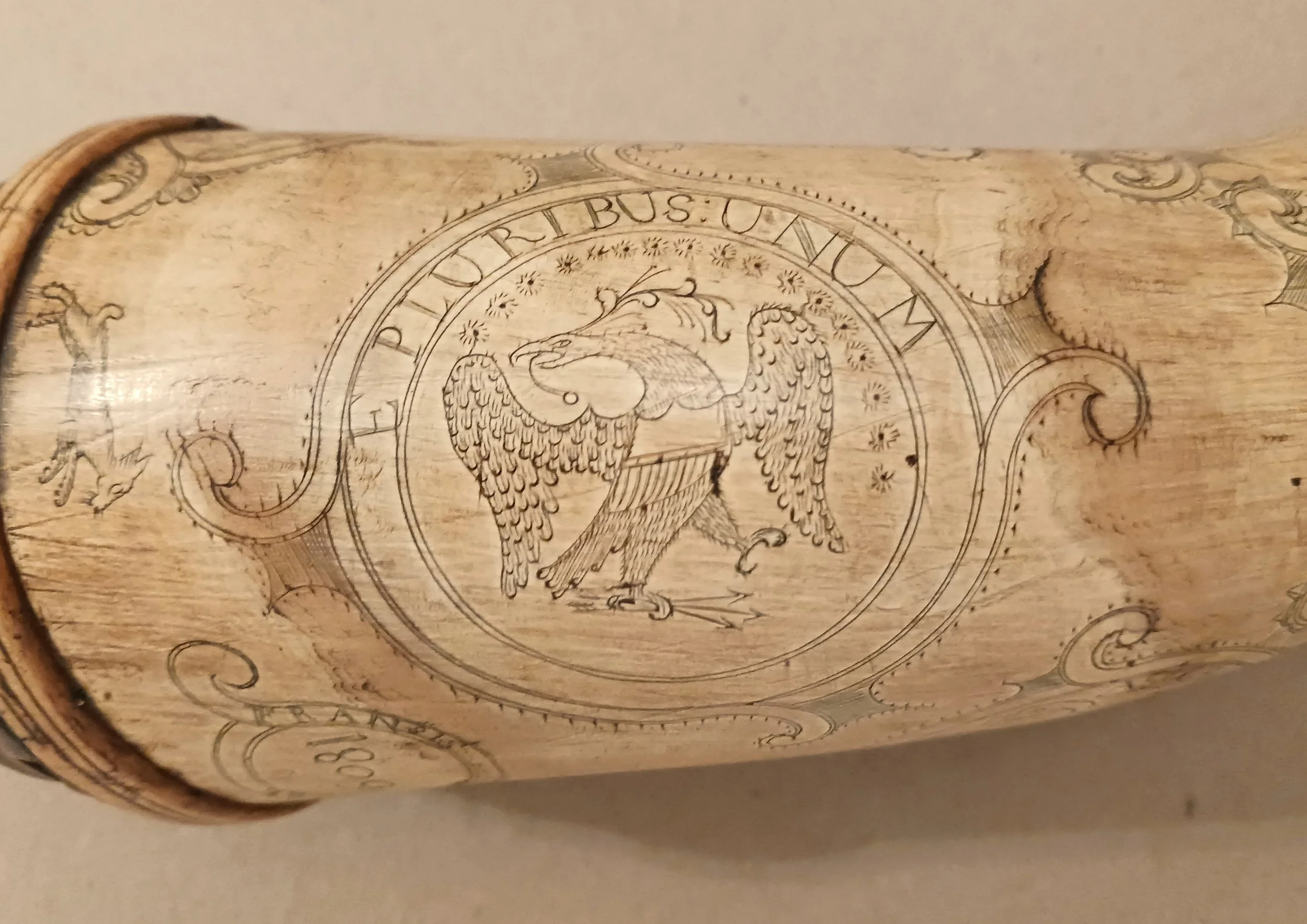
Figure No.4: Francis Tansel’s War of 1812 eagle, typical of eagles on horns used just before and during the War of 1812, was taken from the head of a Kentucky Militia officer’s commission/discharge document. While unproven, the presence of this style eagle on a Tansel horn may indicate the owner served in the Kentucky militia during the War of 1812.
The “Thumb Nail” Horn: Beyond its fine condition, meticulous carving, and mellow original surface, the “Thumb Nail” horn has a detail not seen on other Tansel horns. The fish-mouth on the top side of the horn has a small protruding “thumb nail” tab filling the bottom of its “V” notch as seen in Figure No.3. A menagerie of animals decorates the horn including the War of 1812 style eagle in Figure No.4 accompanied by a swan, arctic bird, horse, mountain lion, wolf, wren, turkey, bobcat, and the always present Tansel deer. Francis Tansel’s early “trademark” of an Indian hunter shooting a deer is seen in Figure No.5, while a smaller round cartouche near the butt is signed and dated as “Fransis (sic) Tansel” and “1809” in Figure No.6. The artwork is well spaced and covers the horn’s surface from end to end. As with most great carved horns, the original horn surface had the desired soft white color that has aged over the years to a mellow tan, allowing the carving to be clearly seen.
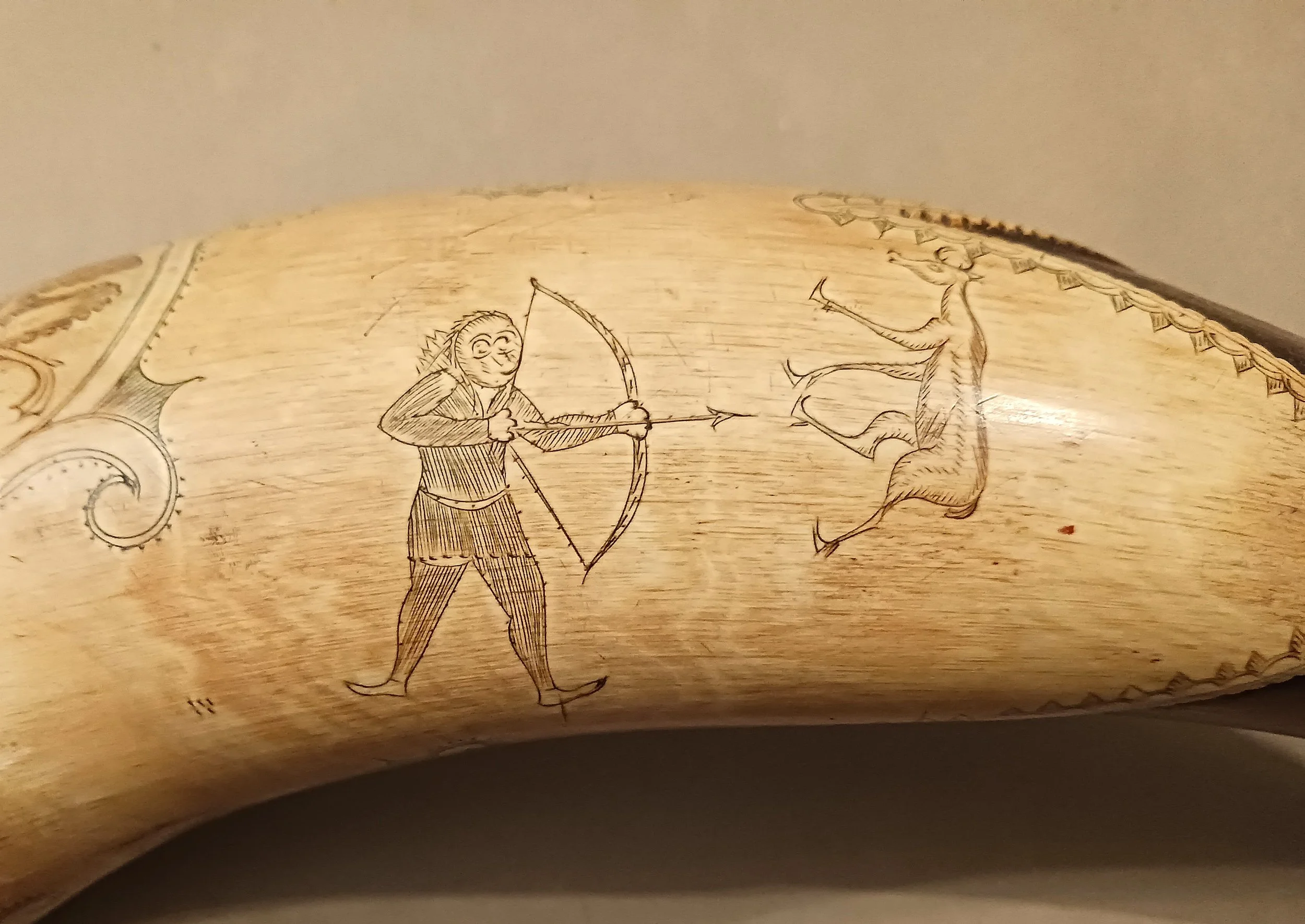
Figure No. 5: The majority of Francis Tansel powder horns made before 1812 have his traditional scene of an Indian shooting a deer with bow and arrow. Oddly, most horns have this same arrangement with the deer at a right angle to the hunter. Note the tiny pin prick dots around the Indian and his bow, suggesting Francis transferred pattens to his work.

Figure No.6: An important detail on the powder horn is the small, circular cartouche near the butt plug where Francis Tansel signed and dated his work. He spelled his first name as “Fransis” on this horn, but later signed horns and surviving civil records spelled his first name as “Frances.”
The horn body deserves comment. Francis Tansel’s early horns usually had a narrow horn band just behind the butt plug that covered the plug nails. Often with wear and age, the thin bands cracked and fell off, but this horn has retained its original horn band. Another detail that is often missing is the small horn button in the plug’s nose for strap attachment, which on this horn has also survived. The button has a tapered shaft about an inch long that is pushed tightly into a matching hole. Both the horn’s basal band and strap button are seen in Figure No.7. On the opposite end of the horn, hand-carved rings decorate the spout. A visible wear pattern from the strap can be seen below the lower strap retaining ring, indicating the horn was used/carried for a number of years. Another unusual detail is the horn’s “powder maintenance” tool. A small, rounded pebble was put inside the horn before the butt plug was mounted, sized too large to fall out through the spout, and today it rattles when the horn is handled. Several other Tansel horns are known with a small piece of stone or wood inside, thought to be intentionally placed there so when the owner carried his horn in the field, the stone or wood piece would jostle around inside the horn, keeping the powder free flowing and small clumps pulverized.
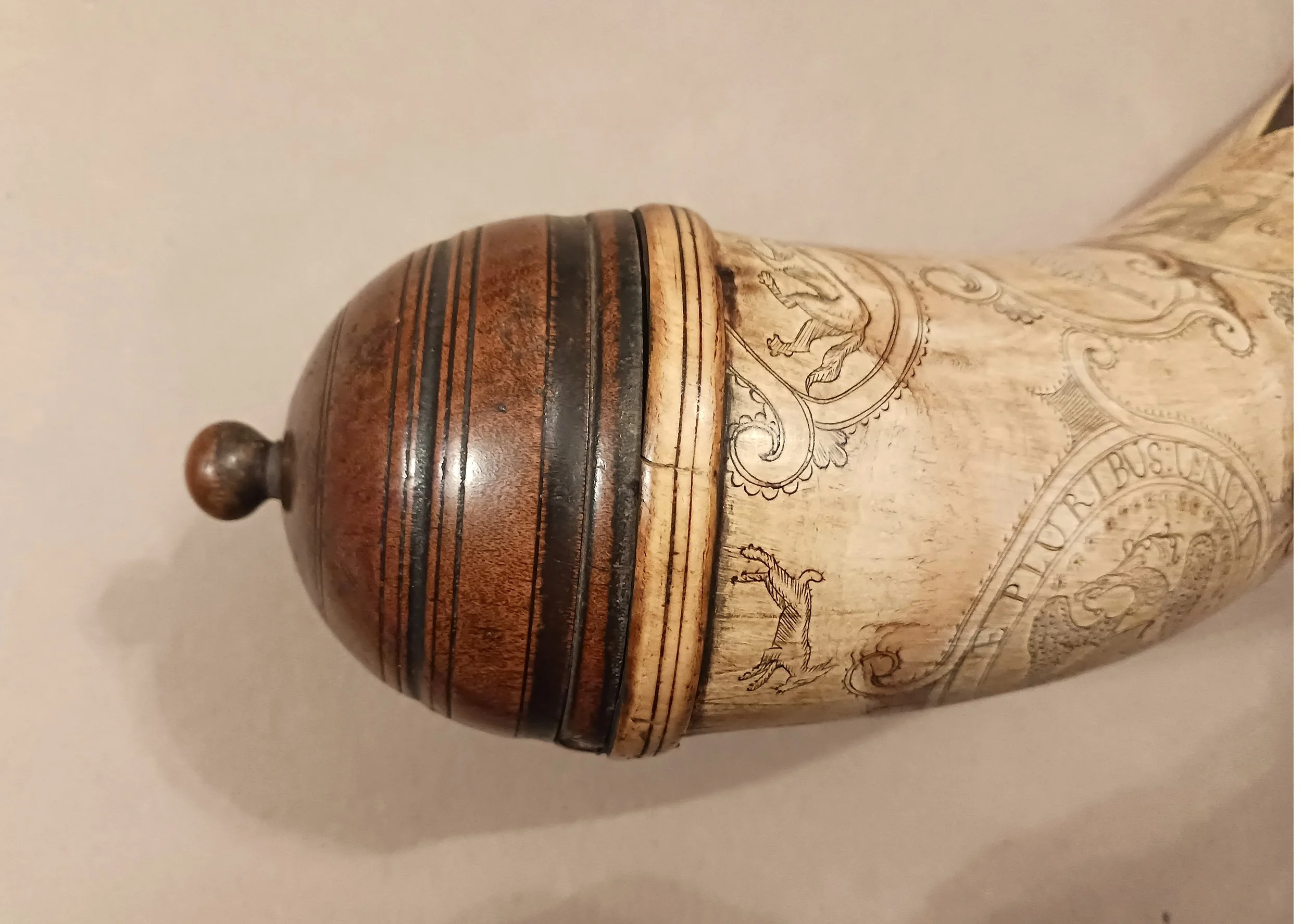
Figure No.7: This close-up view of the butt plug shows the horn button in its nose for strap attachment and the thin horn ring behind the butt plug that hides the plug pins/nails. Those two items are often missing, and even on this better than average horn, the beginning of a crack can be seen on the horn ring running with its directional grain.
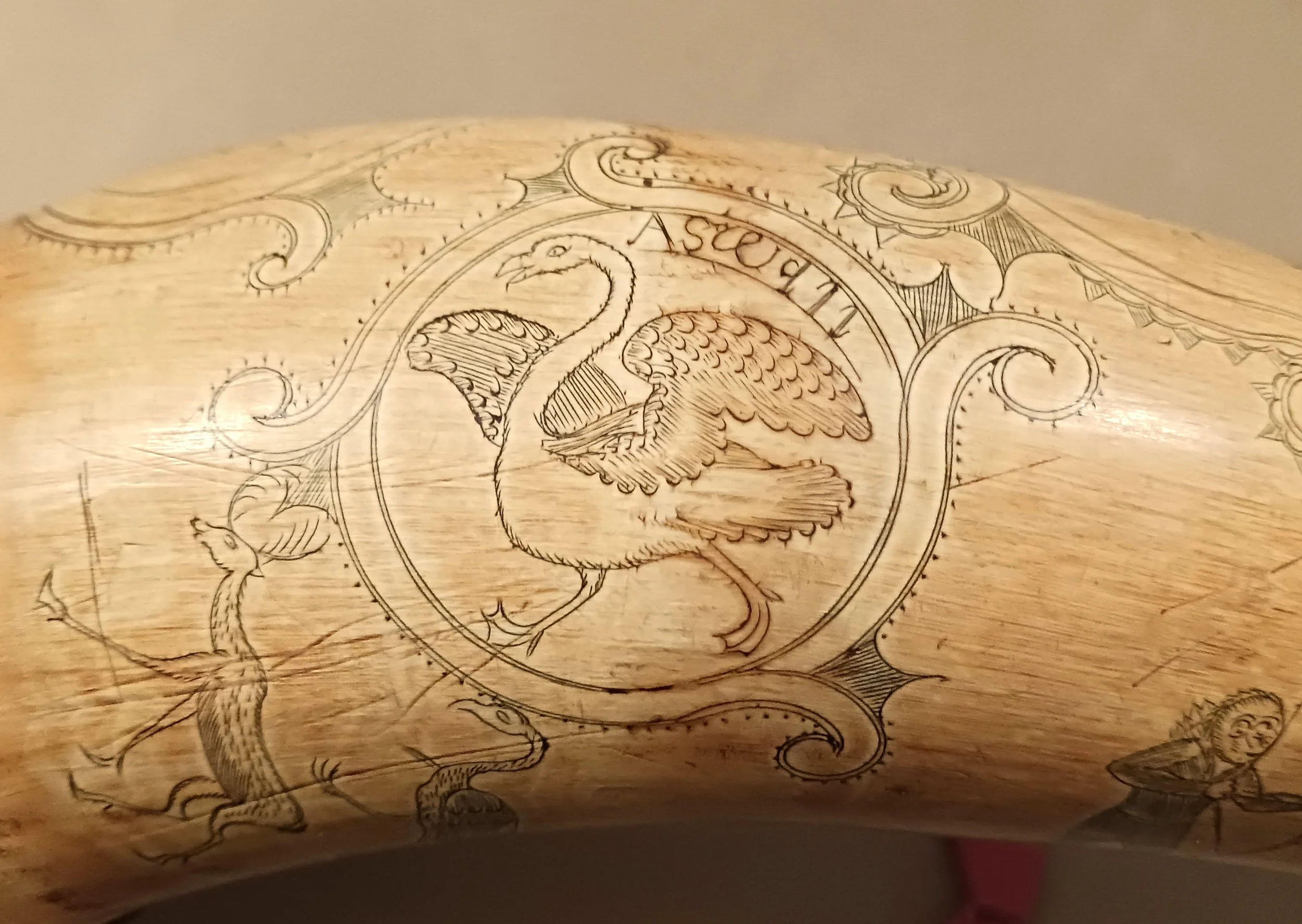
Figure No.8: Another interesting and often repeated figure on Francis Tansel’s Pre-War of 1812 horns is his swan figure. At times these swans are not labeled, but this one is clearly labeled as “A Swan” in a mixture of upper- and lower-case letters. A deer and turkey are just below the swan’s front foot.
Summary: The carving quality of different Tansel powder horns can be debated among collectors [and often is], but the “Thumb Nail” horn by Francis Tansel exhibits superior carving in its meticulous execution, wide range of figures, and layout that uniformly covers the horn’s surface. When a well-turned walnut butt plug and attractive, hand-carved spout is added to an already great horn, it’s hard to find a better Tansel powder horn from the pre-War of 1812 era. The horn’s only slight detraction is the lack of an original owner’s name. Perhaps the omission was due to Francis Tansel carving the horn without a specific owner in mind, or perhaps as the author prefers to think, he carved so many figures on the horn that, when finished, he realized there was no room left for the owner’s name!
Footnotes:
[1] A description of the six (6) identified phases of Francis Tansel’s work is available in: “Early Tansel Powder Horns from Kentucky,” Part I, Muzzle Blasts Magazine, November 2006, pp.4-10.
[2] Francis Tansel’s War of 1812 eagle was from the heading on Kentucky militia officers’ commission & discharge papers. For an example, see Kentucky Gunmakers 1775-1900, Vol. 2, p.315.
Post Script: A second pre-War of 1812 horn by Francis Tansel is illustrated below so that similarities and differences between the 1809 study horn (top) and a similar but slightly later circa 1811 horn can be seen.
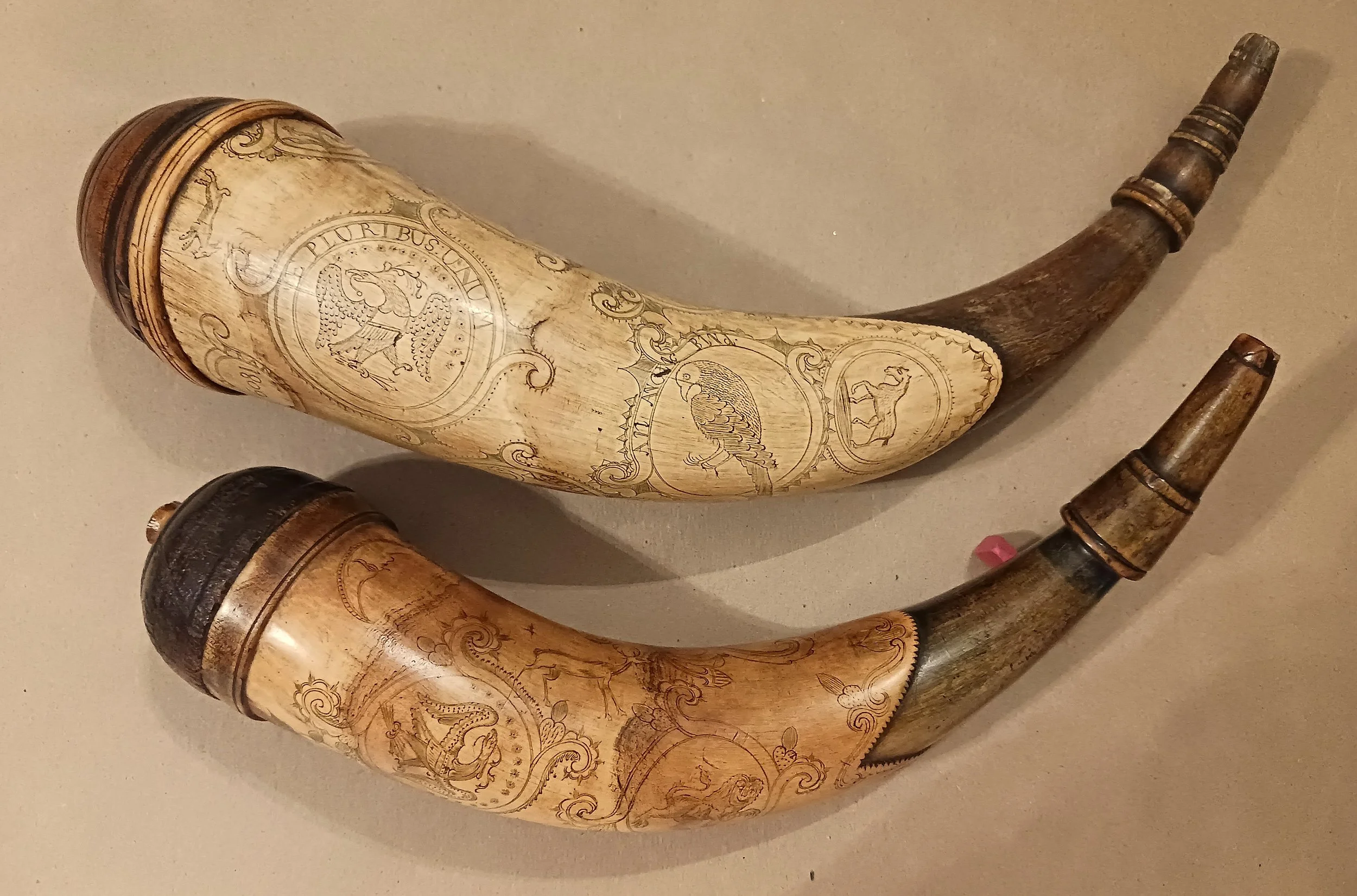
Figure No.9: For those who would like to see another pre-War of 1812 powder horn by Francis Tansel, a slightly smaller example is shown below the 1809 study horn. Both horns have a horn button in the plug’s nose for strap attachment, and a horn ring behind the plug to hide/protect the plug nails. Francis usually carved his eagles at this time in an upright position when the horn was carried, but the bottom horn’s eagle appears sideways when carried… probably the result of rushing the layout a bit. Also significant is the more elaborate spout on the earlier top horn, while the lower horn has an early example of the simpler Tansel “barrel style” strap retaining ring, heavily used years later by his third son Timothy. The top horn is dated “1809,” while the bottom horn has an estimated date of 1811 based on significant known dates and events in the life of its owner. Author’s collection, photo by author.