
Little Known Kentucky Gunsmith Morris A. Tilman of Adair County ©
Foreword: Many lesser-known Kentucky gunsmiths left little evidence of their work, raising the question of whether they made guns or primarily did repair work. When a rifle is found by one of these men, it changes their status from a “maybe” gunmaker to a documented gunmaker. Morris Tilman of Adair County, Kentucky, was one of those “maybe” gunsmiths for many years, until a signed gun was finally found.
Morris Austin Tilman: He was born to parents John Boxom Tilman (1768-1860) and Nancy Ann Bush (1774-1845) of Fluvanna County, Virginia, on August 23, 1797, trained as a gunsmith, and moved to Adair County, Kentucky, as a young journeyman in the early 1820s. He married Mary Ann Brown (1805-1875) in 1824 and first appeared in Adair County records in 1825. The Tilman’s’ first two children were born in Adair County, Jonathon in 1826 and James in November of 1827. Their third child named John was born in Crawford County, Indiana in December of 1828, documenting Tilman’s move from Kentucky to Indiana in 1828. He eventually had eleven children, worked as a gunsmith in Crawford County until the mid-to-late 1850s, and by 1860 was living in nearby Dubois County, Indiana. Tilman was listed as a “Gunsmith” in both the 1850 and 1860 censuses. He died on June 1, 1863, and was buried in Shiloh Cemetery at Ireland in Dubois County. It should be noted that Morris Tilman always spelled his last name with one “l” as Tilman, while other relatives, including his son James Henry Tillman (sic) who was a later Indiana gunsmith, spelled their last name “Tillman.”
Author’s Note: The reason for doing a blog article on little-known gunsmith Morris A. Tilman is the lingering question in the author’s mind about Tilman’s possible connection to the old Tilman Gun Store in Ft. Wayne, Indiana. Several generations of Tilman gunsmiths ran the store for the better part of a century, and two Tilman brothers were running the store in 1970 when the author moved to Ft. Wayne… but despite visiting the store back then, he never thought to ask them about their family history or how the Tilman name got involved with the gun store. The author has always thought Ft. Wayne’s Tilman Gun Store probably had a family connection to the early Kentucky/Indiana gunsmith Morris A. Tilman, perhaps through Tilman’s gunsmith son, James H. Tillman (sic), who worked in Warrick County, Indiana, for many years. The old Tilman gun store was demolished in the 1990s.
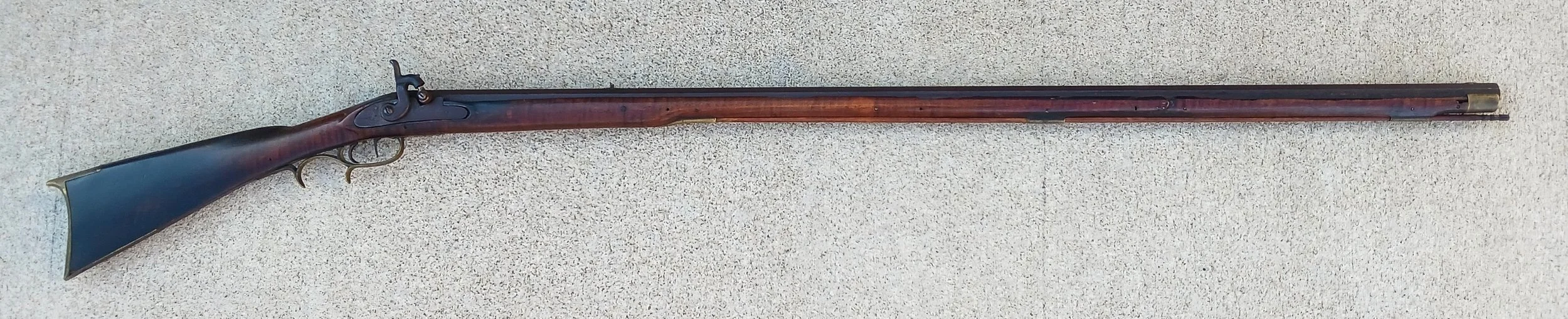
Figure No.1: This is the earliest “M. A. Tilman” signed rifle known to the author and probably dates to about 1840. It retains earlier Kentucky influences from Tilman’s first years working in Adair County that include its triangular butt with good height, slender forestock, and guard with remnants of a Kentucky “square shoulder” where the rear spur runs straight up [angled here], rather than curving up, to meet the guard’s rear extension. Stock wood is southern curly red maple with much of its original finish remaining. The barrel is pinned to the stock and has been shortened 1-7/8 inches during its working life. Barrel: 44-1/2 inches (originally 46-3/8 inches) with .32 caliber bore and 7-groove rifling. Author’s collection, photos by author.
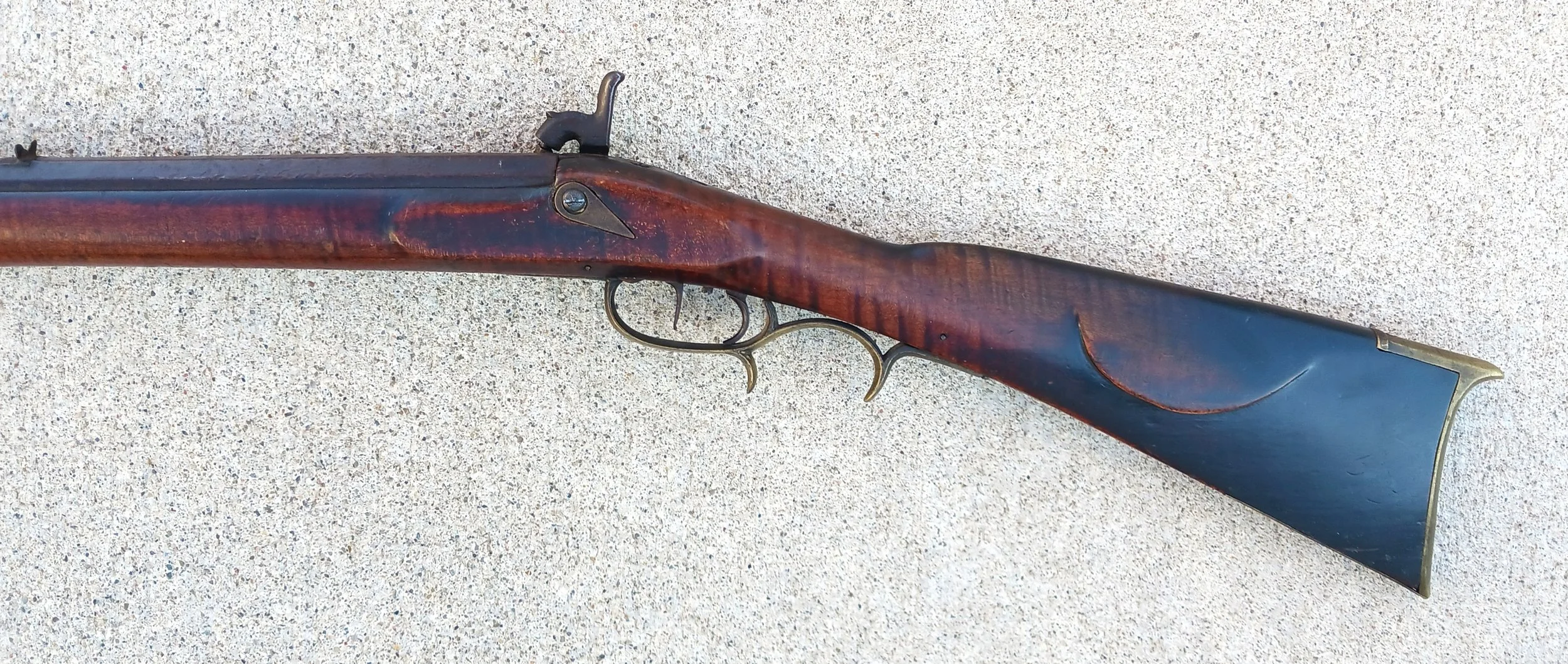
Figure No.2: The back of the Tilman rifle highlights its darkened original finish and rather flat butt plate for a circa 1840 rifle. The lock bolt uses a simple brass “tear drop” shaped washer, and the butt’s cheekpiece is an oval “beaver tail” style common to central Kentucky’s percussion era rifles. Small details not readily noticed include a decorative tab at the tip of the front trigger, a narrow, raised ridge on the butt plate return similar to Lexington guns, and two flats on the guard’s outer surfaces often found on Kentucky guns made from Lexington north to the Ohio River.
Tilman’s Rifle: The author has collected early Kentucky firearms for over forty years but never saw or heard of a Morris Tilman rifle until recently when the above signed rifle finally showed up. The rifle in Figures No.1 and No.2 was made during Morris’ early Indiana years after leaving Kentucky and retains several Kentucky features. Stock architecture is slender and graceful with a triangular butt with good height for a percussion gun. Side-facings around the lock are relatively uniform and tight, and the guard’s rear spur has a vestige of a Kentucky “square shoulder” running up in a straight line, rather than a curve, to meet the rear extension. The gun’s relatively flat butt plate has a small, raised ridge at the end of its top extension similar to Kentucky’s Lexington School butt plates, while the guard has two flats on its outside surfaces like Lexington School guards. The gun’s fine, hand-made triggers are well-made with a small tab on the tip of the front “hair” trigger. Overall, the rifle recalls Kentucky’s earlier preference for “function over frills” with its good architecture and construction but no inlays or embellishments. The moderate butt thickness, simple lock bolt washer, and pinned barrel help date the gun to circa 1840.

Figure No.3: Despite the gun’s lack of other engraved surfaces, Tilman was a competent engraver as seen in his large script barrel signature. Perhaps an earlier gun will be found with inlay work that shows more of Tilman’s engraving ability.
Several other details on the Tilman rifle deserve comment. First and foremost is the engraved script signature, “M. A. Tilman” seen in Figure No.3 above; later Tilman rifles used a stamped signature. The barrel tang has a nicely shaped “thumbnail” finial seen in Figure No.4 that is similar to tangs on many Lexington School guns. Two other details are also of interest. The front sight has two small, decorative lines running across its base as seen in Figure No.5, and the forestock has an interesting period repair. A crack on the forestock’s front side just beyond the middle pipe was repaired/stabilized with several small brass pins as seen in Figure No.6.
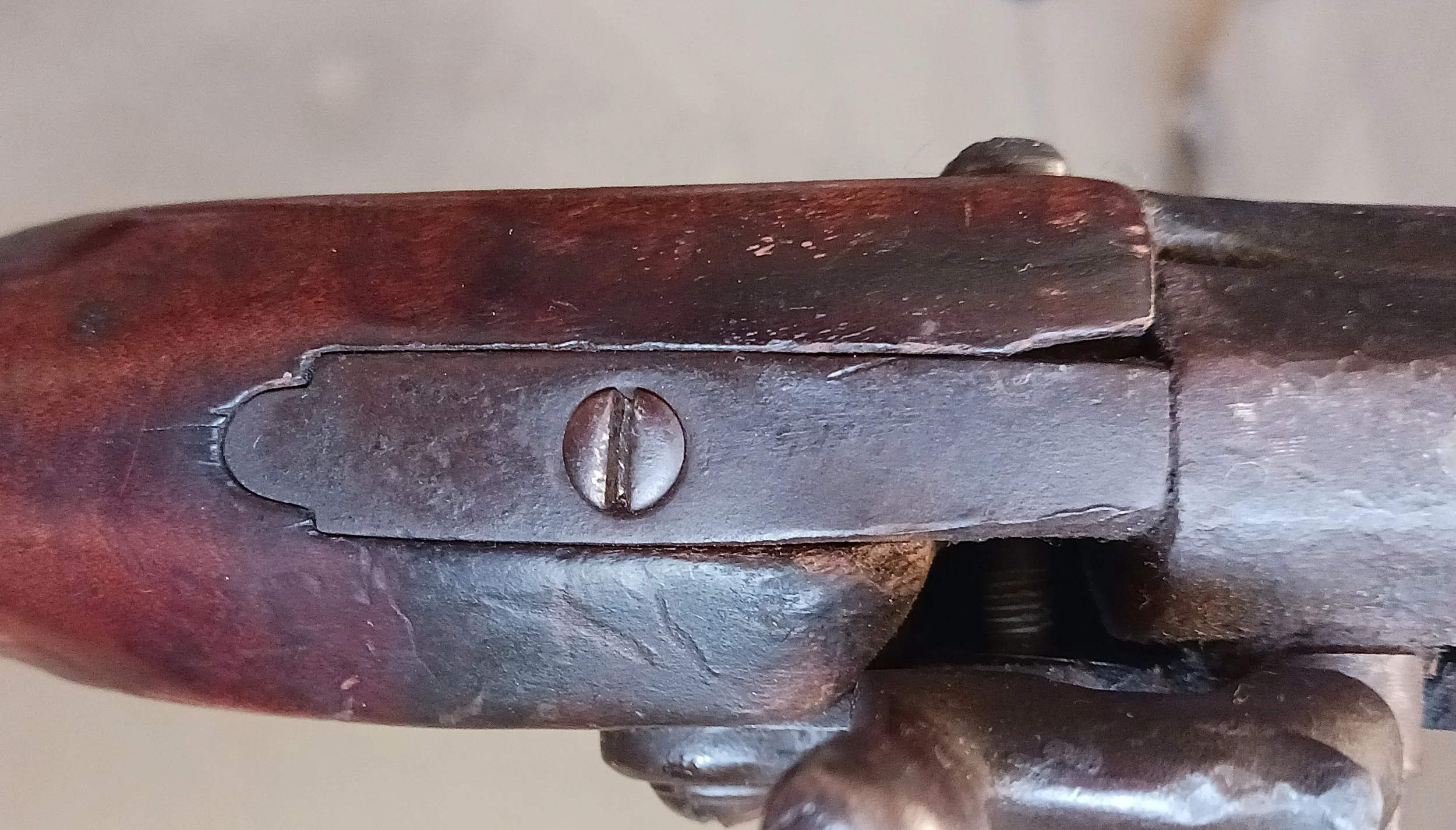
Figure No.4: Tilman used a single bolt tang with straight sides and a “thumb nail” finial, similar to earlier Lexington rifle tangs. Length is 2-1/2 inches.
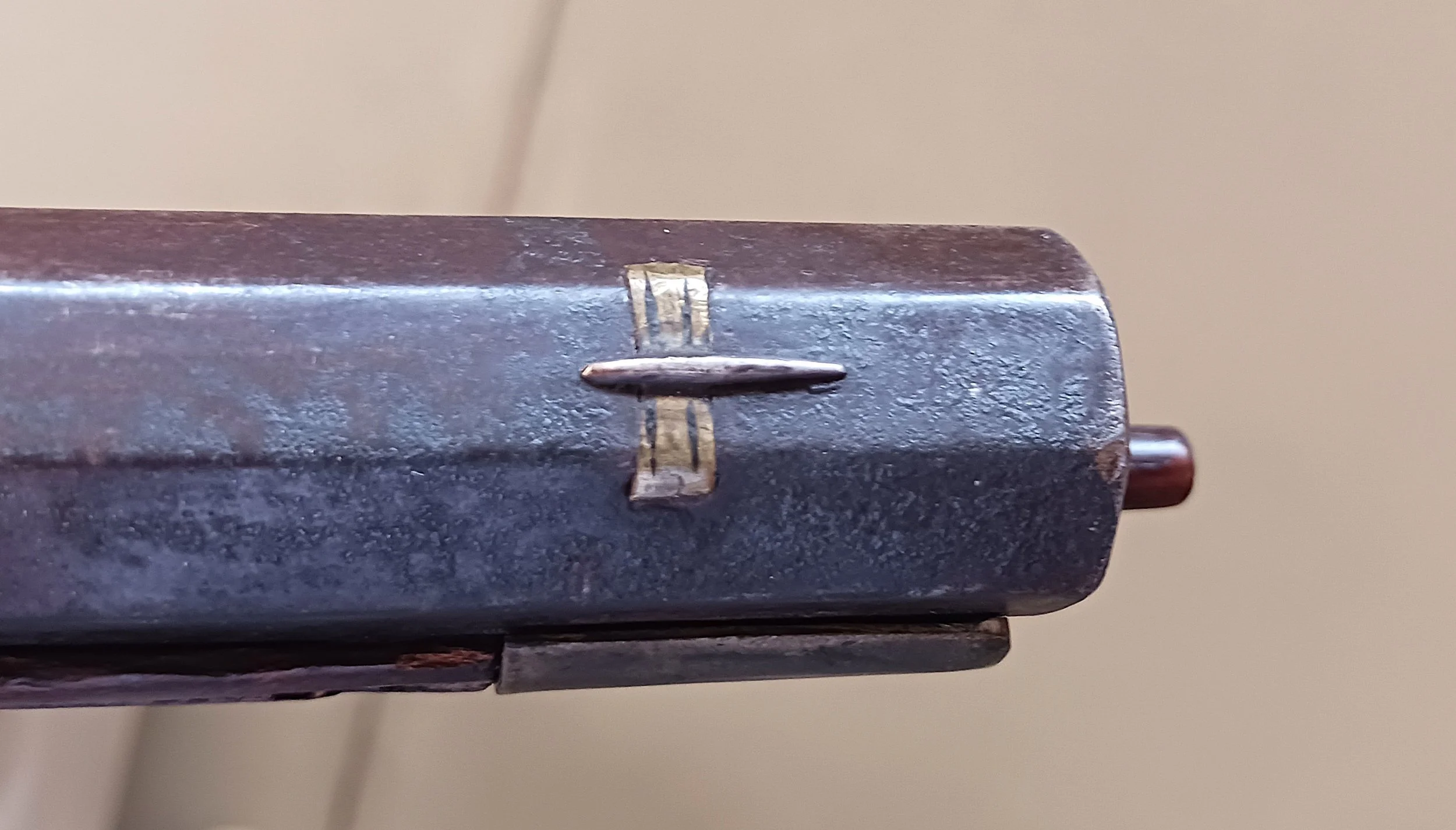
Figure No.5: The only decorative detail on the Tilman rifle is the filed lines across the base of the front sight. It is a rare detail for any rifle and perhaps unique to Tilman’s work.
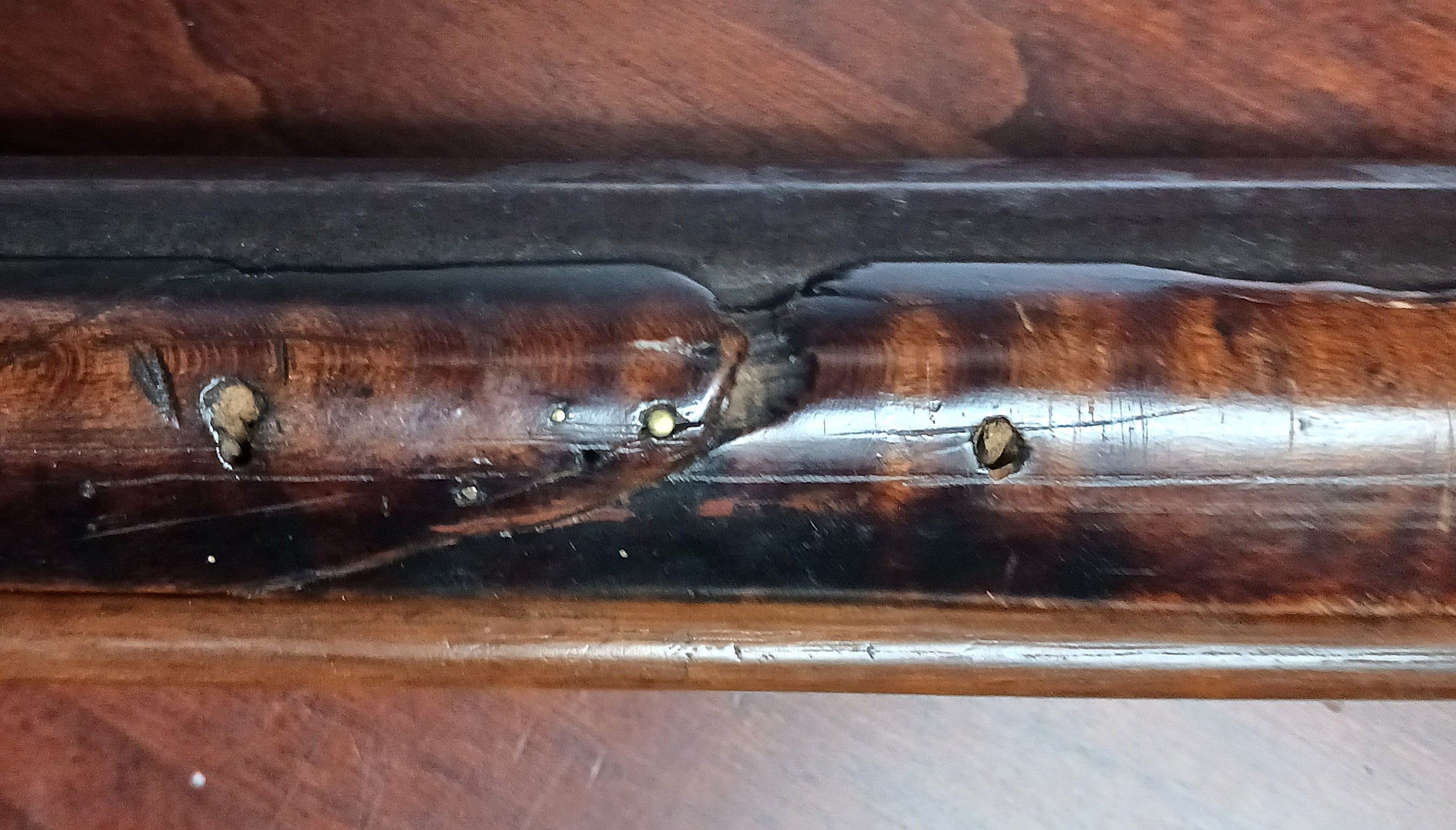
Figure No.6: The Tilman rifle has an interesting old, well-worn repair on one side of the forestock that had cracked. Several small, brass pins/nails hold the break together.
Another Tilman Rifle: More recently a second signed Tilman rifle sold at auction. It is shown in Figure No.8 and is a later Indiana gun by Tilman, probably made in the 1850s. The rifle has a more rounded comb with a sharp drop at the nose along with a back-action percussion lock. The gun is unembellished and has lost most of Tilman’s earlier Kentucky influences including the more streamlined stock architecture. This rifle appears to be a bit thicker and less graceful in the wrist area and looks a lot more like a percussion era Indiana rifle.

Figure No.7: This recently discovered Tilman rifle is stamped “M. A. Tilman” on the barrel. It has Tilman’s usual three ramrod pipes, shorter forestock grip area, and pinned barrel. The most noticeable change is its butt profile with a more rounded comb, sharper drop at the comb’s nose, and beefier upper wrist in the lock area. Private collection.
Summary: Many of Kentucky’s lesser-known gunsmiths have no known surviving guns, raising the question of whether they made guns or serviced other makers’ guns. Morris Tilman fell into that questionable category for many years, until a signed rifle was finally found and shared with the author. The gun was made in Indiana after Tilman had left Adair County, Kentucky, but it is his earliest known work with strong Kentucky influences in its stocking and furniture, verifying Tilman’s connection to Kentucky. We now have an example of his work that, while made in Indiana a few years after he left Kentucky, shows his Kentucky roots. Hopefully an earlier signed gun from his Kentucky days will be found, perhaps with a bit more decoration, to answer any lingering questions about his work. Tilman’s final resting place is shown below in Figure No.8. He worked for many years in Crawford County, Indiana, but spent his last years in nearby Dubois County just west of Crawford County, where he died on June 1st, 1868. His wife’s grave marker [not shown] is to the left of his white grave marker pictured below. Both husband and wife were buried in the Shiloh Cemetery in the town of Ireland in Dubois County.
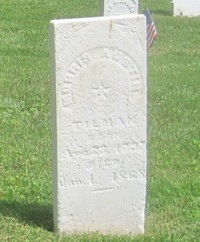
Figure No.8: Morris Tilman spent most of his Indiana years working in Crawford County in southern Indiana. But by 1860 when sixty-three years old, he was living in nearby Dubois County in the small town of Ireland. He died there in 1868 followed by his wife in 1875. Both were buried in the Shiloh Cemetery at Ireland with matching white marble markers that are a bit weathered today but still readable.