Allen County, Kentucky, Rifles by Gunsmiths Whose Work was Unknown ©
Foreword: Allen County, Kentucky, rifles have a distinctive “Heath-style” stock architecture that separates them from almost all other rifles, whether from Kentucky or elsewhere. A recent auction rifle was unsigned, but both its stock architecture and cheekpiece style strongly related it to Allen County, Kentucky, gunmaking. A second new rifle that followed the pattern of the Heath gunsmiths in Scottsville was made by Benjamin Williams, an apprentice of William Heath in Allen County, whose work had not been seen before. For additional information on the Heath gunsmiths, see 7/18/26 blog article, William M. Heath, Allen County, Kentucky’s Best-Known Gunsmith ©.
Allen County Rifles: The most easily recognized and best-known rifles from Allen County were made by the Heath brothers, William and John, who grew up in northern Tennessee, were taught gunsmithing by their father Richard Heath, and after reaching adulthood moved north across the state line to work in Allen County, Kentucky. William’s and John’s rifles are so similar in appearance that often the barrel signature is the only way to tell them apart. The author has never seen a rifle by the father or two brothers who stayed in Tennessee to work, and all signed “Allen County” style rifles the author has seen were signed by one of the Kentucky Heath brothers or one of their apprentices.

Figure No.1: This William Heath rifle from Scottsville in Allen County, Kentucky, highlights the major features of most Allen County rifles in its stock architecture, rear sight set behind the rear ramrod pipe, and nose cap set four or five inches past the rear ramrod pipe. Many, but not all, Allen County rifles have a slight “fish belly” in the butt’s lower line that, when more closely examined, is really a slightly/softly stepped wrist. Later Heath rifles discarded the softly stepped wrist and had straighter lower butt lines. Author’s collection.
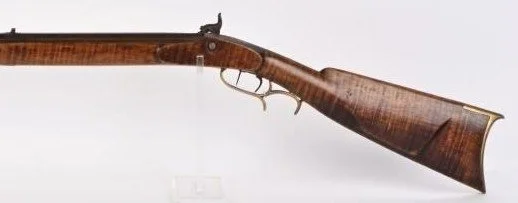
Figure No.2: The back of the William Heath rifle is perhaps the most important side of the rifle for identifying Heath and other rifles from Allen County in Kentucky. The cheekpiece appears unique for an American longrifle, with its heaviness that extends downward almost to the bottom of the butt. Also note the sharp drop at the comb’s nose, which is seen on many of the Heaths’ earlier rifles. Later rifles had a more generic comb. Author’s collection.
All known Heath rifles from Kentucky are half-stocked with details similar to those seen in Figures No.1 and No.2 above. Their cast nose caps sit four to six inches past a conventional brass rear ramrod pipe, the rear sight is located several inches behind the rear pipe, and the butt often appears to have a slight “fish belly” in its lower toe line, which is actually a softly stepped wrist. More importantly, the cheekpiece is larger than normal, looks a bit chunky, and runs farther down the butt than most convention cheekpieces, going almost to the bottom of the butt. Its odd appearance is rare [perhaps unique] for mid-century percussion rifles made west of the Appalachians. When these details appear on a gun, it is usually an Allen County, Kentucky, rifle. Other Allen County details include barrels signed with three large initials with dots at mid-height after each initial; the Heaths always included their middle initial, which was “M” for all three Heath gunsmiths working in Kentucky. A final distinctive detail on Heath rifles is the lack of a forestock barrel pin. Unless a Heath rifle was later modified [which happened to several known rifles] with a standard barrel wedge, Allen County Heath rifles do not have a forestock pin. Instead, a hidden pin is buried inside the cast nose cap, and an open-ended rear barrel lug/loop, or a small tab coming off the back of the iron under-rib, hooks over the hidden pin when the barrel is slid back into place. While perhaps done to prevent the loss of a removable barrel pin [or provide a “unique” detail to attract customers], Heath rifles have forestocks that feel a bit looser than the standard pinned forestocks. Some owners later modified their Heath rifles by installing a standard forestock pin/wedge in the normal position to hold the forestock more tightly to the barrel.
Unknown Allen County Rifle: A fresh “Allen County” style rifle is shown in Figures No.3 and No.4 below. It has a striking resemblance to rifles by the Heath brothers of Scottsville, both in stock architecture and the heavy, low cheekpiece that is a trademark of Allen County guns. Compare the new rifle to the Heath rifle in Figures No.1 and No.2 above and note the strong similarities. One detail the new gun lacks is a hidden forestock pin. Two standard forestock pins are visible and were apparently moved back one time when the gun was rebreeched. Based on ramrod pipe spacing, the author thinks when the gun was re-breeched, it lost about 2-1/2” to 3” of barrel, disturbing the original graduated [progressively longer] spacing on its four original ramrod pipes. The gun has an extended, two-screw tang found on most Kentucky guns. While the author cannot say with certainty this rifle was made in Allen County, Kentucky, its many borrowed details strongly suggest that it was made in that area, probably not by a Heath gunsmith, but by someone who had worked in their shop, or worked nearby and was heavily influenced by their style.

Figure No.3: This unsigned rifle shares stock architecture along with other features of the Heaths’ rifles from Allen County, Kentucky, including their slightly beefier side-facings around the lock, a vestige of their Tennessee roots. But it also differs in several small details. It has a straight lower butt line without the softly “stepped” wrist, there are four pipes instead of the Heaths’ usual three pipes, and the gun is pinned in its forestock area. Private collection.
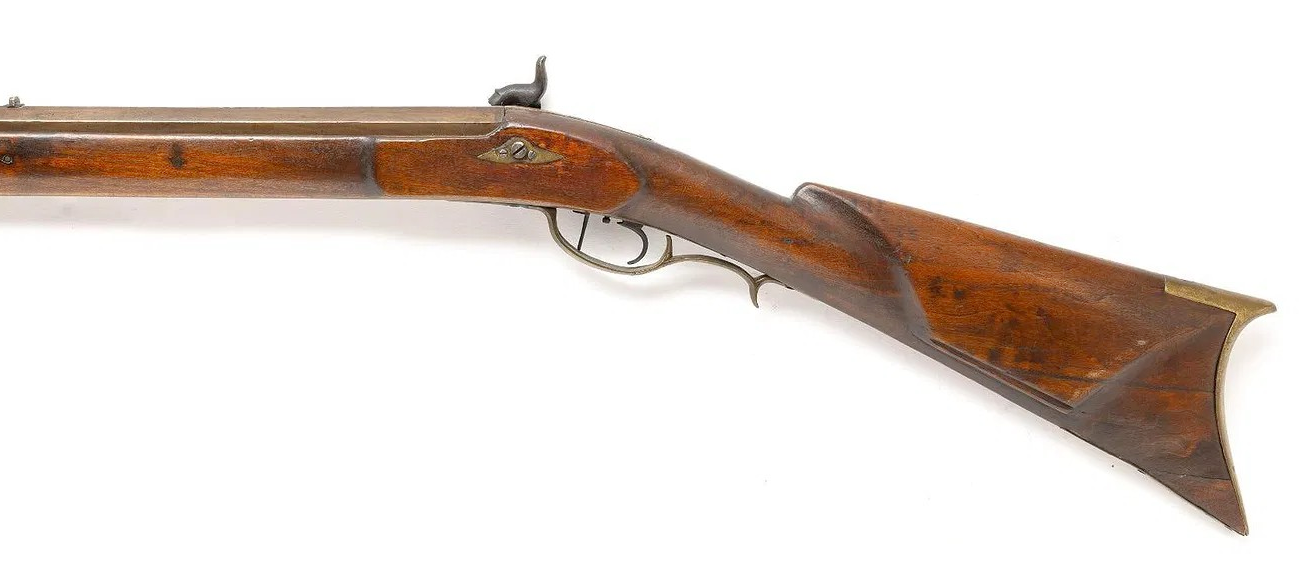
Figure No.4: The back of the unsigned/attributed Allen County, Kentucky, rifle has the area’s “trademark” heavy cheekpiece that stretches almost to the bottom of the butt, along with a rather strong, or abrupt, nose on the comb. The cheekpiece also has more highlighted edges that run higher than on Heath rifles. But despite the small differences, the stock architecture and cheekpiece are strongly related to Allen County style rifles. Private collection.
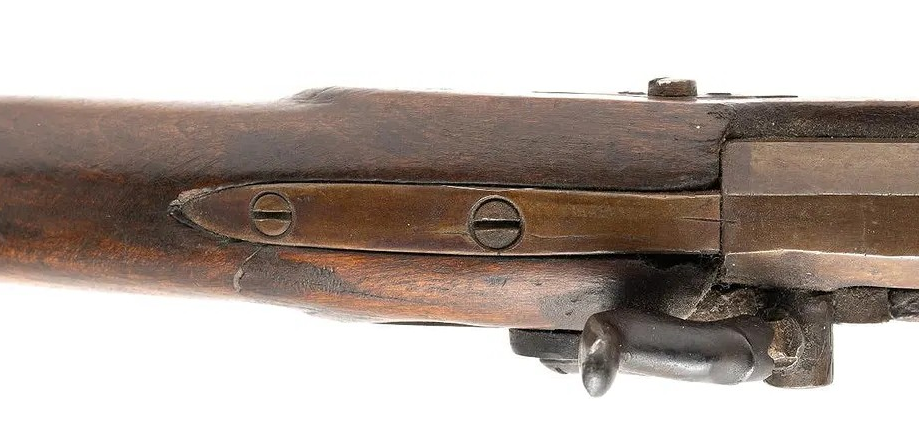
Figure No.5: The unsigned rifle’s longer, two-screw tang is similar to Heath rifle tangs, and Kentucky tangs in general.
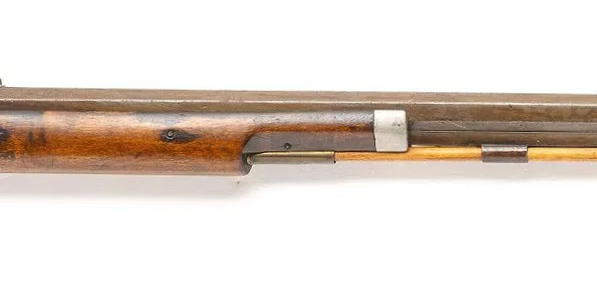
Figure No.6: The rifle’s simple cast Heath-style nose cap sits several inches beyond the brass rear pipe, while the rear sight is behind it.
From viewing the above photos, it becomes apparent the new rifle is not identical to the William Heath rifle, but it has a lot in common with the Heath rifle in stock architecture, rear pipe arrangement, and in particular the heavy, low placed cheekpiece. Its guard style suggests it is a few years earlier than the Heath rifle, possibly making it a Tennessee Heath family rifle… although without a signed barrel, that is impossible to verify. However, the gun shares many details with the Kentucky Heaths’ rifles and most likely was made in/near Allen County.
Apprentice Rifle: Another new Allen County, Kentucky, rifle was made by Benjamin A. Williams, William Heath’s apprentice and then journeyman for a few years. The 1860 census lists Benjamin as 24 years old, living in William Heath’s household, with the occupation of “Gunsmith.” Presumably he apprenticed under Heath in the 1853-1857 years, then worked in Heath’s shop as a journeyman until he married and moved away to open his own shop. Wiliams was working as a gunsmith at Bowling Green in Warren County, Kentucky, in 1885, but not much else is known about him. His rifle shown below is distinctly in the style of Allen County, Kentucky, rifles architecturally, and its three-initial signature imitates those of the Heath gunmakers. However, while the basic rifle mimics a Heath rifle, it is more heavily decorated in German silver than any known Heath rifle and was apparently made for a well-to-do local mason in/near Allen County.
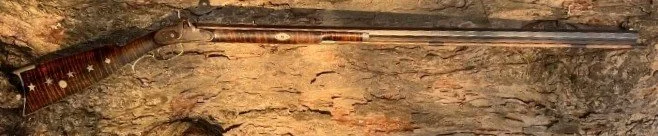
Figure No.7: This Allen County, Kentucky, rifle by Benjamin Williams closely follows the work of William Heath, who he worked as a journeyman. Reportedly no one but Heath signed rifles from his shop, so Williams must have worked independently for a few years in/near Scottsville before leaving for Warren County, Kentucky. Private collection.
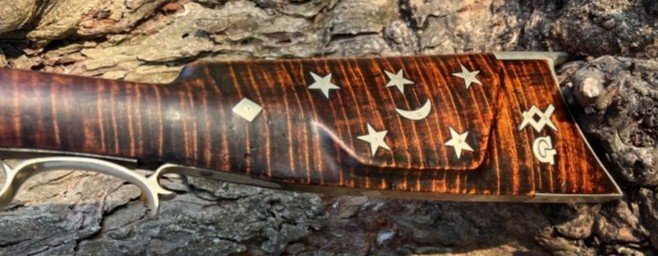
Figure No.8: The back of the Benjamin Williams rifle has a typical low Heath style cheekpiece and a softly stepped wrist. William’s use of German silver is rare for Allen County and was probably ordered by a wealthy local mason due to the Masonic emblems on the back of the butt. This is the only Williams rifle the author has ever seen or heard about. Private collection.
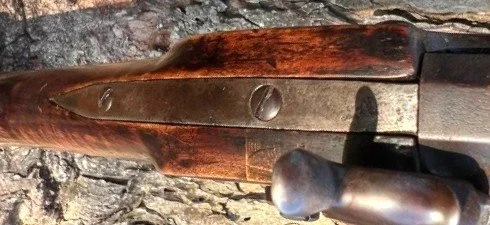
Figure No.9: The Williams rifle has the typical longer, two-screw style tang found on most Kentucky guns outside the Bluegrass area.
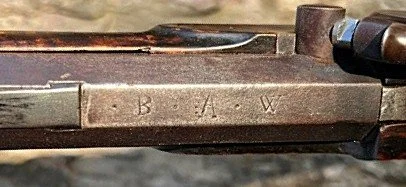
Figure No.10: Scottsville rifles are signed with three initials with dots in between. This shortened barrel has the initials near the breech.
Summary: The Heath brothers were the best-known gunsmiths working in Allen County, Kentucky, in the mid-percussion era. They made half-stocked rifles with distinctive stock architecture, particularly with the nose cap/rear pipe spacing, low cheekpiece, and rear sight positioned several inches behind the rear pipe. But other gunsmiths also worked in Allen County and made similar rifles like the one illustrated in Figures No.3 through No.6, and Figures No.7 through No.10. Most known Allen County rifles share the same basic stock architecture, nose cap arrangement, initialed barrels, and a large, distinctive cheekpiece that extends down almost to the bottom of the butt. Those details help document the strong influence the Heath brothers had on gunmaking in Allen County, Kentucky, during the percussion years.