Doctor James W. Dobson’s Tansel Horn from Owen County, Indiana ©
Note: This article was posted on August 1, a special date for the author. It is the birthday of his best friend for many years, Dale Halbakken, who passed away three years ago, and his oldest daughter Heather, who built this website for him as a retirement gift. Those people made his life better.
****************************
Foreword: An exceptional Indiana Tansel powder horn is inscribed “James W. Dobson Presented by D. M. Dobson” on one side as seen in Figure No.1, and the Tansels’ more common “Brave LaFayette” slogan on the other side in Figure No.2. Both Dobson men lived in Owen County, Indiana, a short distance west of Bloomington. The men’s names, along with other key images on the horn, provide a fascinating glimpse into the lives of two leading citizens of Owen County, Indiana, during its formative years.

Figure No.1: The most unusual detail on the Dobson horn is its gifting inscription that reads, “James W. Dobson Presented by D. M. Dobson.” Research has verified the two men were brothers, and the fine Tansel powder horn may have been a wedding gift.

Figure No.2: This long “La Fayette” inscription appears on several Tansel horns from the late 1830s and honors General La Fayette who left France to assist General Washington during the American Revolution.
The Dobson Horn: The horn has two lengthy inscriptions, the “Dobson” inscription in Figure No.1, and a second, more common Tansel inscription used on several other horns, “His Name You Shall Hear It and Never Forget * The Friend of America Brave La Fayette” in Figure No.2. The usual Tansel hunting dogs and deer are present, with one deer’s head turned back over its shoulder toward the dogs behind it. The horn has survived in fine condition with a mellow patina seen in Figure No.3 below, perhaps because it was a gifted memento horn rather than a working horn. A large Tansel eagle is centered on the horn’s front panel with an “E Pluribus Unum” banner flowing through its beak and fifteen stars held within the banner’s curves. While star counts can vary on later Indiana era Tansel horns, when fifteen are present [as often happens], it can represent the Tansels’ early ties to Kentucky, the fifteenth state in the Union. However, it is the unexpected figures on the back of the horn including the “Dobson” banner in Figure No.1 and man and woman in Figures No.4 and No.5 below that make the horn special. The man is a well-dressed hunter in top hat and fancy hunting coat, while behind him is a lady wearing a fancy hat with long stemmed flower [rose] and flowing veil. Based on similar images of well-dressed couples on other Tansel horns, the man and woman usually represent a newly married couple…which may be the case with the Dobson horn.
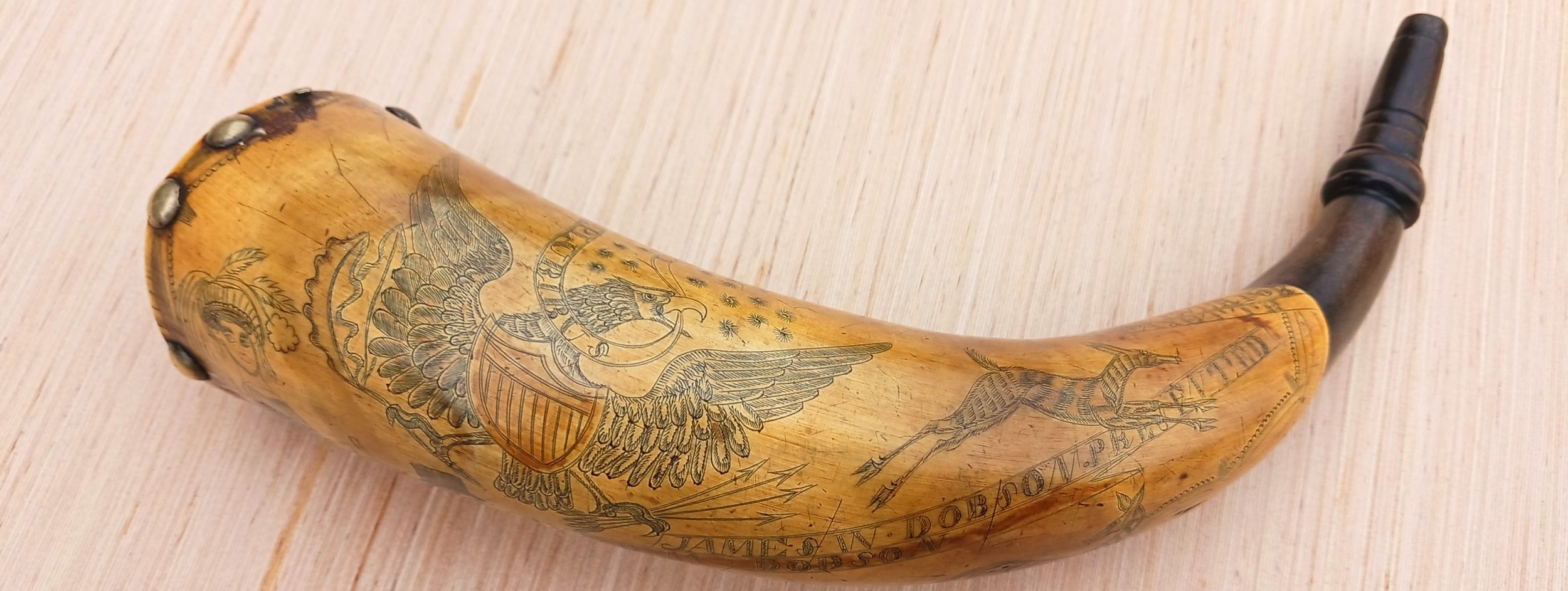
Figure No.3: The “Dobson” horn has survived in fine condition with intact spout that suggests it saw little usage, with the only damage/alteration being its brass tacks added later by the owner. The horn lacks the expected engrailed edges around its fish mouth, which seems a bit odd for a superior Indiana era Tansel horn. Polychrome, or decorative staining, can be seen in the eagle’s shield and elsewhere. Author’s collection, photos by author.
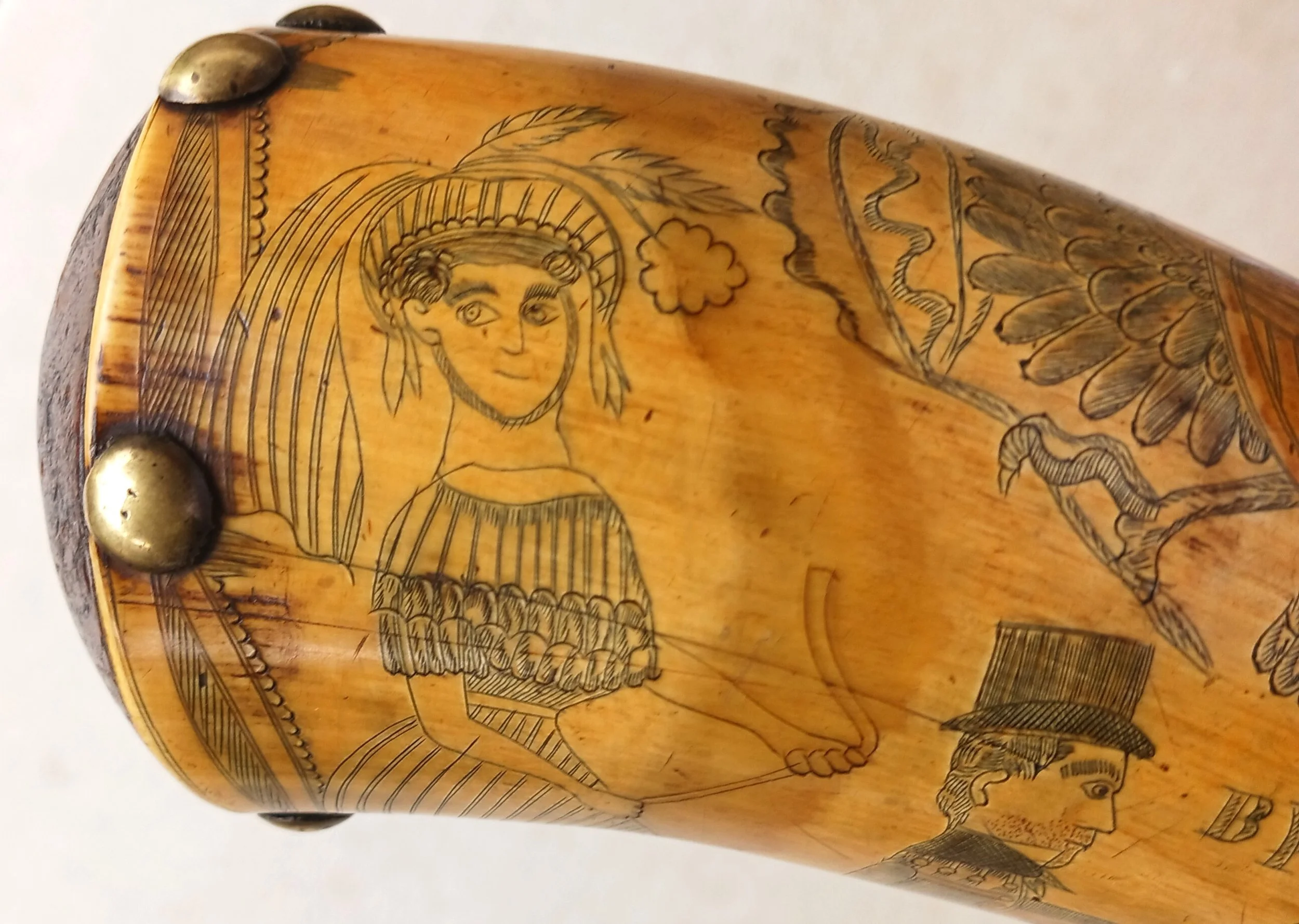
Figure No.4: A well-dressed lady and gentleman appear on the horn. The lady’s fancy hat has a flower and veil, suggesting a wedding. Similar scenes on other Tansel horns are known to represent a newly married couple.
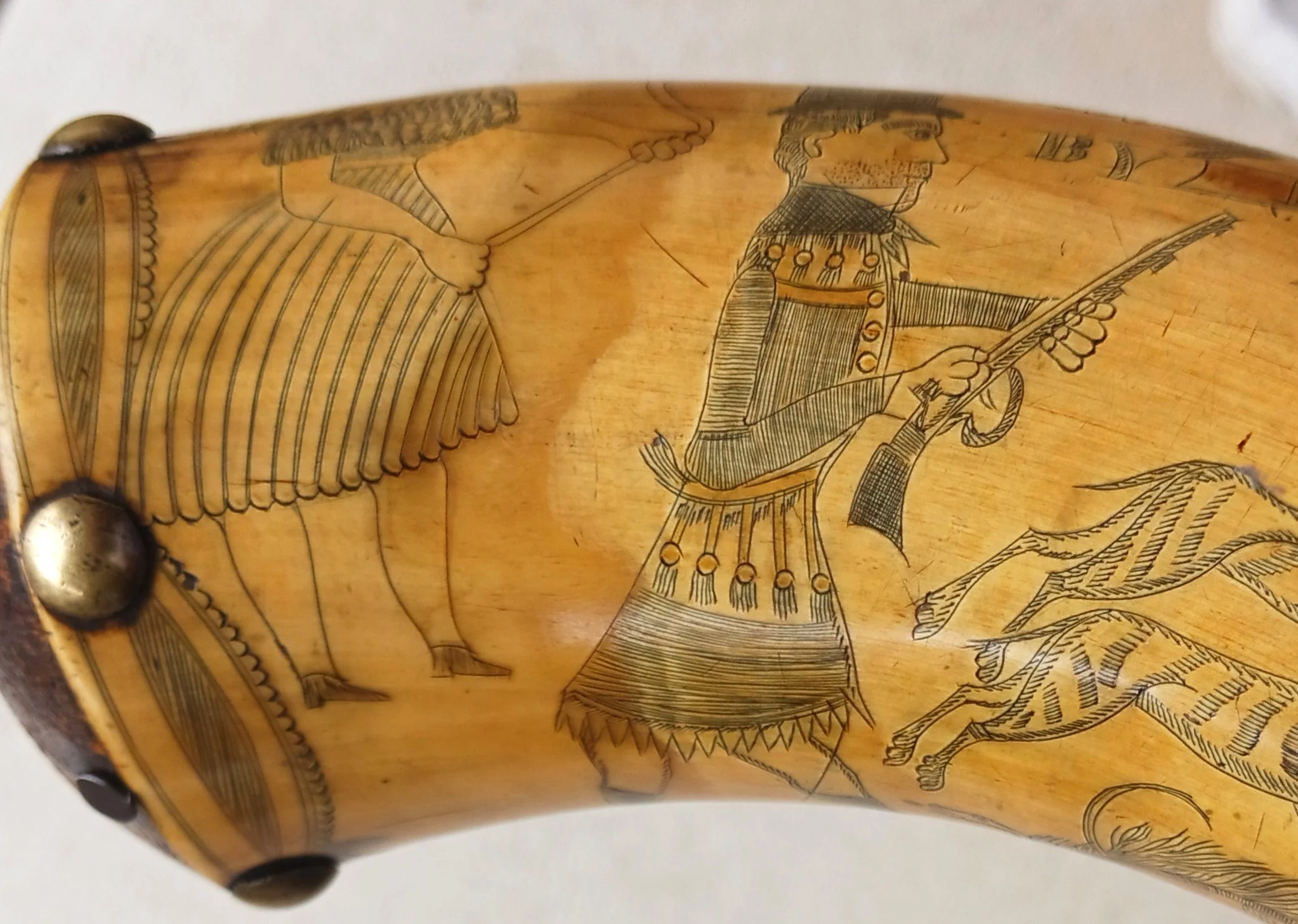
Figure No.5: A lower view of the lady and gentleman hunter shows their fancy attire. The gentleman hunter has a rifle with his three hunting dogs in front of him chasing two deer.
James & David Dobson: The importance of the Dobson horn comes from the two names carved prominently on its surface, “James W. Dobson” who received the horn, and “D. M. Dobson” who purchased the horn and gifted it to James. A search of Indiana census records identified the two Dobsons. The presenter was David McCall Dobson (1807-1853) of Spencer in Owen County, and the recipient of the horn was his older brother, James W. Dobson (1805-1877), also of Spencer in Owen County. The 1850 Indiana Census provided additional information on the men. David M. Dobson was 42 years old, born in Tennessee, and was a “Physician” in Spencer. His wife, Elizabeth R. Freeland (1806-1859), was 43 years old, born in Maryland, with three children, Joseph age 12, Benjamin 9, and David 7, all born in Indiana. Living in David’s household was his brother, James W. Dobson, age 45, no wife, also a “Physician” with $2,500 in real estate suggesting he also owned a farm in Owen County. Also in the household was a younger couple, William Taylor age 29 and Sarah Taylor 26, with son Edward age 2. William was listed as a “Farmer” and probably managed David’s farm property while David and James worked as doctors in Spencer. The FamilySearch.com website provided additional details in their lives.
David and James Dobson were born in Greene County, Tennessee, to parents Samuel “Silas” Dobson (1782-1848) and Margaret “Peggy” Copeland Dobson (1784-1864). The two sons left Tennessee for Owen County, Indiana, in the mid-to-late 1820s. Owen County’s first settlers arrived about 1818, but it wasn’t until the 1820s that the population began to grow. The actual year the brothers arrived is unknown, and there is no record of when/where they received their medical training, whether in Tennessee or later in Indiana from an older physician. David returned to Greene County, Tennessee, briefly in 1835 to marry Elizabeth Freeland on November 12, 1835.
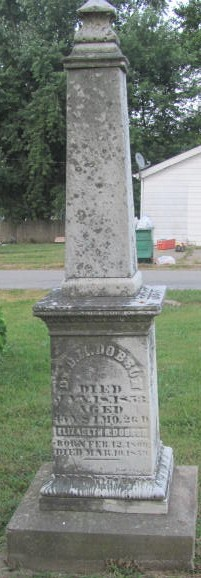
Fig. No.6: Grave marker of David M. Dobson.
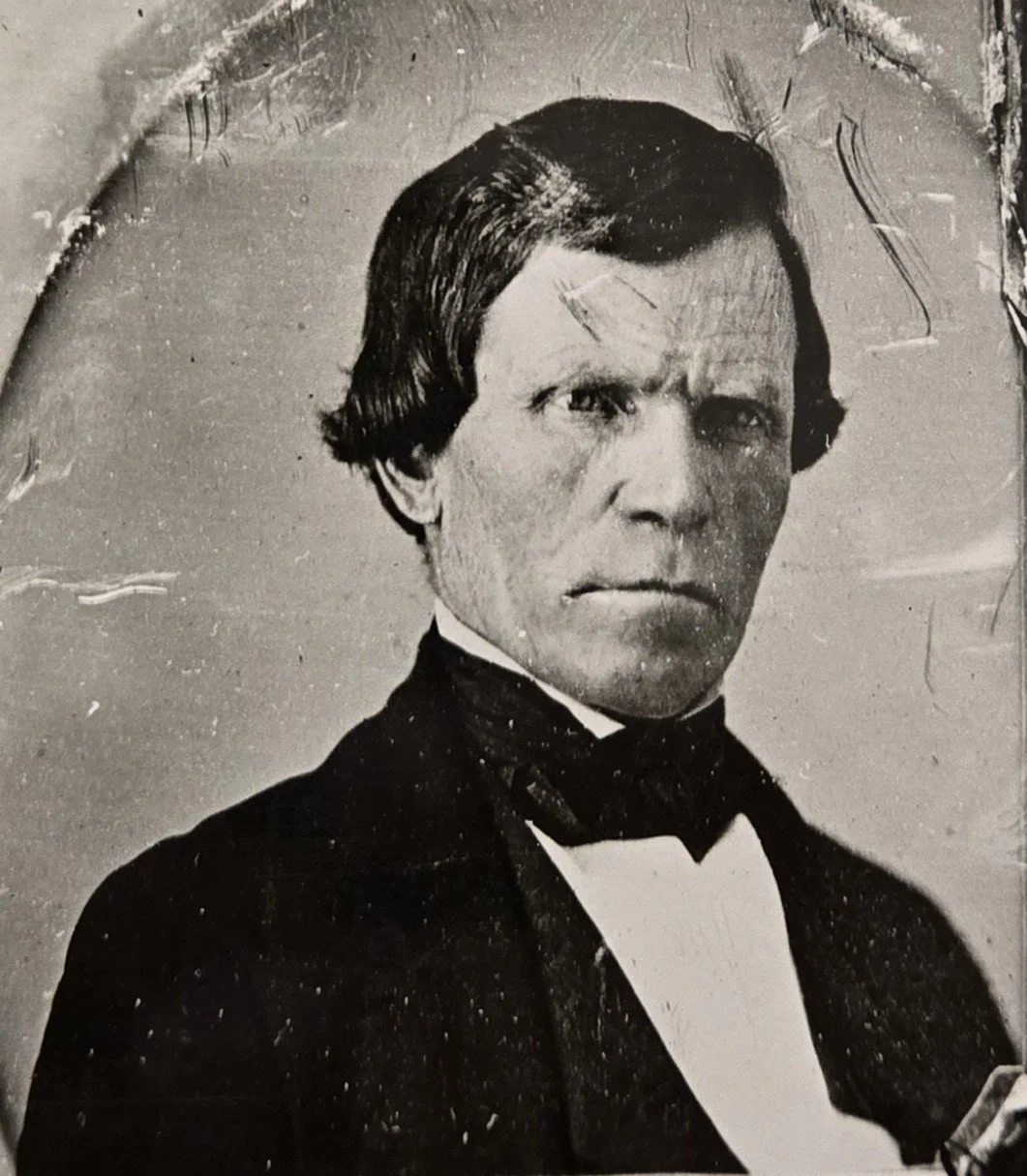
Figure No.7: This daguerreotype of James W. Dobson, the owner of the Tansel powder horn, is from the 1850s. He was a well-known physician and politician in Spencer, the county seat of Owen County, Indiana. He ran successfully in 1846 and 1848 as a Democrat, serving two terms as a representative of Owen County in the State Legislature. Photo courtesy Indiana State Historical Society.
Politics: Both brothers were early physicians at Spencer, the county seat of Owen County, and both became politically active in the county’s Democrat Party. David served as a State Senator from 1836 to 1846, State Representative in 1848, and member of the Constitutional Convention in 1851. He died when only 45 years old on January 18, 1853, and was buried in the Old Riverside Cemetery at Spencer with the impressive grave marker seen in Figure No.6 above. James followed the same career path but was slightly later in his political work. He was a physician in Owen County before representing the county in the State Legislature in 1846 and 1848 as a Democrat. He later helped organize the Owen County Agriculture Society in 1856 and served as its Treasurer until the Civil War. A daguerreotype image of James Dobson from the 1850s is shown in Figure No.7. The 1860 census listed him as 54 years old, single, and a “Farmer” in the “East half” of Owen County with $5,000 in real estate. He later moved to Illinois where he was documented as a farmer in Douglass County in 1875 and died there in 1877.
Horn’s Date & Attribution: The eagle’s shape and feathering in Figure No.8 and the fancy strap retention bead in Figure No.9 help date the horn to the later 1830s. The eagle’s wings do not have the later strong notch in their top lines where the lower and upper sections meet, and feathers in several areas are shaded around the perimeter, leaving a white section in the middle. The larger, more extended claws also suggest an 1830s horn. The author dates the Dobson horn to about 1838.
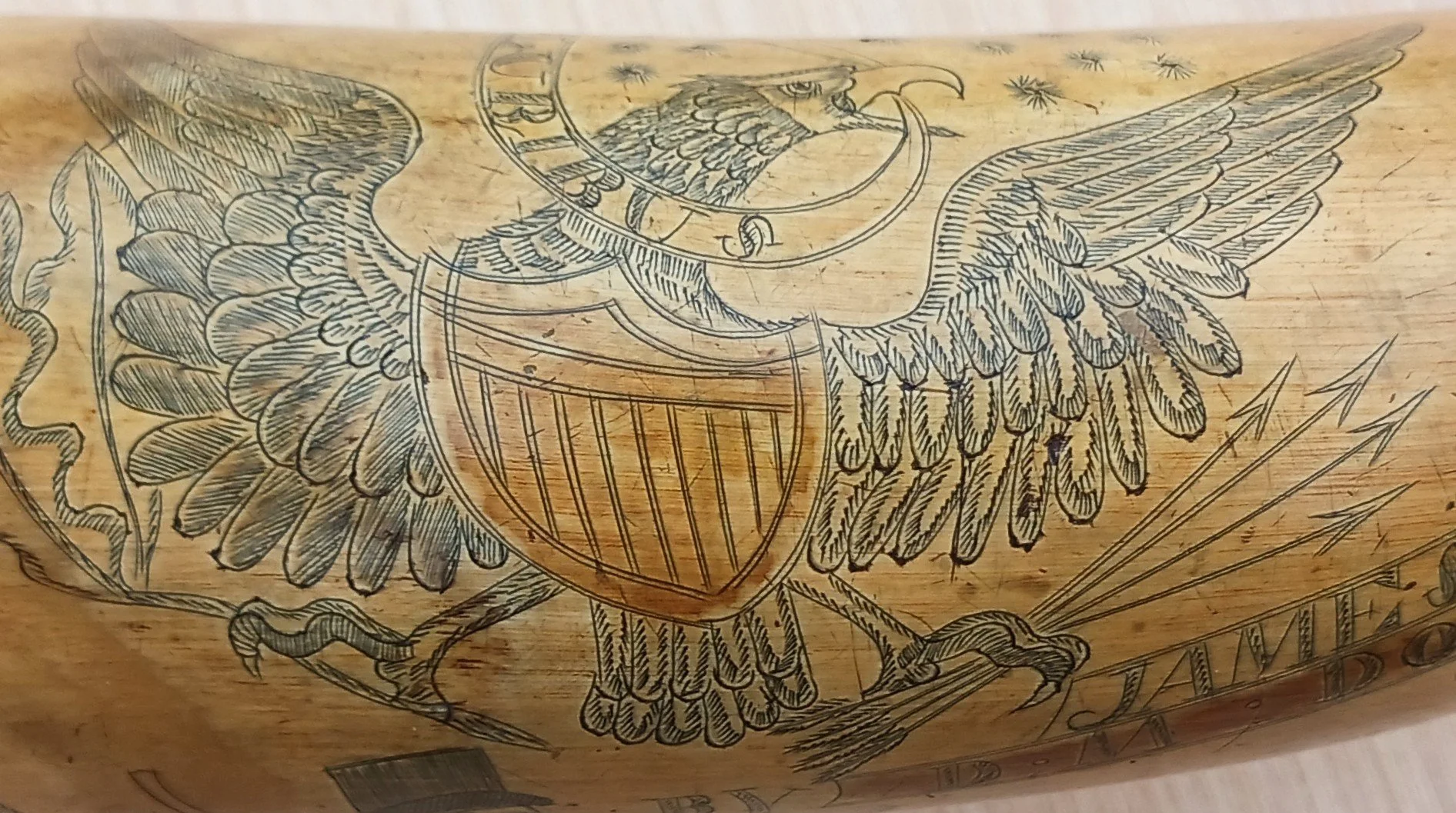
Figure No.8: The eagle on Tansel horns evolved over the years, providing a tool to help date the horns. Here the large talons, wing feathers shaded around their edges leaving a white center, and smooth, unnotched curves in top edges of the wings support a late 1830s date.
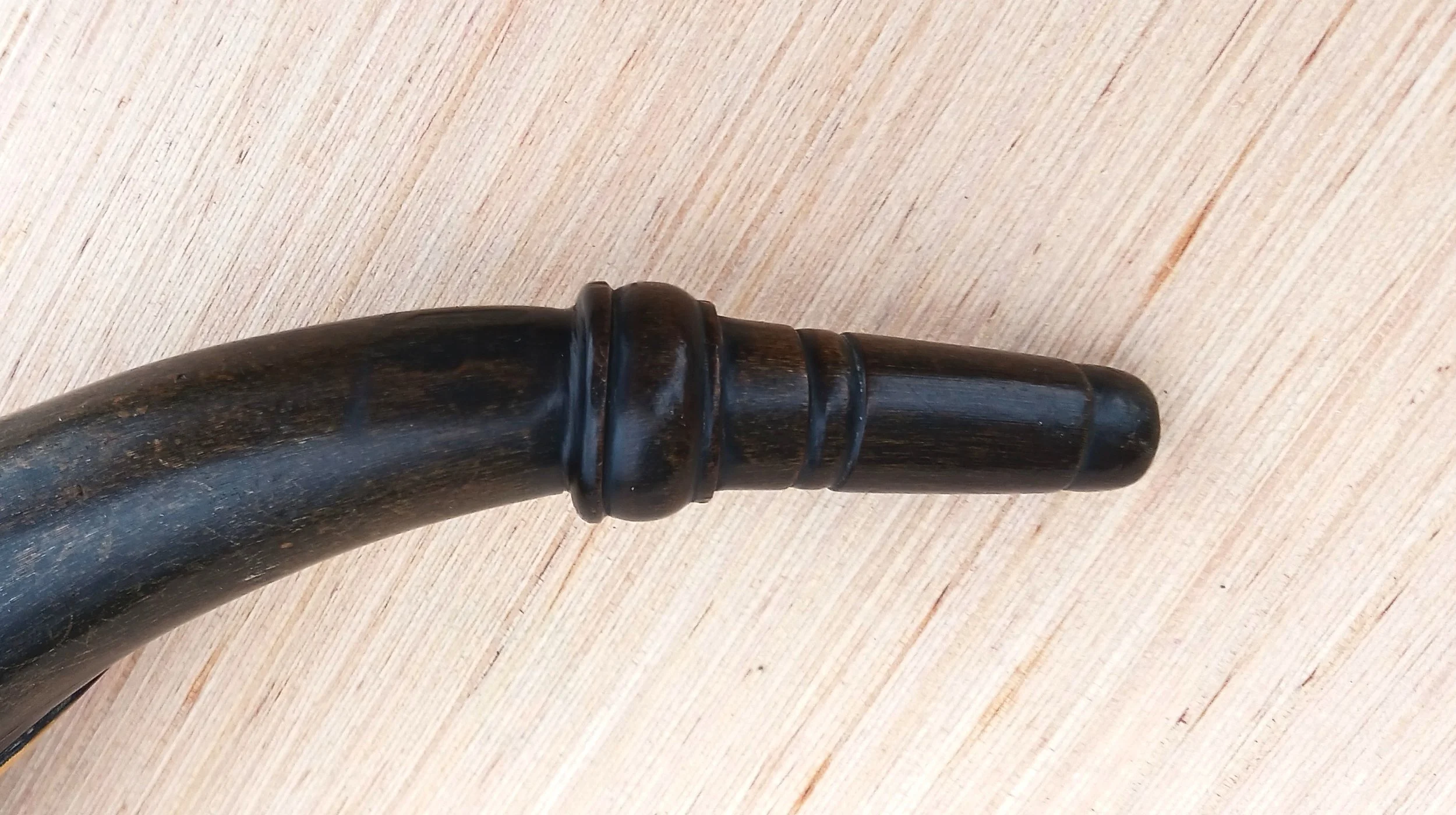
Figure No.9: The Dobson Tansel horn has a nicely rounded, hand-cut bead for strap retention, suggesting the hand of Stark Tansel. Tim Tansel, whose work is very similar, preferred a standard Tansel “barrel style” bead on most of his spouts.
Unsigned horns by Stark and Timothy Tansel look similar and attributions often become guesses. However, several details on the Dobson horn suggest it was made by Stark Tansel. The deer with its head turned back over the shoulder was more commonly used by Stark, and the long grass strip under the hunter’s feet in Figure No.10 that extends out under the dogs and deer is strongly a Stark Tansel detail, along with the snake coming out of the grass in front of the hunter… a reminder of the copperheads that plagued early settlers. The fancy strap retention bead on the spout in prior Figure No.8 is more in Stark’s style than Timothy’s, who liked to use a standard Tansel “barrel style” bead for strap retention. A lesser factor is the political affiliations of the Tansel horn carvers. John and Timothy Tansel were strong Whigs while Stark was a staunch Democrat [like James Dobson] with his 2nd wife once stating the brothers had “spirited debates” regarding politics at her home. The horn can be safely attributed to Stark Tansel.
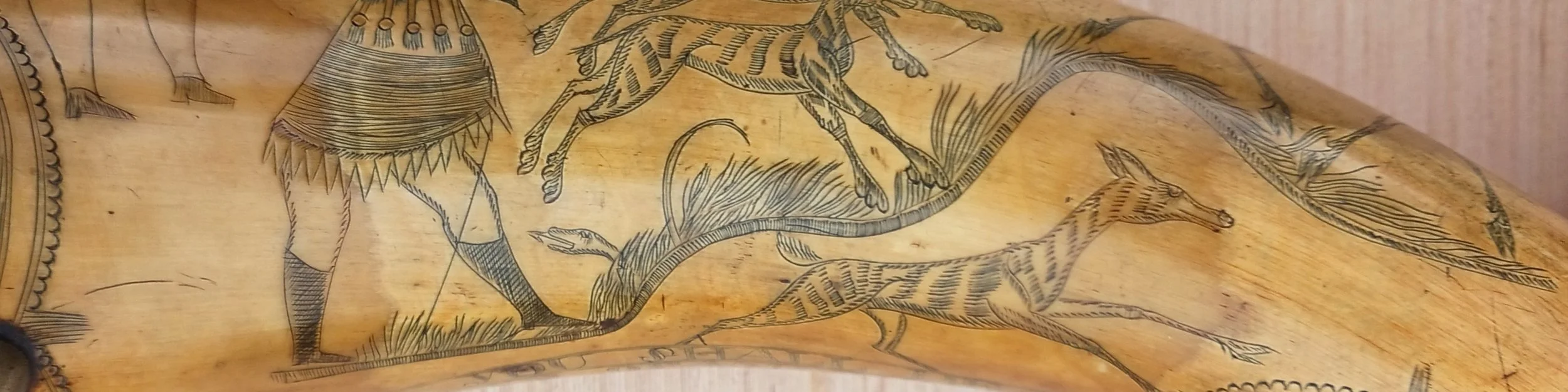
Figure No.10: This view of the hunter and his dogs shows a long, thin strip of grass running below their feet. Stark Tansel was the carver who liked to put a thin strip of grass under the feet of his figures at times, while Timothy rarely, if ever, used a grass stip. In addition, a snake, thought to be a copperhead, is rising out of the grass right in front of the hunter. That was another small detail Stark liked to use on his horns when using grass under his figures’ feet.
The Gift: The horn was purchased about 1838 by David Dobson as a gift for his older brother, James Dobson, to celebrate an important event in Jame’s life. Since David was married in 1835, it is probable that James married about the same time. It is the author’s opinion that the horn’s images of a well-dressed man and woman represent the marriage of James about 1838 to an unknown first wife who probably died within a few years, perhaps in childbirth, since no wife was listed in the 1850 census. While speculative, based on other Tansel powder horns decorated with similar well-dressed men and women, the horn most likely was a wedding gift from one brother to another, and after the wife died a few years later, it became a cherished memento for the husband who never remarried.