Foreword: Recently the author was made aware of a signed Tim Tansel powder horn that had survived major damage during its working life. The horn caught his attention with two details he had not previously seen on a Tansel powder horn. The first detail was a fascinating inscription running across its face, and the second was a unique repair to its spout.
The New Horn: The horn was found in a home in central Indiana that was being cleaned out by its new owner. It was easily identified with Tim Tansel’s name prominently displayed in the carving. The new owner contacted the author through the Kentuckygunmakers.com website to discuss the horn’s age, what its figures represented, condition issues, and how it compared to other Tansel horns.
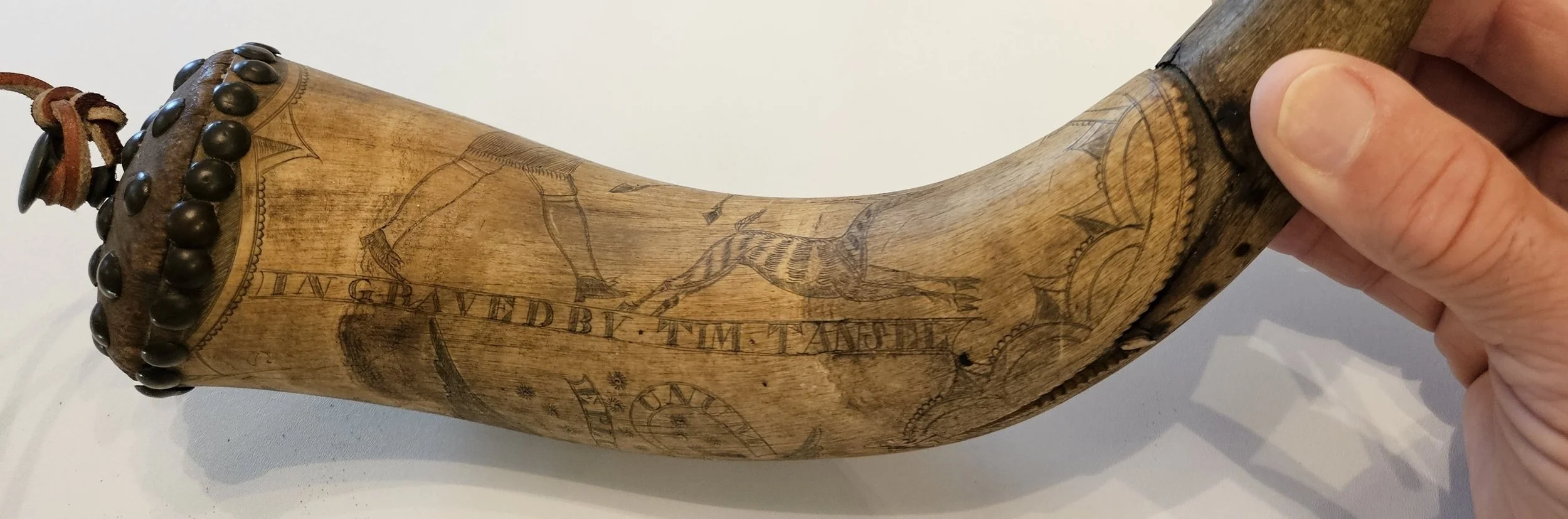
Figure No.1: The new horn’s most interesting detail is its banner proclaiming “Ingraved By Tim Tansel” just above the eagle. Timothy Tansel was listed as “Illiterate” in the census, yet several of his horns suggest he could spell words phonetically as on this horn. The second significant detail is the horn’s repaired spout. The original spout was badly damaged and repaired with a replacement spout that overlapped remnants of the original spout and was attached with small iron pins/nails [small black spots on spout’s base]. Courtesy B. Mattox.
The horn was of moderate size with visible repair work and had two details that intrigued the author. The first was its inscription, "Ingraved by Tim Tansel" (sic), in Figure No.1 above that the author had not seen before. The second detail was a fascinating repair undertaken to salvage the horn after suffering heavy spout damage. Both the basal and spout ends had period repairs. The base was cut back about a quarter inch to remove damage from torn out plug nails; fortunately, no other cracks or breaks occurred in the basal area. The horn was then re-plugged with its current low dome, hand-made butt plug. The new plug was probably mounted with small nails, but the brass tacks, normally used for decoration, could have been used during the repair to “nail” the new butt plug in place. The new plug was covered with additional brass tacks as seen in Figure No.2 to help hide the basal horn loss when trimmed back to remove damage. Replacing a butt plug was a somewhat common repair during a horn’s working life [things get dropped], but the spout repair or reconstruction was a different matter.
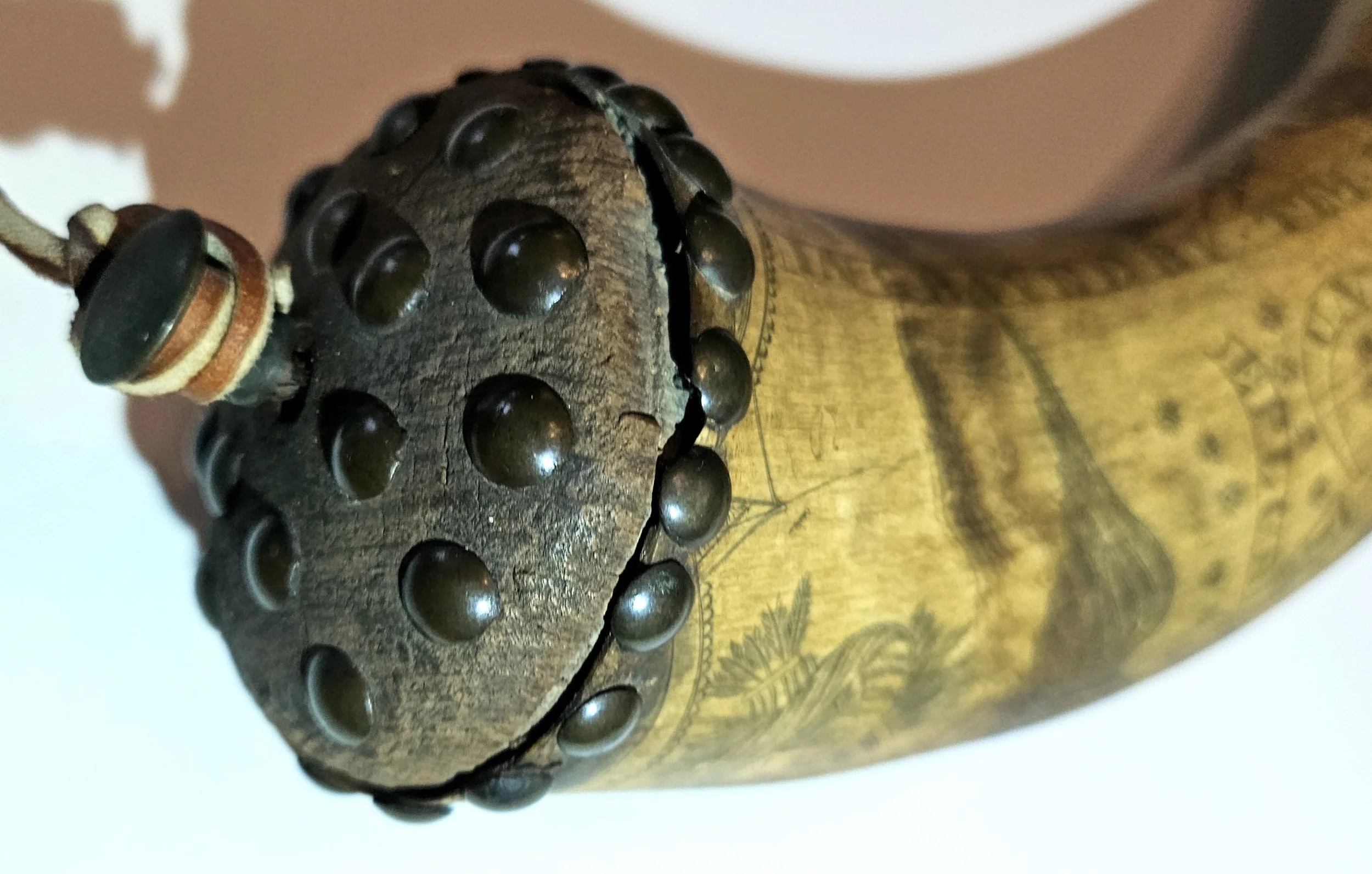
Figure No.2: The replacement butt plug differs from Tansel butt plugs with its soft wood, cross-grain structure, when original Tansel plugs were normally made from end-grain walnut [occasionally cherry] for greater strength, stability, and durability. About a quarter to three-eighths of an inch of horn was trimmed from the base to clean up torn out plug nail holes. The new plug was probably pinned in place, but the tacks could also have been used to attach the plug, with more added later to hide the repaired area. The strap attachment button in the butt plug’s nose appears to be a small brass drawer pull. They often came off stacked lawyers’ bookcases and replaced the old wood screws that served as nose buttons on many later butt plugs; the pulls were usually added in the 20th century. Courtesy B. Mattox.
The spout suffered major damage that made the horn unusable, but luckily the damage did not extend into the horn’s decorated surface area. The original owner valued his Tansel horn highly, and either he or a local craftsman carefully removed the damaged spout and replaced it with a new spout made from a horn of about the same size and color. The replacement spout was attached in the fish-mouth area by sliding it over shaved-down remnants of the old spout and using tiny iron pins/nails to secure it in place as seen in Figure No.3. The author thinks that a sealer such as resin or hot wax may have been used between the surfaces in the spliced area to waterproof the joint. The replaced spout matched the taper of the original spout but differed with its simple strap ring instead of a Tansel “barrel” style bead for strap retention. The repair was effective, functional, and guaranteed the survival of a Tansel powder horn that otherwise would have been lost. A point of interest with the spout repair is its orientation. The horn body was a left-hand horn rotated 90 degrees to convert it to a right-hand horn. The new spout was taken from a right-hand horn, so its “twist” clashes a bit with left-hand twist in the horn’s body when viewed from the top.
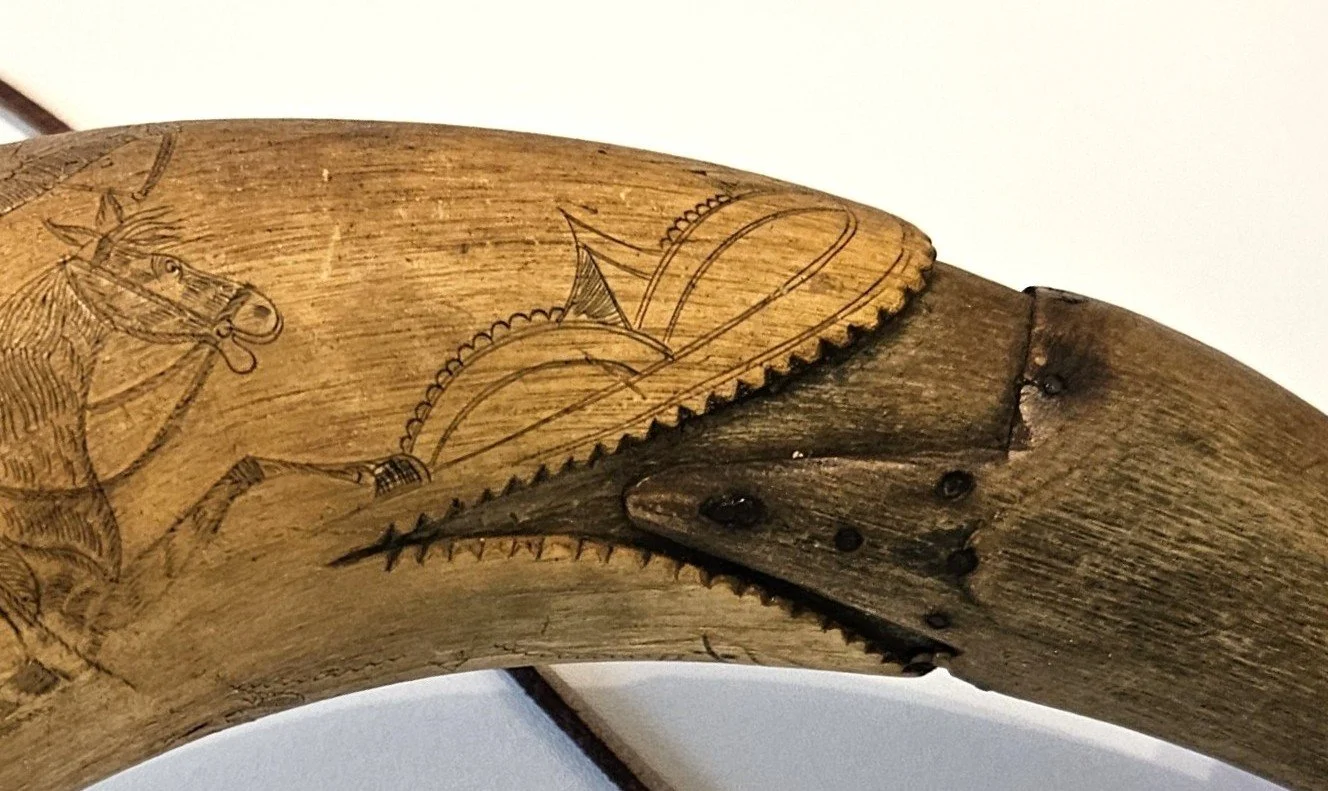
Figure No.3: The spliced-in new spout is easily seen in this view, with its tabs that fit down into each of the deep fish-mouth cuts on the Tansel horn. The black dots on the tab are the original iron pins/nails, now rusted, that attached the new spout. Courtesy B. Mattox.
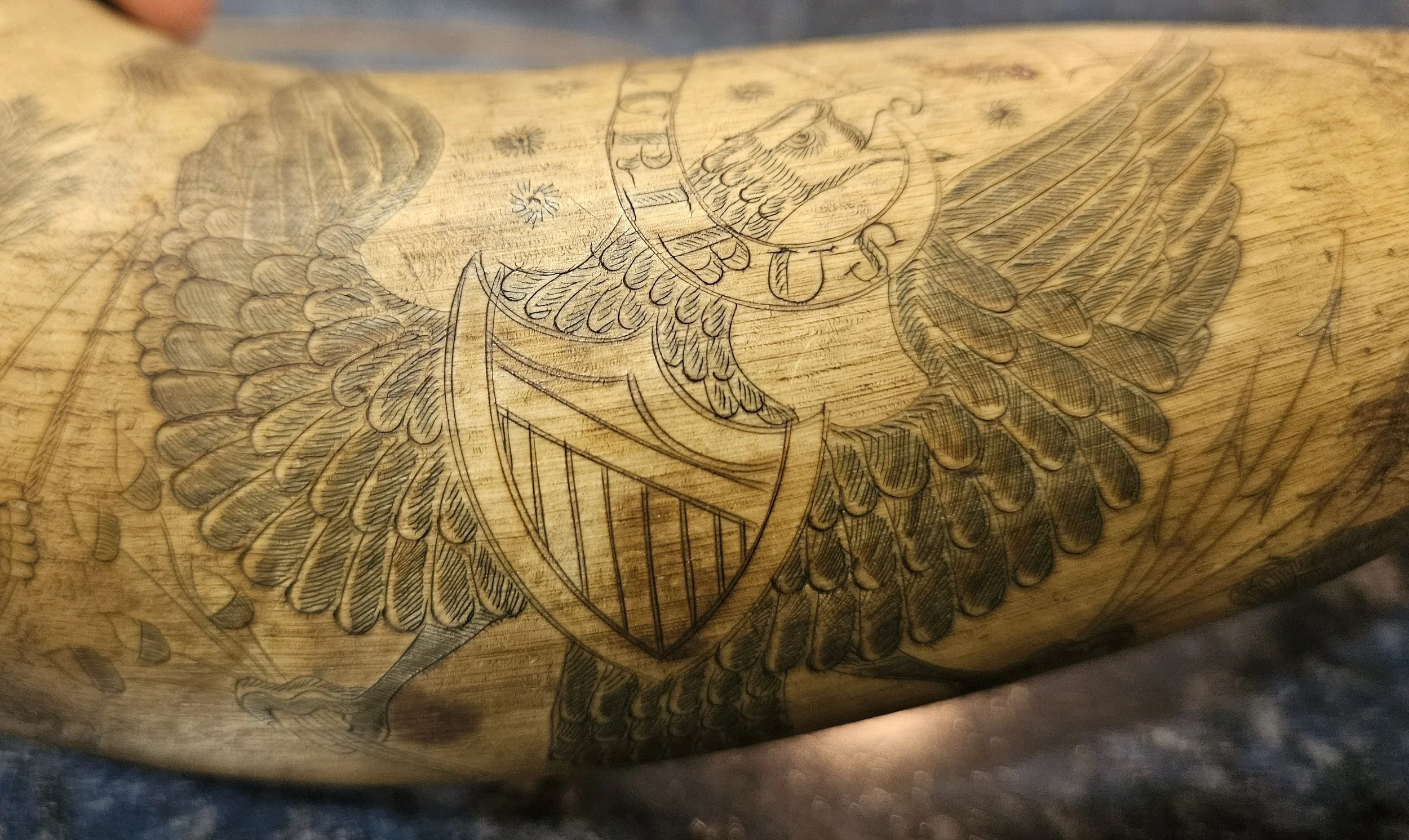
Figure No.4: The new horn’s “trademark” Tansel eagle is nicely done by Tim Tansel. Its shield is a bit lopsided, feathering is all about the same size/width, and no open or white areas appear in the upper wing sections, indicating an earlier Tim Tansel horn.
Caved Details: The Tim Tansel horn is nicely decorated with a Tansel style eagle and scalloped borders, along with three Indian figures… or perhaps two Indians and a fleeing Indiana or Illinois militia member. Two deer also appear on the horn, one a normal Tansel deer, and the other a chubby deer that could be mistaken for a dog… if it did not have deer hooves! The Tansel eagle in Figure No4. is an earlier example of Tim Tansel’s work with its tilted shield, heavily shaded wings with no white areas, uniform feather size/width, and large claw feet. But the horn’s most interesting figures are its Indians, two with bows & arrows and feathered headdresses, and all rather large by Tansel standards with each figure stretching almost halfway around the horn. The tallest Indian is alongside the butt plug in Figures No.5a and No.5b with an empty bow in one hand with a quiver of arrows on his back. He has one knee pulled up as if relaxing while his other arm is raised and bent in an odd manner, perhaps reaching for an arrow. The middle Indian, also rather tall, is in Figures No.6a and No.6b and seems to be aiming his bow & arrow at the third “escaping” figure on horseback that could be either a third Indian, or a mounted militia soldier.
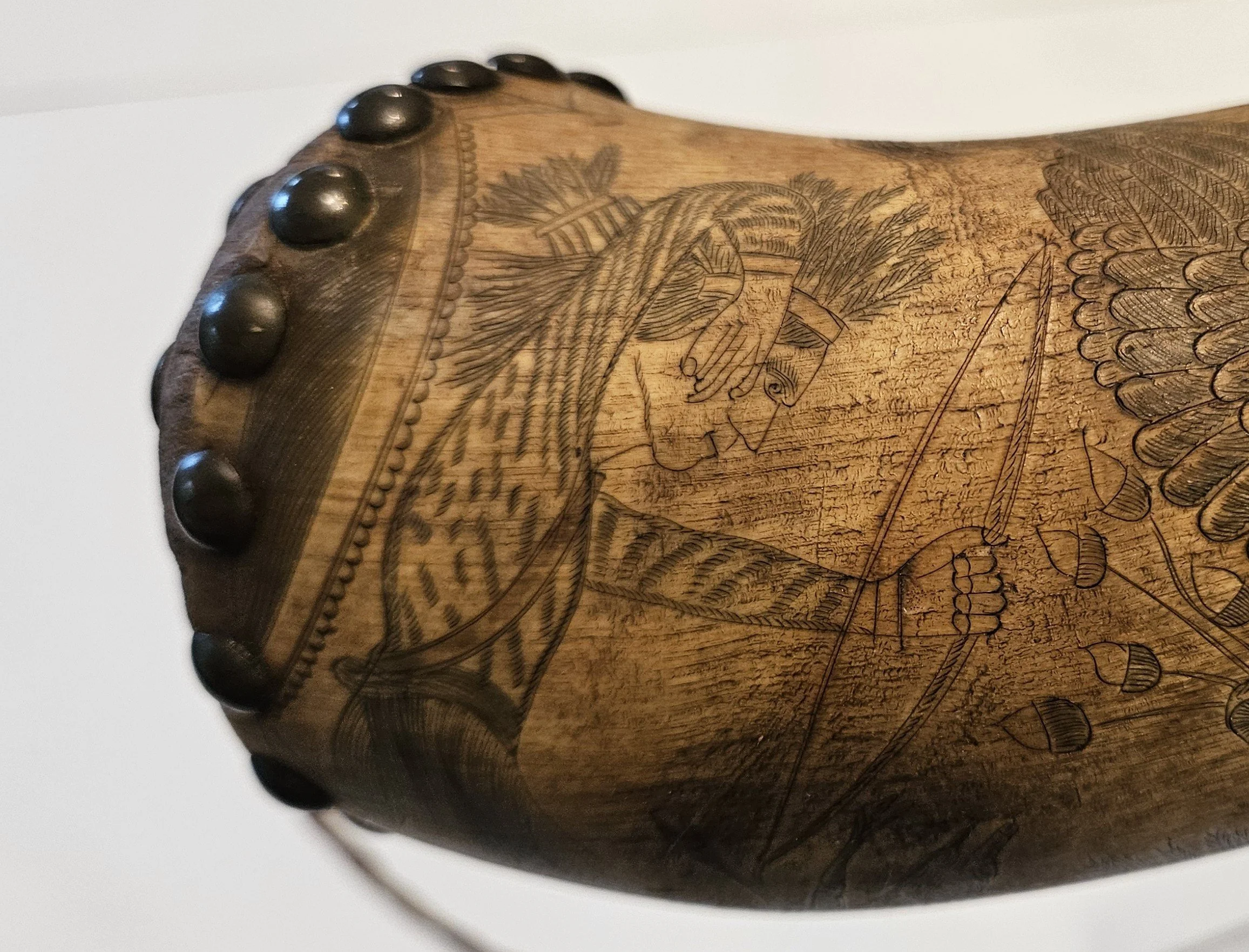
Figure No.5a: This figure and the one directly below show the horn’s tallest Indian. He is well-dressed, has a feathered headdress, and is armed with a bow and arrows.
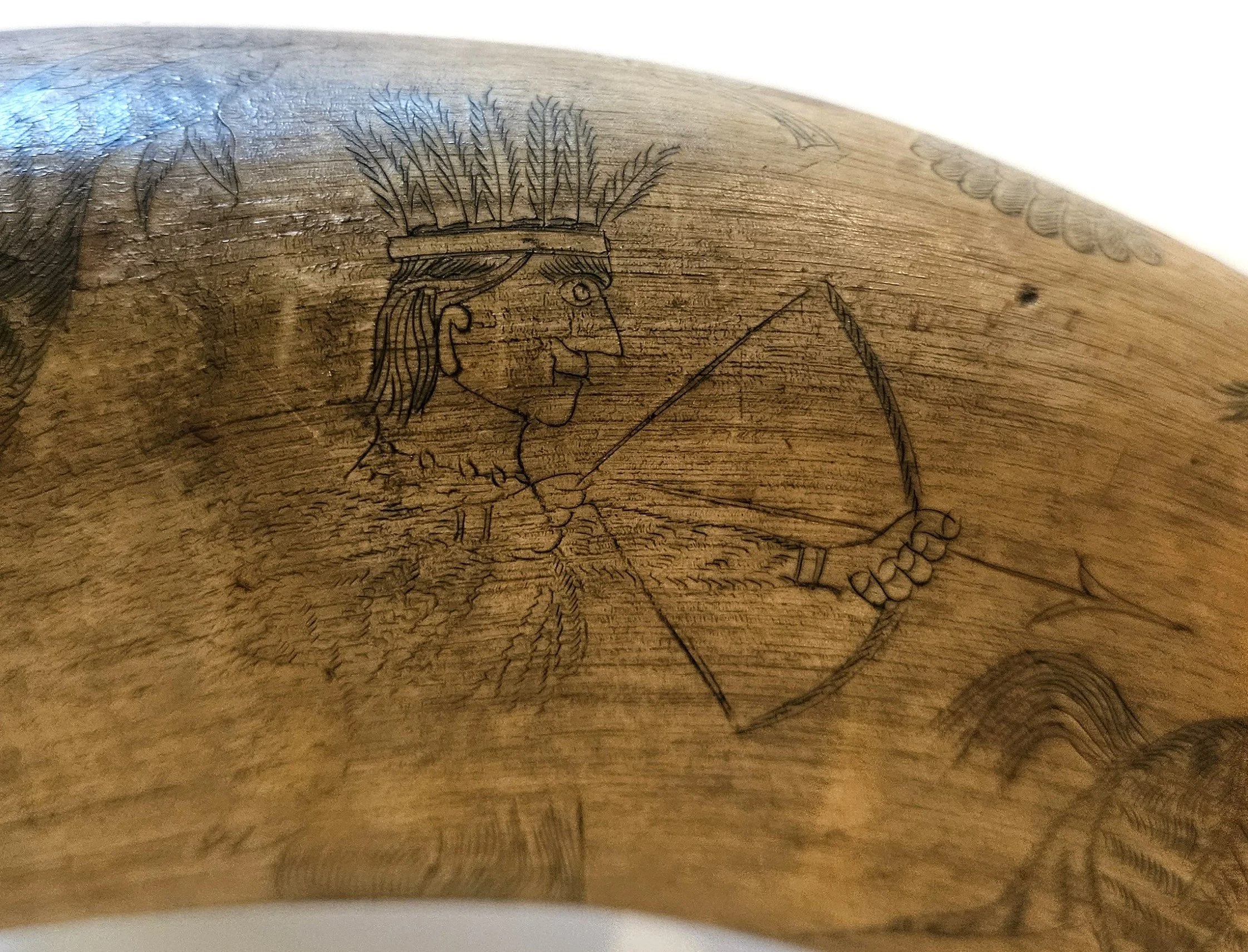
Figure No.6a: This is the top half of the middle Indian with bow drawn and pointing at the horse and rider ahead of him. Note the flat head and heavy ear that indicate Tim’s work.
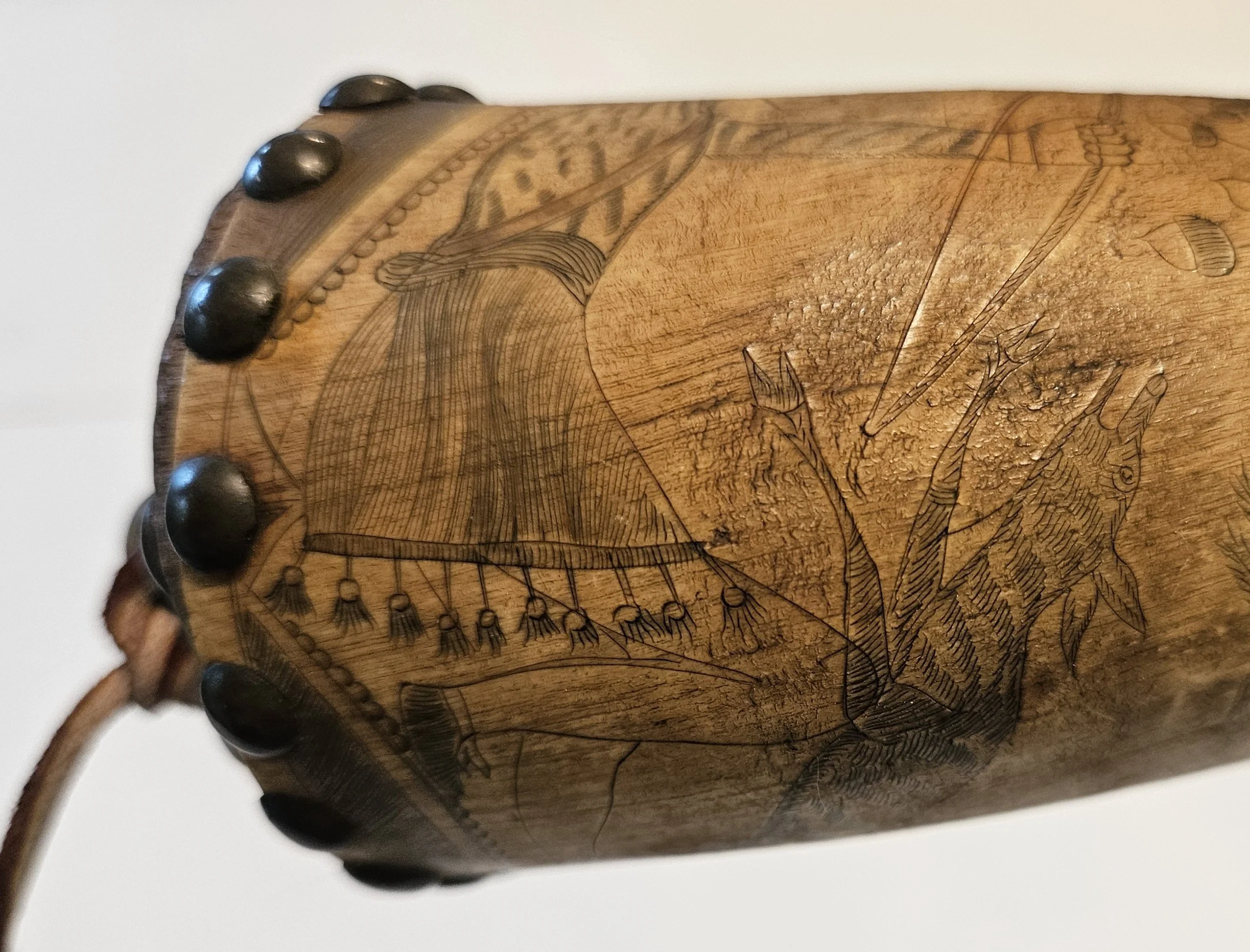
Figure No.5b: The lower half of the tall Indian in Fig.5a above shows his fancy belted outfit with fringed or tasseled skirt, and moccasins. The animal at his feet is a chubby deer.
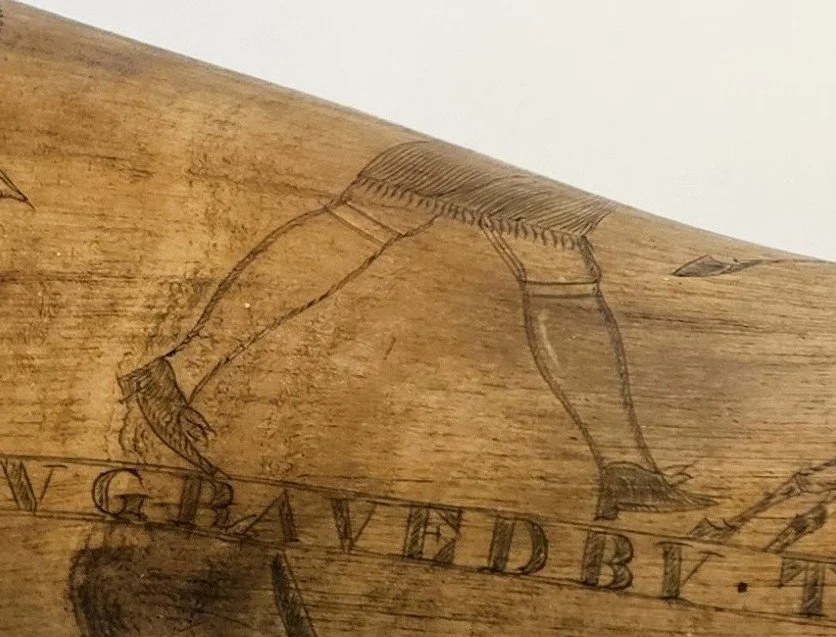
Figure No.6b: The bottom half of the middle Indian shows his fringed hunting jacket, knee bands, and shoes… or perhaps fancy moccasins with heels.
An Indian on horseback is rarely seen on Tansel horns, since horsemen on Tansel horns are almost always famous American soldiers such as Generals LaFayette, Washington, Harrison, Taylor, and Jackson. The mounted figure in Figures No.7a and No.7b is also shooting a bow & arrow as he rides, strongly suggesting he is an Indian. The rider and horse serve as important figures in verifying that the carver was, in fact, Tim Tansel. In his typical style, the rider is too large and out of proportion for the horse, while the horse has a cartoonish feel, especially in the face and his “clunky” hooves. Overall, having two, possibly three, Indian figures on one horn is rare, when most horns with multiple figures have at most a single Indian such as “Black Hawk” or “Tecumseh” along with soldiers, hunters, and at times a well-dressed woman/sweetheart. However, the pictures below of the third “Indian” tell us who the rider really is.
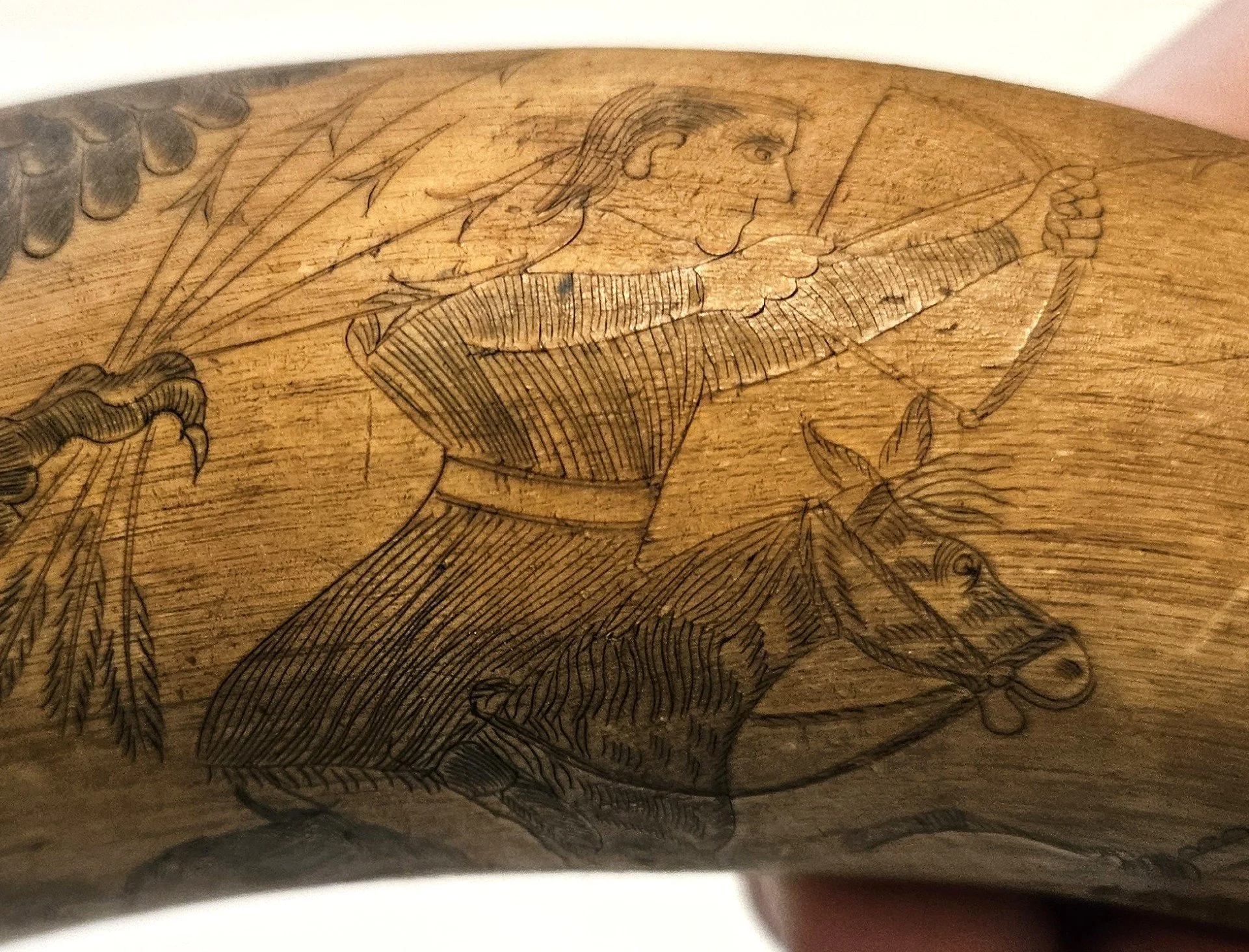
Figure No.7a: This is the top of the third figure. He lacks a headdress and looks like a Tansel hunter or mounted militia, but the bow & arrow suggest he is an Indian.
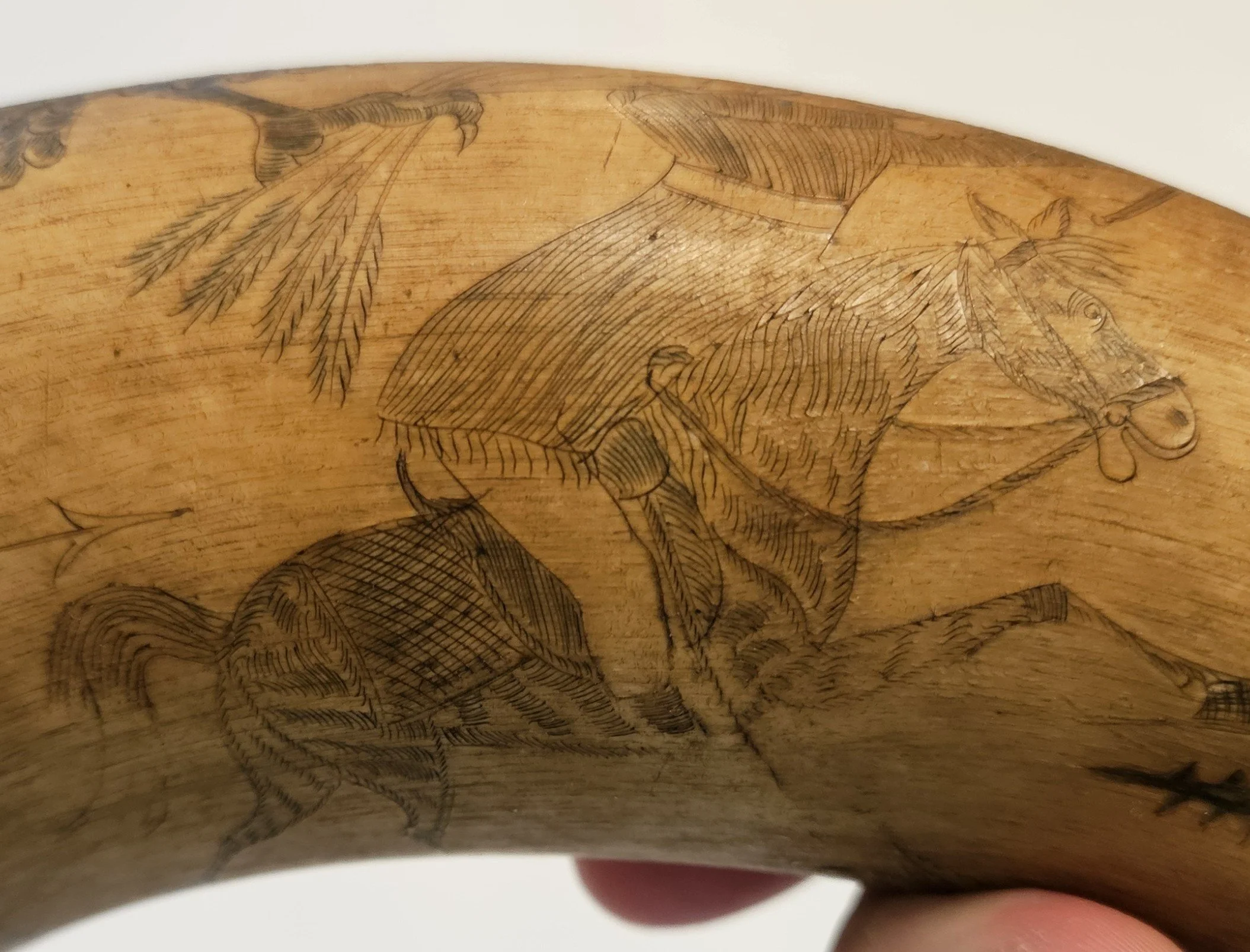
Figure No.7b: The bottom of the mounted figure tells us who he is. He is wearing boots and has an American saddle, saddle blanket, and harness. He is mounted militia.
Dating the Horn: While the eagle pre-dates known “1840” horns by Tim Tansel, the neat border style in Figure No.3, use of two different Indian figures, notched wings on the eagle, and the “cartoonish” style horse suggest the horn was made a year or two into Tim’s carving career… which is thought to have started about 1836 based on his earliest dated horns. The author dates this horn to about 1838 or 1839.
Summary: The “Ingraved by Tim Tansel” horn is interesting for its unusual “Ingraved by…” reference ahead of the carver’s name, and for the functional replacement of its original spout that saved the horn from being discarded. The horn’s depictions of two well-dressed Indians in different poses and a fleeing Indiana/Illinois mounted militia differs from the normal figures of hunters, politicians, and military heroes, making the horn a bit unusual. The Indians and mounted militia figure are undoubtedly reminiscent of the Black Hawk War in 1832 that briefly sent waves of fear across central Indiana as exaggerated reports of Chief Black Hawk’s return were everywhere… and that concern lingered for several years after the war as documented by this horn.