
Foreword: Kentucky’s Lexington School and related Clark County School made slender, elegant rifles with attractive patchboxes, silver inlays, and distinctive molding lines. But some gunmakers in those schools made “Secondary” Lexington and/or Clark County rifles with low-cost iron mountings in “poor boy” style without butt plates, rear ramrod pipes, often without nose caps, and rarely signed. [1] For years Secondary Lexington/Clark County rifles were thought to be made by lesser skilled gunsmiths in those areas, but a recent discovery has debunked that theory.
“Secondary” Rifles: Secondary rifles were unknown until Kentucky Gunmakers 1775-1900 was published in 2012. In the “Lexington School” chapter, a number of plain, iron mounted rifles with Lexington stock architecture and triggers but lacking patchboxes, inlay work, and Lexington molding lines, presented a problem… what were they? They were too strongly related to Lexington rifles to ignore, and they did not fit into any other Kentucky gunmaking school… so they were identified as “Secondary” Lexington rifles. When the new Clark County School was identified as a subset of the Lexington School, the close relationship in their guns suggested “secondary” rifles were also made in the Clark County School. The two schools shared the same stock architecture, mountings, molding lines, and inlays, but the Lexington School was known for its unique two-piece, cast brass patchbox with “captured” lid seen in Figure No.1, while the Clark County School had a conventional four-piece sheet brass patchbox seen in Figure No.2 that was reminiscent of the Sheets gunsmiths’ work from Virginia/West Virginia.
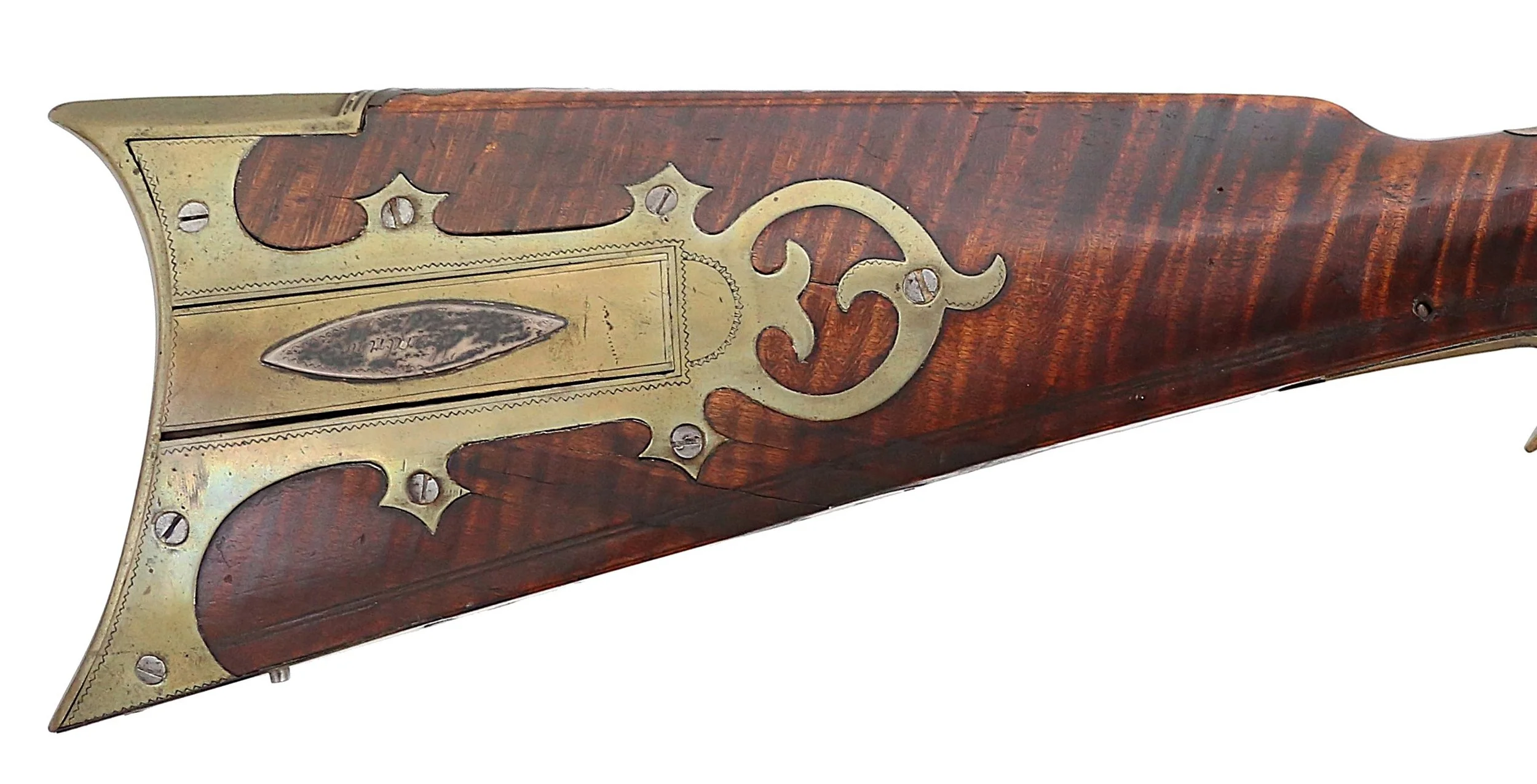
Figure No.1: This two-piece cast brass patchbox is the iconic trademark of a Lexington School rifle. Other Lexington School details include the small, raised ridge on the butt plate return and double-line lower butt moldings. Author’s collection, photo by J. Jaeger.
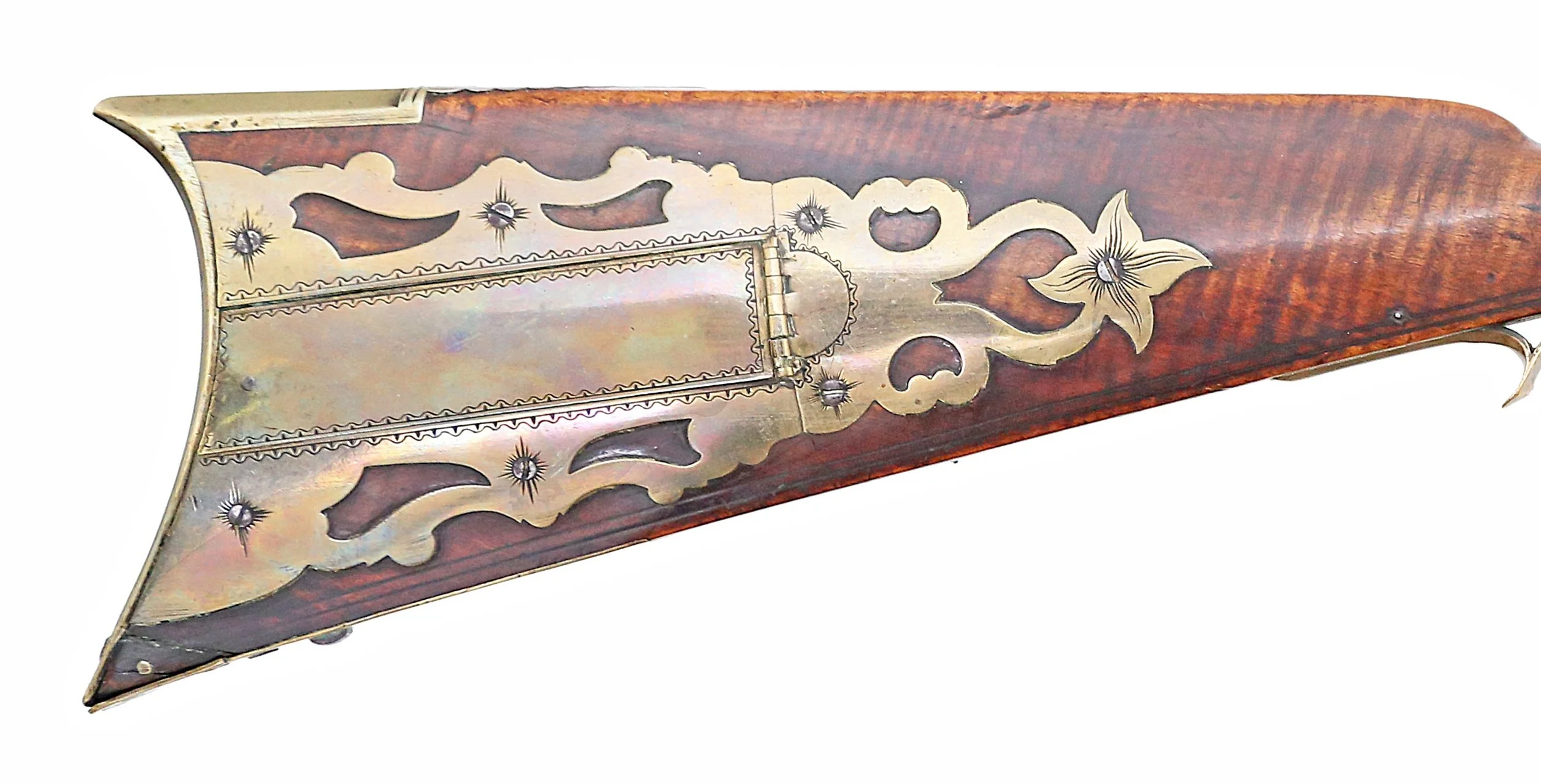
Figure No.2: The “L. Harmon” rifle has a Lexington style raised ridge on the butt plate return and double-line lower butt moldings, but its patchbox is a more conventional four-piece sheet brass box with that shows Virginia influences. Author’s collection.
“L. Harmon” Rifle: An exceptional Clark County School rifle signed “L. Harmon” was found in Canada about ten years ago. [2] It was stocked and mounted like a Lexington rifle, but instead of Lexington’s two-piece cast brass patchbox, it had a standard four-piece sheet brass box with surface hinge. Its toe plate also differed from Lexington toe plates with engraved rays around the screw heads making them look like spiders. The Harmon rifle helped define the new Clark County School and is one of only a few signed Clark County School rifles. The rifle has fine silver inlay work and Lexington style molding lines, and its barrel is signed on a silver inlay, “L. Harmon.” An extensive family provenance came with the rifle that identified its original owner as Dr. Richard D. Greene (1791-1857), a pioneer physician of western Montgomery County, Kentucky, just east of Clark County. The gun was made by Leonard Harmon of Clark County, and its superior quality suggests Harmon was one of the better gunmakers in Kentucky’s central Bluegrass region. The gun is shown in Figures No.3, No.4, and No.5 below.

Figure No.3: The Harmon rifle has typical Lexington architecture with its slim forestock with double-line molding, triangular butt, guard with a heavy front post and two flats on the bow, and four ramrod pipes. Better Lexington guns used silver ovals at the barrel wedges, while the Harmon rifle has small, shell-shaped inlays. The triggers are fancier than normal, yet they retain a strong Lexington influence in the straighter back on the rear trigger and decorative tab on the front “hair” trigger. Author’s collection, photo by J. Jaeger.
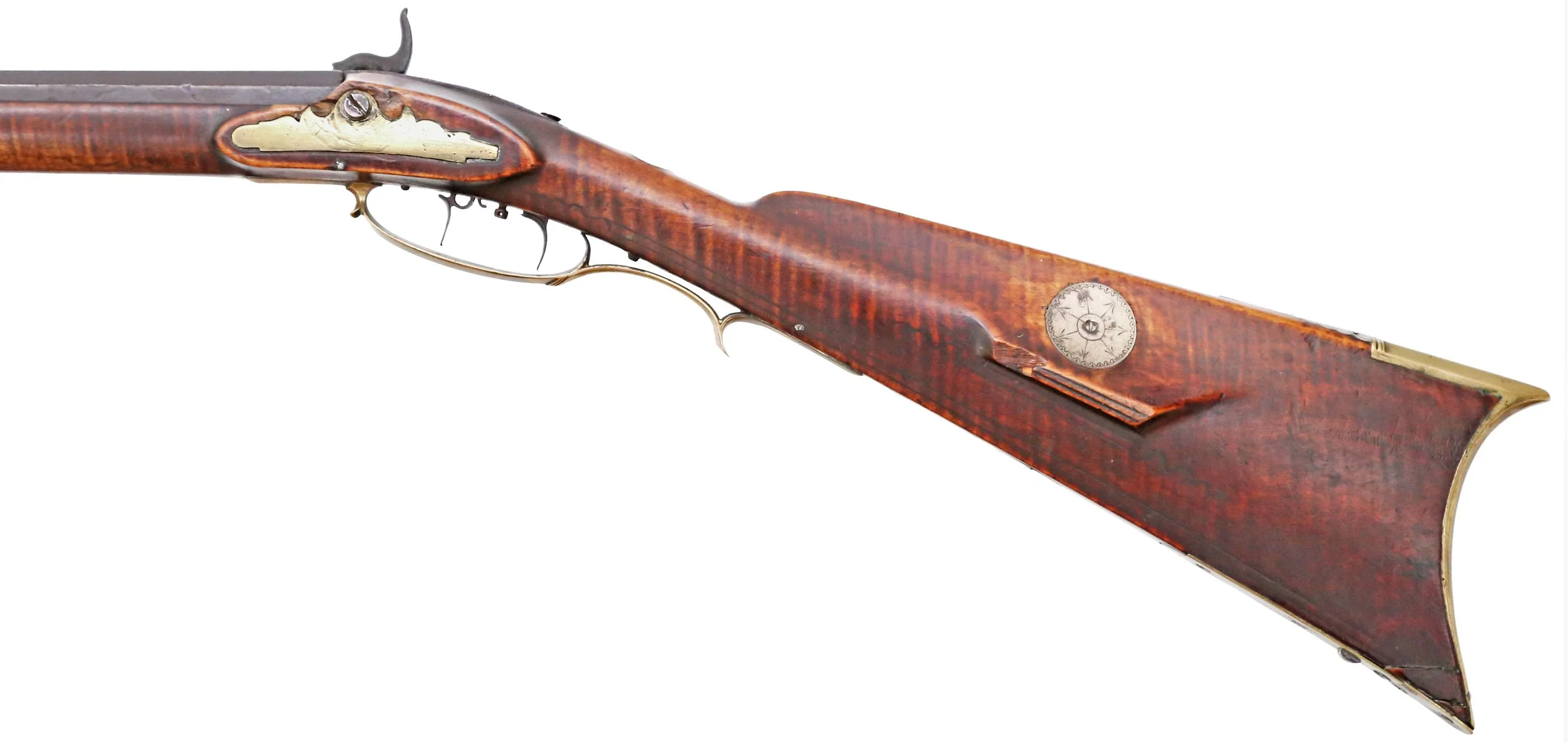
Figure No.4: The back of the fine Harmon rifle has a “horned” side plate similar to Lexington rifles, tight side-facings, a short cheekpiece, and silver cheek inlay mounted with a small center screw similar to Lexington rifles. Author’s collection, photo by J. Jaeger.
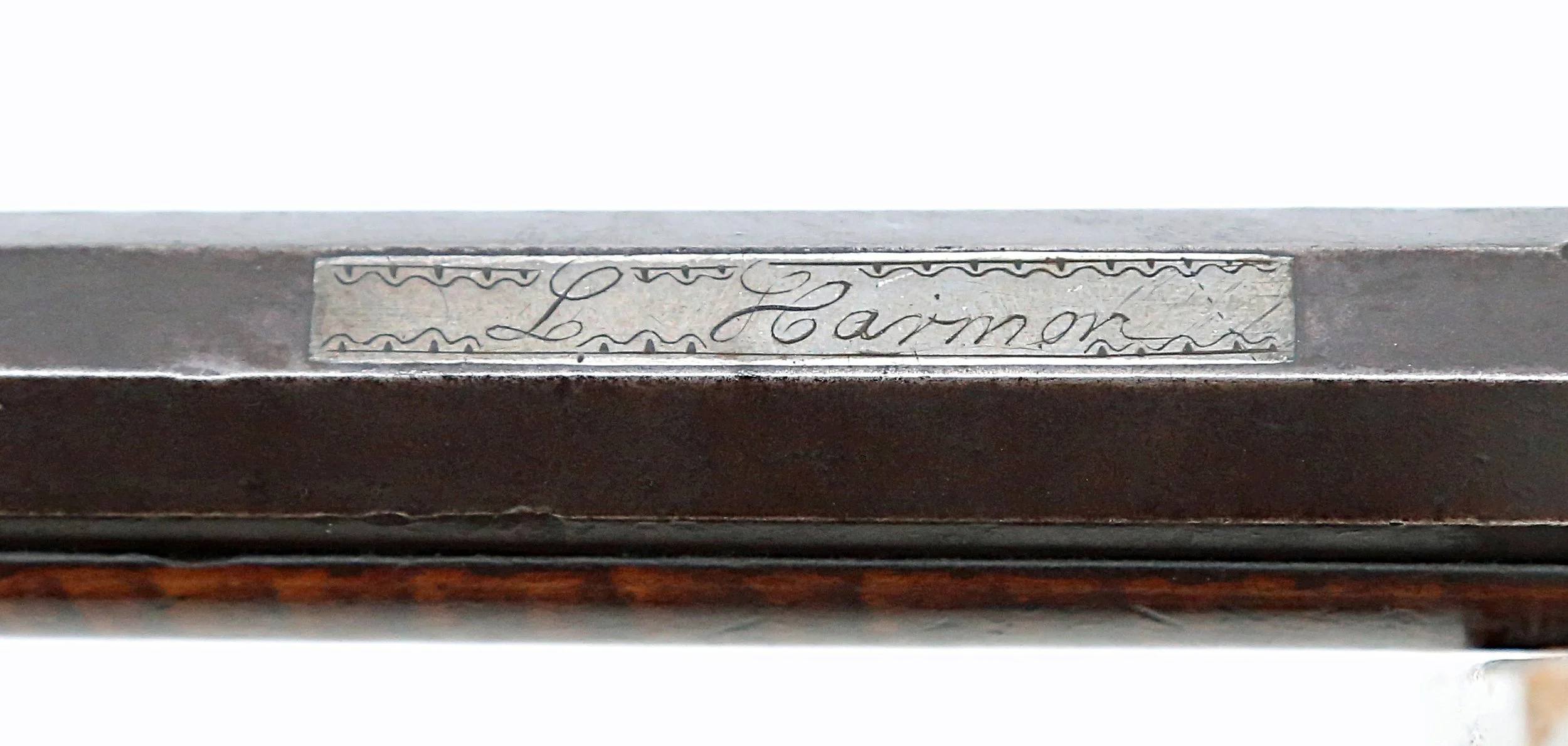
Figure No.5: Most better Lexington guns were signed on a silver barrel plate, and so was the Harmon rifle. It’s “wavy” borders on the silver barrel plate are similar to borders on barrel plates use by the Bryan family gunsmiths. Author’s collection, photo by J. Jaeger.
“Secondary” Harmon Rifle: The author has known Dr. James B. Whisker, well-known author on American longrifles, for many years. During that time, Jim freely shared his research and photography with the author whenever asked. When the “L. Harmon” rifle was found in Canada, the author discussed its impact on Kentucky research with Jim. It tweaked his memory, and he recalled photographing another “L. Harmon” rifle years before. He was able to find the old photos and mailed them to the author. The photos surprised the author, since the gun looked nothing like the first Harmon rifle. Instead, it was a poor-boy style “secondary” rifle without butt plate, patchbox, rear ramrod pipe, or molding lines as seen in Figures No.6, No.7, and No.8 below. Unfortunately, the old black & white photo was taken with the rifle stretched diagonally across the film, so when the author “straightened” the image to save space in the blog article, the process clipped about two and a half inches off the muzzle and the nose cap was lost.

Figure No.6: This well-made but plain, full-stocked rifle was signed in script cut into the barrel iron with “L. Harmon.” Unfortunately, no image of the signature could be found, but the photograph documents the signature with its name tag that Whisker used during his photo shoots. Despite its austerity, the gun has similar stock architecture to the finer Harmon rifle, its rear sight sits slightly behind the rear pipe location, there are four ramrod pipes [actually 3 since no rear pipe], and it has Lexington style triggers, Perhaps more importantly, the gun has a traditional Lexington secondary rifle’s simple iron strip guard. Photo courtesy J. B. Whisker, Ph.D.
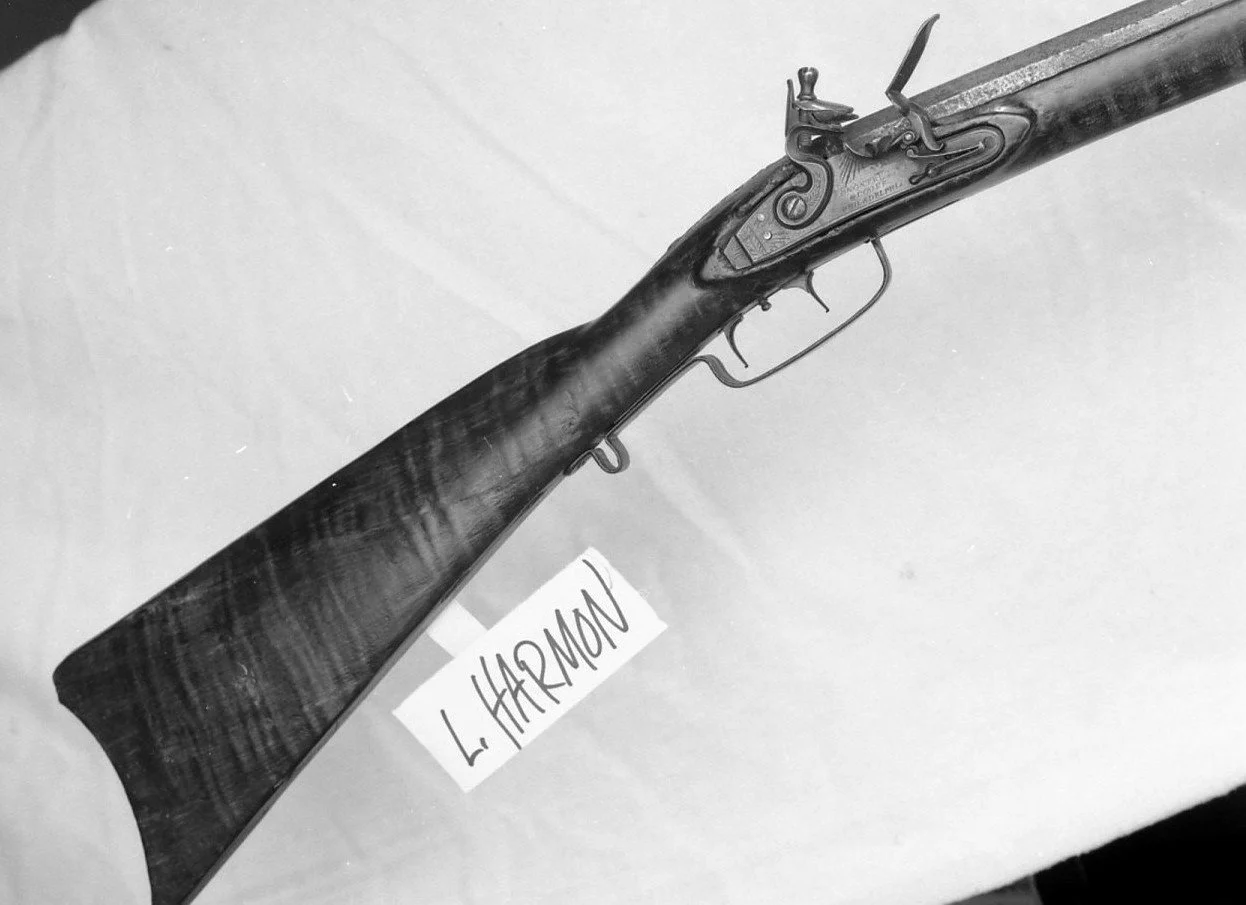
Figure No.7: This view shows the guard and triggers more clearly. The guard is a typical secondary Lexington guard made from an iron strip and shaped by hand into a rectangular bow with flat rail and simple loop for a rear spur. Photo courtesy J. B. Whisker.
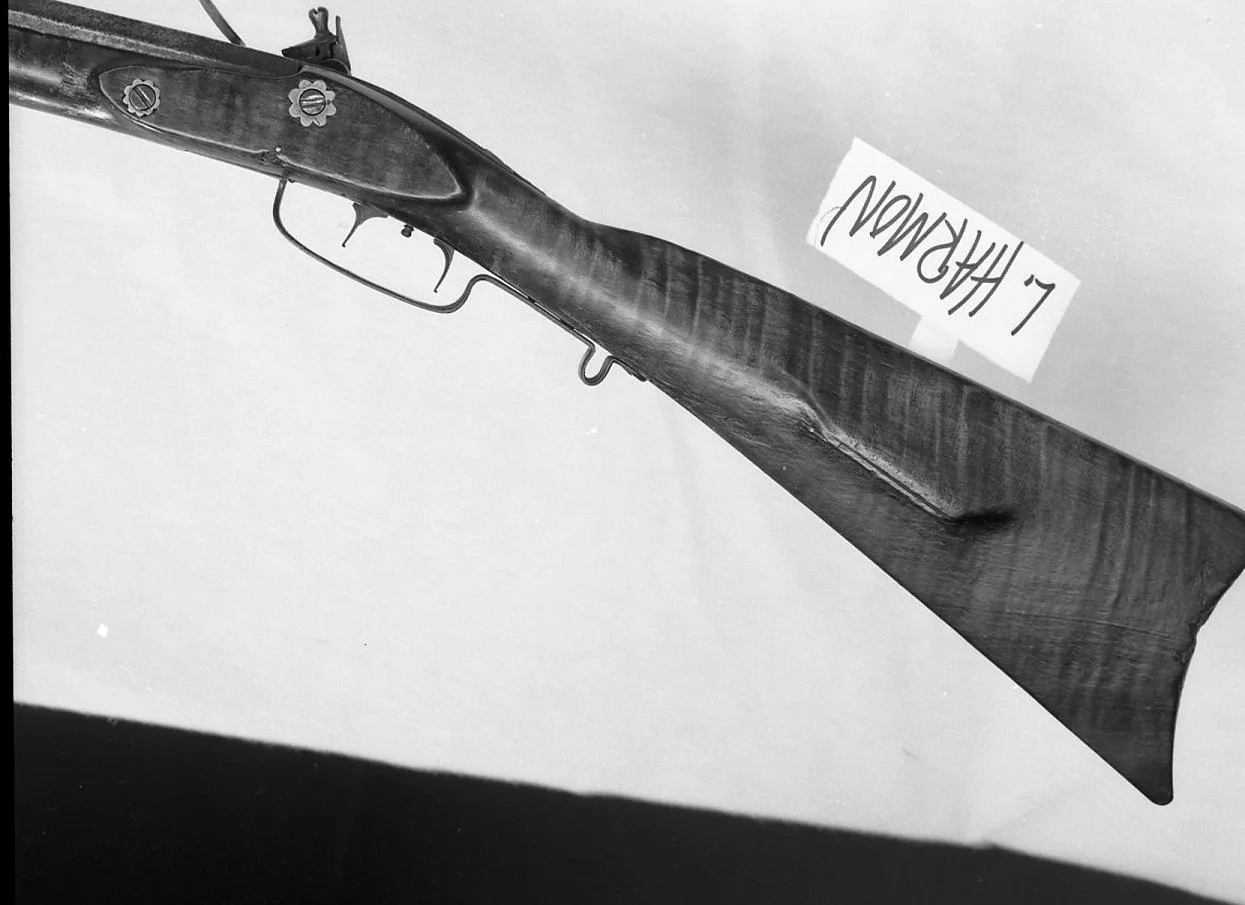
Figure No.8: The back of the secondary Harmon rifle has a short cheekpiece, straight butt lines, and no butt plate. While perhaps original, the author believes the scalloped brass lock bolt washers were added later after the bolts had cut heavily into the stock wood.
The rifle’s simple iron guard mimicked guards on secondary Lexington rifles, as did its typical Lexington/Clark County stock architecture, cheekpiece, long barrel, and script signature. It was a low-cost, common man’s gun made by gunsmith Leonard Harmon of Clark County as a secondary rifle that was very different from his fine rifle repatriated from Canada. The author’s first thought was… the same man could not have made both rifles since they looked so different. But a more careful inspection found many similarities in stock architecture, triggers, side-facings, cheekpiece, and long, graceful appearance. Then the realization set in… here were signed examples of a well-trained Kentucky gunsmith making both fine rifles and low-cost “secondary” rifles depending on a customer’s needs. The discovery of the “L. Harmon” secondary rifle was important in helping collectors understanding Kentucky’s early firearms manufacturing, or “cottage industry” gunmaking. It verified that Kentucky’s better gunmakers who made the two Schools’ fine rifles also made the basic, “secondary” style rifles when the need arose… although they rarely signed their “secondary” work, probably because such guns did not “enhance” their public image or advertise their true gunmaking skills. But the old question of who made the secondary rifles was answered… it was the same gunsmiths who made the fine rifles most collectors cherish.
One Explanation: All secondary Lexington and Clark County rifles known to the author were originally made as flintlocks. Plain rifles were made later in Kentucky, but by then most had brass mountings and only the backwoods guns were stocked as poor-boys. A possible but unproven explanation for the Bluegrass region’s secondary rifles may have been the increased demand for rifles before and during the War of 1812. Kentucky supplied more troops than any other state, its young men were eager to join in the fight, and many may have needed a rifle that could be procured quickly at a price they could afford… which in a nutshell summarizes what secondary rifles were.
Sources:
[1] Kentuckygunmakers.com, “Secondary Lexington Rifles - Who Made Them? ©,” blog article posted 3/2/25.
[2] Kentuckygunmakers.com, “A Kentucky Treasure Comes Home From Canada ©,” blog article posted 11-12-22.