An Historic War of 1812 Tansel Powder Horn from Ft. Meigs ©
Foreword: Early Kentucky era Tansel powder horns often become associated with the War of 1812 and its major battles. Such claims are usually based on the names or initials on a horn, but without a provenance supporting the claim, it remains speculative. One important exception is the “Sam’l Arnold” horn shown in Figure No.1. It has a documented War of 1812 record [1] with an accompanying family provenance that provides its ownership history for over two hundred years. [2]
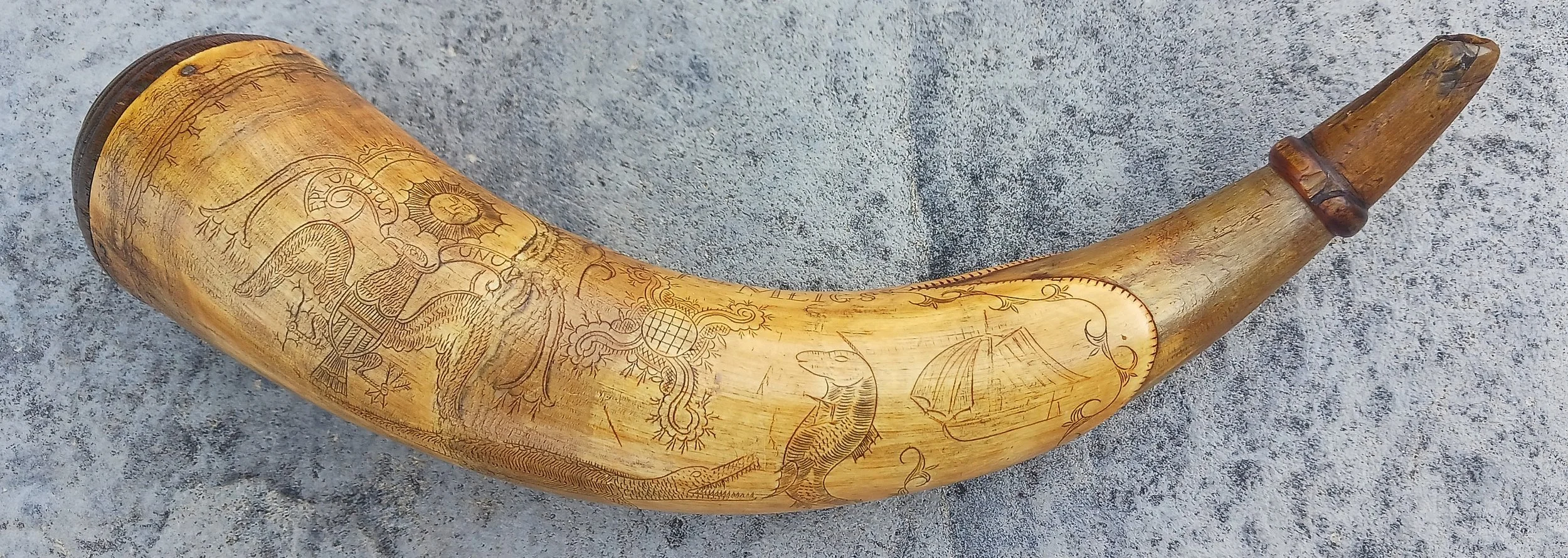
Figure No.1: The “Sam’l Arnold” horn carved by Francis Tansel while he and fellow Kentuckian Samuel Arnold were serving at Ft. Meigs in northwest Ohio, making it one of the rarest of all Tansel horns. It is documented to have seen service at Ft. Meigs and a short time later the Battle of Thames in Canada, where the British were routed and their allied Indian federation under Shawnee war chief Tecumseh destroyed with Tecumseh’s death. The front of the horn has a unique “Fort Meigs” style of Tansel eagle, seen only on Ft. Meigs horns.
War of 1812: Tansel horns were carried by some members of the Kentucky militia who could afford a more expensive carved horn. Most Tansel horns used in the War of 1812 were made well before the war by Francis Tansel and had an eagle like the one seen in Figure No.2 below. However, horns made a year or two before the was as war tensions were growing used a military-style eagle. The military eagle was smaller, more compact, and enclosed in a round cartouche as seen in Figure No.3 and was taken from the patriotic heading on Kentucky militia enlistment/discharge documents. [3] The author thinks the military eagle appeared primarily on horns of Kentuckians who had previously served in the militia, or who were preparing to serve in the militia in the impending War of 1812. Its presence recognized the owner’s militia service and brotherhood with other Kentuckians who served before and during the War of 1812, but there was one exception… the Ft. Meigs eagle.
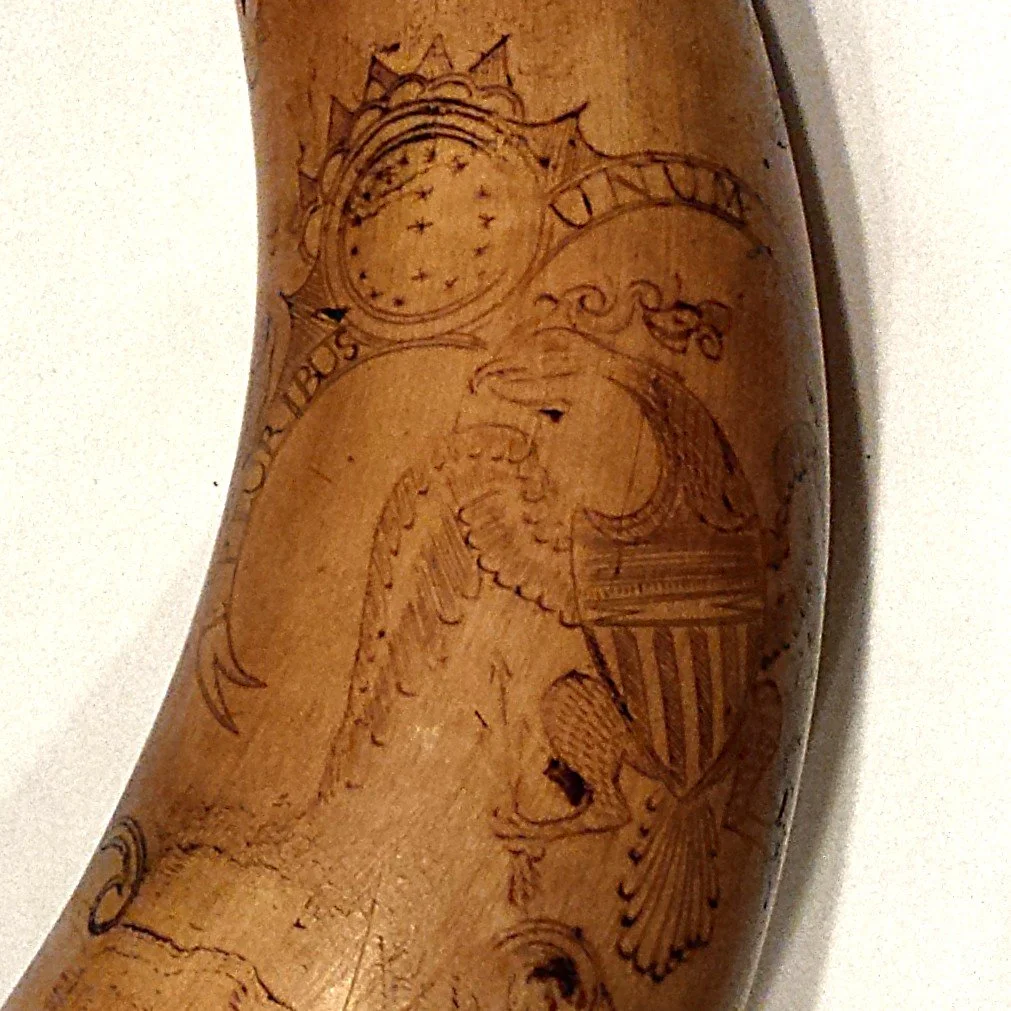
Figure No.2: This eagle by Francis Tansel appears on an “1810” dated horn when war tensions were low and he had not gone to his military style eagle for the impending war.
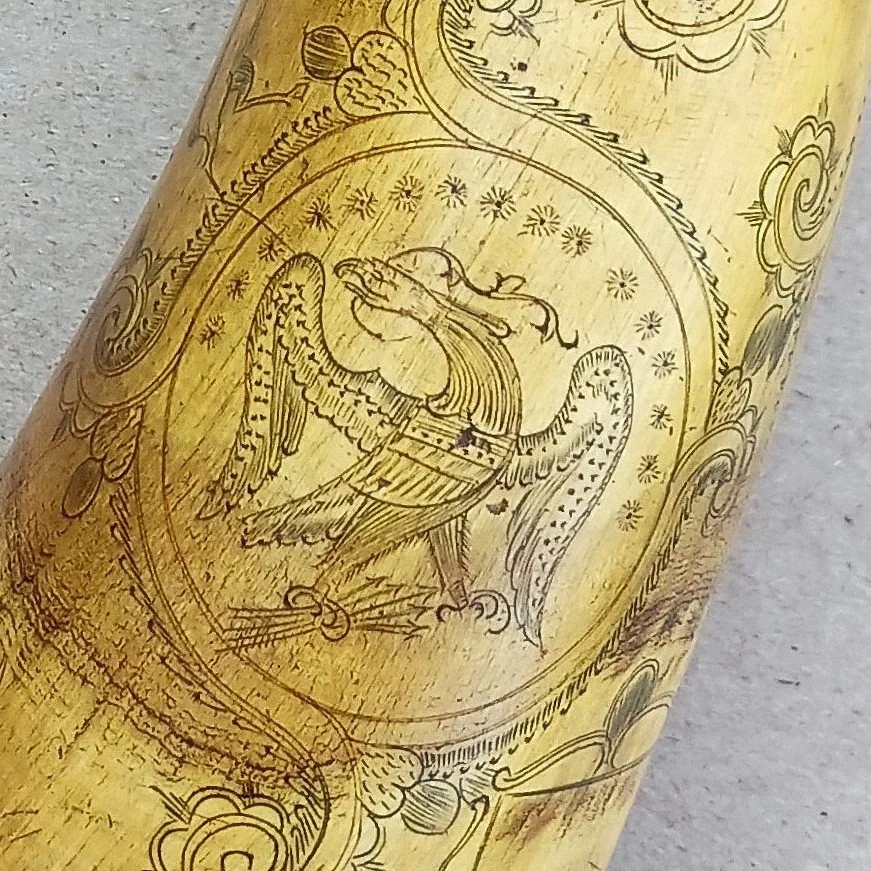
Figure No.3: This is Francis Tansel’s military style eagle that he switched to as war tensions grew and Kentuckians wanted an eagle that represented their war service.
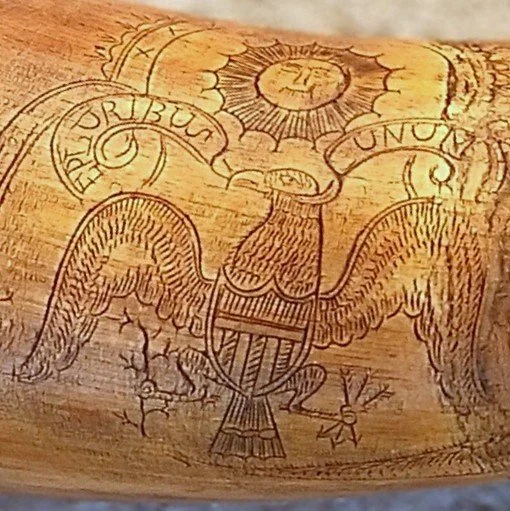
Figure No.4: This is the Ft. Meigs eagle, simplified in design and detail except for the “E Pluribus Unum” banner overhead. It shows the impact of war on the carver.
Ft. Meigs Horns: Francis Tansel used the compact military eagle for several years on his War of 1812 era horns but made an exception with his Ft. Meigs horns. Most of his horns were carved at home under peaceful conditions, but Ft. Meigs horns were carved under adverse war time conditions. Francis served as a private in Captain John Duvall’s Company of Kentucky Militia from March 4th to September 4th in 1813, with most of his time spent at Ft. Meigs in northwest Ohio. [4] While there, he carved several horns of Kentucky militia members to document their service at Ft. Meigs. Francis did not make the horns but rather decorated the soldiers’ personal horns. His Ft. Meigs carving was simpler than the carving he did before and after his Ft. Meigs service. The Ft. Meigs style eagle with its smaller size and fewer details is shown in Figure No.4. The head is less defined, wings and tail feathers less heavily shaded, and the olive branch and arrows in the eagle’s tiny feet are reduced to a few basic lines. His borders resemble his earlier “wave-like” borders but with less detail in each wave. The work was done in haste under stressful and uncertain wartime conditions.
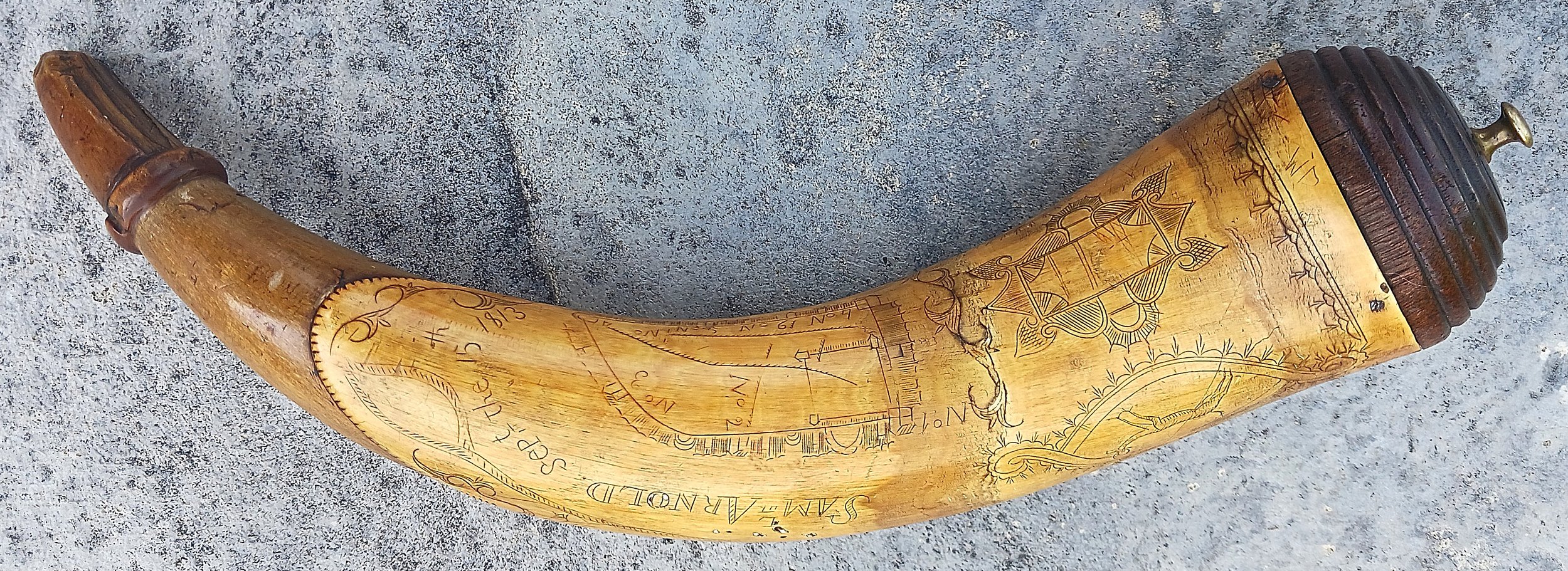
Figure No.5: The back side of the “Sam’l Arnold” horn shows a detailed depiction of Ft. Meigs and the soldier’s name and date the horn was decorated by Francis Tansel. The basal border with tiny scallops and the spout border with entwined waves/flowers were patterns used on earlier Tansel horns, but here they are smaller and simplified to expedite the carving. Note the fancy rectangular cartouche found on earlier horns for the owner’s name but not needed here since Samuel Arnold’s name is carved above the image of Ft. Meigs.
Three of Francis Tansel’s Ft. Meigs horns have survived. They all have similar images of Ft. Meigs, a Ft. Meigs style eagle, and a soldier’s name and date as seen in Figure No.5. The documented Kentucky soldiers’ names on the three surviving horns are James Arnold, his brother Samuel Arnold, and Archibald Elliott. The James Arnold and Archibald Elliott horns are at the Ft. Meigs Museum [Ohio Historical Society] in northwest Ohio, and both have suffered losses. The Arnold horn lost its butt plug, while the Elliott horn was badly weathered/scaled and lost much of its carving, but the soldier’s name and date remain readable along with traces of other carved figures. The third horn owned by Samuel Arnold has been more fortunate. It has survived in good condition for over two hundred years as it passed down through generations of Samuel Arnold’s relatives.
Samuel Arnold: Samuel was living in Bourbon County, Kentucky on March 29, 1813, when he enlisted in Capt. Peter Dudley’s company of Col. William Boswell’s regiment, Kentucky Volunteer Light Infantry, for service at Ft. Meigs.[5] His enlistment ended on September 9, 1813, and during a short respite at Ft. Meigs, he had his powder horn decorated by Francis Tansel to record his Ft. Meigs service. Samuel then immediately re-enlisted in Capt. George Baltzell’s newly formed company of Kentucky infantry as a lieutenant. [6] Baltzell’s company accompanied General William H. Harrison into Canada and fought at the Battle of Thames [Moraviantown] on October 5, 1813, where the British Army was routed and the great Shawnee war chief Tecumseh was killed. Samuel Arnold carried his Ft. Meigs powder horn on the battle field and witnessed the historic conflict and victory for the American troops.
Samuel’s Horn: Francis Tansel decorated Samuel Arnold’s powder horn and, in the process, added a shallow Tansel-style “fish mouth” between the horn’s body and spout. Neither the plug nor spout resemble Francis’ work since it was a pre-existing horn. However, its domed “beehive” style plug and raise strap retention ring were common to central Kentucky horns and support the horn’s Kentucky origin. The wave-like border around the fish-mouth, small sailing ship, and four-armed cartouche in Figure No.6 were all simpler forms of Francis’ earlier work. But several unique details set the “Sam’l Arnold” horn apart from non-war horns, with the most important being a highly detailed image of Fort Meigs with the label “Ft. Meigs” just below it. The fort’s outline, cabins, gates, and inside ditches/traverses are depicted with the soldier’s name [Sam’l Arnold] and date [Sept. the 15th 1813] carved above it as seen in Figure No.7.
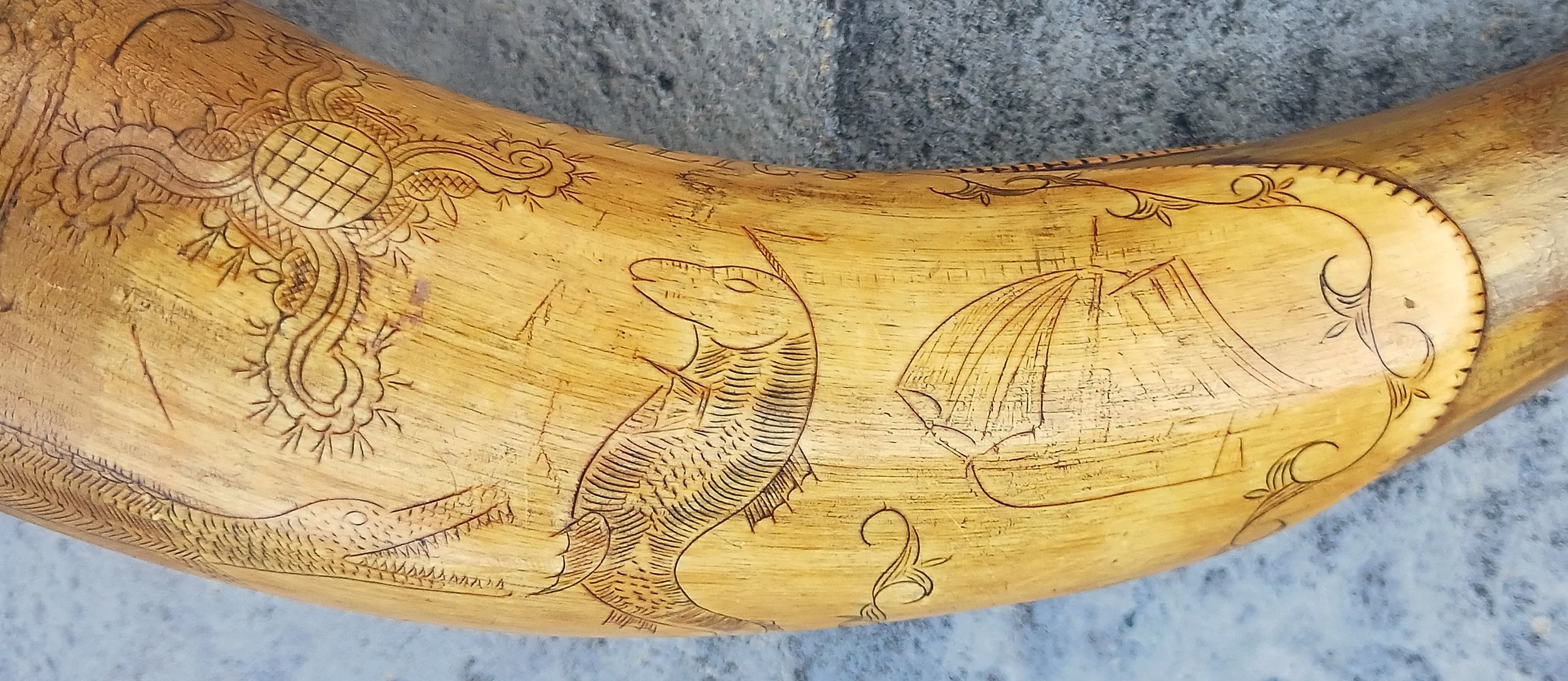
Figure No.6: Several figures seen here including the sail boat, wave-like border, and four-armed cartouche were used on earlier Tansel horns, but here they are smaller or simplified, a result of the war time conditions and time constraints the horn was carved under.
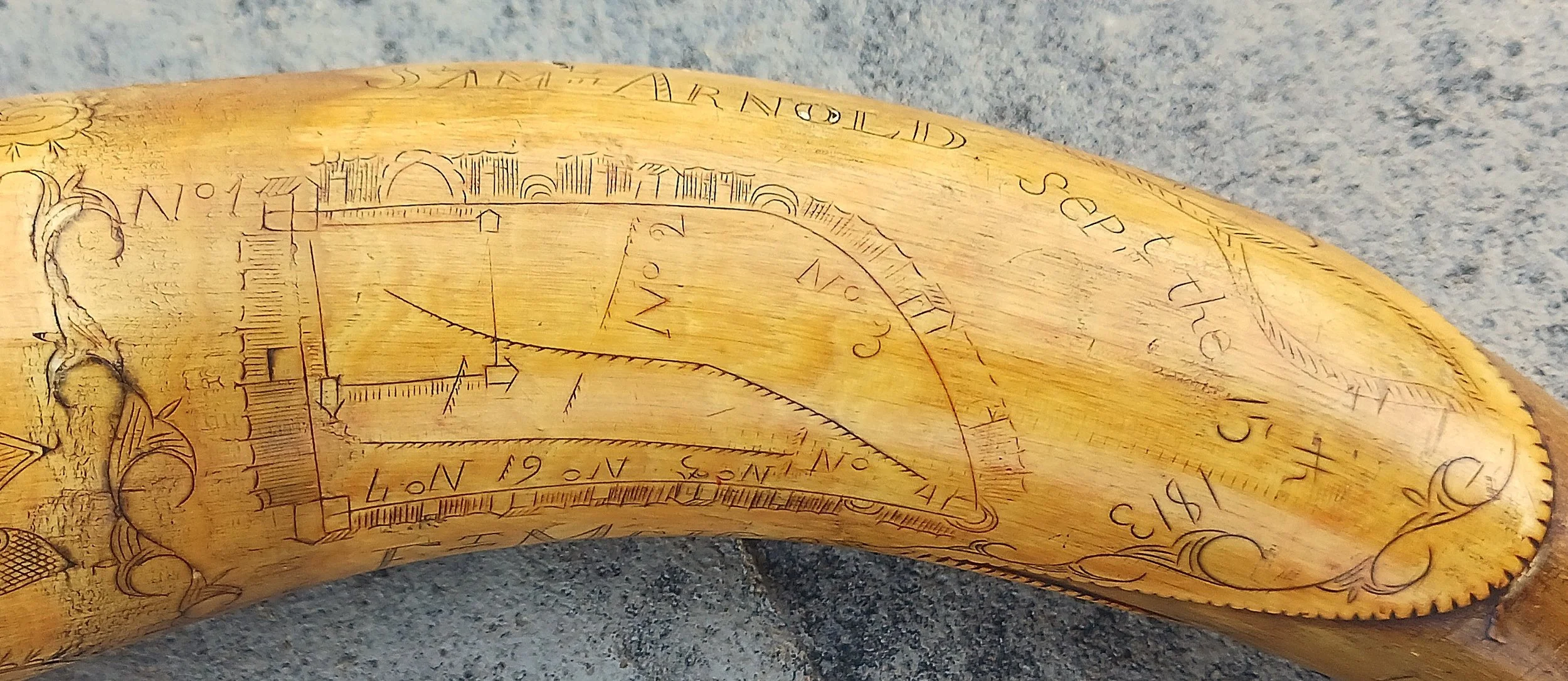
Figure No.7: The horn has a relatively accurate depiction of Ft. Meigs with its block houses, cabins, gates, and the extensive trenches dug inside the fort to protect soldiers from British cannon balls when being bombarded.
The fort-name-date details are crucial for identifying a Ft. Meigs horn; without all three details present, a horn is not a true Ft. Meigs horn. Francis Tansel carved a few horns before arriving at Ft. Meigs and soon after leaving that have one or two of these details, but not all three… and they are not actual Ft. Meigs horns carved at the fort. Other unusual details on Ft. Meigs horns are the simplified Tansel eagle with uniquely looped “E Pluribus Unum” banner overhead seen in prior Figure No.5, and the important “seahorse and alligator” figures representing the “half horse and half alligator” nickname for Kentucky’s fighting troops seen in Figure No.8. The borders, eagle, small rectangular cartouche for owner’s name, and most other figures on Ft. Meigs horns are smaller, simpler, and less detailed than related figures on Francis’ pre- and post-war Tansel horns, showing the hurried and stressful conditions the horns were carved under.
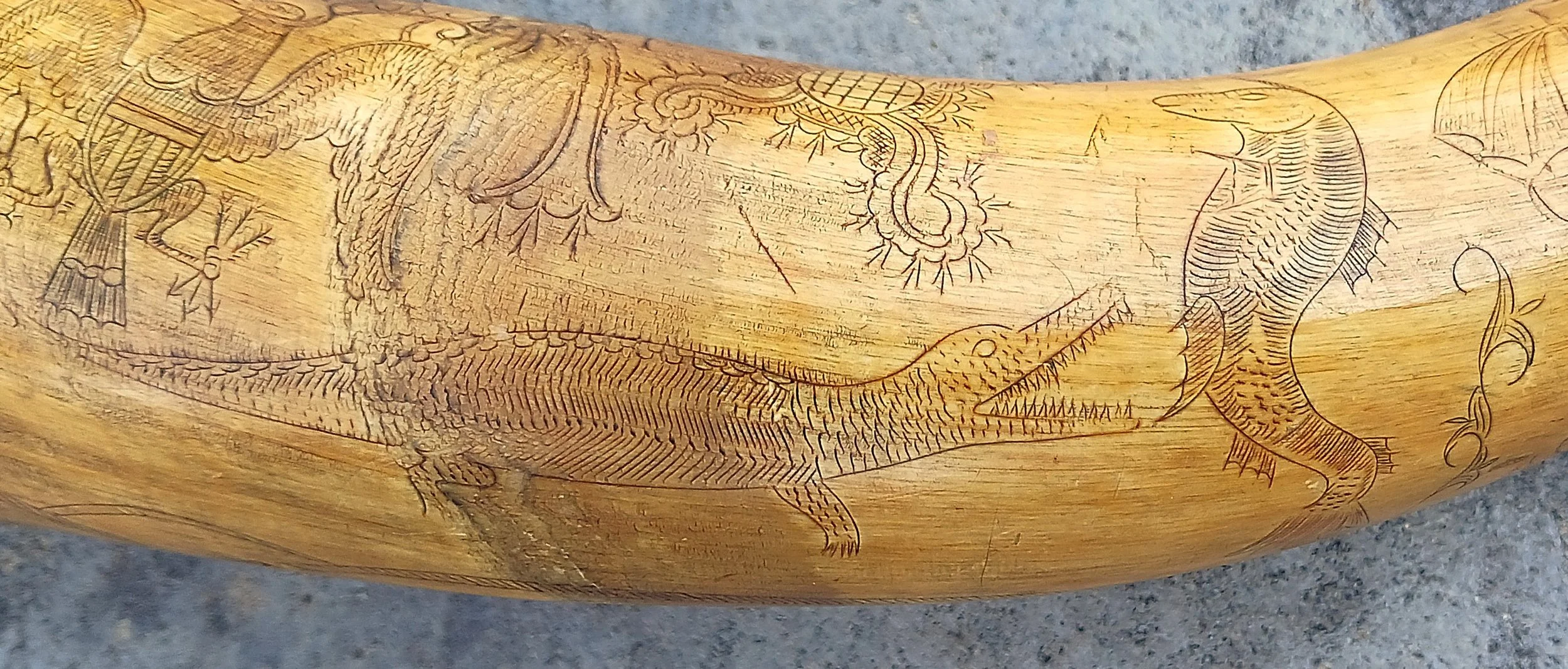
Figure No.8: Kentuckians were known to be fearless fighters, almost to the point of foolhardiness. They earned the nickname of “half horse-half alligator” to describe their ability to move quickly and fight with ferocity. The unexpected pairing of a sea horse and alligator suggests their “half horse-half alligator” reputation, perhaps with a subtle reference to the sea duty [sea horse] of some Kentucky sharpshooters who volunteered to help Commodore Oliver Hazard Perry on Lake Erie.
Provenance: Samuel Arnold’s horn has a long history behind it. It eventually let Samuel Arnold and went to a relative in the Bruner [Brooner] family of Kentucky, who carried it north into Spencer County, Indiana, where it resided for many years and eventually moved into the related Miller family. The horn then went to Oregon for many more years in the Miller family before finally coming back east. Miller descendants contacted the author in 2020 seeking verification the horn was a true Tansel horn [it was not signed by Francis Tansel]. They shared the horn’s history and related family letters with the author, and after lengthy discussions, allowed him to acquire it. The “Sam’l Arnold” horn is unique for its documented War of 1812 service and lengthy family provenance. It was carried to Ft. Meigs by a Kentucky soldier, decorated at Ft. Meigs by Francis Tansel to record the soldier’s service there, and then taken to Canada where it was at the Battle of Thames. The horn and its owner survived the battle, and later descendants cherished the horn for its service at Ft. Meigs, the Battle of Thames, and later on the frontier of Indiana. The author is indebted to the Miller family for allowing him to be the next caretaker of this historic Tansel powder horn.
Sources:
[1]
[2]
[3]
[4]
[5]