
A Rare Jewel by Benjamin Mills of Kentucky ©
Foreword: Benjamin Mills was best known for his fine hunting rifles, target rifles, and rifle/shotgun combination guns. He tinkered with new designs and was known to make double-barreled rifles, triple-barreled rifles, and shotguns, and after the Civil War he made breech loading rifles and shotguns. But he also made high-quality pistols with no two alike… unless made as a matched pair. Most Mills pistols were single barreled target guns, but recently an exceptional Mills pistol appeared that was made like Mills’ superposed rifle/shotguns and his finest target rifles; it had a pin in the breech section that allowed the barrels to be dismounted from the butt. The author had never seen a Mills pistol made like that before. The pistol is shown in Figures No.1 and No.2 below. Note: All photographs unless otherwise stated are courtesy of College Hill Arsenal, Nashville, Tennessee.
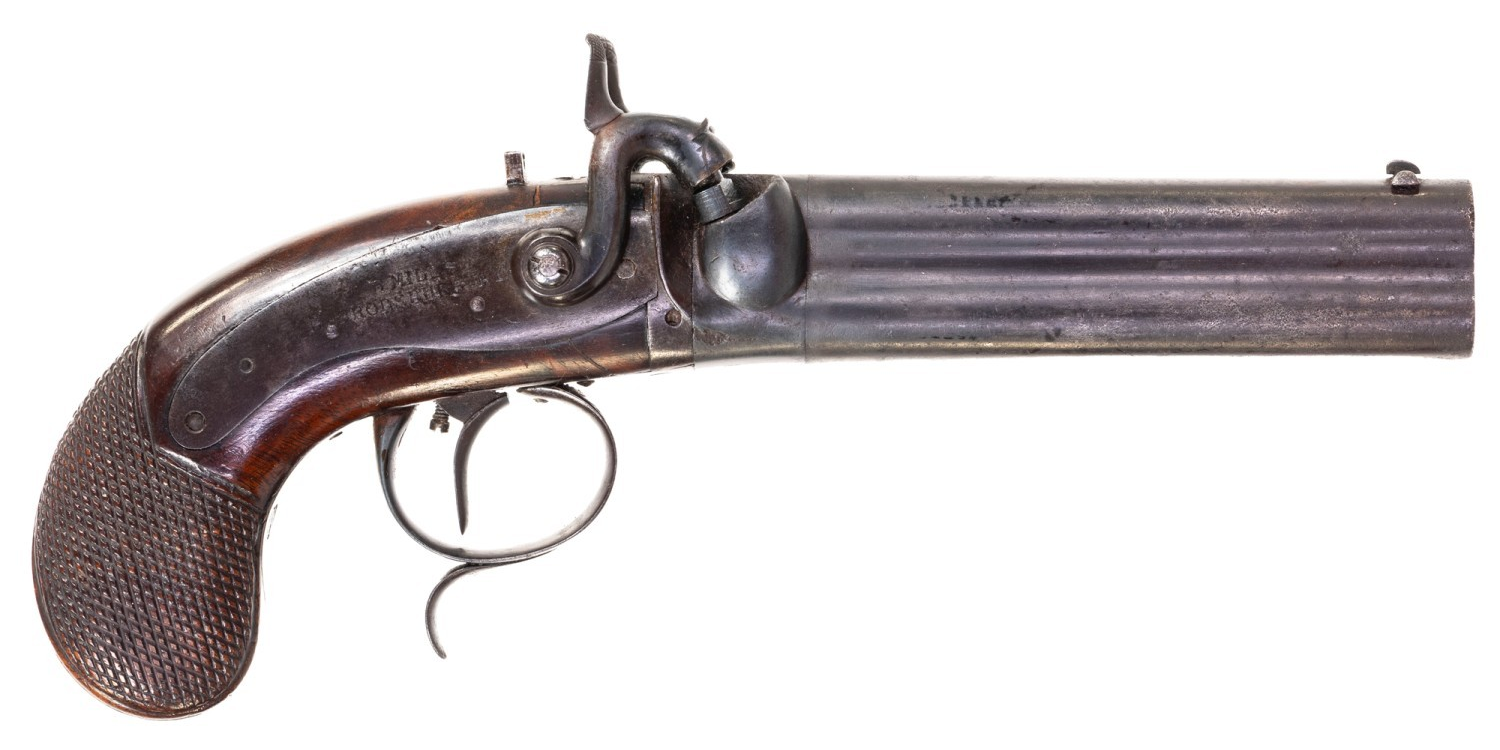
Figure No.1: The Mills pistol has two stacked barrels cast in one piece and then finished and rifled. The back-action lock is marked “B. Mills / Harrodsburg Ky.,” and the round guard has a spur to help stabilize the shooter’s hand and single “set” trigger for greater accuracy.
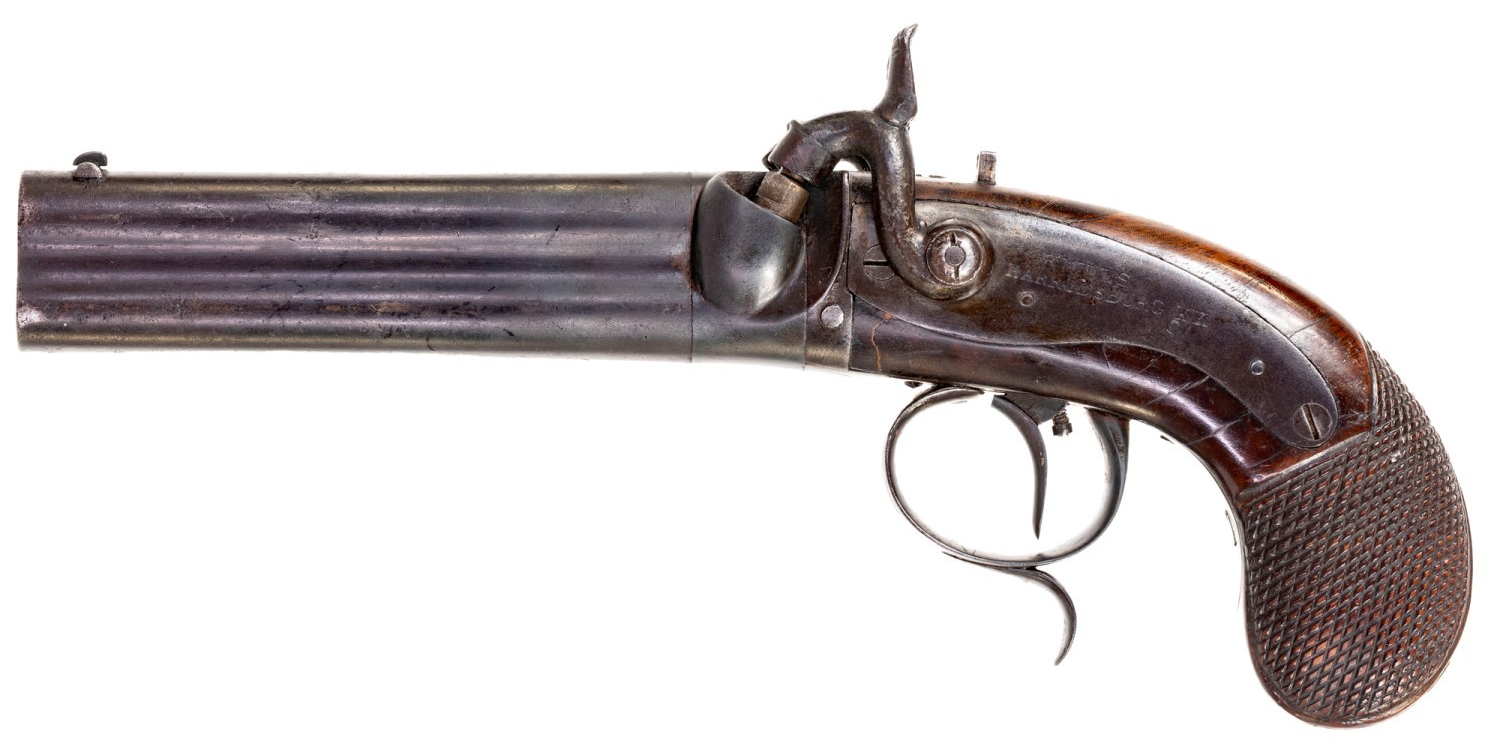
Figure No.2: The reverse of the Mills pistol is almost an exact copy of the front side with matching signed back-action locks, matching fine checkering, and same height bolsters on the patent breeches despite one firing the top barrel and the other the bottom barrel.
Superposed Mills Pistol: Mills’ pistol, shown in Figures No.1 and No.2 above, has two stacked .40 caliber barrels made as a single unit and stamped “Cast Steel.” The barrels have a patent breech with a flash shield and percussion bolster on each side, with the front hammer firing the top barrel and the rear hammer the bottom barrel. The grip is nicely grained walnut with fine checkering, and the coin silver inlay in Figure No.3 curves around its bottom edge for the owner’s name. The back-action locks are both stamped “B. MILLS / HARRODSBURG KY.” in two lines as seen in Figure No.4, and the percussion hammers are attached with rounded bun-nuts [slotted nuts] preferred by Mills. Behind the patent breech is a short cast receiver with integral tang and rear sight. All metal surfaces are finely filed and fitted with the wood-to-metal fit virtually perfect. A small but important detail on the pistol sets it apart from most known Mills pistols and is shown in Figure No.5. A tapered pin runs through the receiver to lock the barrels to it… similar to the pin that locks the superposed barrels to the receiver on Mills’ superposed rifle/shotgun in Figures No.6 and No.7. It was a detail used on better New York target rifles and superposed guns that Mills brought to Kentucky; it allowed his better rifles and superposed guns to be taken down into two shorter pieces for easy storage in the fitted cases that accompanied them.
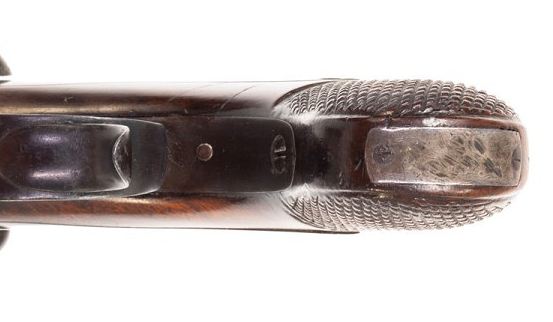
Figure No.3: The Mills pistol has an unexpected silver inlay on the bottom of the grip, probably for the owner’s name, but any remaining engraving is unreadable.
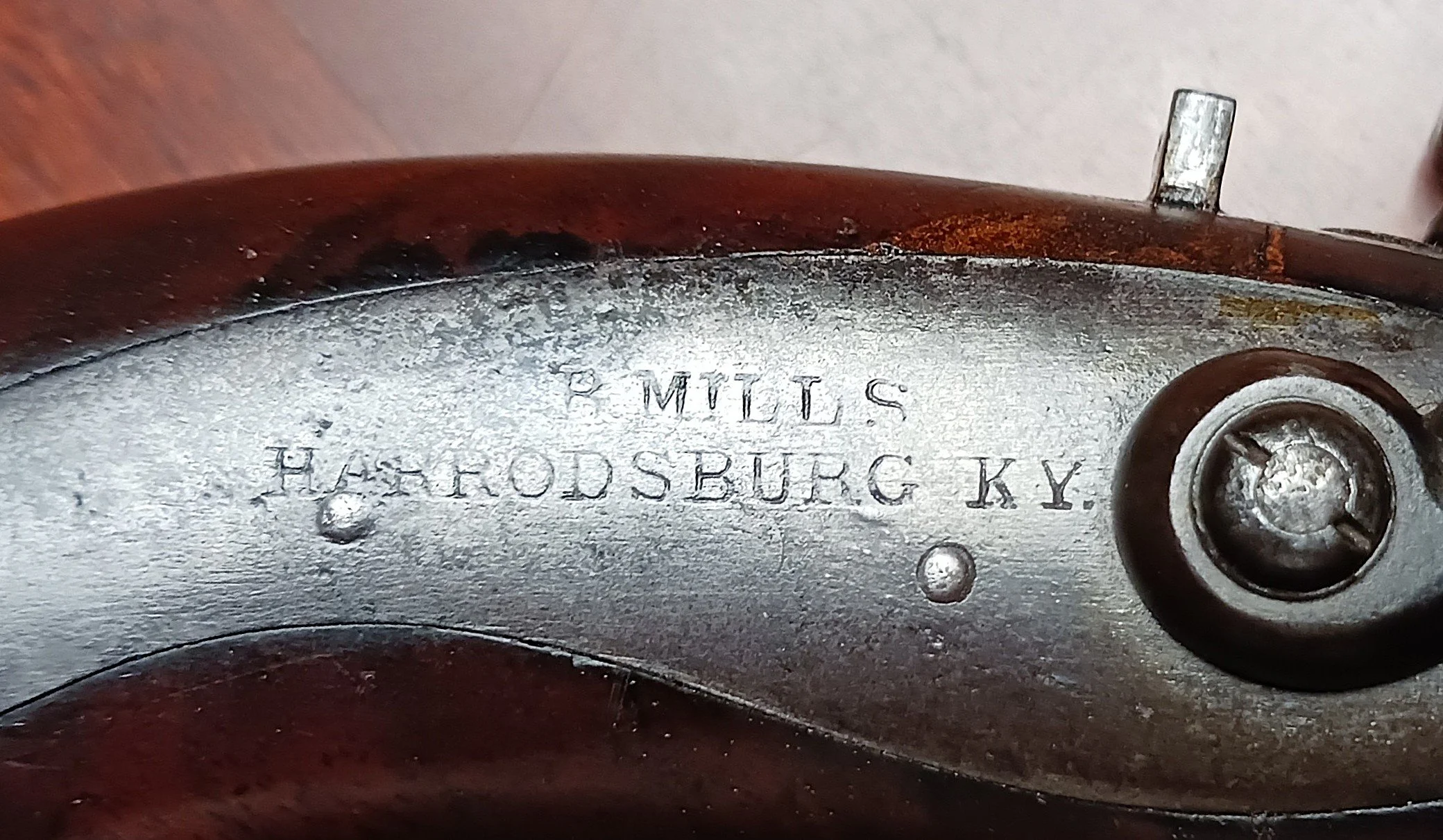
Figure No.4: Both back-action locks are stamped with Mills’ traditional “B. Mills / Harrodsburg KY.” signature. Note his preferred slotted bun-nut on the tumbler shaft.
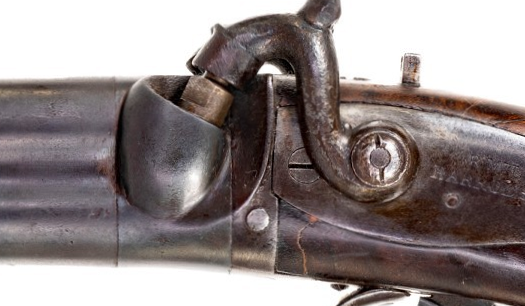
Figure No.5: The pistol’s receiver/tang unit mounted to the butt stock shows the round head of the tapered iron pin locking the receiver to the superposed barrel unit.
A single set trigger fires either barrel when its hammer is cocked, and the guard has a curved rear spur for the shooter’s middle finger to stabilize the gun when aimed. The author has seen perhaps a dozen Mills pistols, all very well made and clearly marked, but the new superposed example is the best pistol he has seen with its immaculate workmanship and two shots instead of the usual one for self-protection. Readers may notice the absence of a ramrod on the pistol, suggesting the pistol was cased with shooting accessories that included a ramrod and perhaps a second matching pistol, despite no visible number on this pistol.

Figure No.6: This Mills superposed rifle/shotgun has survived in fine condition. It has Mills’ typical highly figured walnut wood in the butt stock, saw-handle tang that was Mills’ trademark, and his long rear ramrod “catchers” on both sides [smaller rod for rifle barrel, larger rod for shotgun barrel]. More importantly, it has a rare dual lidded cap box for caps in the front cavity and patches/wads in the rear cavity; both lids are overlaid with thin sheet silver. Just below the percussion flash shield on the breech block is a small gray “dot” that is the tapered pin that locks the gun’s butt section to its barrel section. A better view of the pin is seen in Figure No.7 below. Author’s collection, photo by J. Jaeger.
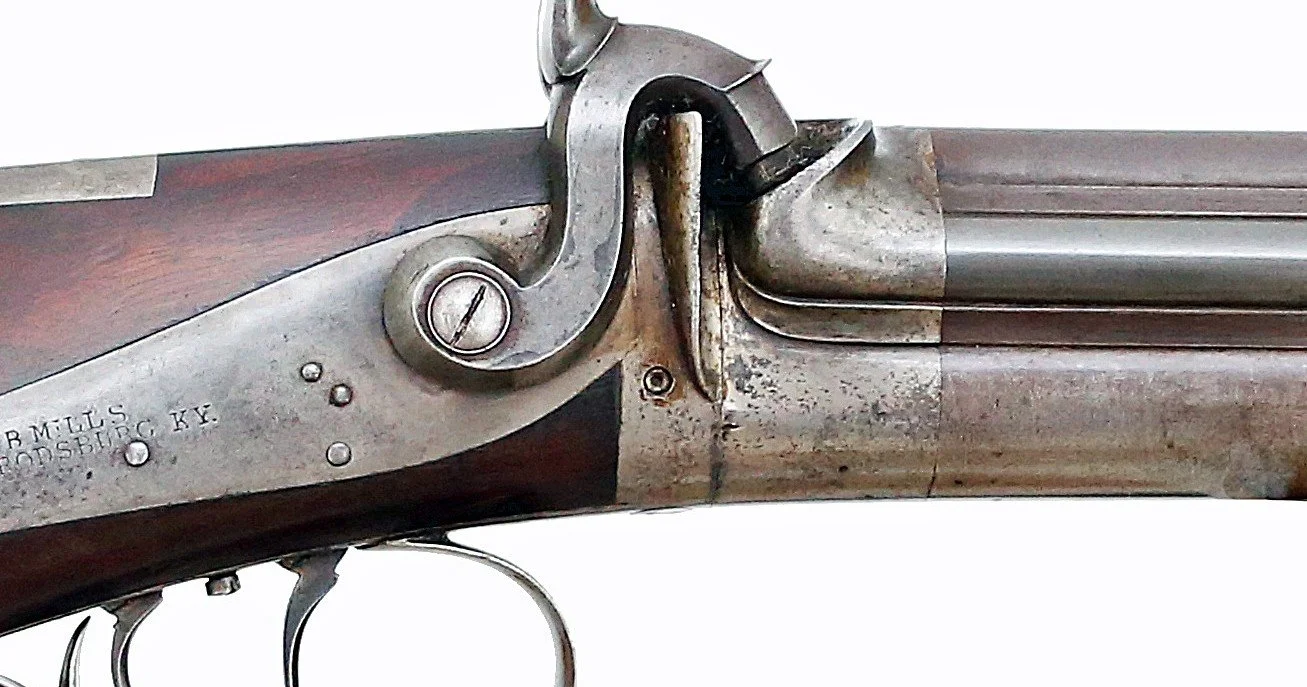
Figure No.7: The breech area of the superposed rifle/shotgun by Mills shows the breech pin that locks the butt section to the barrel section. The pin is near the base of the flash shield. It is driven out from the front, with a small dimple present for centering a punch to drive it out. Note the similarities to the Mills pistol breech in Figure No.5 above with a breech pin. The superposed rifle/shotgun has taller flash shield due to its shotgun barrel on the bottom, and the percussion snail is modified to match the end of the rear ramrod “catcher.” “Catcher” describe the extra-long rear ramrod pipes on Mills’ superposed guns. Author’s collection, photo by J. Jaeger.
Benjamin Mills: Mills was born in New York in 1810 and learned the gunsmith’s trade while growing up. His later Kentucky guns exhibited New York influences in their design, fine workmanship, and distinctive “saw-handle” tang. Mills began his career in Toronto, Canada, about 1831, but in 1839 he moved to Mayslick in Mason County, Kentucky, and opened a gun shop. Two years later in 1841 he moved to Standford in Lincoln County, and a year later to Harrodsburg in Mercer County in 1842. It was at Harrodsburg that he established himself as one of Kentucky’s finest gunsmiths for his superb target rifles. The 1860 census recorded four journeyman gunsmiths in Mills’ shop, but the Civil War brought a sharp decline in his business due to turmoil from split allegiances within Kentucky. After the war, demand for muzzle loaders waned as new factory-made breech loading guns grew in popularity and forced many old gunmakers into other professions. Mills was a skilled mechanic and was able to convert to breech-loading hunting rifles, but he had accumulated substantial debt by that time, and creditors began hounding him and filing lawsuits for unpaid debts. Mills moved to Lexington, Kentucky, in 1871 and opened a new gun shop with his son Charles, where they made breech loading guns and shotguns. But eventually debt began to overwhelm him again, forcing him back to Harrodsburg where he had to mortgage his gun shop and machine tools to stay in business. He faced financial struggles and illnesses for the rest of his life and died at Harrodsburg in 1888.
Summary: The new Benjamin Mills pistol has survived in superior condition with most of its original finish and no visible damage or dings, a rare feat for most Kentucky guns. However, a small silver band on the bottom of the butt has been dinged up, perhaps to obliterate a prior owner’s name. The pistol is the finest Mills pistol known to the author with its fascinating construction that copied his finest target rifles and superposed guns; the barrel section was pinned to the butt section for easy disassembled and storage in a case. The pistol’s lack of a ramrod and ramrod pipes indicates it was originally cased [perhaps with a mate] with accessories that included a separate ramrod when it left Mills’ shop, but today only the pistol remains.