
Foreword: The author has owned many of Kentucky’s finest guns over the last 40 years. But over time, collecting interests can start to change. Most of his guns have no provenance to connect them to an actual time and place in Kentucky’s history. In recent years, the author has become fascinated with Kentucky guns with a family history that physically connects them to actual people, places, and events in early Kentucky, making them active participants in the state’s history. Due to the rarity of well-documented Kentucky guns, condition becomes secondary to the story behind a gun. The Samuel Peak rifle is one of those rare rifles with a documented family history that breathes life into it. To collectors who seeks only finer guns, it would go unnoticed; to a collector and historian who values the ability to place an object with actual people, places, and events, it is a rare “diamond in the rough.”
The well-used, plain working rifle in Figures No.1 and No.2 below came out of an old Iowa collection accompanied by a family letter detailing the gun’s long ownership history that began in Adair County, Kentucky, then Jackson County, Indiana, and finally Madison County, Iowa. The rifle has suffered significant damage from rough usage and poor care over the years and has only moderate collector value today, but its documented ownership for almost two hundred years makes it a rare piece of early Kentucky and Midwestern history.

Figure No.1: This rifle reportedly came from Adair County, Kentucky. Its first owner was Samuel Peak, a young man who had just married and was preparing to move north to Indiana to begin his adult life. Years of neglect have damaged the rifle, but its slim architecture and triangular butt are evident. It was a low-cost “working rifle” with mixed brass and iron mounts, simple iron guard, pinned barrel, and no decoration. Barrel: 39-7/8 inches (originally 43-5/8 inches) with .36 caliber bore and 7-groove rifling. Author’s collection, photos by author.
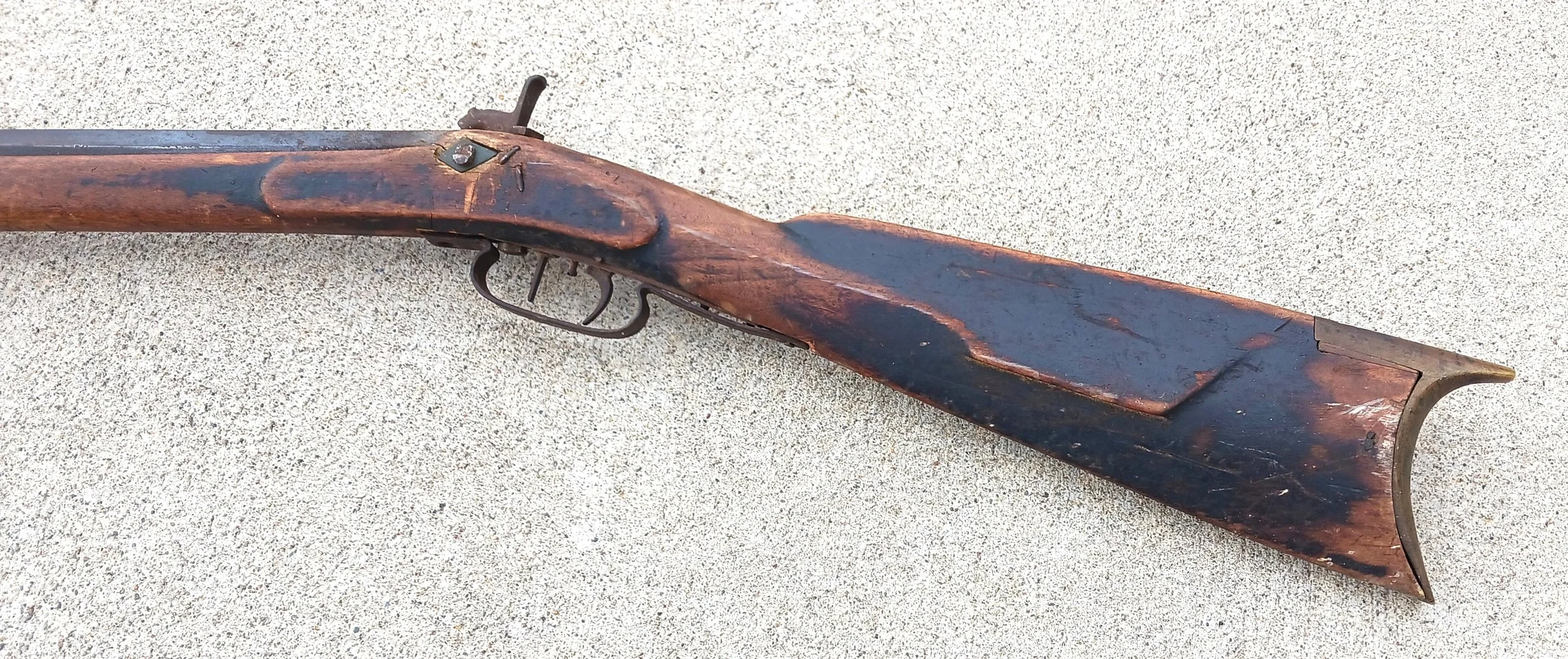
Figure No.2: The back side of the Samuel Peak rifle has areas of original finish highlighted by lighter areas of handling wear in appropriate places. A simple lock bolt washer, guard made from a hand-formed strip of iron, and lack of molding lines and inlays indicate it was made in a more rural county of Kentucky as a plain, no-frills working rifle. Author’s collection.
Family Letter: An old family letter written in pencil on yellowed paper provided an exceptional provenance for the well-travelled rifle. The letter gave a detailed history of the rifle’s ownership and movement over almost two centuries. A brief second page gave birth and death dates for several of the Peak family members mentioned in the provenance. The letter with all its misspelled words, poor punctuation, and grammatical errors is below:
This rifle first belong to Samuel Isreal Peak who was born Nov. 1791 and past away Feb 1861.
Samuel married Rachel Blair around 1818 in Adair Co. Ky. The rifle was bought around 1825 or 1826.
They moved to Jackson Co. Indiana were Samuel past away Feb 1861. Then the rifle went to his wife
Rachel and then to there son Elza Peak who was born 1850 and past away 1932. He moved to Iowa
Two sons & a daughter was born to Elza Peak
Ralph Peak 1891-1967
Hugh Peak 1900-1970
Ruth Peak 1898-1983
Ruth Peak cared for her Dad Elza Peak till his death and received The rifle and house hold stuff
It was bought from Ruth Peak by Tom Bergsten MD Winterset Iowa. He had it for 4 monthly and then
Bought by Gearold E Sull for restoring Feb 1983. History of the family came from Jean Hadsell
at Moury’s Iowa [perhaps Murray?] Jean Hadsell is the daughter of Ralph Peak
Letter Verification: The author verified the Peak family names and dates in the provenance letter with the FamilySearch genealogy website; the letter’s information was found to be accurate with only a few dates guessed at that required tweaking. The original owner of the rifle, Samuel Peak, his parents, his wife Rachel Blair, and all their children were found on the website with individual dates and locations. A contact with the auction house that sold the rifle added additional information on the last owners. They verified the last purchaser of the rifle was Jerry/Gearold Gull [misspelled as “Sull” in the provenance letter] who was an avid collector of antique firearms for many years in Iowa. He had attended local farm auctions in central Iowa for about sixty years and bought almost every old black powder rifle he saw. Mr. Sull recently passed away, and his son Jerry inherited the collection and is selling off the lower-end guns… which explained why most of the guns in the recent auction were damaged and in need of restoration. Since Samuel Peak was the original owner of the study rifle, a short review of his life from information on the FamilySearch website will help readers understand the rifle’s history as Samuel Peak and his descendants moved around.
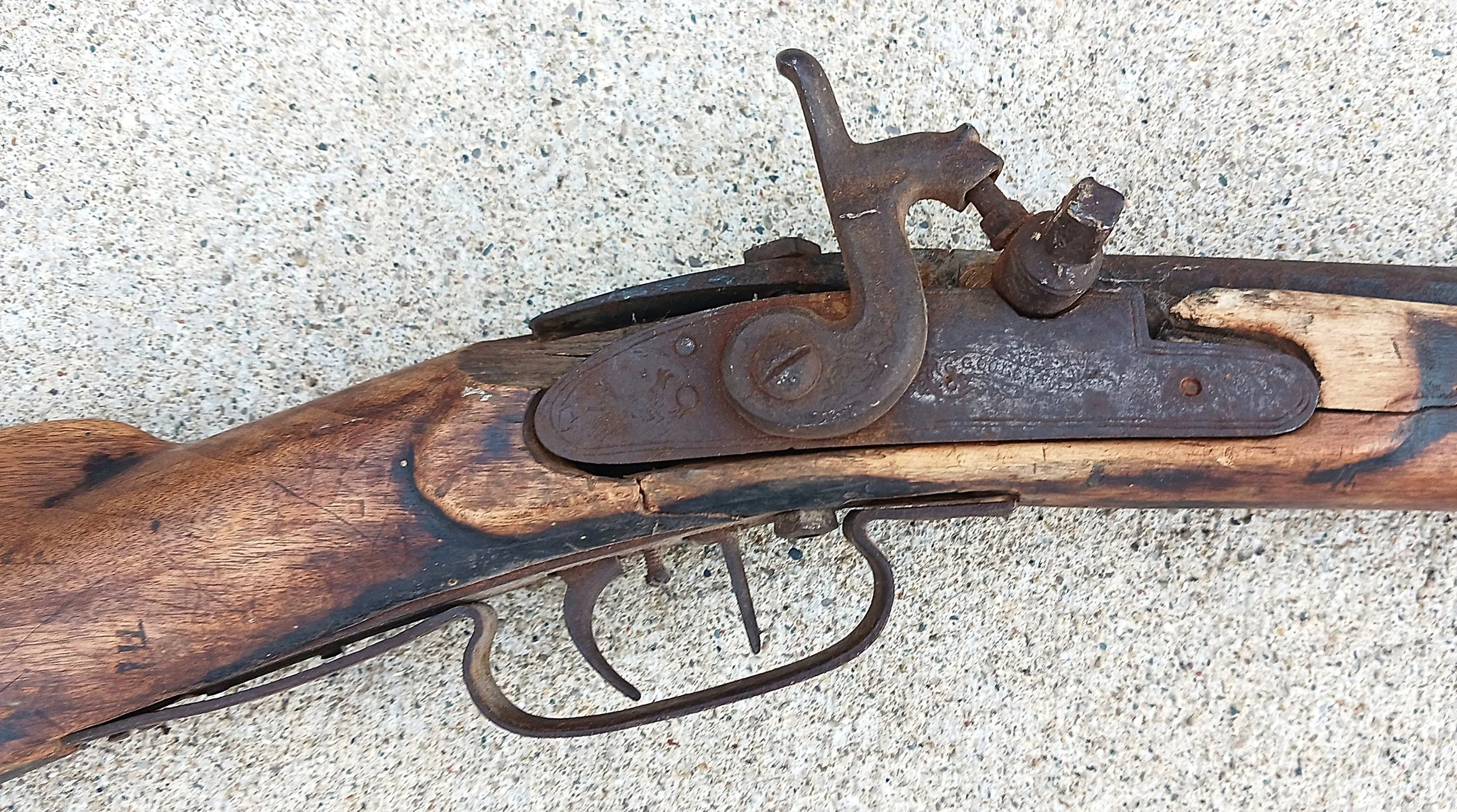
Figure No.3: This view shows the oval tail on the lock plate suggesting an early percussion lock. The triggers show a Kentucky influence, as does the percussion drum’s extended square shank for easier removal. The “G. Goulcher” name is visible on the lock plate.
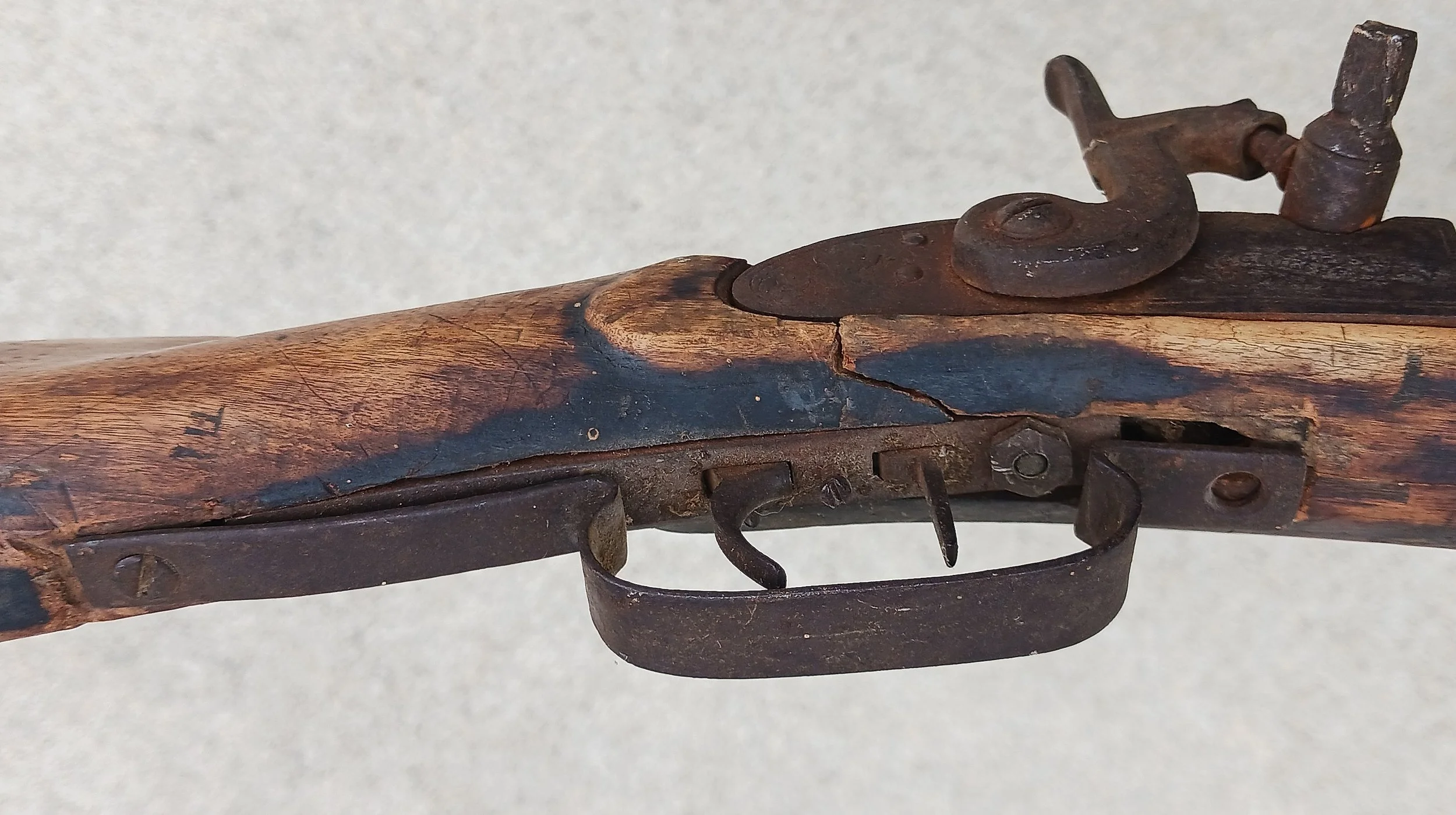
Figure No.4: The gun’s iron guard is mounted with two screws rather than pinned to the stock. The original tang bolt was replaced with a threaded rod with hex-nuts on each end, and despite a major crack below the lock mortise, the gun remains relatively solid.
The Rifle: Samuel Peak’s rifle was a low cost “working rifle” with a mixture of iron and brass mounts, no rear ramrod pipe, and no toe plate. Its two forward ramrod pipes and butt plate are brass, while the simple, hand-bent guard is iron. Stock wood is plain maple and the “G. Goulcher” percussion lock has a narrower oval tail suggesting an early percussion lock. The lock is attached by a single bolt with small, diamond-shaped washer on the back side. Both the percussion drum’s square shank and the well-shaped triggers in Figure No.3 exhibit strong Kentucky influences, while the simple iron guard in Figure No.4 hand-shaped from a strip of iron shows no regional affiliation. While the gun’s long barrel [originally 43-5/8 inches] and slender stock architecture with triangular butt are Kentucky characteristics, the tang in Figure No.5 has only a single bolt, yet it is a bit longer than most single bolt tangs and has a small “V” notch filed in its tail. The gun is a common working rifle with simple mountings, plain stock wood, no decoration or molding lines, and no rear pipe or toe plate. The bare ramrod entry area and plain grained stock wood can be seen in Figure No.6 below.
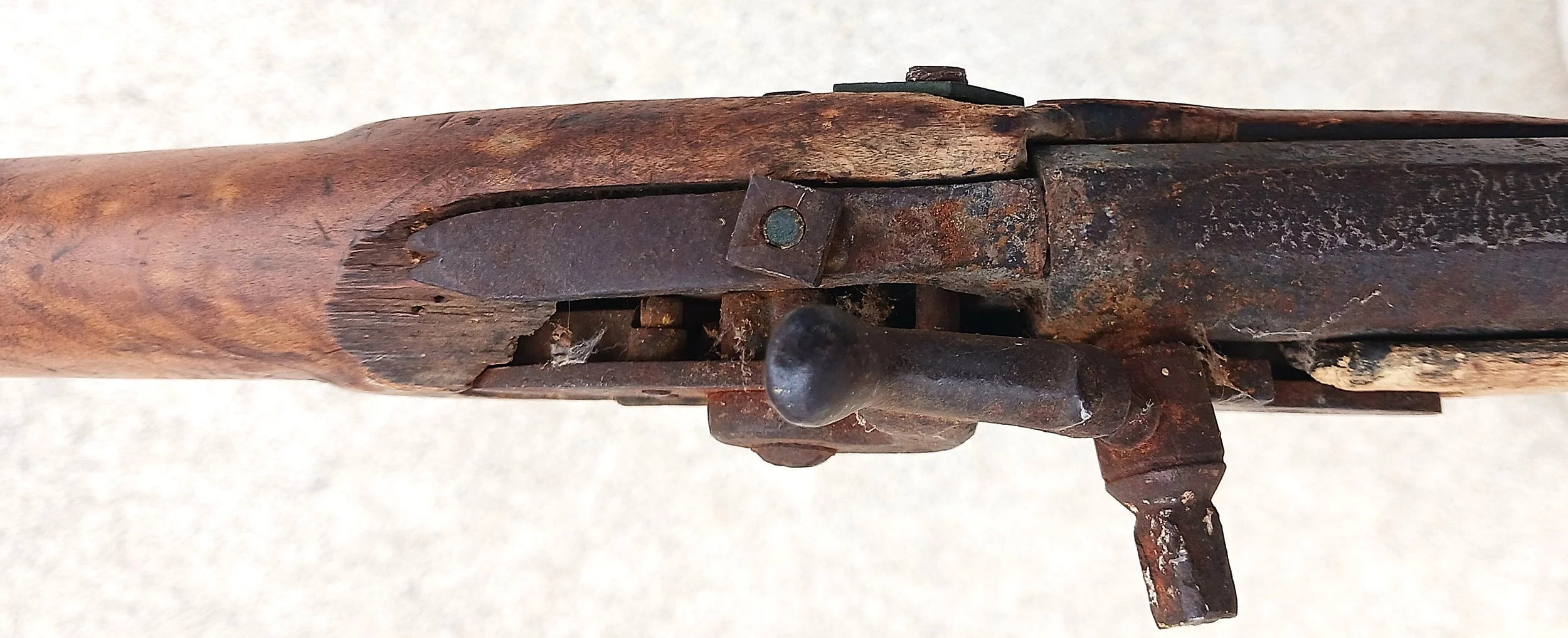
Figure No.5: This view shows the rough condition of the Peak rifle, but it also shows Kentucky-style extended percussion drum with square shank for ease of removing and installing. A threaded rod with nuts on both ends Has replaced the original tang bolt.
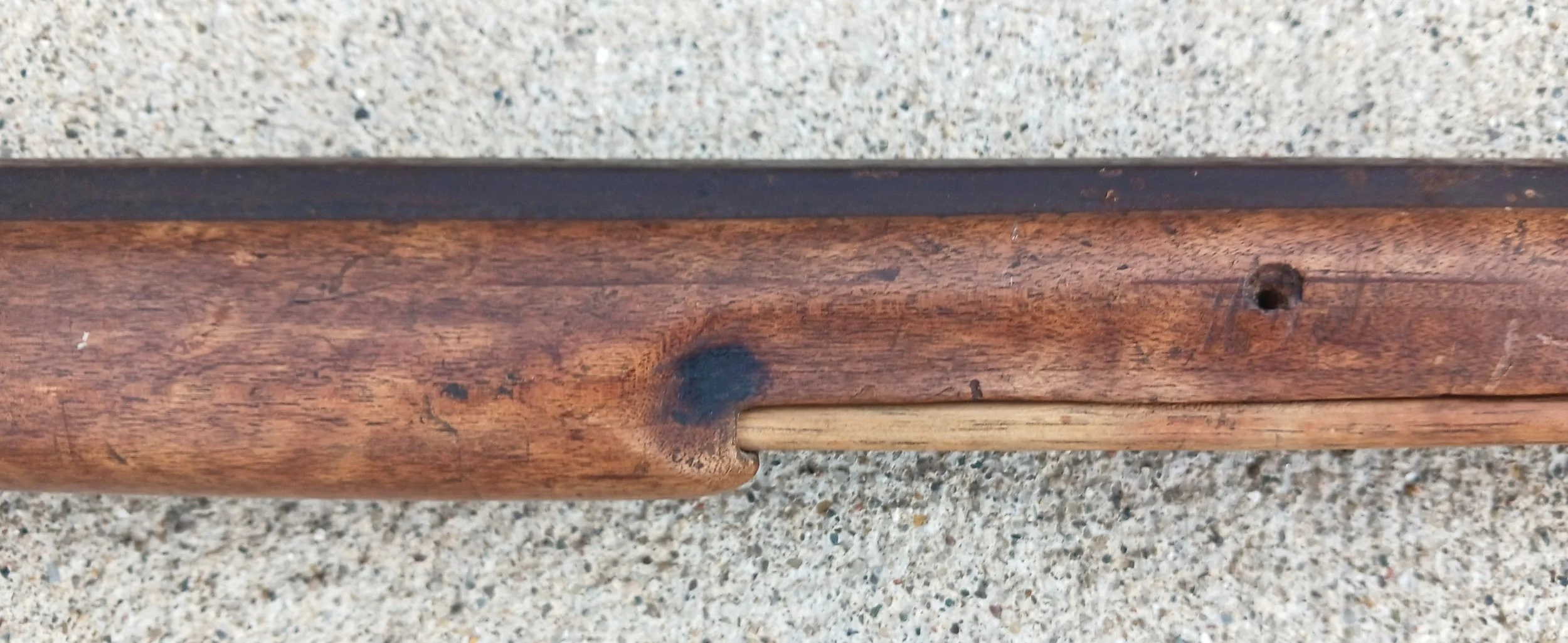
Figure No.6: The rear ramrod pipe area is significant for its lack of a brass entry pipe. Instead, the ramrod slides into a simple, non-reinforced hole in the forestock’s grip area. Note the straight grained maple stock wood with no hint of curl or figure.
The Peak rifle’s barrel has been shortened about 4 inches at the breech, moving any maker’s signature or initials rearward and close to the percussion drum where fulminate residue from fired caps can cause corrosion. No name or initials are immediately visible, but in the area where a name would have been found, there “almost” appears to be three initials. The possible initials are shown in Figure No.7 and seem to resemble “T M J” or “T K J,” but they could also be corrosion pits/lines that seem to resemble letters. A better detail that might help eventually identify the maker is the muzzle stamping, which is often unique to a specific gunsmith. The muzzle has two lightly cut concentric rings with small “V” marks stamped around the bore between the inner and outer rings as seen in Figure No.8. Unfortunately, when old rifles are poorly cared for and their barrels have been re-breeched so names/initials are close to the percussion caps, barrel marks often disappear, which is probably the case with Samuel Peak’s rifle.
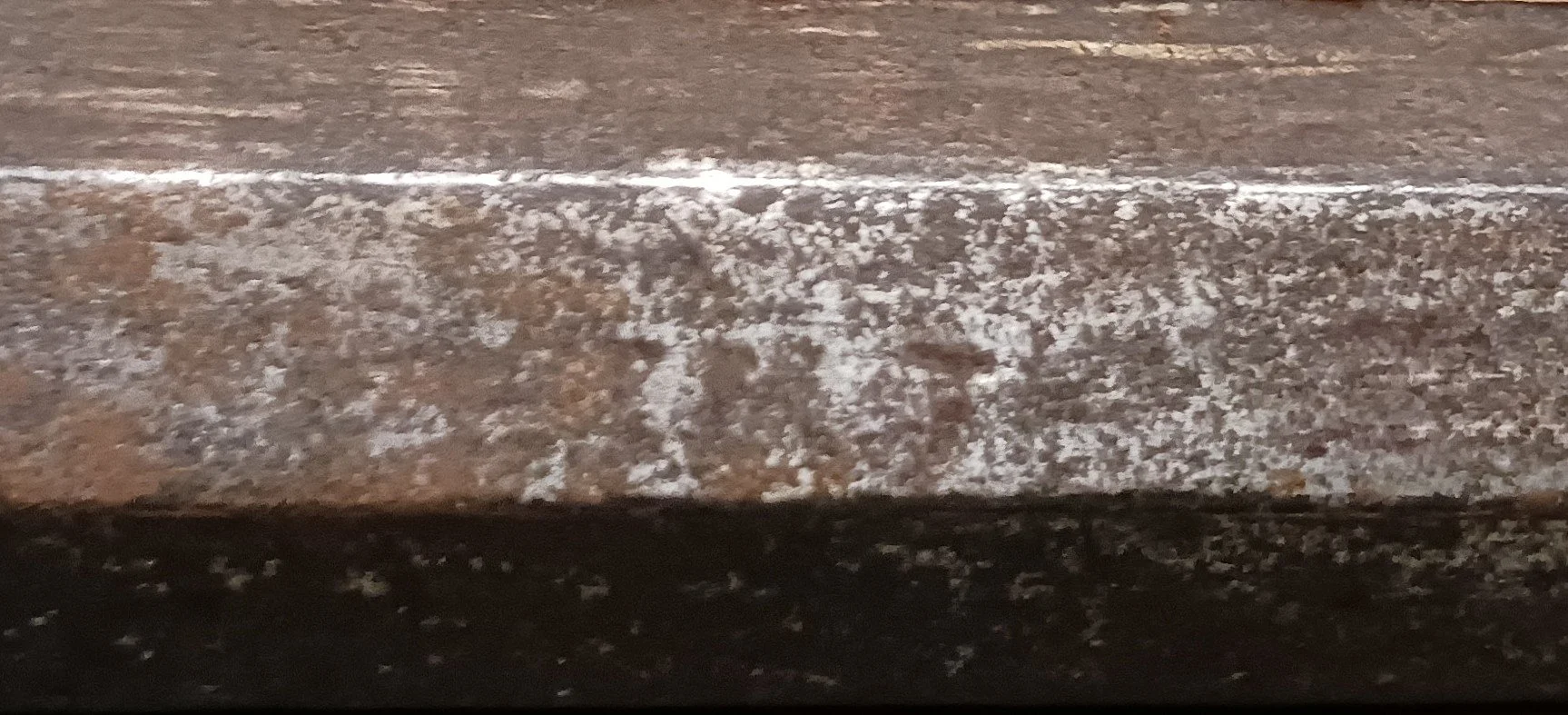
Figure No.7: The top barrel flat has possible maker’s initials of “T M J” or “T K J” in the right area, but barrel shortening has moved the signature area close to the percussion caps, so the “initials” may be corrosion spots shaped like letters. Either way, it is hard to decipher.
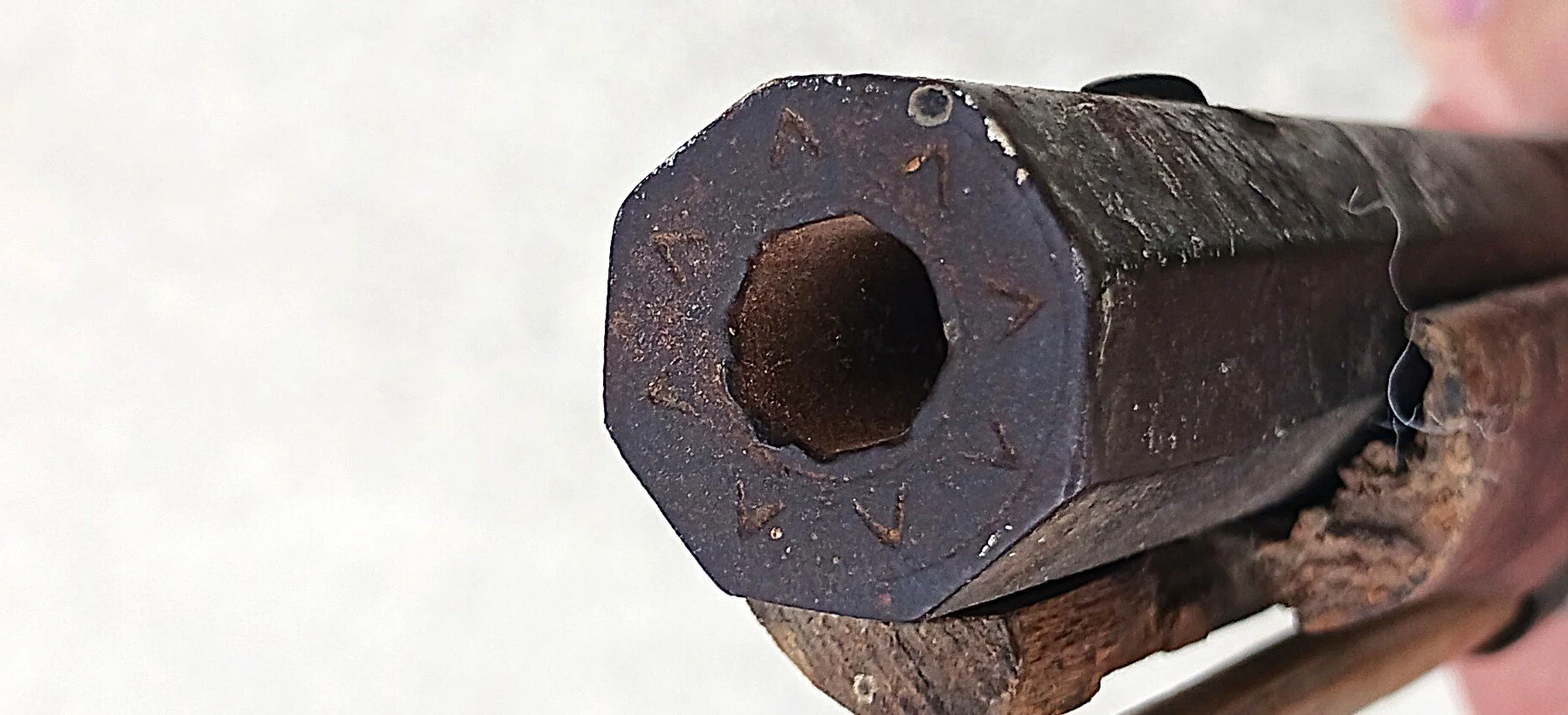
Figure No.8: The Peak family rifle has relatively clear muzzle decoration, or stampings. It has an inner and outer ring with “V” shaped stamps inside the rings that encircle the bore. Most gunsmiths used repetitive muzzle patterns, so it can help identify a gunmaker’s hand.
Chain of Ownership: Samuel Peak was born March 12, 1806, in Kentucky to parents Presley B. Peak (1770-1821) and Judith Wilholt Peak (1776-1824), who were married in Scott County, Kentucky, in 1797. When twenty-one years old, Samuel married Rachel Blair in Adair County, Kentucky, on June 7, 1827, which suggests he was working there at or before that time. The family letter states he purchased the rifle “around 1825 or 1826,” which was about when he reached adulthood in Adair County, Kentucky. The letter indicates the rifle was probably purchased by Samuel in preparation for his move to Indiana. Samuel and his new wife moved to Grassy Fork Township in Jackson County, Indiana, in 1828 or 1829, since their first child, Elizabeth, was born in Indiana in December of 1829. His marriage and decision to move to Indiana, all within a short period of time, undoubtedly led to his purchase of a rifle to ensure food and protection for his new family. Unfortunately, the family letter fails to provide any anecdotes involving Samuel’s new rifle while in Indiana. The 1850 Indiana Census listed Samuel as a “Farmer,” 44 years old, born in Kentucky, with $1,200 in real estate. His wife Rachel was 42 years old, keeping house, and also born in Kentucky. Samuel died at Tampico in Jackson County on January 26, 1863, when fifty-six years old and was buried in the local Mount Pleasant Cemetery. Sometime after Samuel’s death, his wife Rachel gave the rifle to their youngest son, Elza Peak (1850-1932), who eventually moved to Madison County, Iowa. Late in Elza’s life in Iowa, he was cared for by his daughter, Ruth Peak, and before he died in 1932, he gave Ruth the old family rifle along with his other household items. Ruth apparently had little interest in the old rifle and eventually sold it out of the family to a local doctor named Tom Bergsten of Winterset in Madison County, Iowa. He kept the gun for a while, but it was damaged, so he sold it to Gearold Sull (sic) in 1983 who supposedly had the skills to restore it and planned to do so. However, based on the rifle’s current condition, it was never restored. In November of 2026, the rifle along with about forty other old rifles and shotguns, most needing significant restoration, were sold at auction in Dexter, Iowa. The Peak family rifle, despite its condition, intrigued the author due to its rare family provenance letter and early roots in Adair County, Kentucky. The gun’s general appearance also suggested it was a Kentucky gun, so it was purchased and went into the author’s collection of Kentucky firearms.
What will happen with the Samuel Peak rifle now? Its value and historical significance are in the family history letter that accompanies it, not the rifle itself. The author does not plan to restore the damaged old rifle at this time. Rather, it will be enjoyed “as is” for its historical connection to both Kentucky and Indiana, admired for its survivability despite its rough life, and perhaps someday a Peak family descendent will read this blog article, become excited when he or she learns about an old family rifle that has been long forgotten by family members… and the old gun will get reunited with its family.