
Foreword: All Tansel powder horns are unique documents of history that capture period images of America’s national figures, Native Americans, deer hunters and their dogs, and at times larger scenes such as stagecoaches and famous battles. Even damaged horns with missing plugs, broken and/or shortened bases, cut off spouts, worm holes, surface scalding or scaling, etc., are fascinating relics of our past. With historic value in all Tansel powder horns, even the most damaged ones that survive, how could there really be a “worst” Tansel horn? Easy… just keep reading.
Discovery: In 2023 the remnants of an Indiana era Tansel horn showed up on a dealer’s table at an antique firearms show. It was purchased by a Midwest collector who was a friend of the author. In early 2024, the collector gifted the horn to the author, first building him up about “a new Tansel horn” to get him excited, then presenting him with the horn. The author’s first reaction was… it’s so rough, it can’t be a real Tansel powder horn. But a closer examination showed it was the remnant of an Indiana Tansel powder horn… with emphasis on the word “remnant” since it was almost unidentifiable. As with all Tansel powder horns, the author asked his “generous” friend if there was any history behind the relic horn, and he then realized why it was gifted to him. The author had collected early Kentucky firearms and powder horns for many years, and the new horn was found in Owensboro, Davies County, Kentucky, on the Ohio River below Louisville… so it had a Kentucky connection.
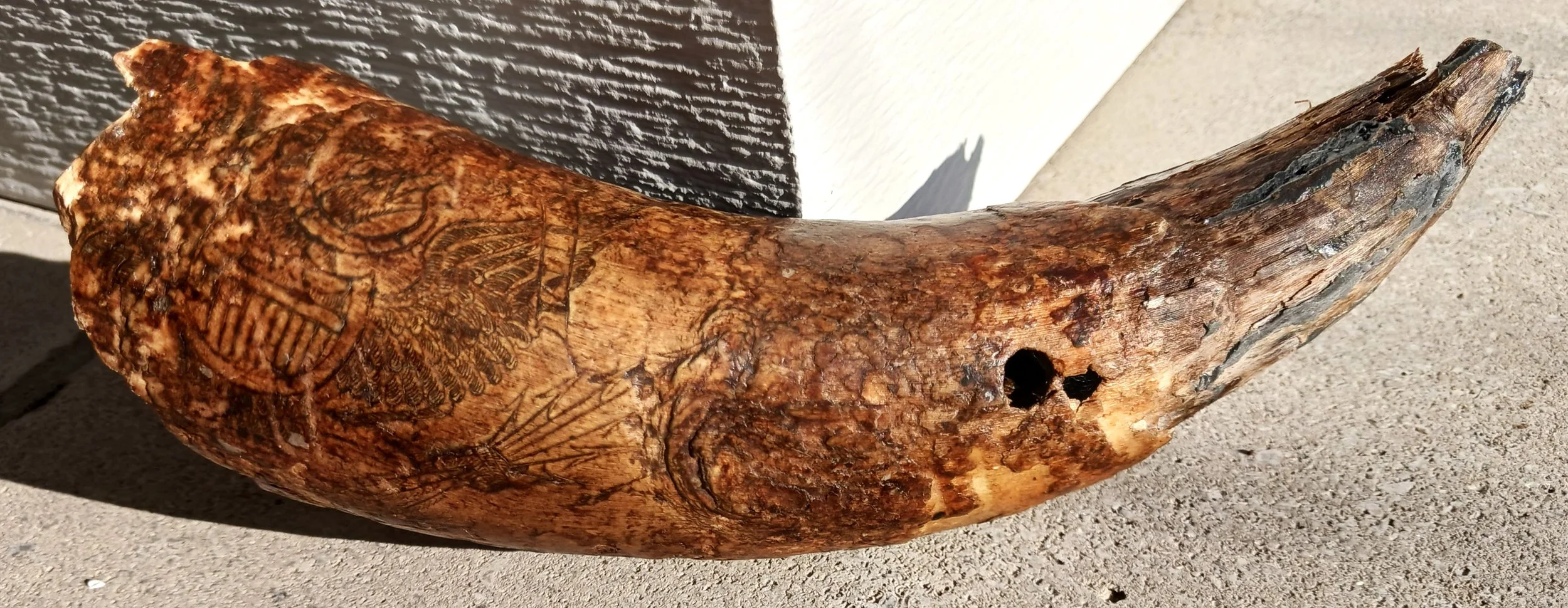
Figure No.1: This is the remnant of an Indiana Tansel powder horn that lost the end of its spout and a large section of its butt from excessive damage and long exposure to the elements. The photo has been enhanced slightly to better show the traces of carving that remain on the horn. The Tansel eagle is visible on the left side of the horn, and a small trace of the Tansel fish-mouth is on the right side near the top of the horn. Despite a large portion of the eagle that can be seen, no other carving is visible due to surface deterioration and heavy scaling.
The Worst Horn: The relic Tansel powder horn was only about two-thirds of the original horn as seen in Figure No.1. Despite being in poor relic condition with a large piece of the spout and about a third of the horn body missing, the relic retained an important feature with its Tansel eagle still being visible. A few of partially visible details including the banner’s angled end in the eagle’s beak, the letter “U” in the word “UNUM,” shading of the wing feathers, and size/shape of the feet suggest the horn was made by Timothy Tansel about 1840. Unfortunately, the badly damaged surface had no other visible figures. But it did have an interesting detail with a round hole on that looked suspiciously like a bullet or buckshot hole.
The back side of the relic Tansel powder horn was also heavily scaled with no visible carving on its surface as seen in Figure No.2. Even the always-present scalloped border around the fish-mouth lobe was gone without leaving a trace. The only significant detail that remained was the smaller rear lobe of the Tansel fish-mouth, verifying it was a Tansel powder horn
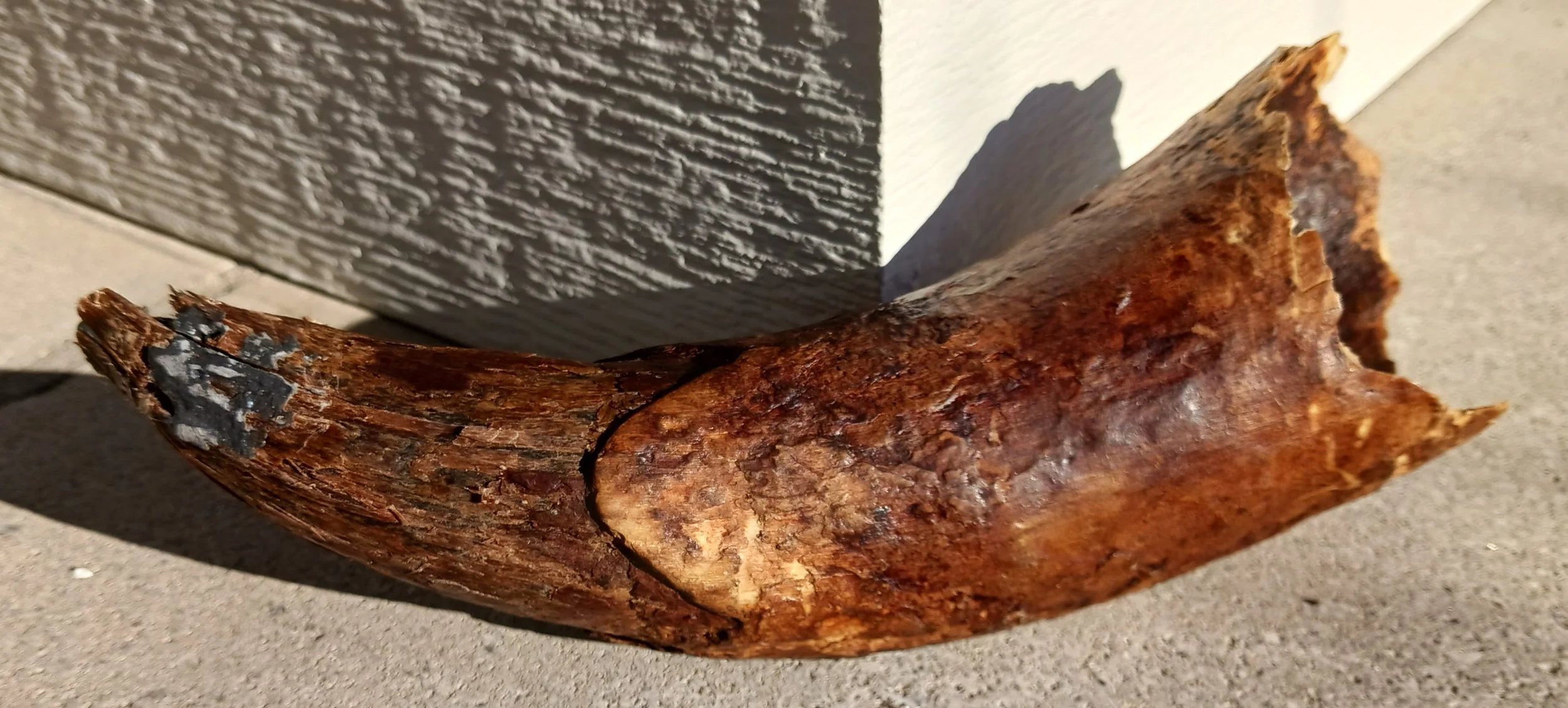
Figure No.2: The back side of the relic Tansel powder horn shows its smaller fish-mouth lobe that left the larger lobe and panel on the front side for a larger carving area. The horn’s heavily deteriorated condition suggests it was exposed to moisture, decay, and probably rodents for an extended period of time. The horn appears to have been shellacked at one time to stop further deterioration and surface loss. The well-shaped rear lobe has no visible remnants of its once carved surface or the small engrailment cuts around its edges.
A Hypothetical Story: A rumor in Kentucky included a once-fine relic powder horn found with a heavily rusted rifle that was thought to have been involved with the early regulators or vigilantes of Davies County. Despite Kentucky’s official support of the Union during the Civil War, many citizens of Davies and nearby counties were strongly sympathetic to the southern cause and Confederacy. When reconstruction began in 1867, it proved to be a dangerous time for freed Blacks, and to a lesser extent white Union sympathizers, in Davies and other pro-southern Kentucky counties. Southern guerilla groups terrorized Blacks and Union sympathizers during the war, and after the war the guerillas evolved into “vigilantes” and eventually the Ku Klux Klan as they continued their violence, harassment, and constant threats against freed Blacks and white sympathizers.
In the late 1860s, northern abolitionists would sometimes travel to the south to assist Black people. In Kentucky, some counties were less hateful toward northern visitors, but strong pro-southern counties such as Davies County despised them even more than their local citizens who were sympathizers. Supposedly an abolitionist from Indiana who had served in the Union Army during the Civil Way visited Kentucky after the war to help the condition of freed Black people. He carried a rifle and fine powder horn for protection and traveled to Davies County, Kentucky, where some of the worst treatment of freed Blacks was taking place. He disappeared shortly after his arrival, after his presence became known to local vigilantes. Years later, an old, rusted rifle and remnants of a once fine powder horn were found in a wooded area of Davies County, thought by some to be from an unknown northern sympathizer from Indiana who had disappeared years earlier without a trace. It is interesting to note that the relic Tansel horn has two round holes in its front side about the size of buckshot… a coincidence?