
Foreword: Other than Tansel powder horns and a few period “copycat” horns by unknown carvers made “in the style of” Tansel horns, Kentucky wasn’t known for carved powder horns. Recently, a moderately sized Kentucky powder horn sold at an estate sale in Frankfort, Franklin County, Kentucky, that was carved using many small dots to outline and shade its figures. A 93-year-old widow lady whose husband had previously died was selling family items, and the horn was one of the items, reportedly from the husband’s side of the family. While not a great horn, it caught the author’s eye for its interesting figures, and more importantly, for being a carved Kentucky powder horn.
Franklin County Horn: The horn’s front side is shown in Figure No.1; the back side is uncarved, shows wear, and therefore not shown. The carved figures were apparently made by pricking the horn with a small, sharp tool or tip of a blade, then twisting the blade slightly to “open” a tiny hole in the horn’s surface. The holes were later darkened to highlight the dot-liked carving. Perhaps it should be called a “pricked” horn rather than a carved horn, but it accomplished the same objective of putting permanent figures on the horn’s surface.
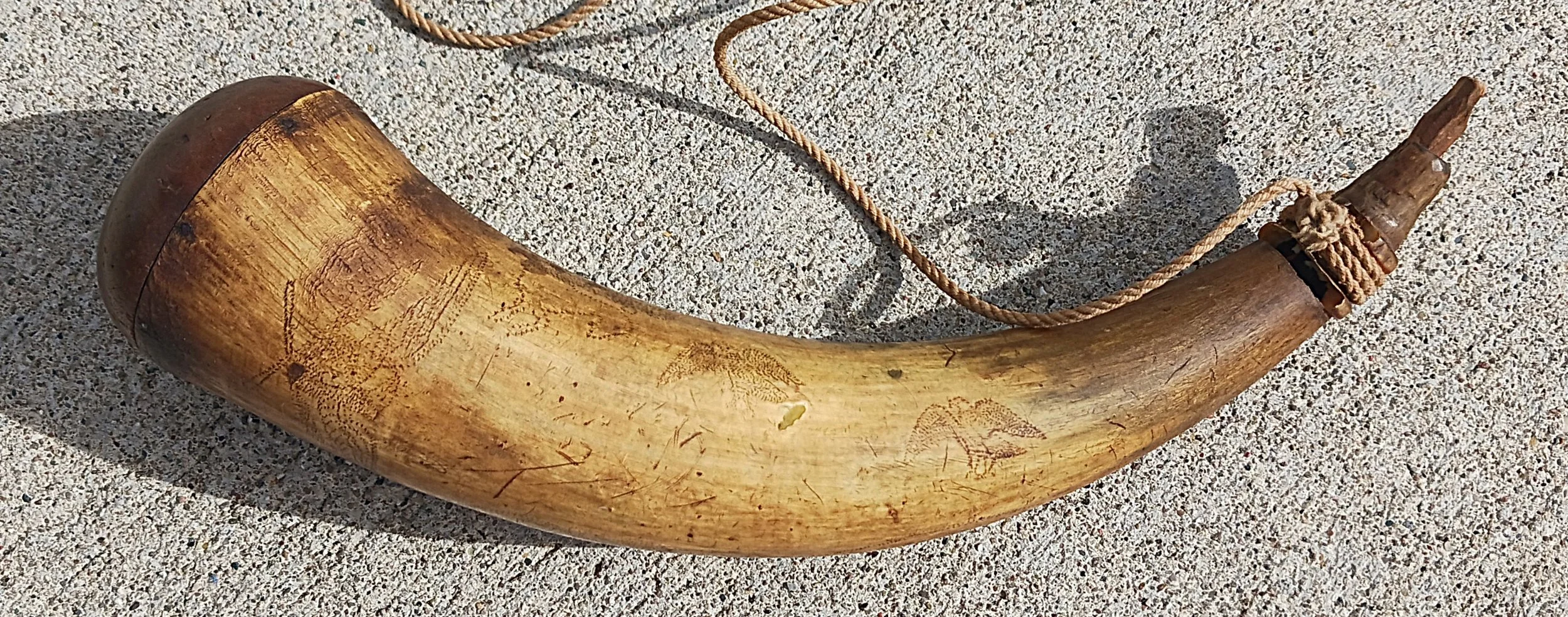
Figure No.1: This decorated powder horn from Franklin County, Kentucky, has its figures outlined in dots, or small cuts, darkened with lamp black or other dark substance. Three eagles are visible here, a larger one near the butt plug and two smaller ones in the middle of the horn. Other figures decorate the top and bottom surfaces of the horn, but the back is plain. The butt plug is end-grain walnut with an iron staple, and two spout rings hold the strap at the rear. Outer curve 10-3/4inches, inner curve 8-1/2”, base diameter 2-9/16.” Author’s collection.
The early history of the horn is undocumented but said to be with the family of the seller’s departed husband in/near Franklin County, Kentucky. The horn’s construction helps validate its Kentucky origin and earlier history. The butt plug is domed in typical Kentucky style, and more importantly, lathe-turned from end-grain black walnut, the preferred material and grain orientation in Kentucky powder horns. The horn also has carved raised rings on the spout and a small iron staple in the nose of the butt plug for strap attachment, again typical of most Kentucky horns.
Carved Figures: The powder horn has multiple figures of moderate size. The decoration covers the top, front, and bottom surfaces of the horn reasonably well. The front side has several eagles {Kentucky’s favorite powder horn image] of different sizes. Near the butt plug is the horn’s largest eagle with outstretched wings, head facing left, and what appears to be large palm fonds in each foot seen in Figure No.2. While the wings are spread similar to those on Tansel eagles, there is no shield on the eagle’s breast. Above the eagle’s left wing [viewer’s right] is a second, slightly smaller eagle seen in Figure No.3 with outstretched wings, done in less detail with its head facing right and no fonds/items in its feet. Above the first two eagles and near the horn’s mid-section are two smaller eagles seen in Figure No.4 with droopy outstretched wings and heads facing left. While none of the four eagles have a shielded breast like the federal eagles on Tansel powder horns, they undoubtedly represent the same federal symbol for the Kentuckian who carved/pricked the horn, and the Kentuckian who carried it.
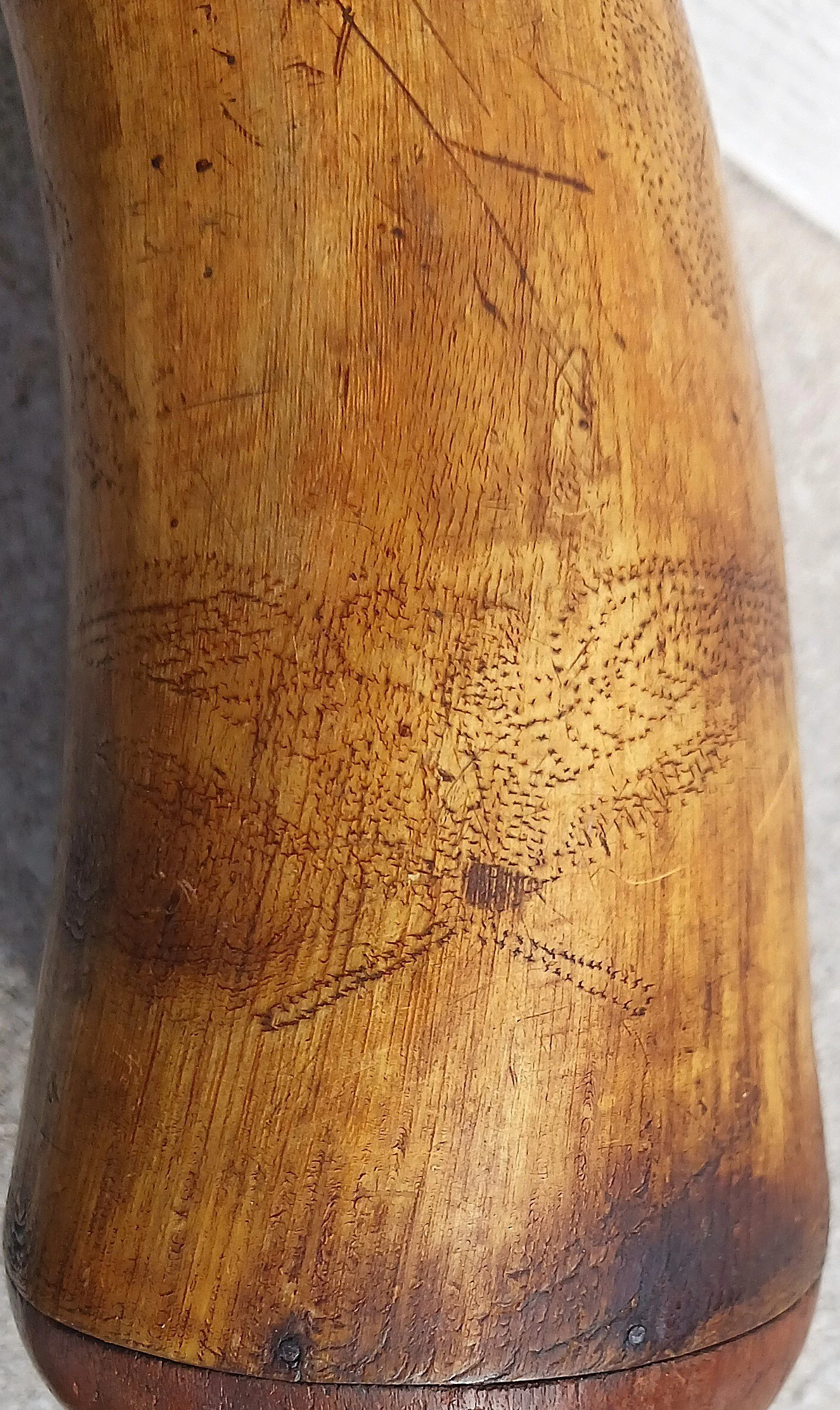
Figure No.2: The largest of the horn’s four eagles is near the butt plug with outstretched wings and palm fonds [or unfurled flags] in its claws.
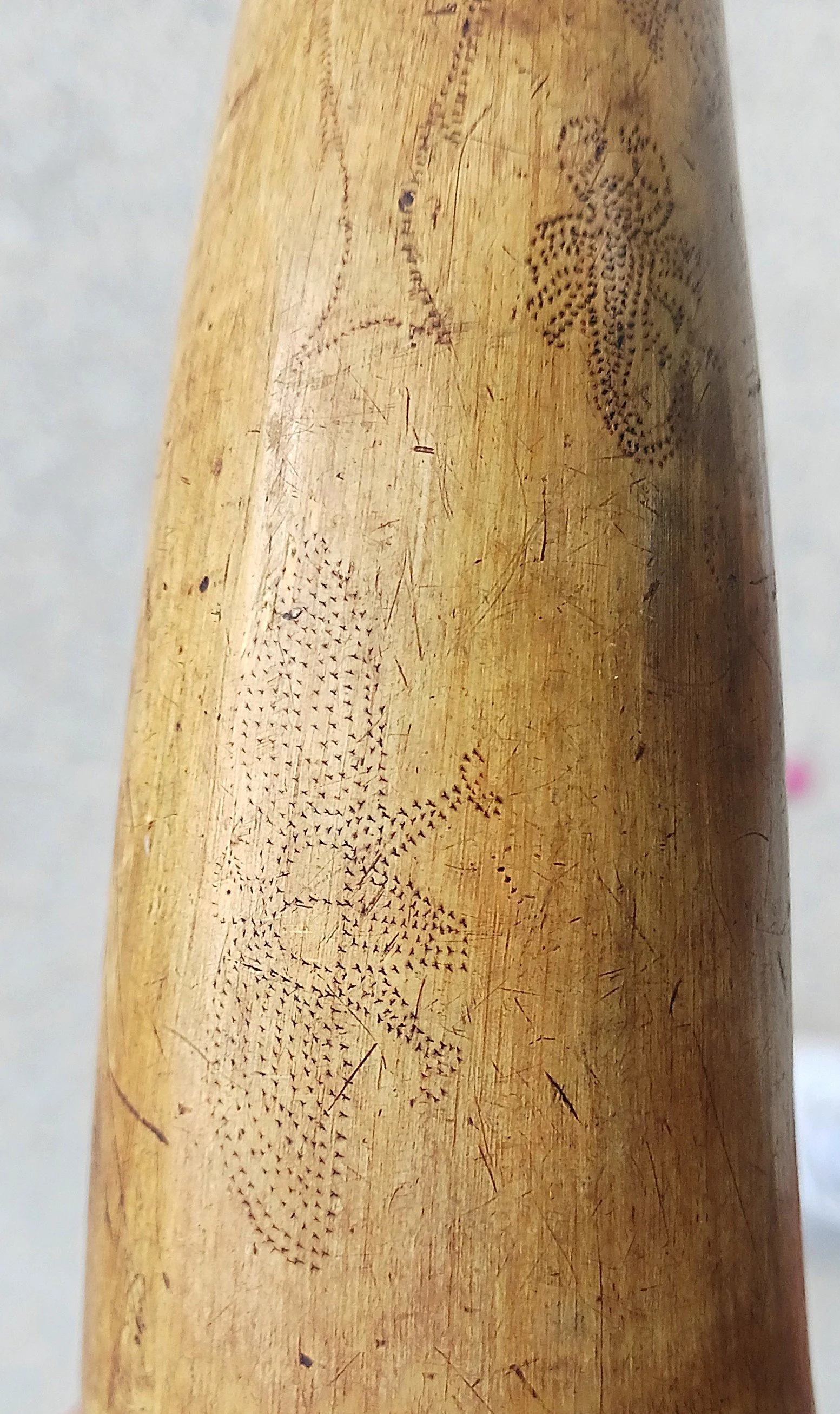
Figure No.3: The second largest eagle is midway up the horn body. It has less detail and shaping than the larger and smaller eagles.
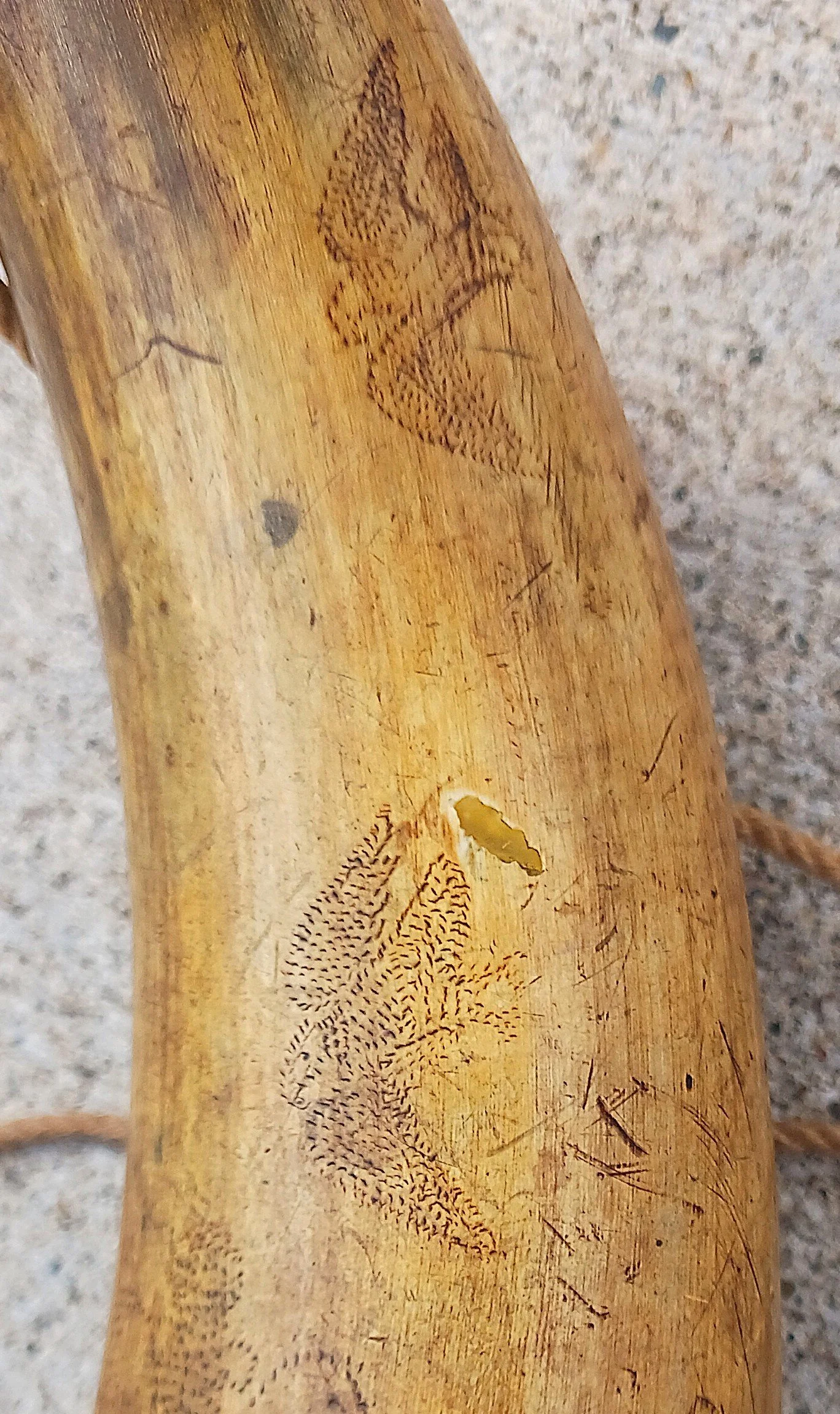
Figure No.4: The last two eagles in the horn’s mid-section are smaller than the others. None or the eagles have a federal shield on their breast.
Lower on the horn’s face and extending down and across much of the horn’s bottom surfaces are the second eagle shown enlarged in Figure No.5, and an interesting combination of a large fish, scorpion, and two small “crossed” fish seen in Figure No.6. Artwork on Tansel powder horns is readily recognized by viewers, but lesser carved Kentucky “poor-boy” horns by unknown makers/owners can present more of a puzzle with certain figures being speculative in appearance and often unknown. We can speculate on the several fish on the horn as being subtle Christian symbols to remind the horn’s owner of his faith and duties when away from home… but that is only an educated guess by today’s viewers. As for the scorpion, usually a desert dweller, perhaps it replaces the copperhead snake seen at times on Tansel horns that reminds the owner of the dangers that can lurk in newly opened/settled lands.
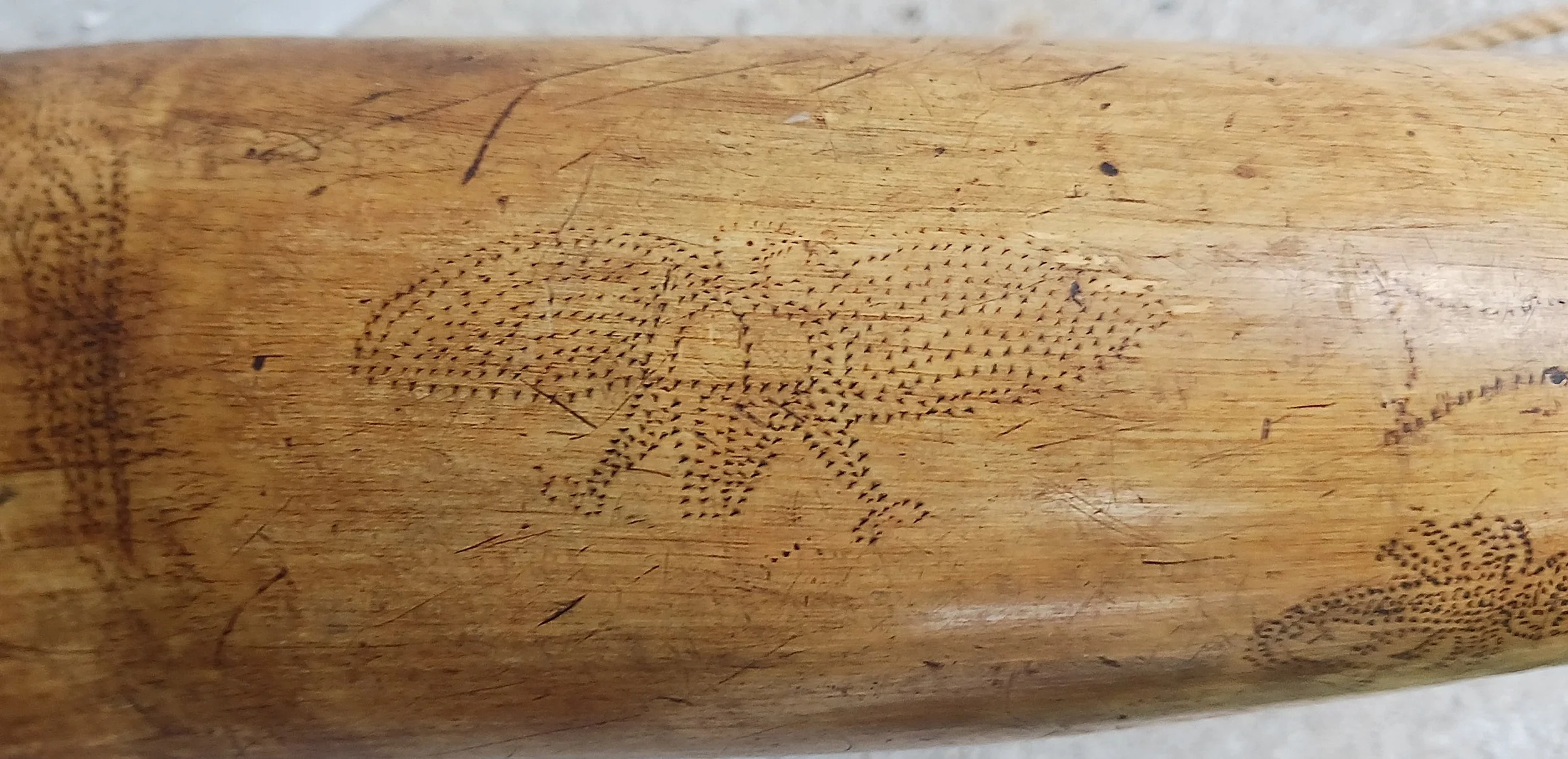
Figure No.5: This larger view of the second largest eagle shows its simpler, more primitive shape with bulky wings, tiny head, and empty claws. Possibly, the arched details on the eagle’s breast represent federal shields, but the eagle’s simplicity makes it hard to tell.

Figure No.6: The most interesting animals on the horn are the large fish, scorpion, and two crossed fish in the middle of the horn. The large fish clearly shows its dots were made by a knife tip. The reason for images of a scorpion and crossed fish on the horn is unknown.
The horn’s early history is said to be associated with the seller’s departed husband’s family in Franklin County, Kentucky. The horn itself appears to validate its Kentucky origin. The butt plug is high domed in typical Kentucky style and lathe-turned from end-grain black walnut, the preferred material and grain structure in Kentucky butt plugs. The horn also has raised rings on the spout and an iron staple in the butt plug for strap attachment that are typical of Kentucky powder horns.
Two other fascinating figures decorate the horn near its base. The largest is a “double horse” image seen figure in Figure No.7 that has the front ends of two horses joined together with a rider in the middle. The rider’s details are difficult to see, and the entire figure is difficult to interpret or understood what it represents. The second, smaller figure is a cat just below the two-headed horse figure as seen in Figure No.8. It looks like a house cat with short ears, long tail, and beady eyes, but perhaps it represents a dog running along with the two-headed horse. The final illustration in Figure No.9 is the horn’s spout with its raised rings for strap attachment. The smaller size of the horn suggests it was made in the percussion era probably ca.1840-1850, and a later-in-life cord eventually replaced the original shoulder strap. Note the original soft wood stopper that survived with the horn… always a nice addition to any horn.
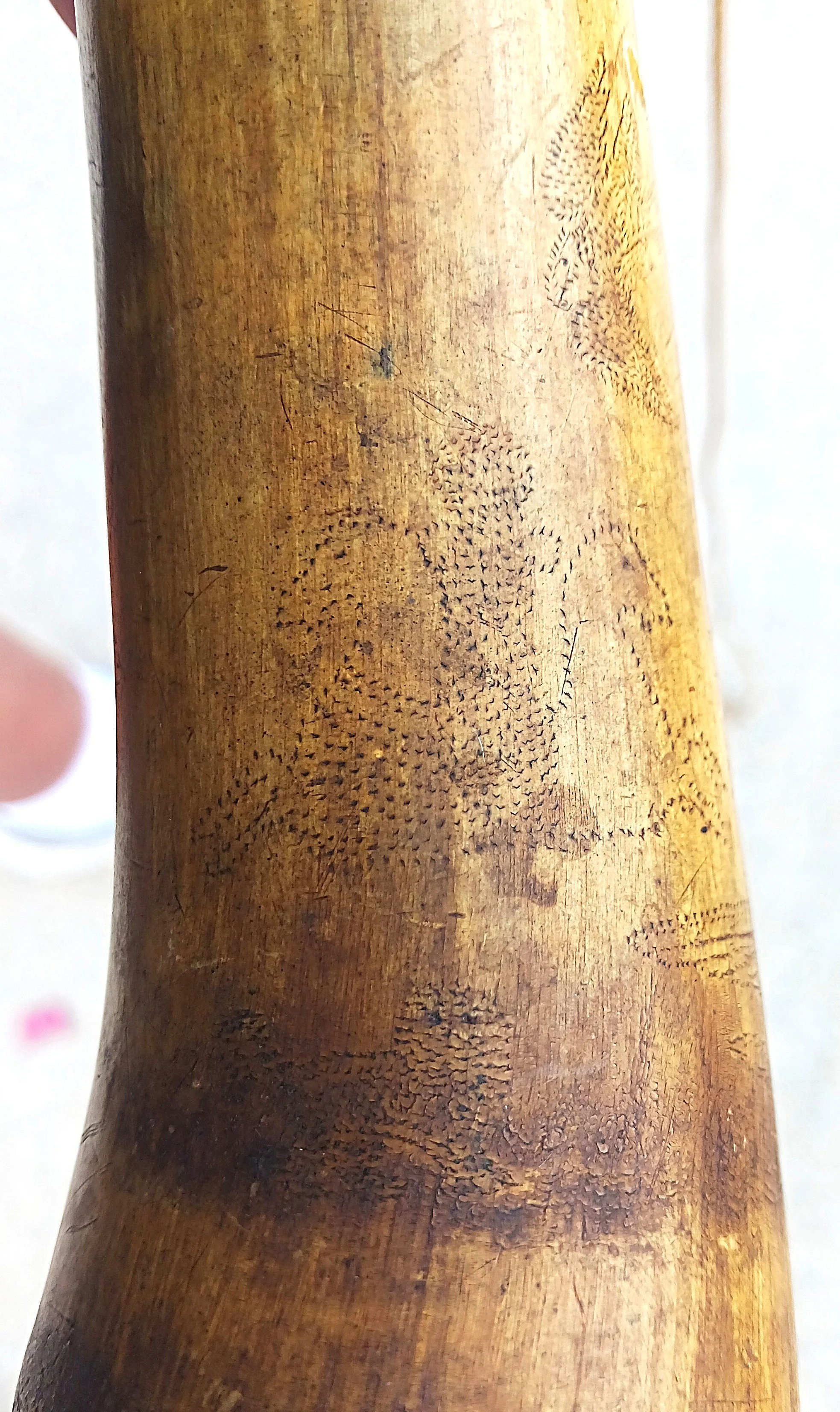
Figure No.7: The strangest figure on the horn is a two-headed horse with rider: one horse is darkened with dots and the other left white. Below the horses is a cat figure.
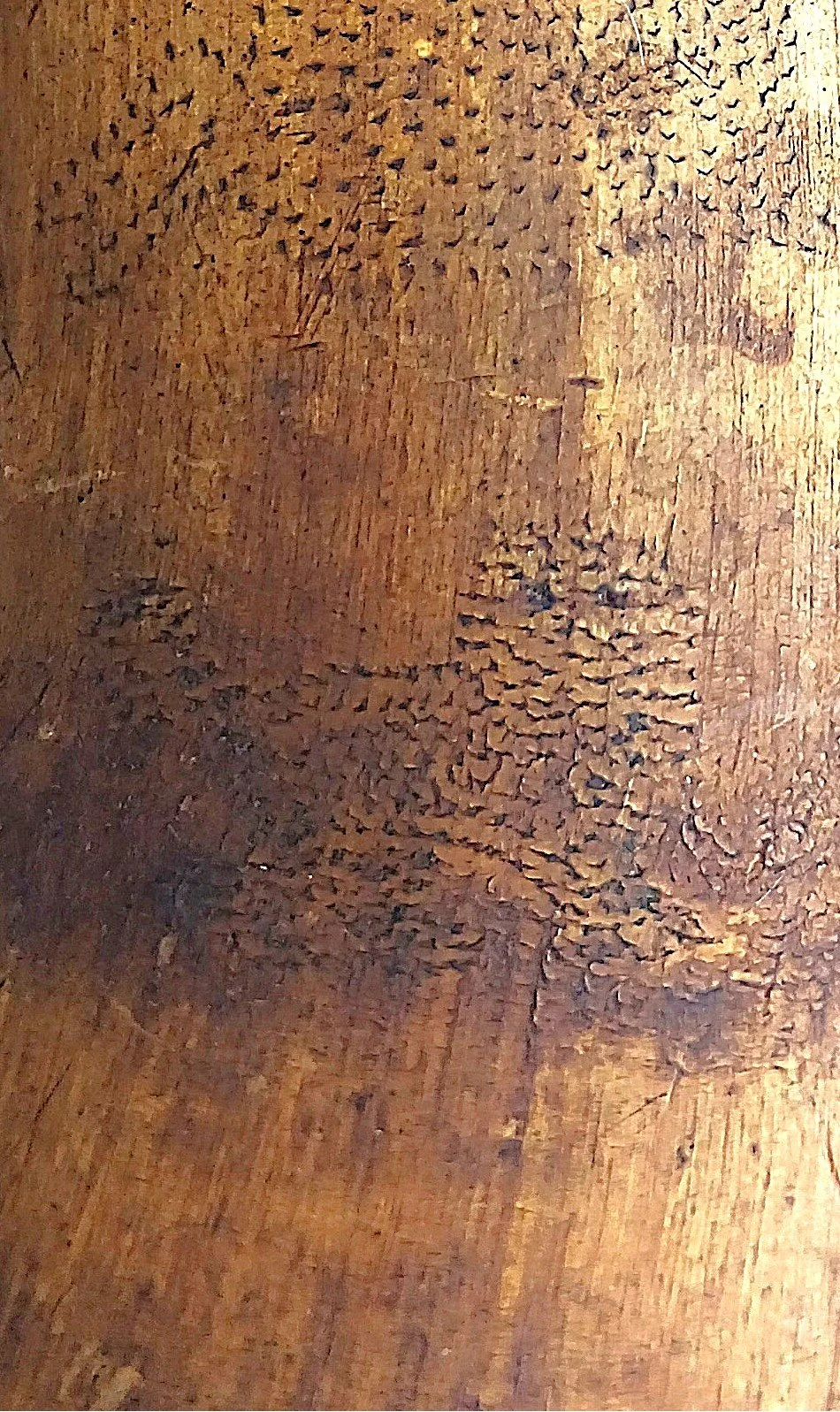
Figure No.8: This enlarged view of the cat figure below the two-headed horse figure shows its long tail, legs, short ears, and beady eyes. The knife-cut dots are readily visible here.
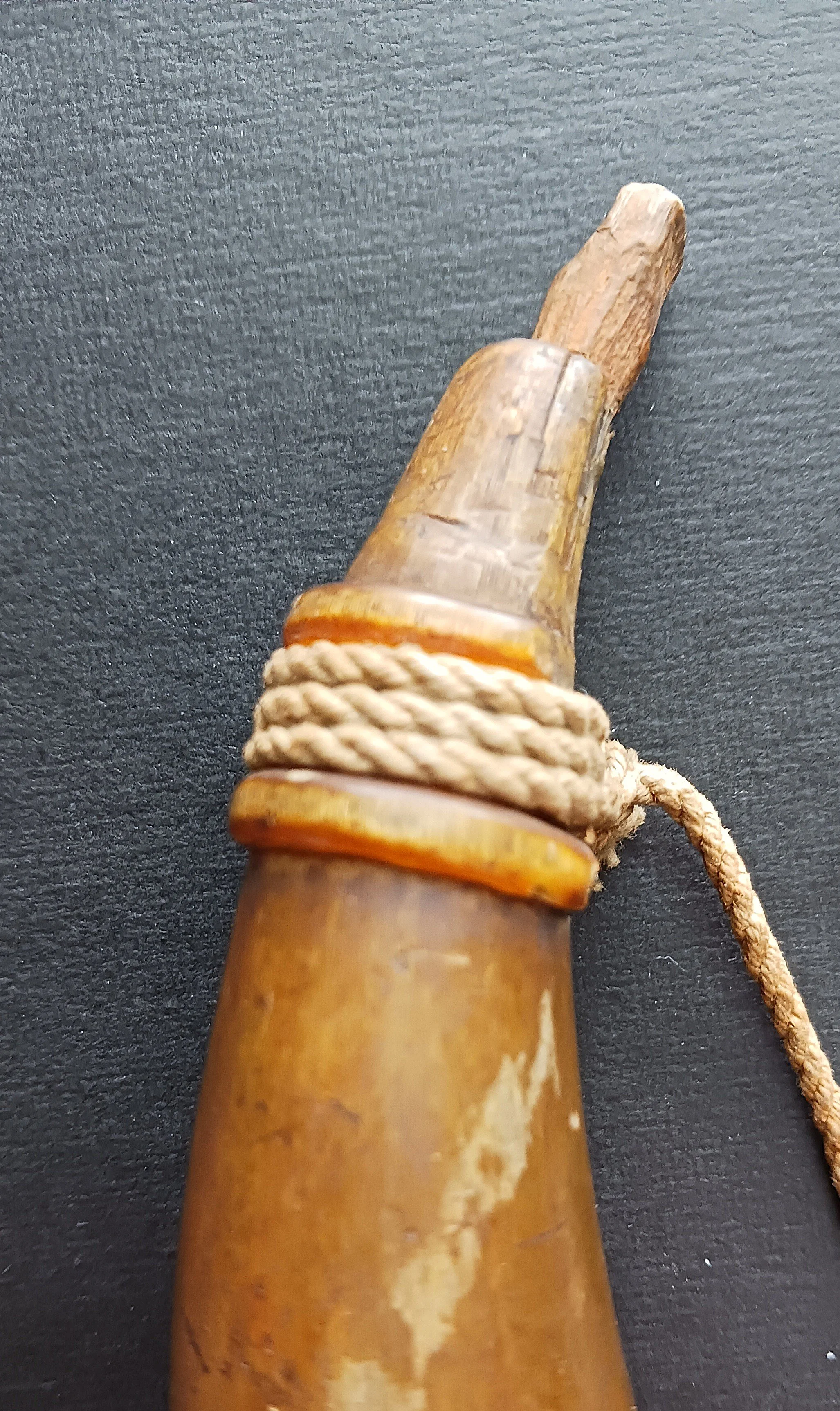
Figure No.9: The spout has two hand carved, raised rings for strap attachment. While the original strap was probably leather, the last working “strap” was a heavy twisted cord.
Summary: A recently discovered, carved Kentucky powder horn of moderate size came out of an old family in Franklin County, Kentucky, where Lexington-style rifles and earlier Tansel powder horns were the preferred guns and horns. While simpler and smaller than most Kentucky-era Tansel powder horns and a “poor-boy” carved horn by comparison, it kept horn carving alive in central Kentucky into the percussion years, well after the Tansel family’s departure for Indiana in 1829. Other than the fine Tansel powder horns and a few period “copy-cat” horns by unknown makers, there were not many fully carved/decorated Kentucky powder horns. That scarcity makes each new discovery of a carved Kentucky powder horn special, worthy of study and preservation as a physical record of Kentucky’s early history.