
The Reason For Screw Tips on Powder Horns ©
Foreword: Old wives’ tales die hard, since most were started by knowledgeable people trying to explain gaps in then-current knowledge with “reasonable” answers. Explanations for why screw tips were made have generally been “wives’ tales” that included better esthetics, hornsmiths highlighting their talents, maintaining local traditions, and perhaps the most widely accepted reason… the removable tip served as a funnel for filling the horn. But a wider study of better-quality powder horns with both screw-tips and standard integral tips suggests a different and more functional reason for screw tips appearing on powder horns.
Study Horns: Screw tip horns are usually superior quality horns made by professional hornsmiths. But to understand why screw tips were made, other superior quality horns with conventional spouts need to be examined, and Tansel powder horns provide good examples of those horns. A few Kentucky-era Tansel horns have screw tips, some of which have non-Tansel style butt plugs and undoubtedly were made by others and later taken to a Tansel carver for decorating. However, a few Tansel horns with Tansel style butt plugs have screw tips that a Tansel could have made. The Tansel carvers were skilled horn workers and used lathes to make chimed cup bottoms, chimed flat butt plugs of horn at times, and Tansel-style spouts when needed for horns with skinny throats that lacked the girth to make an integral strap bead. Such spouts were then mounted on the horn and pinned in place. But overall, the large majority of Tansel horns like those in Figure No.1 had hand-carved integral spouts.
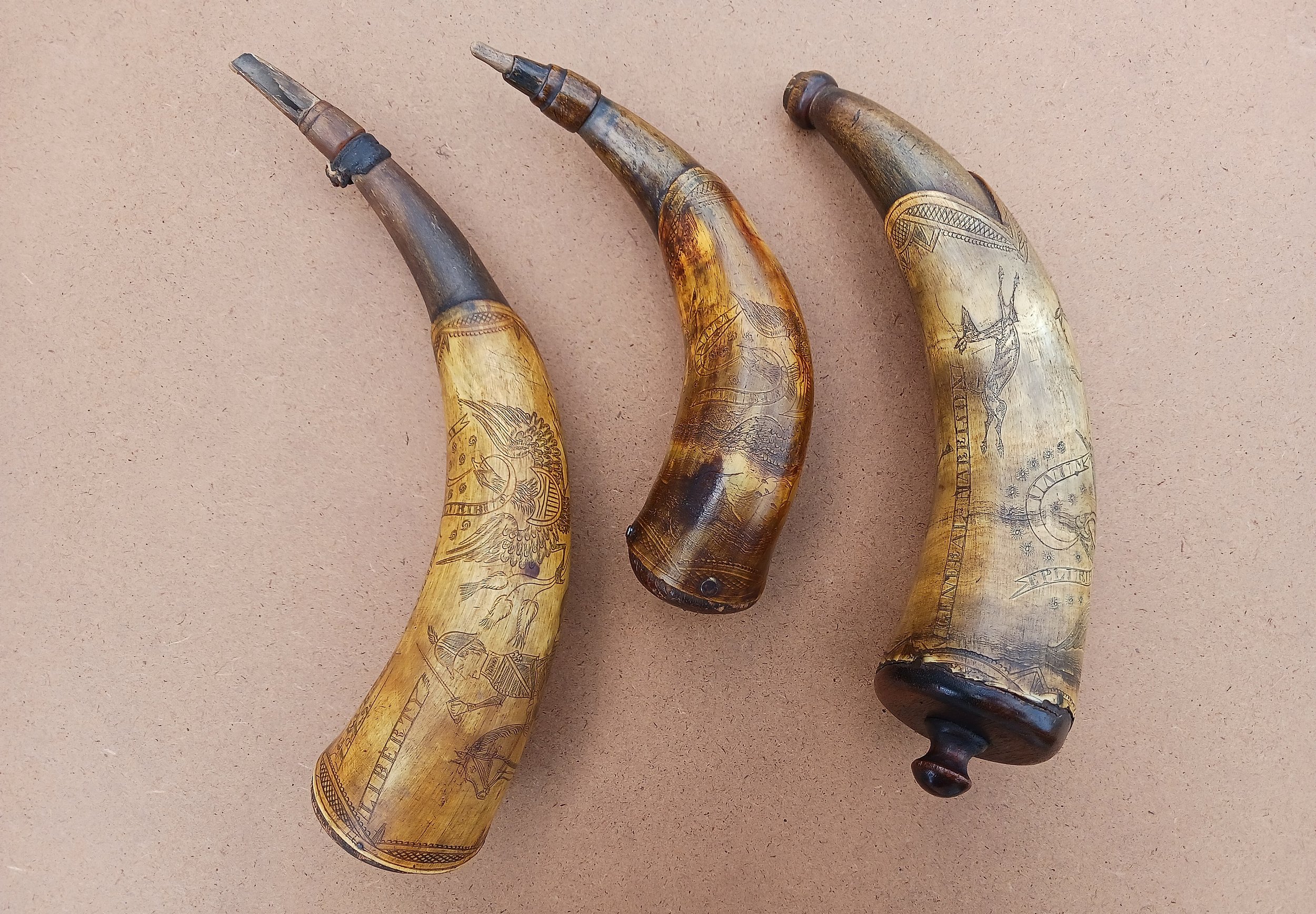
Figure No.1: These Tansel horns demonstrate the commonly seen types of damage that occurs to integral spouts during their working life, often from stoppers being inserted with excessive force, but also from being dropped and banged around.
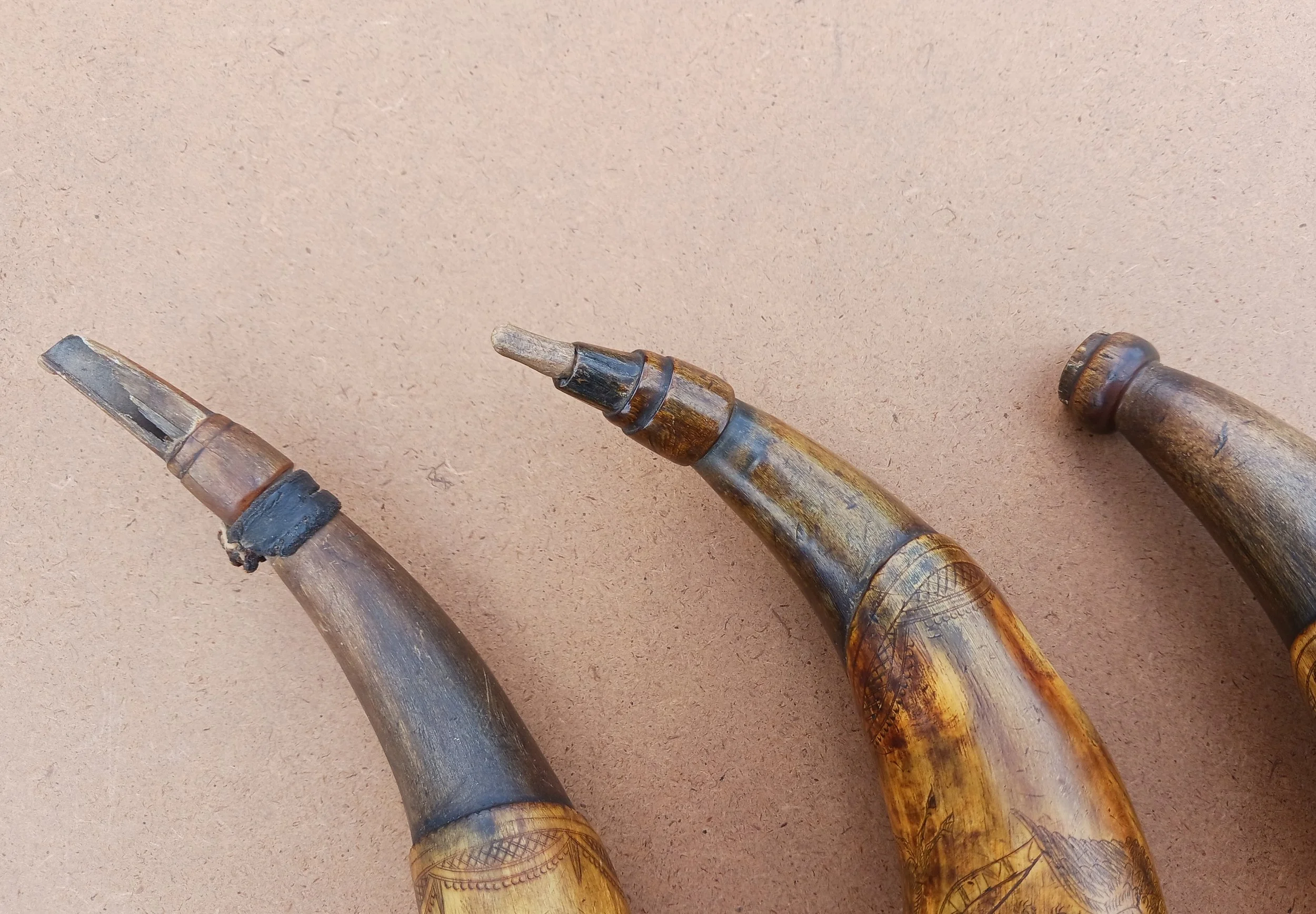
Figure No.2: The first damaged Tansel spout show a typical split from the stopper being inserted with excessive force. The middle horn suffered tip damage that was cut off and the remaining tip reshaped, and the horn on the right had its spout badly damaged and removed.
Spout Damage: Three Tansel powder horns with varying degrees of spout damage are shown in Figure No.1. Their progressively damaged spouts are enlarged for easier viewing in Figure No.2. The horn on the left had its spout tip abused [stopper seated too firmly too often] causing a large sliver to split off the side that made the horn unusable due to not sealing tightly. The middle horn has a common repair seen on Tansel and other spouts when the spout tip is chipped or gets shallow cracks. The spout’s damaged section was cut off, and a shorter, tapered spout made from the spout’s remaining lower section. The third horn is typical of any Tansel or other integral tip horn that had its spout badly broken or split down to the strap retaining bead. The entire broken spout was cut off at the top of the strap retaining bead, which stopped the splitting process due to its more robust thickness. Similar spout damage is seen on two carved Mercer County horns from Ohio in Figure No.3. Both Tansel and Mercer County horns, like Pennsylvania screw tip horns, were premium horns that cost significantly more than a standard, plain horn. Yet damage is often seen on their integral spouts that required shortening or reshaping to salvage them. If damage became excessive, the entire spout was often removed down to the strap retaining ring, and if the split or break was so severe that it ran past the strap ring, the horn was no longer serviceable. But highly decorated carved horns had an advantage over plainer screw tip horns in their decoration. If they had excessive spout damage that prevented the horn from sealing properly to keep powder dry, owners still valued the folk-art decoration and at times salvaged them into blowing horns like the one shown in Figure No.4. But the question remains… how do damaged Tansel and Mercer County horns help explain the rationale for screw tip powder horns?
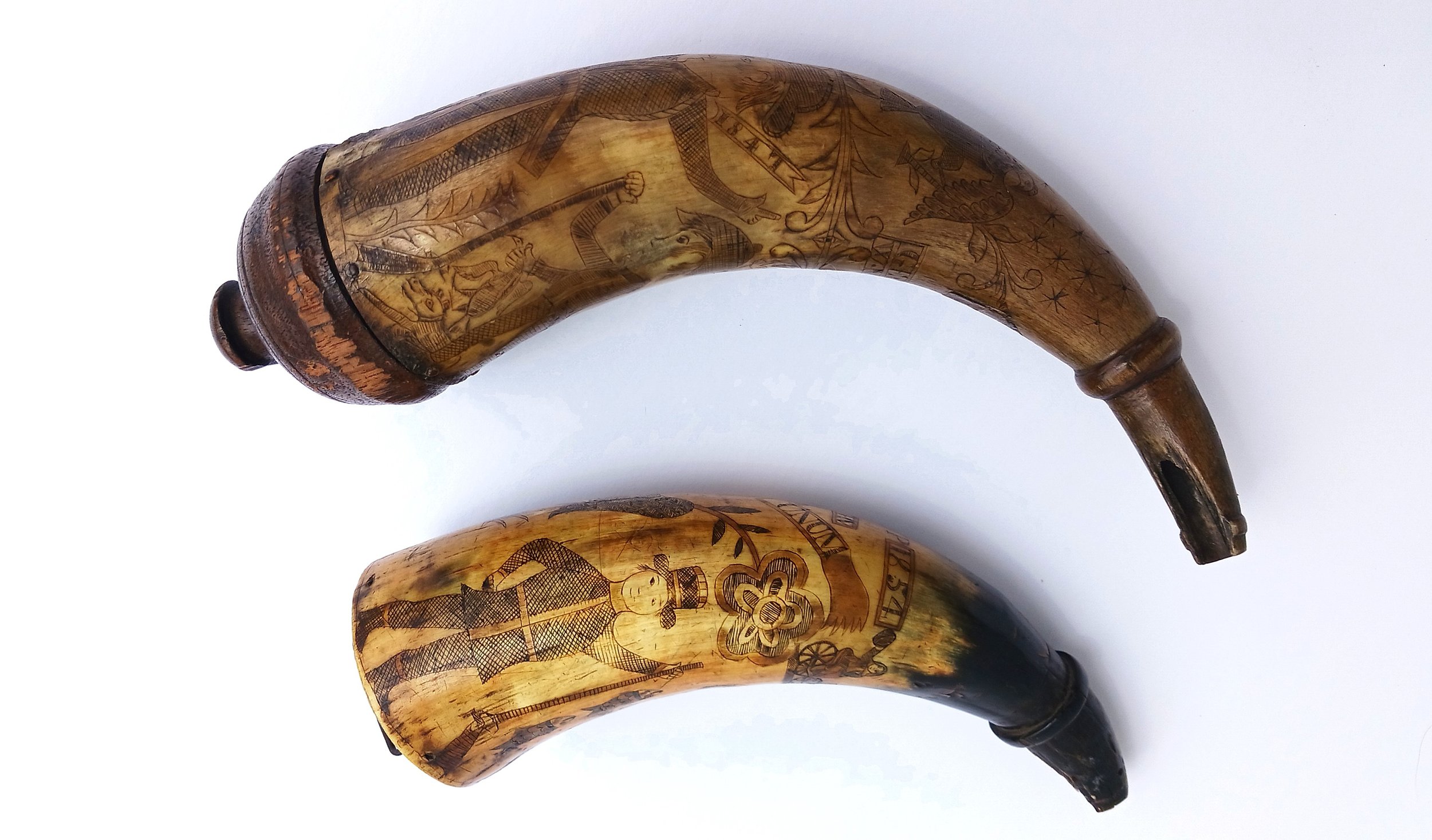
Figure No.3: These two high quality Mercer County, Ohio, carved powder horns have suffered spout damage similar to the damage on the Tansel powder horns above. The top horn had a chunk broken out of its spout from excessive force [or oversized stopper] being used too often, probably initially cracking the spout and eventually breaking a piece out of it. The smaller horn has a very dark spout, making it hard to see the damage. But it also has a piece of the spout wall broken out from excess stopper force. Neither horn shows much wear, so they were probably “retired” to the fireplace mantle.
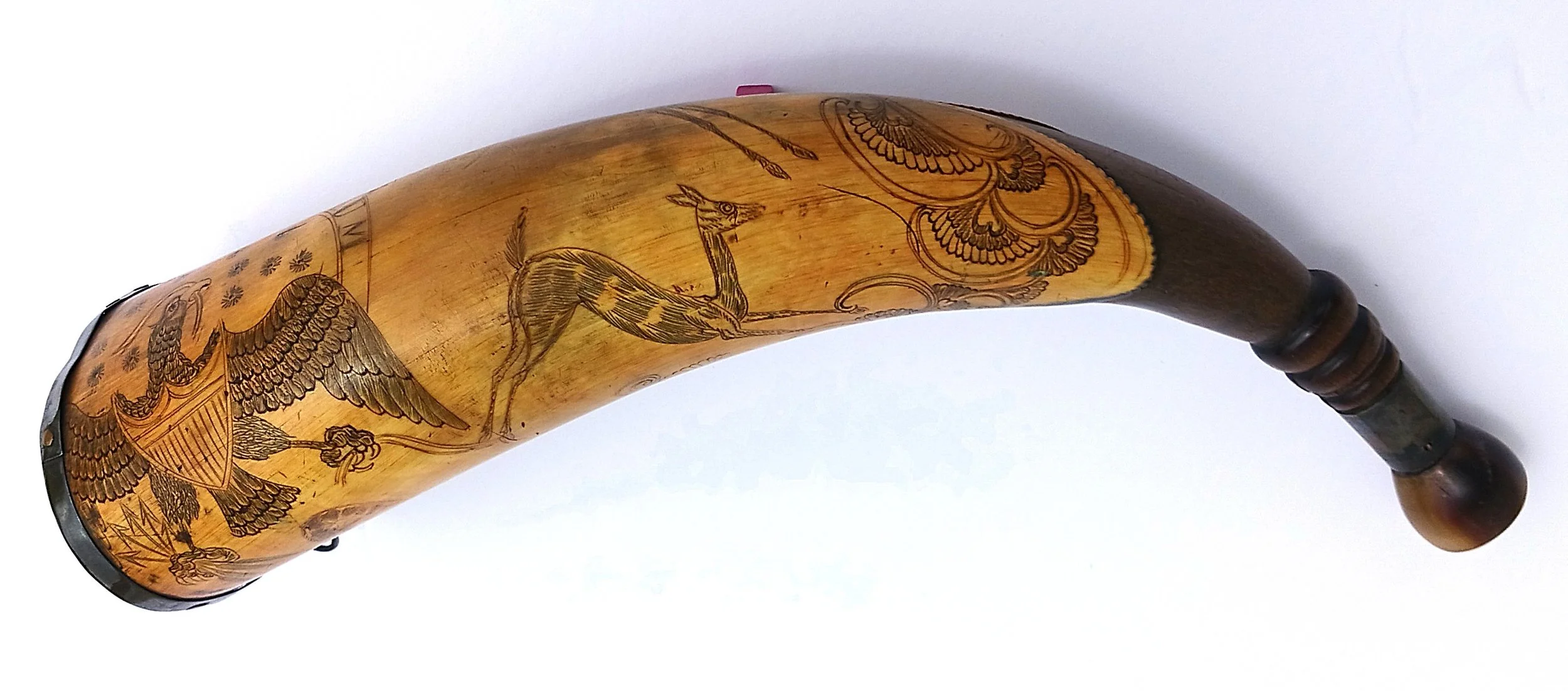
Figure No.4: This early Indiana Tansel horn had its spout heavily damaged, perhaps from being dropped since the horn’s big end was also damaged and trimmed back [see eagle’s shortened wing]. The owner must have admired the carved decoration. He had a coin silver band put around the horn’s open end to stabilize it, added a lathe-turned mouthpiece held in place by a silver collar, and salvaged the powder horn as a blowing horn.
Pennsylvania Screw Tips: Three heavily used Pennsylvania internal screw tip horns and their tips are shown in Figures No.5 and No.6, along with an external screw tip horn from Indiana shown in Figures No.7 and No.8. The big difference between the screw tipped horns and the prior Tansel and Mercer County horns is less spout damage on screw tips than on integral spouts. Screw tips were the solution to an inherent weakness in powder horns with integral spouts that were more prone to damage, particularly on better powder horns where spouts were often longer and thinner as a mark of quality over shorter, chubbier spouts on homemade or gunsmith-made powder horns. A replaceable tip solved a longstanding problem with many powder horns.
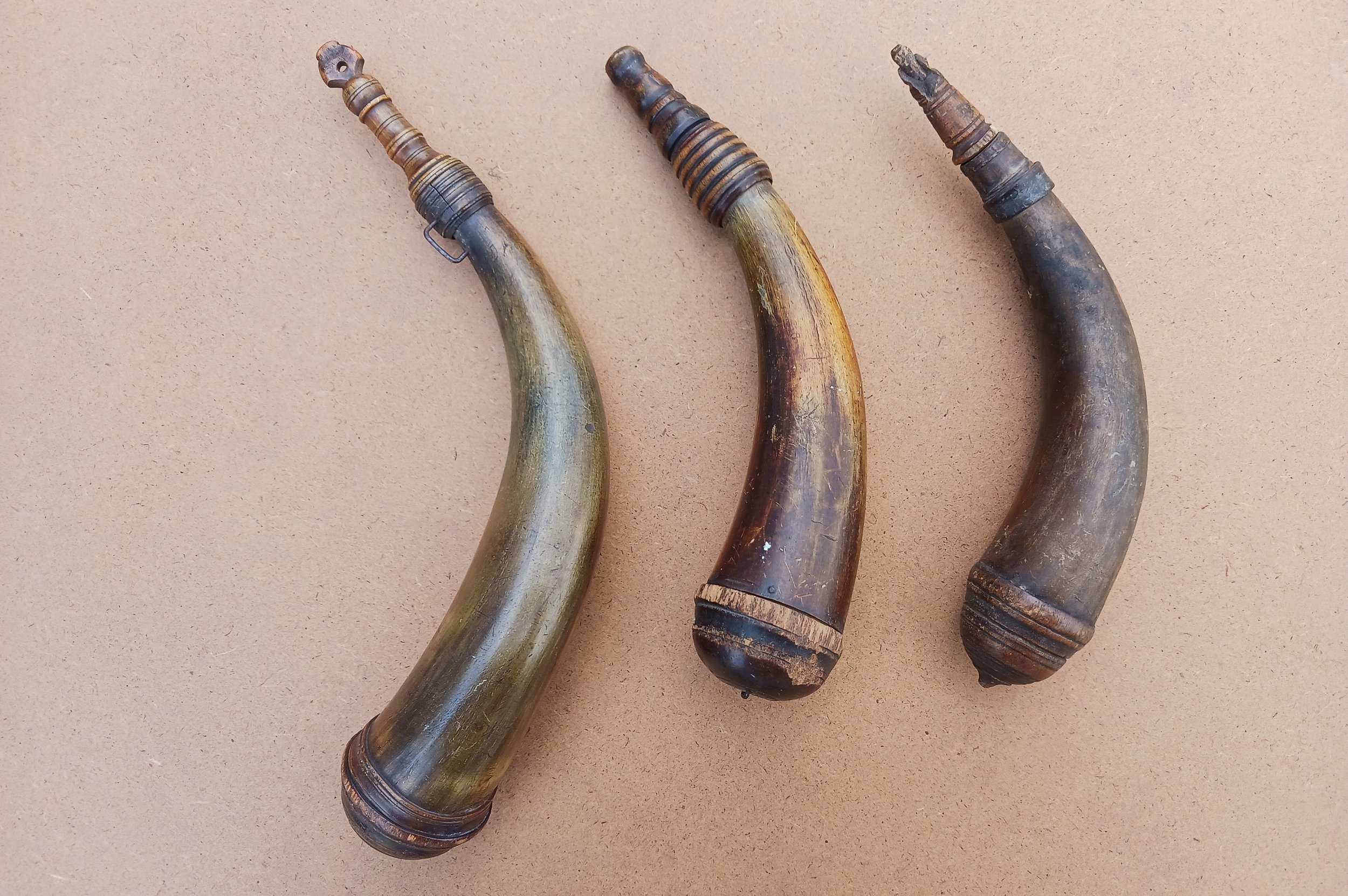
Figure No.5: These three heavily used Pennsylvania horns all have internal screw tips. Each horn has a nicely turned applied collar below the screw tip and an attractive turned butt plug with graceful beads and coves. The larger horn has a turned horn ring over its plug nails.
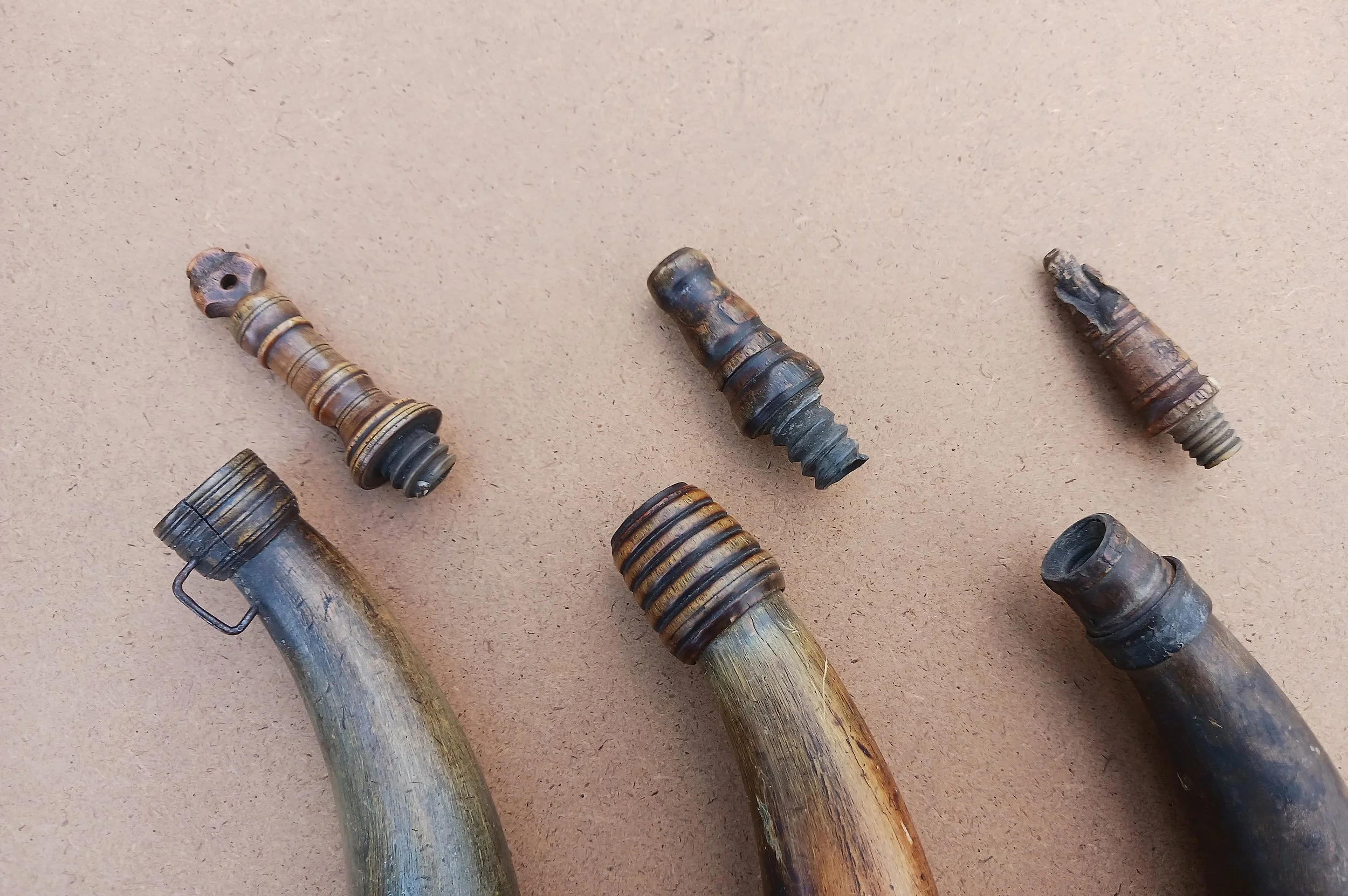
Figure No.6: A close-up view of the tips on the three Pennsylvania horns highlights their different pitches of internal threads and different decorative turnings that help identify them. Two spouts are intact, and one has a chip out of its tip but retains its stopper.
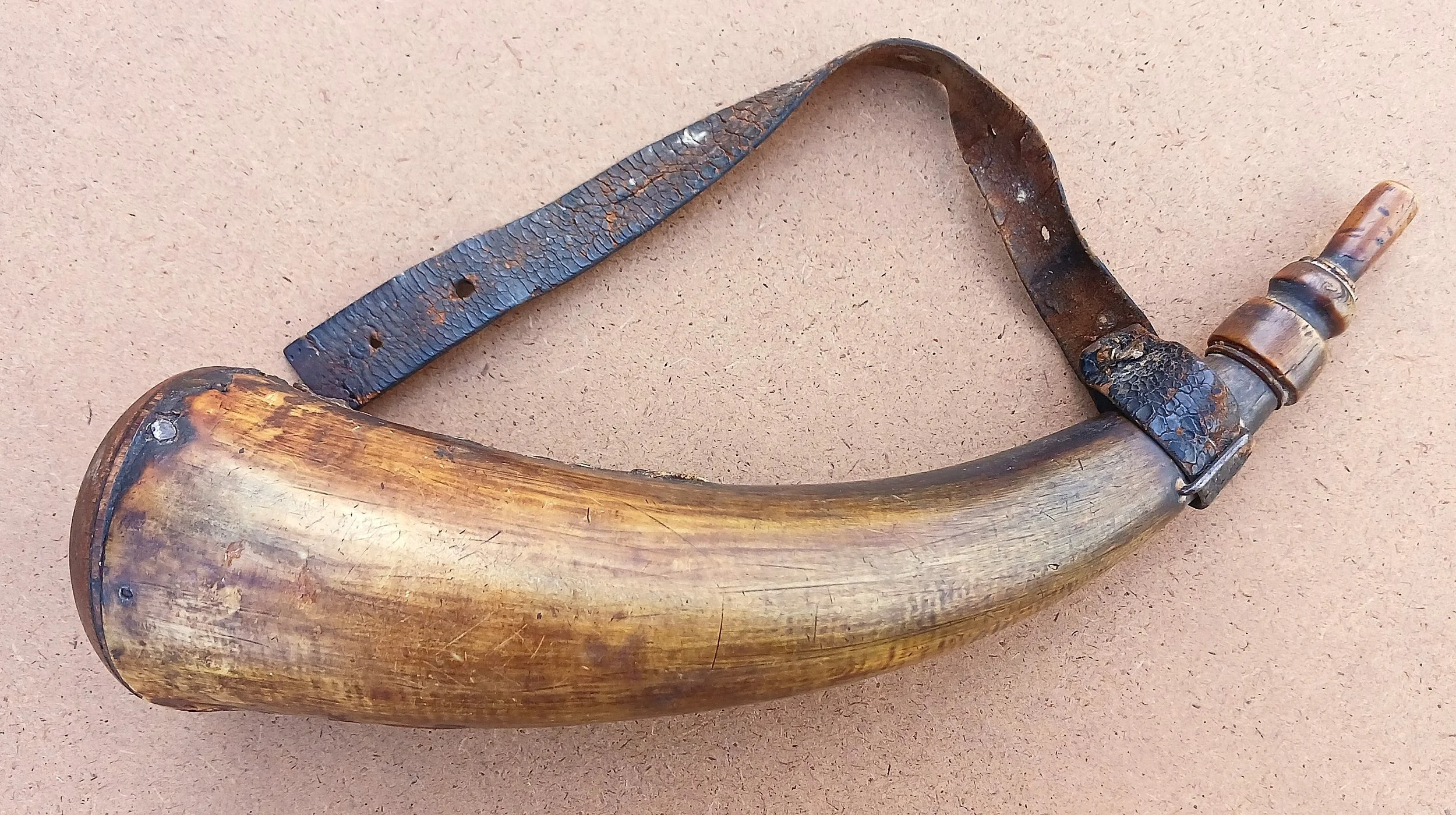
Figure No.7: This Midwest screw tip horn came off a farm in northern Steuben County, Indiana, along with its original bag and Indiana rifle. The bag remains in good condition despite strap damage and has a small sheath and loop for a camp axe on its back side.
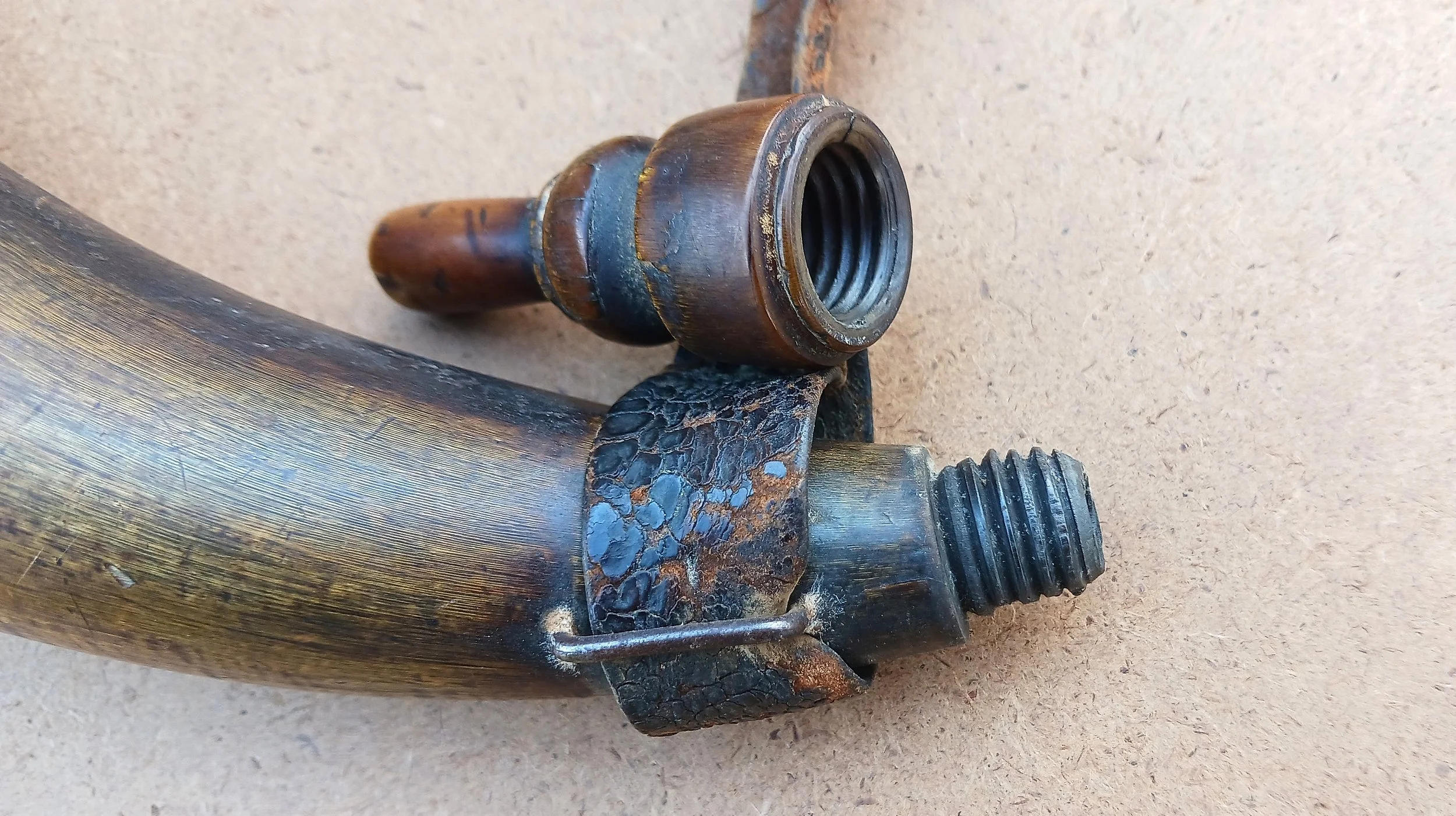
Figure No.8: The Indiana horn’s screw tip is simpler than those on better Pennsylvania horns, but it clearly demonstrates the average size of the threaded opening on many external screw tips, which is relatively small and highlights the difficulty of pouring powder into it.
Tansel and Mercer County horns started life with better quality, lighter colored raw horns and nicely turned butt plugs, but their real value was in the folk-art images carved on their surfaces depicting period hunters, dogs and deer, sweethearts, political and military heroes, at times the owner himself, and other figures the owners could relate to and appreciate. In contrast, better Pennsylvania horns lacked decorative carving but were highly valued for their superior construction with beautifully turned and chip carved butt plugs, fancy horn rings over the plug nails, and attractively turned screw tip spouts and collars. The focus on superior structural design undoubtedly led to the development of screw tips on powder horns as an improvement over the more damage prone integral tips, despite requiring extra time, material, and tools to make them.
Debunking the Myth: The theory that screw tips were made to provide a funnel for filling powder horns has major flaws in its logic. First, the threaded opening on most external screw tips was still rather small, making it difficult to pour powder cleanly into it from a larger container without spillage and waste… especially if in a hurry or pouring from a keg. Second, a small piece of paper easily made a funnel with a much larger opening than the end of a screw tip, and even leather, bark, leaves, or anything at hand that bent or curled easily, would make a wider mouthed funnel or chute for filling a powder horn than the mouth of an external screw tip. If that is not reason enough to convince readers that screw tips were not used as funnels, then why did so many fine screw tip Pennsylvania horns have internally threaded tips? If external screw tips offered an advantage by serving as funnels for filling horns, would not most Pennsylvania screw tips have externally threaded tips to provide that advantage? External screw tips should then be MUCH more common than internal screw tips, but they are not.
Benefit of Screw Tip Spouts: Screw tips used more material, required additional tools, and took longer to make than a standard integral spout, yet both type spouts could be very attractive. So why were screw tips heavily used on better Pennsylvania horns [and to a lesser extent on horns elsewhere]? Screw tips offered two big advantages over integral tips: 1) they protected the horn body from damage by limiting the propagation of major splits/ruptures in the spout, and more importantly, 2) damaged screw tips could be replaced to make the horn “as good as new” again… which was not possible with a damaged integral spout. A fine Tansel or Mercer County horn with a damaged spout always remained a damaged horn, and any repairs usually detracted from its appearance and devalued it for the owner. But a threaded screw tip, when damaged, could be removed and replaced with a new tip from a local hornsmith, gunsmith, or mechanic. A nicely turned replacement tip kept the horn fully functional and attractive for the owner, protecting his investment in the more expensive powder horn. Knowing that screw tips could be replaced when damaged explains why a screw tip horn may have a plug/body/collar that matches well with a known school of screw tip horns, but its screw tip differs a bit from the norm and weakens the attribution. The horn may have a replaced tip made by a different craftsman!
Long ago an unknown hornsmith in Pennsylvania realized that an interchangeable spout tip would solve the age-old problem of broken spouts on powder horns. By doing so, he extended the working life of powder horns while ensuring they retained full visual and functional value for their owners.