
A Simon Settle Rifle from Green County, Kentucky ©
Foreword: Settle rifles from Kentucky are well-known and highly regarded within the state, and the name resonates with almost all collectors of muzzle loading rifles. While not the fanciest rifles made, they had a reputation for accuracy and toughness that exceeded the reputations of many other early rifles in Kentucky. A good number of Settle rifles are known since most were signed, but finding new examples is sporadic with long periods between the appearance of a Settle rifle at auction. When one shows up, most collectors want to see it and how it relates to other known Settle rifles. Recently a signed Simon Settle rifle from Green County, Kentucky, sold at auction in Illinois.
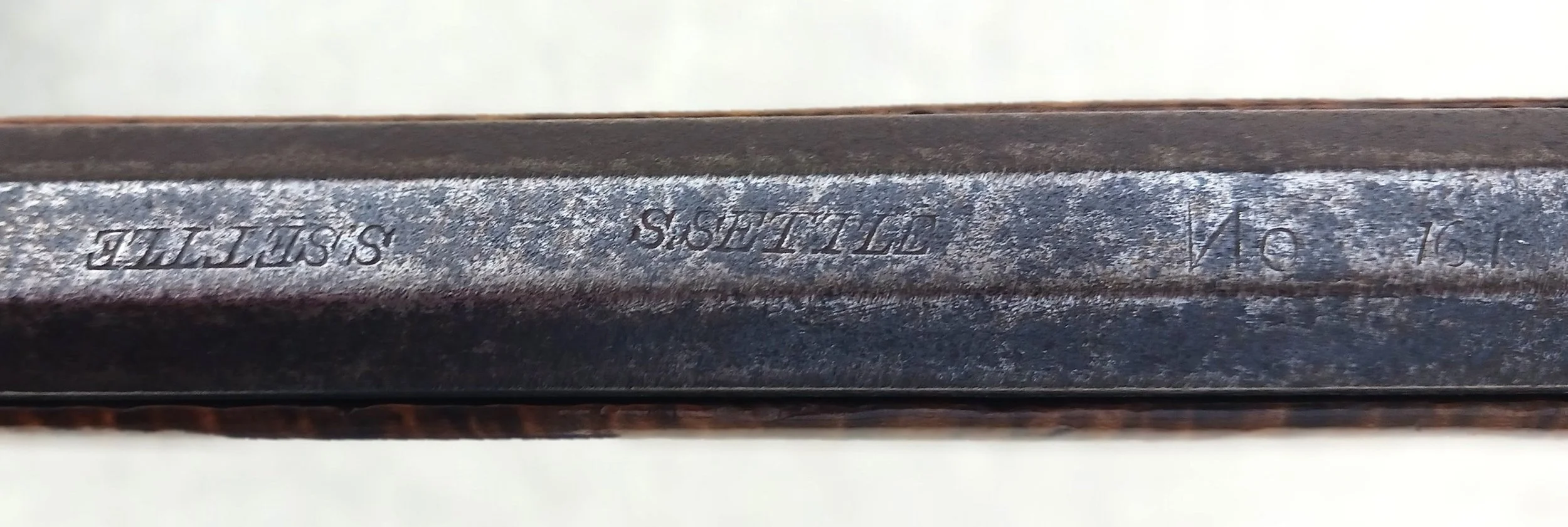
Figure No.1: The barrel on Simon Settle’s half-stocked rifle is stamped twice with “S. SETTLE” followed by the engraved number “No. 161” to the right of the name. The last digit of the number looks a bit like a “4,” but when enhanced, it appears to be a “1.” The double stamped barrel, one right side up and the other upside down, allowed the Settle name to be read from either side of the gun.
Simon Settle: Kentucky’s Settle clan began in 1798 when William Settle (1770-1808) of Virginia moved to Barren County, Kentucky. He was reportedly taught gunsmithing by his namesake uncle, William Settle (1731-1839) of Virginia. Kentucky’s William Settle made full-stocked rifles with iron mountings in Barren County. His son, Felix Settle, learned the trade from his father and continued to make guns in Barren County for many years. Felix had two sons of his own that became gunsmiths, oldest son Simon (1823-1871) and second son Willis (1826-1892). Simon is perhaps the best-known Settle gunsmith today because his name is frequently seen on surviving Settle rifles. He worked for years at Greensburg in Green County starting in 1844, but after the Civil War he moved to Bowling Green in Warren County where he finished his career.

Figure No.2: The “S. Settle” rifle has typical Kentucky architecture with a triangular butt and long, slender barrel. The nose cap is located past the rear entry pipe in Kentucky style, and the guard and triggers look as if they were purchased in Louisville with the style common to that area, i.e., “square shoulder” above the guard’s rear spur, and a small “C” scroll behind the front trigger. Note the superb curly maple that looks “quilted” in the butt and enhances the gun’s appearance. Barrel: 42 inches long, .36 caliber bore, 7-groove rifling. Author’s collection.
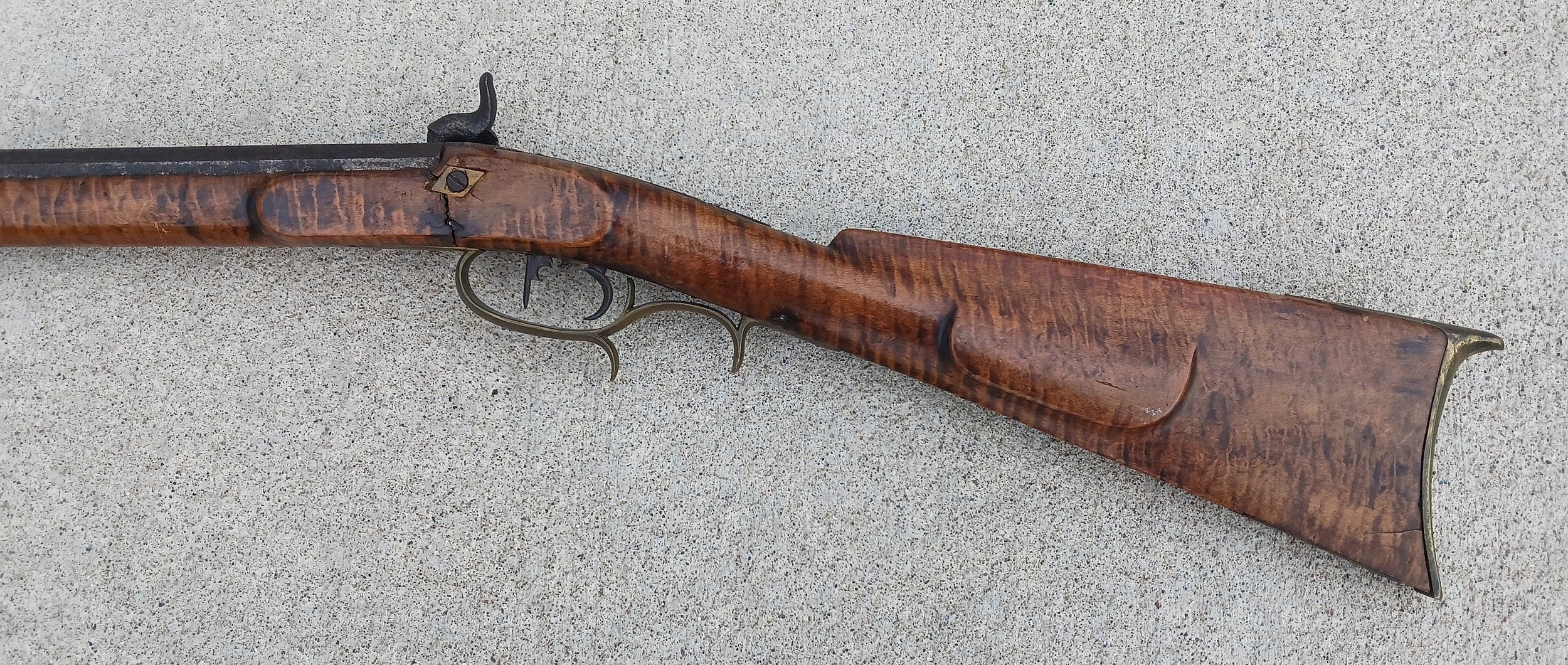
Figure No.3: The back of the Simon Settle rifle has a rounded style cheekpiece, indicating an earlier work by Simon since many of his later guns did not have cheekpieces. The lack of strong curvature in the butt plate also suggests an earlier gun, as does the production number “161” on the barrel. There is no cheek or wrist inlay, and the lock bolt washer is a simple brass diamond, typical of most plain but highly functional rifles by the Settles.
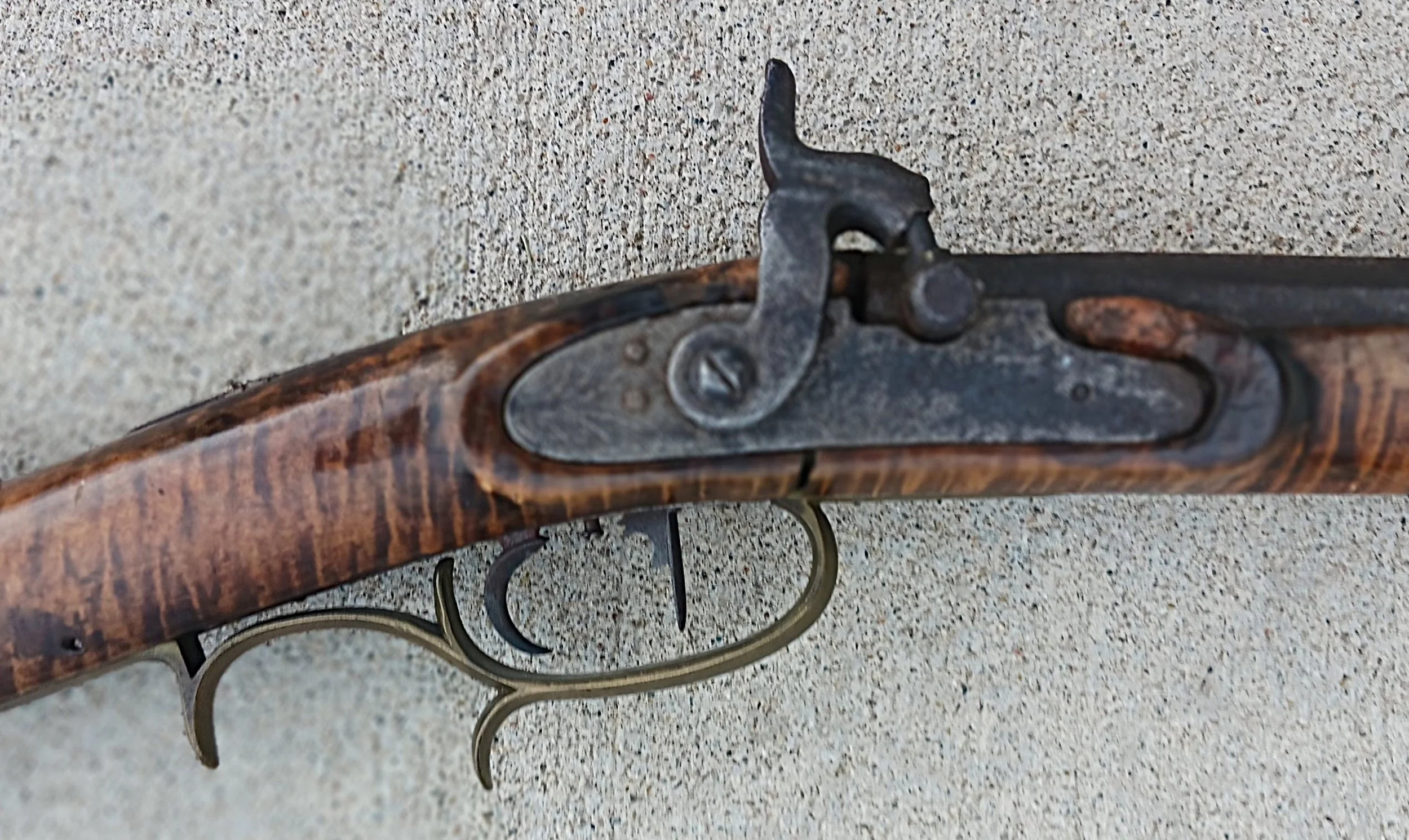
Figure No.4: A close-up view of the guard and triggers shows the mountings were probably purchased in Louisville, or from a local hardware store that received its stock from Louisville. The rear spur has a “square shoulder” where it runs up to meet the rear extension, a strong Ohio River detail, and the front trigger has the rear “C” scroll of Ohio River triggers. Also note the side facing around the lock plate is relatively even and tight, typical of most Kentucky guns.
Simon Settle Rifle: The new rifle’s barrel is stamped “S. Settle” twice [so readable from either side] followed by “No. 161” in script as seen in Figure No.1. The highest rifle number known to the author is #979, so the rifle was made in Greensburg early in Simon’s career. The gun is typical of most Settle rifles with its lack of ornamentation… no cap box, thumb piece, or cheek inlay as verified in Figures No.2 and No.3. But what it lacked in decoration was made up in its fine curly maple, stock architecture, and long barrel. The gun is a typical Kentucky product with its triangular butt, graceful stock architecture with tight side facings, nose cap set a couple inches past the rear entry pipe, and Louisville-style mountings with a “square shoulder” above the guard’s rear spur and small “C” scroll behind the front trigger seen in Figure No.4. Its Kentucky tang, long with two screws, is shown in Figure No.5. An unexpected detail is the butt plate’s narrow top extension with tapered finial in Figure No.6 that makes it more attractive than most Settle butt plates.
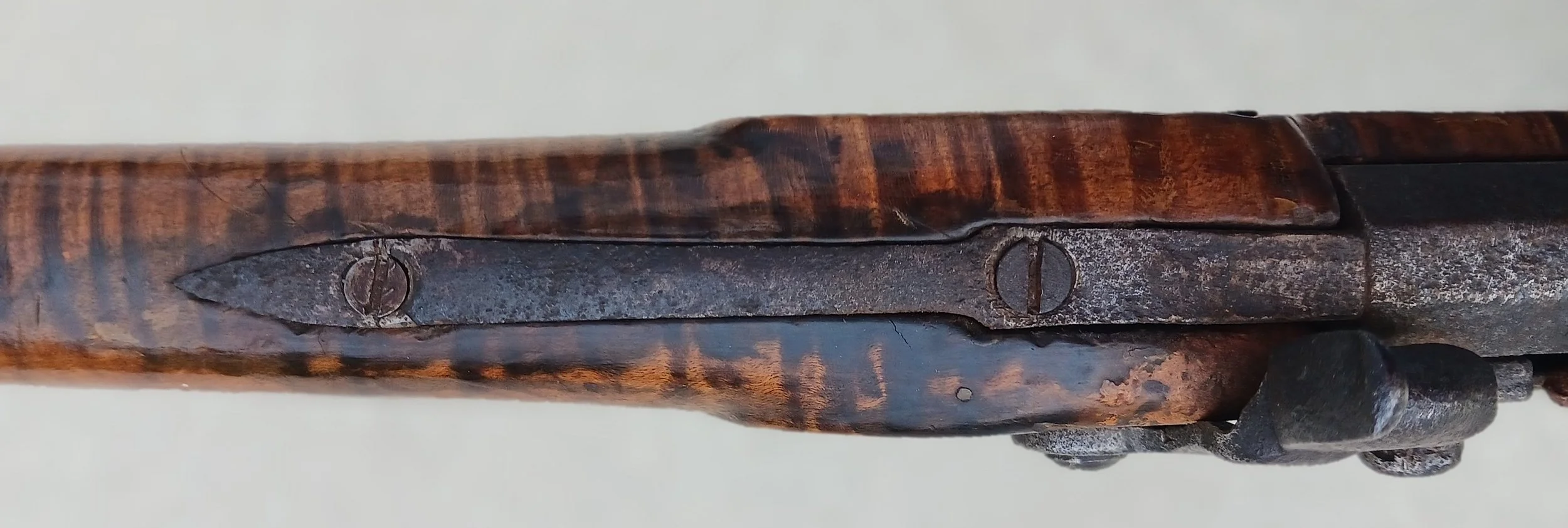
Figure No.5: The Settle rifle’s 5-1/4 inch tang with two screws [actually, a tang bolt and tail screw] is typical for a majority Kentucky guns. The vivid figure in the curly maple stock wood stands out in this view of the wrist.
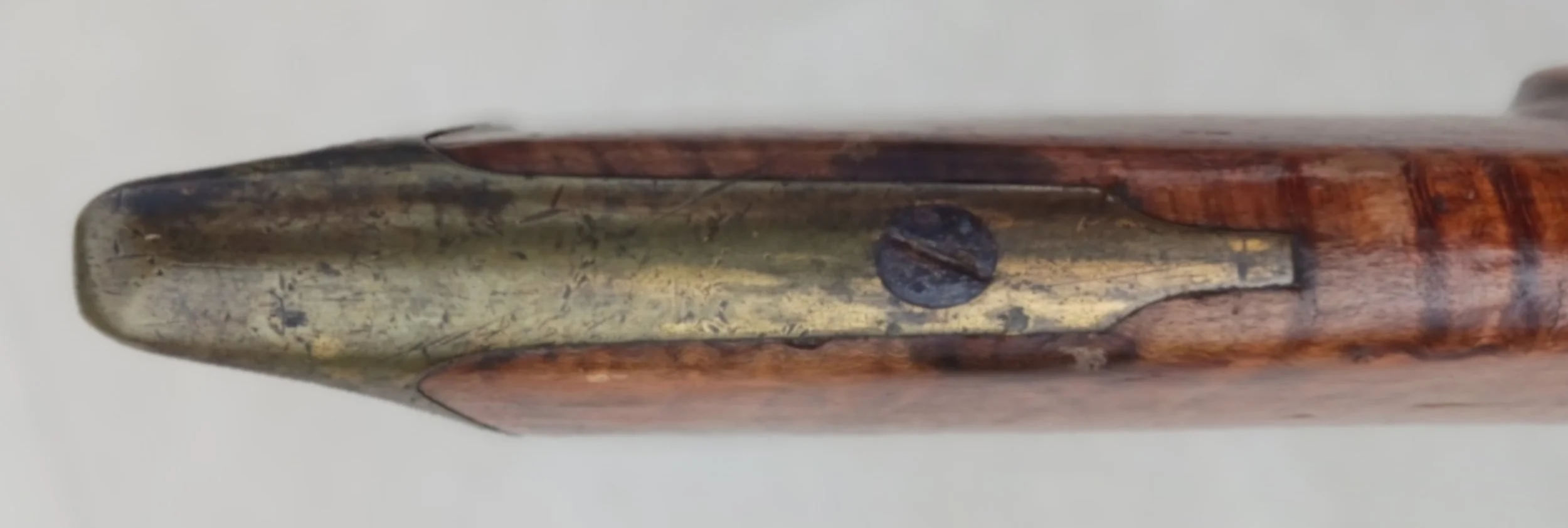
Figure No.6: An unexpected detail that adds a touch or decorative to the gun is its narrow butt plate extension with finial. Most Settle rifles have standard butt plates with their extensions having flat ends. While hard to see, the rifle’s comb is almost flat on top.
Summary: The newly discovered Simon Settle rifle epitomizes most Settle rifles with its lack of inlays and molding lines but attractive stock architecture with slim lines. Most known Settle rifles were made a few years later than the study rifle and lack a cheekpiece, but the new rifle was above average with its outstanding stock wood, oval cheekpiece, and attractive butt plate return. Settle rifles always catch the author’s attention as well as his auction bid when the price is reasonable. But most are destined to go back to Kentucky where Settle descendants eagerly await the chance to acquire a rifle made by one of their illustrious ancestors.
*******************************************************************
POST SCRIPT: The only known [to the author] Simon Settle pistol is a small under-hammer with octagon-to-round barrel and curly maple grip. The gun is dated “1842,” which was early in Simon’s career, since he was only nineteen years old at the time and working in his father Felix Settle’s gun shop. The new study rifle is also one of Simon’s earlier long guns, so together the rifle and pistol help document Simon’s early working years in a more complete manner. Both guns, while not fancy, are among Simon’s better-made early pieces. He seldom engraved his metal surfaces, but the pistol has an engraved signature and date with small accent cuts around the capital letters in his name… making it one of his “more heavily” engraved guns. This is the only Simon Settle gun known to the author where the old style “Maker” [“Fecit” on eastern rifles] was used after his name, suggesting it was one of his first guns.
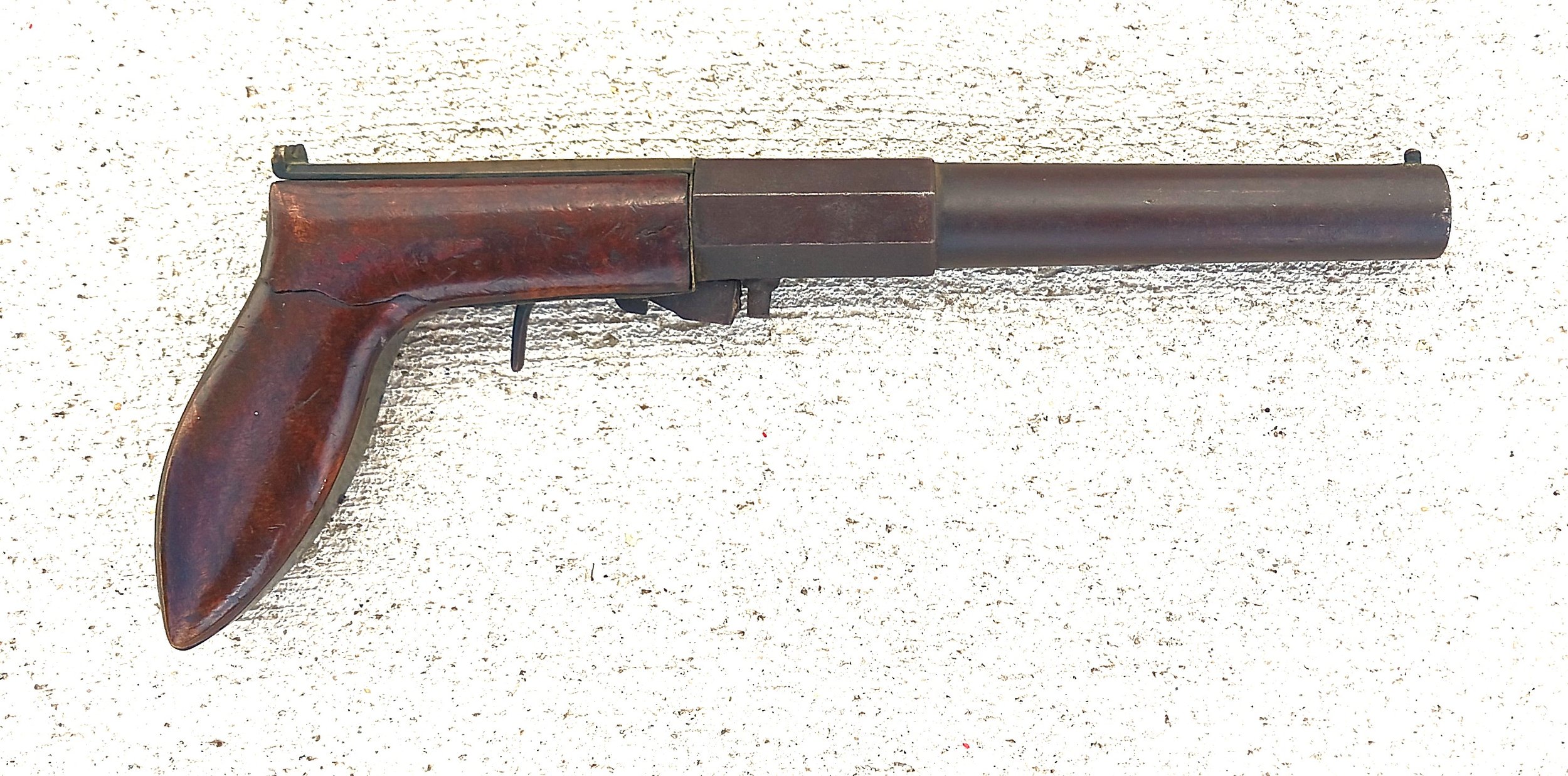
Figure No.7: This under-hammer pistol is signed “S. Settle 1842” in front of the rear sight. A form-fitting brass strip runs around the maple grip, and the head on the percussion hammer has snapped off. Barrel: 5-7/16 inches, .36 caliber, 7-groove rifling. Author’s collection.
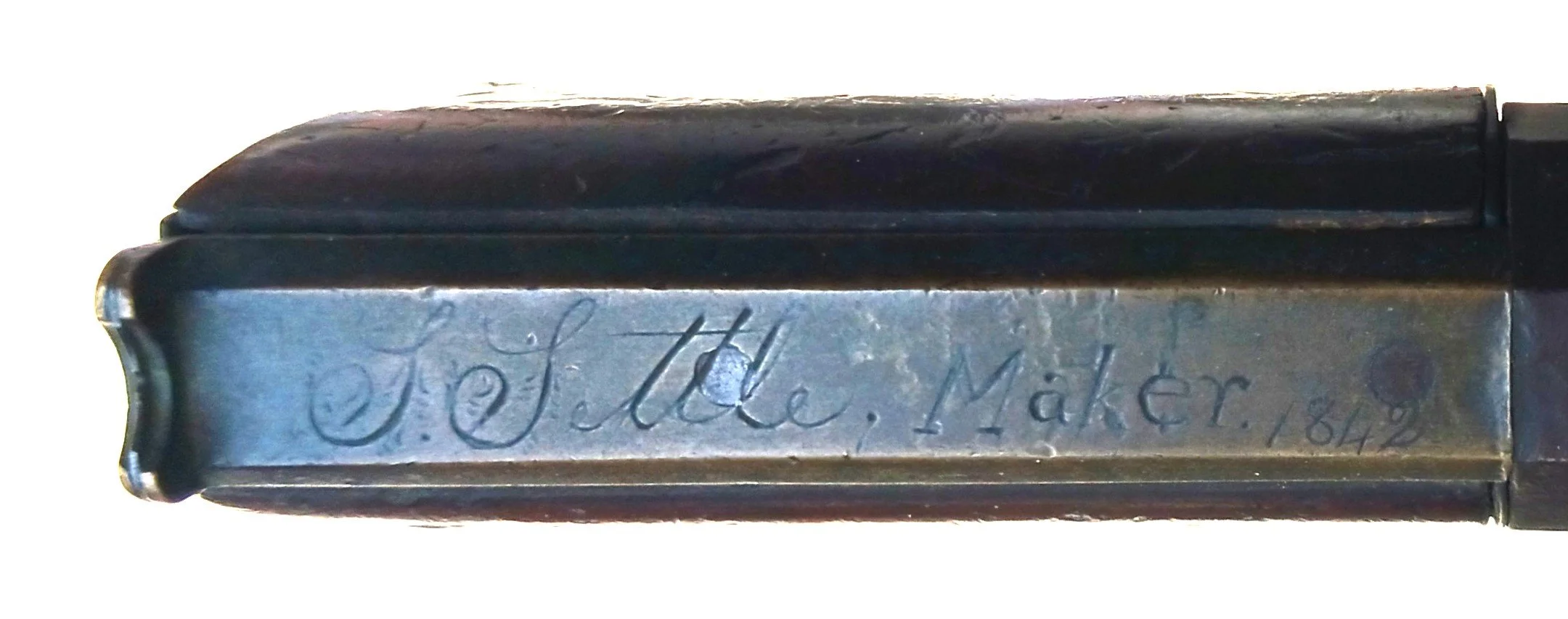
Figure No.8: Simon Settle’s under-hammer pistol is signed in script on a brass plate above the grip, with the rear sight being an integral part of the brass plate. The sight has a small iron insert with a more precise sighting “V” at the bottom. This signature is important for its “1842” date that documents Simon was signing guns independently when only 19 years old and still working in his father’s shop at Roseville in Barren County, Kentucky.