
Insights by Shelby Gallien
Please Note: All written content and images on this website are copyrighted and cannot be copied, reproduced, or used in any manner without the written permission of the author.

A Rare Kentucky Under-Hammer Rifle by Gunsmith George A. Mayer ©
Under-hammer rifles from Kentucky were nonexistent… until a signed example recently sold at public auction. The gun was stamped on the barrel “G. A. Mayer” for gunsmith George A. Mayer of Henderson in Henderson County, Kentucky. No one had ever seen a Kentucky-made under-hammer rifle before, so the discovery was a major event for those who study and collect early Kentucky’ firearms.

Kentucky Gunsmith William Kelsay and the “William Kelsay” Rifle ©
William Kelsay worked as a gunsmith in Wayne County, Kentucky, from about 1816 until 1851. No William Kelsay rifle was known to collectors until 2019 when a signed rifle finally appeared at auction. The rifle was much finer than most southern Kentucky “hill county” guns that were utilitarian pieces, and it raised an intriguing question… was it too early to be the work of Kentucky’s William Kelsay?

An English Pistol Sold by Moses Dickson of Louisville, Kentucky ©
Moses Dickson was Louisville's best-known gunsmith from 1822 until his death in 1863. He was business-minded and over time expanded his gun shop into one of Louisville’s largest sporting goods stores. As sales increased, he began to import English firearms and related items to expand his product lines, in addition to his own guns which remained his premium products. A small box-lock pistol marked “M. Dickson” on one side and “Louisville” on the other provides an interesting example of an English import pistol sold by Moses Dickson in about 1830.

Kentucky’s Bryan Gunsmiths and Their Lexington Style Patchbox ©
Kentucky’s iconic, cast brass Lexington style patchbox was used on fine rifles from in/near Lexington. Its evolution is unclear, but evidence suggests the design was heavily the work of Bryan family gunsmiths from North Carolina who settled Bryan’s Station northeast of Lexington in 1779. Daniel Brian became Lexington’s most important early gunsmith and is thought to be the first gunsmith to use the Lexington style patchbox... which was rapidly copied by other local gunsmiths.

Unraveling the Mystery of a Great Tansel Powder Horn ©
Tansel powder horn collectors prefer horns that are signed and dated with the original owner’s names, giving the horns an historical context. But at times unmarked Tansel horns can provide clues that allow much of its missing background to be reassembled. An exceptional Kentucky era Tansel horn from an old Iowa collection lacked a date, signature, and owner’s name… but it’s artwork offered clues about its history in Kentucky.

Graham Family Powder Horn from Franklin County, Kentucky ©
Old powder horns at times have odd features that do not fit the pattern of other local horns, raising the question, “Where did it really come from?” Answering that question offers educational opportunities for collectors. A different style horn showed up in central Kentucky recently with a well-turned, chip-carved butt plug that resembled plugs on fine York County, Pennsylvania, screw-tip horns. But it also had details that varied significantly from York County horns. Its provenance stated the horn was originally from Franklin County, Kentucky.

David Weller’s Role in the Bardstown Rifle ©
Kentucky’s Bardstown School of gunmaking in/around Nelson County was known for its highly decorated rifles. Gunsmith Jacob Rizer played a major role in the development of the Bardstown rifle, but his partner, David Weller, was working with Rizer when the Bardstown rifle’s distinctive patchbox appeared after 1815. Rizer was the master, but Weller was a close second in the quality of his work.

Kentucky’s Finest Gunmaker, Jacob Rizer of Bardstown ©
Bardstown rifles made in or near Nelson County were Kentucky’s most artistically decorated rifles. Pierced and engraved patchboxes, attractive inlay work, classic molding lines, and touches of carving elevated Bardstown guns above those from Kentucky’s other major gunmaking schools. At the heart of the Bardstown School was Jacob Rizer, the gunsmith most responsible for the Bardstown style.

A “Mixed” Powder Horn by Stark and Timothy Tansel ©
Most Tansel powder horns were carved by a single carver who made the plug, horn body, and decorative carving. But some collectors have wondered if more than one Tansel carver ever worked on the same horn. A recently discovered Tansel horn made in Indiana in the late 1830s had details that appear to be by two different carvers, brothers Stark and Timothy Tansel. The new horn is the first Tansel horn known to exhibit carving by two different Tansels.

The Most Sought After Tansel Horn, The Tansel Cup ©
There are less than a dozen Tansel cups known. Unlike the sturdier powder horns, a cup was fragile and prone to damage, causing a much higher attrition rate. A possible cup by Francis Tansel is described, and two later cups, one by Timothy Tansel dated “1841” and the other by Stark Tansel circa 1847, serve as good study pieces. The two cups have fascinating provenances that add to their historic relevance.

A Bardstown “Ghost” Rifle by Henry Killen ©
For years only one signed rifle by Kentucky gunsmith Henry Killen was known. He apprenticed under Jacob Rizer in Bardstown, Kentucky, from 1818 to 1825, then worked in Kentucky for two years before moving to Tennessee. His guns were “ghosts,” almost non-existent, with no Kentucky gun known. In 2019 a Killen “ghost” rifle finally appeared from his early years in Kentucky.

A Mountain Rifle Masterpiece by Kentucky’s John Bull ©
Highly decorated rifles were made in Kentucky’s Bluegrass region, but in rural areas guns were usually “working rifles” with little to no decoration. Kentucky’s southeastern hill country was slow to develop, and its rifles were generally plain, barely more than a roughly stocked barrel with forged iron furniture. But gunsmith John Bull of Knox County made exceptional rifles and brought the Bull/Bean style of gunmaking into southeastern Kentucky.

Kentucky’s Mock Family of Gunsmiths ©
The Mock family of gunsmiths has twelve members documented as gunsmiths in Kentucky. Daniel “Mauk” Sr. (1760-1825) arrived in 1789 and worked as a gunsmith at Springfield in Washington County. Two sons, Daniel Jr. and Reuben Mock, were well-known Kentucky gunsmiths. Two of Reuben’s sons, George S. and James R. Mock, worked in central Kentucky for many years, and their guns provide good examples of Mock rifles made in central Kentucky in the 1840s and 1850s.

Kentucky’s Finest Rifle from its Western Barrens Region ©
Highly decorated rifles were made in Kentucky’s central Bluegrass region, but rifles from more remote areas were much plainer. The Barrens School in southwestern Kentucky was known for good quality guns with minimal decoration. Recently an exceptional Barrens School rifle from Christian County sold at auction. It was the finest Barrens School rifle ever seen.

A Battlefield Relic, the “John Tansel” Powder Horn ©
A signed “John Tansel” powder horn is documented as a surviving relic from the Battle of River Raisin in Michigan during the War of 1812. The Kentucky-made Tansel powder horn seems appropriate for a relic from that battlefield, where many Kentuckians fought and died, but it raises a fascinating question: How could a well-carved John Tansel powder horn be on an 1813 battlefield, when he was only twelve years old at the time? The answer helps explain the origin of several Tansel powder horns of uncertain or “mixed” vintage.

A Tansel Powder Horn’s Second Life ©
All frontier horns including Tansel horns were susceptible to damage if dropped, bumped, or squashed. Perhaps the most common damage came from dropping horns. Dropped horns often suffered basal damage causing them to be trimmed to remove the damaged area before being re-plugged. At times dropped horns retained their original plugs after being repaired, but the plug had to be modified to fit the slightly smaller opening after the damage was removed. But there was also the possibility that a damaged horn would be repurposed, such as turning it into a blowing horn.

Election Year Campaign Powder Horn by Stark Tansel ©
Tansel powder horns from the Indiana era between 1829 and 1852 display a wide variety of subjects. One group of Tansel horns that appeals to both horn collectors and political memorabilia collectors is the politically focused campaign horns from presidential election years. This article examines a horn that promoted/supported Zachary Taylor. The horn is unsigned and offers an opportunity to learn more about how to identify the carver of unsigned horns that look very similar.
Mercer County Powder Horns ©
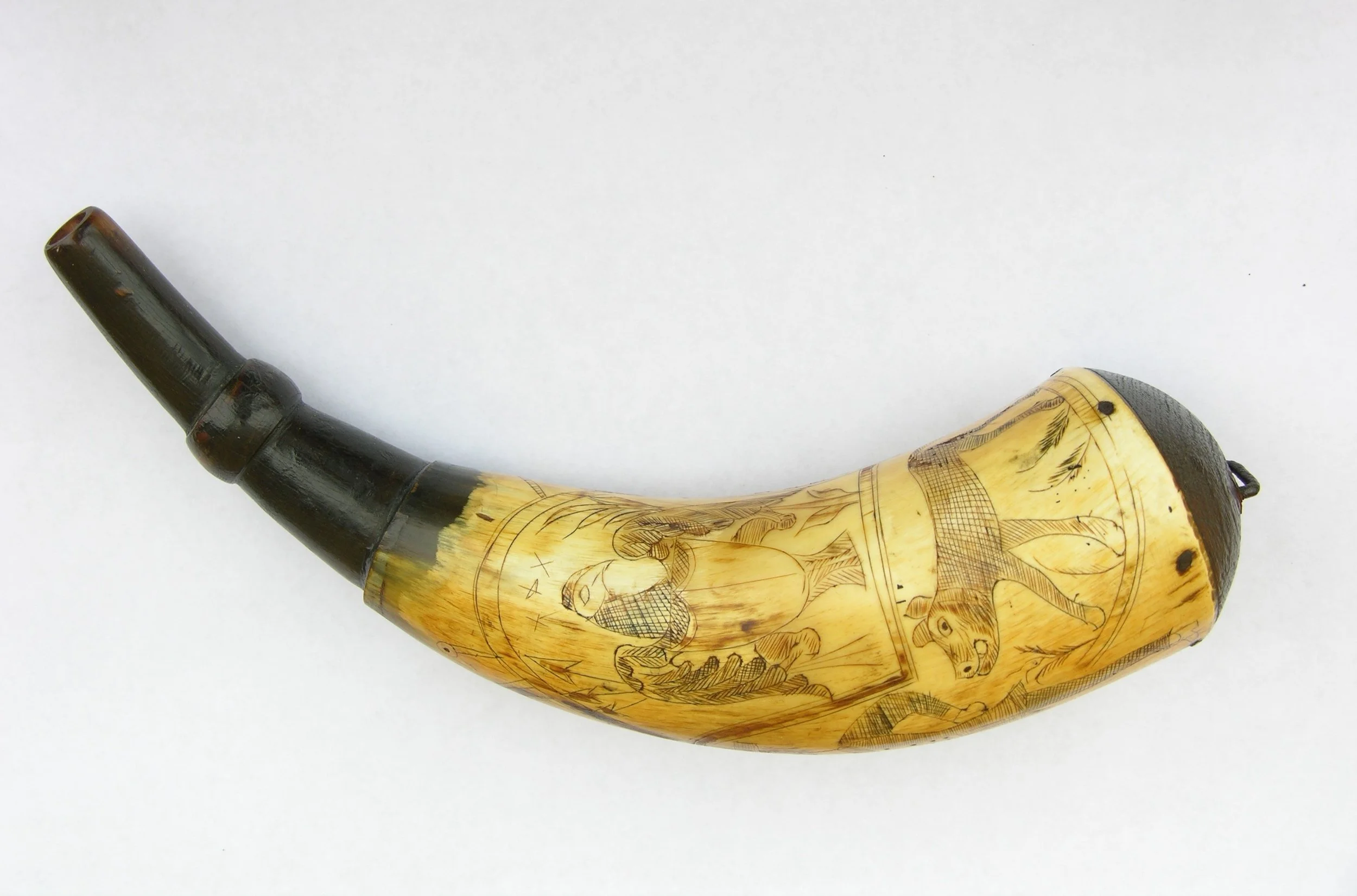
Mercer County, Ohio, was home to a distinctive school of powder horns, first recognized in 2001 when the article “Mercer County, Ohio, Carved Powder Horns and Their Rooster Headed Eagles” appeared in the now defunct The Gun Report magazine. But it has taken additional years to identify the carver/carvers of the horns, and the reason for their creation.

A New Kentucky Pistol Helps Identify an Old Kentucky Pistol ©
The recent discovery of a signed “E. C. Burden” pistol has proven to be a significant event with a “ripple effect” in the study of early Kentucky pistols. While any new Kentucky pistol is rather rare, it has not only expanded current knowledge of Edmond C. Burden’s work, but also helped to properly identify two previously misidentified pistols of similar style as Kentucky products.

An Early Powder Horn by Stark Tansel ©
A newly discovered powder horn by Stark Tansel, second son of Francis Tansel, offers collectors an opportunity to study the details Stark used that can help identify his unsigned work. There are multiple surviving horns by his father Francis, older brother John and younger brother Timothy that are signed or initialed, but Stark signed very few horns, leaving most of his work to be attributed. The new horn provides a training tool to help in attributing Stark Tansel’s unsigned work.