Mercer County Horn Carver William Dunwoody’s Personal Horn ©
Foreword: A “Pennsylvania folk art” powder horn recently sold at auction in Pennsylvania, but it was misidentified. The horn was a "Mercer County School" horn from Ohio that was affiliated with the state’s early Masons as seen in Figure No.1. However, the auction horn was not as heavily decorated as most Mercer County horns. Rather, it was missing many of the standard figures such as hunters, dogs, and deer found on Mercer County horns. But the figures that remained were highly significant and suggested it was the Mercer County horn carver’s personal horn.

Figure No.1: Most Mercer County horns have bold Masonic imagery that often includes the square & compass. This horn, while sparsely decorated, has a huge square & compass inside a circular cartouche that dominates the front side of the horn. Small circles inside the Masonic imagery contain numbers, a unique detail for a Mercer County horn. The small circle on the viewer’s top left is different. While hard to see, it has the small bust of a man inside rather than a number. Busts of men are common on Mercer County horns and usually represent the horn’s owner, often with his name or initials nearby.
An Odd Horn: Of the 30-plus Mercer County horns the author has seen, none looked like the auction horn. Its unusually sparce but oversized artwork, when studied closely, suggests it was the carver's personal horn. The primary Mercer County carver was William Dunwoody [1], and he usually signed his horns with his two initials but occasionally his full name. The auction horn had his initials in large, prominent letters with the date "1843" underneath as seen in Figure No.2 below. No other known Mercer County horn displayed his initials so boldly or devoted so much of the horn’s surface to them, as if they were the centerpiece on the horn. In addition, there was no other owner's name or initials on the horn, only the traditional Masonic "square & compass" symbol on the opposite side that often appears on Mercer County horns. The boldness of the carver’s initials, their placement as a major decorative element filling one side of the horn, and the absence of another man’s name or initials, strongly suggests the horn was the carver's personal horn. It was not the fanciest horn he ever made, but it had the largest and most prominent initials of any known Mercer County horn, and it lacked any other owner’s initials or name. The only other decoration was the traditional Masonic square & compass that filled the horn’s opposite side.

Figure No.2: Perhaps the most important detail on this horn is its very large signature, or initials, with the date “1843” underneath. The “W D” stands for William Dunwoody, the primary carver of Mercer County horns. The initials’ exceptional size, with no other initials or name on the horn, strongly suggests the horn belonged to William Dunwoody himself. Polychrome/stain is visible in the scrolls above the initials and date. A detail of possible significance is the use of seven (7) small nails to attach the butt plug, since seven plug nails were used on a number of other Mercer County horns as well. This horn is typical of most Mercer County horns with its simple spout ring and bulbous butt plug with integral nose button.
Decoration: The new horn has typical but limited Mercer County details. The large “W D” initials and “1843” date have faint working lines above/below them similar to other Mercer County horns. Polychroming occurs on the leafy vines, large scrolls, and pineapple-like figure in the Masonic emblem’s border seen in Figure No.7, similar to polychroming on other horns. A large 3-5/8” diameter circle frames the Masonic square & compass shown in segments in Figures No.3, No.4, and No.5 below. The carving’s most intriguing details are its six evenly spaced, small circles just inside the square & compass’s circular border highlighted in Figures No.3, 4, and 5 that make the larger Masonic figure look like a clock face. Starting with the small circle at the 9 o’clock position [left side in Figure No.3] and reading clockwise, the numbers are: 6-1-2-3-9, undoubtedly with a Masonic meaning for the owner while indecipherable for the reader.

Figure No.3: The large Masonic cartouche with square & compass fills one side of the horn. On its left side are two small circles with numbers and a bottom circle with a man’s face/bust.

Figure No.4: The mid-section of the Masonic emblem has two small, checkered squares. Four of its six small circles with numbers are visible. The bottom left circle has a man’s face/bust.

Figure No.5: The left side of the Masonic emblem shows its polychromed scrolls, vines, and small arcs that make up part of the larger circular border of its cartouche.
The sixth small circle, at the lower 7 o’clock position when the horn is held vertically and shown in Figure No.6, does not contain a number. Rather, it has the horn’s smallest and most fascinating detail, a difficult-to-see bust of a man facing left that represents the horn’s owner. Owners’ busts appear on other Mercer County horns in round or oval cartouches, but they are always much larger and serve as major decorative figures. This horn’s miniature bust is almost hidden. It is the author’s opinion that the bust’s small size strengthens the attribution to horn carver William Dunwoody, intentionally made small to not aggrandize himself on his own horn, or to his fellow Masons. An enlarged image of the small circle with tiny, hard-to-see bust is shown in Figure No.6 below.

Figure No.6: Buried in the 6th small circle on the lower left is a tiny bust of a man that often represents the horn’s owner. It may portray “W. D.” the carver.

Figure No.7: The top of the cartouche around the Masonic square & compass has a cross-hatched pineapple-like figure with polychrome.
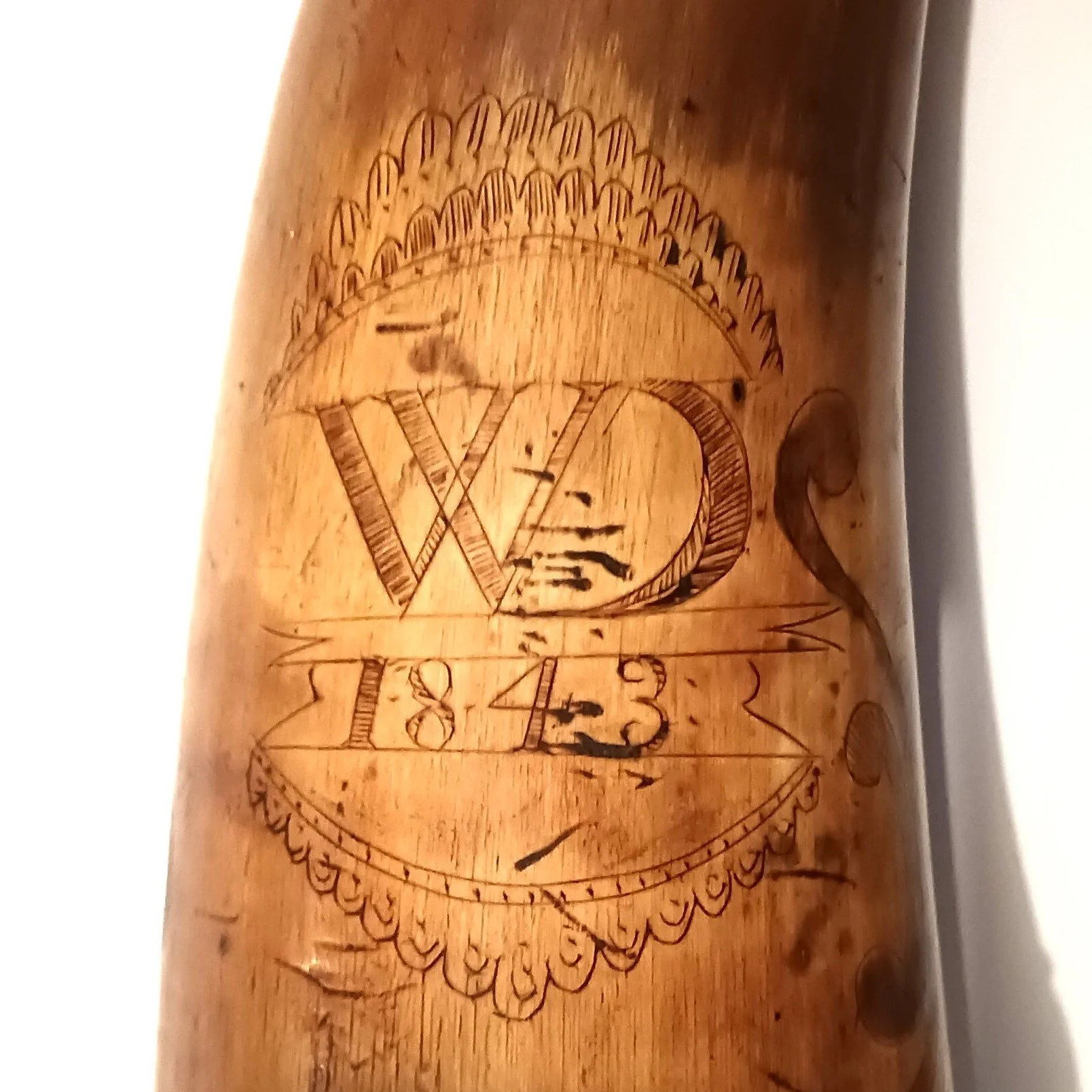
Figure No.8: Prominent and oversized carver’s initials, without any other owner’s initials or name on the horn, suggest it was the carver’s personal horn.
Horn Body: The horn’s body is shaped is like most Mercer County powder horns. The butt plug is end-grain walnut, lath-turned as a high domed plug with integral nose button for strap attachment and a single incised decorative line just above its base. There may have been a slightly raised circular platform just below the integral button in the plug’s nose, but years of wear and abuse make it unclear. The spout’s simple raised ring for strap attachment is also common to most Mercer County horns, as is the slightly tapered spout with a decorative ring just below the tip. Scrape marks can be seen on the tapering throat section, and the raw horn was selected for its light, consistent color that was perfect for carving. Dimensions: outside curve is 10-1/2 inches, inside curve 8-11/16 inches, and butt diameter 2-3/4 inches.
Summary: A recently found Mercer County powder horn has fewer decorative elements than most such horns with only two major figures. On one side, there are the large initials “W D” over the date “1843” in a cartouche that fills that side of the horn. On the other side, another large cartouche contains the Masonic square & compass. The simplified decoration with the largest “W D” initials yet seen on a Mercer County horn, filling that side of the horn with no other initials/name present, strongly suggests the horn was the personal horn of the Mercer County horn carver, William Dunwoody.
Footnotes:
William Dunwoody carved most of the known Mercer County powder horns, but younger brother Samuel assisted him at times and carved a few horns by himself.